
A 202 or 206 code is useful only after the buyer separates nominal end size, the SOT opening design, and the body-to-seamer interface. It is not capacity alone that selects a lid family, even when two can references carry the same fill volume. A larger end code does not by itself prove a lower opening force, a larger pour opening or a better drinking experience. The practical question is whether the specified body neck, end profile, and relevant line evidence all identify the same configuration.
A 202-versus-206 choice is a geometry-and-proof decision, not a capacity shortcut. The number identifies a nominal end-size family; SOT tells you that the opening tab stays attached; neither label confirms that a given can body, end curl, and closing setup belong together. That distinction matters most when a format change is being priced, sampled, or approved from drawings.
Use the code to start a technical comparison. Do not use it as a standalone promise about volume, drinkability, seamer interchangeability, metal use, or current product weight. Qingdao Baixi Industry (Baixi Cans) buyers can browse aluminum can format options by product family after making the same distinction: a visible can format is a useful reference, but it is not compatibility proof.
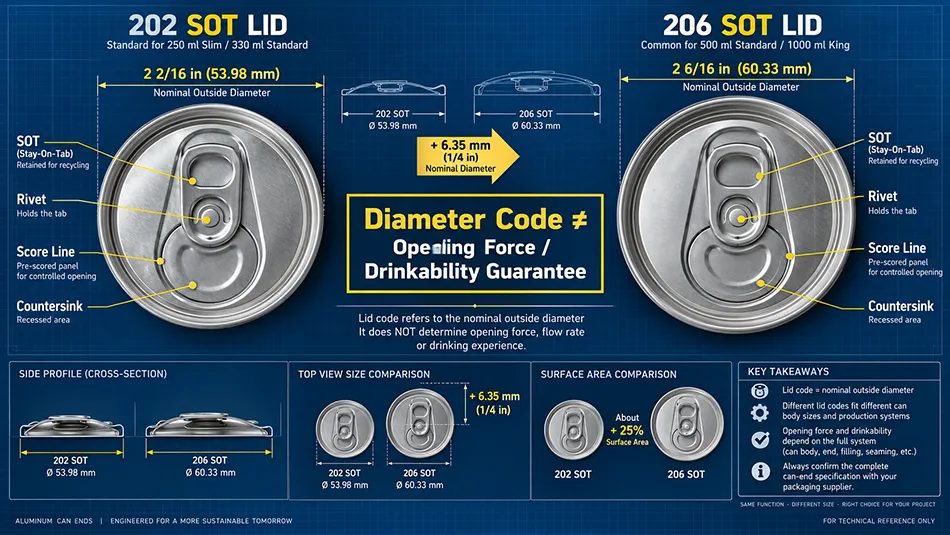
The number names a nominal end-diameter family: 202 is 2 2/16 inches and 206 is 2 6/16 inches. That industry-style notation is described in a published end-nomenclature discussion. It makes 206 nominally one quarter inch, or 6.35 mm, wider than 202; it does not assign either code to one beverage capacity.
| Comparison field | 202 SOT | 206 SOT | What a buyer should not infer |
|---|---|---|---|
| Nominal code | 2 2/16 in | 2 6/16 in | Exact project tolerances |
| Nominal diameter reference | 53.98 mm | 60.33 mm | Can capacity or opening size |
| SOT availability | Possible opening design | Possible opening design | Identical opening behaviour |
| Selection evidence | Body, end, and line records | Body, end, and line records | Interchangeability from the code |
Published beverage-end material associates 202, 204, and 206 with nominal references of 53.98, 57.15, and 60.33 mm, while also describing the necking and seam context in which those end families are used. A CMI 202 reference is a useful reminder that curl, countersink, flange, and neck-related dimensions are separate fields—not detail that can be recovered from “202” alone.
The 6.35 mm nominal diameter difference creates about 25% more nominal circular area, not a guarantee of a larger opening or better performance. That calculation compares only circles based on the two nominal diameters: (60.33 ÷ 53.98)2 is approximately 1.25. It excludes pour-panel shape, score geometry, tab design, metal gauge, seam design, and any actual product tolerance.
CMI's 1998 teaching table lists 7.99 lb per thousand for 206 and 6.06 lb per thousand for 202, including tabs. The historical teaching table helps explain why smaller-end discussions often include material efficiency, but it is not a current supplier quotation, a current end weight, or a cost estimate. When comparing a visible format reference, you can also review a 250 mL slim can format reference while keeping its capacity separate from its end-family decision.
For a request sheet, record the code and the nominal reference in one place, then add a separate row for the applicable body or neck drawing. Add another row for the end profile, including the intended SOT configuration. This layout keeps a buyer from copying a number out of a catalogue, attaching it to a capacity, and assuming the rest of the package has been specified. It also makes a supplier response easier to compare: a missing drawing or profile becomes visible instead of being hidden inside a general “can lid” description.
There is also a terminology boundary worth keeping in the RFQ. Nominal size is a naming convention, while dimensions on a current drawing are the project record. The first helps a buyer locate the end family being discussed; the second tells the technical team which contour, closure region, and mating body are actually in scope. If a supplier uses a different drawing revision or a different opening configuration, it should be treated as a separate comparison rather than assumed to fall inside the same code.
SOT names the retained-tab opening method, not an end diameter. In plain terms, a stay-on tab (SOT) is a pull tab that remains attached while it pushes a scored panel into the can. The panel opens along its score line and stays connected at its hinge region, so the tab and panel do not become loose pieces. A technical description of an SOT end lays out that tab, rivet, score, tear-panel, and hinge relationship.
That is why “202 SOT” carries two different pieces of information. “202” is the nominal end family. “SOT” is the opening-system label. A request that says only “SOT lid” still leaves the end profile, pour-panel design, tab geometry, score specification, and body interface unresolved. A request that says only “206” leaves the opening configuration unresolved as well.
For buyers, the safe reading is simple: the same SOT principle can appear across end families, but it does not make the end families interchangeable. Keep the code and the opening mechanism as separate columns in a specification sheet, then connect both to the exact can body and project evidence.
That separation also improves technical conversations. If the question is about end diameter, compare the nominal families. If the question is about how the tab opens, compare the specified score, panel, and tab arrangement. If the question is whether the component can be used on a particular package, move to drawings and relevant closing evidence. Mixing the three questions leads to answers that sound certain but do not identify the part or condition being approved.
Not capacity alone: body-neck drawing, end profile and seamer trial must agree before a 202 or 206 switch is treated as reviewable. This three-proof approach is a buyer workflow, not a universal release standard. It turns a vague “compatible lid” statement into three checkable records: what body is being closed, what end is being supplied, and what evidence is relevant to the intended setup. For a lid inquiry with Qingdao Baixi Industry (Baixi Cans), the useful starting point is to compare aluminum can lid options against the body record, rather than attach an end code to a capacity label.
Start with the body record because necking changes the upper geometry of the can. Then identify the exact end profile, rather than just its nominal code. Finally, ask what evidence is relevant to the closing or filling setup being considered. A generic declaration that a lid “fits beverage cans” cannot substitute for these three records: it does not identify a drawing revision, an opening configuration, or the conditions under which the closing interface was considered.
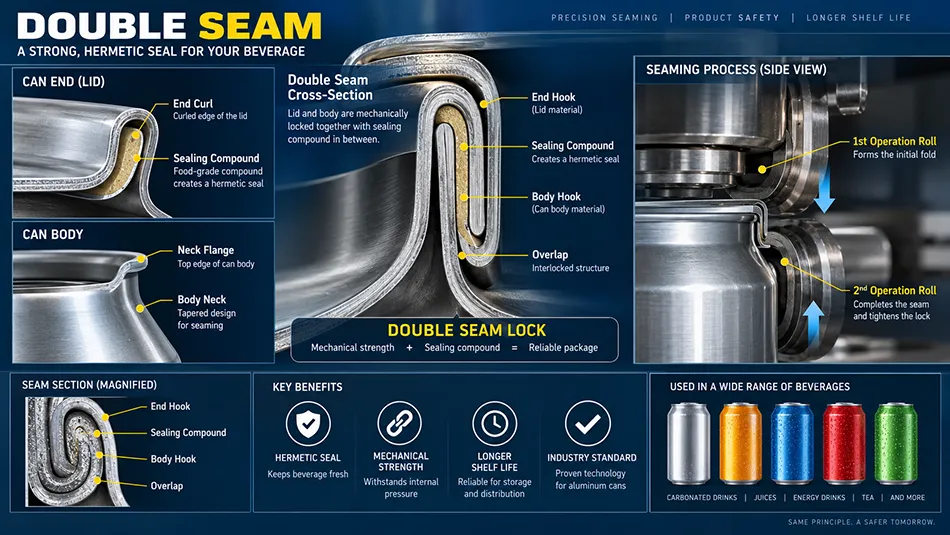
The end curl and can-body flange must be reviewed as one closing system. A double seam is the rolled closure where the end curl and body flange lock together. The published necking and seam description identifies typical end sizes of 53.98, 57.15, and 60.33 mm for 202, 204, and 206, and explains how a drawn body is trimmed, necked, and flanged before the end curl is seamed to the flange.
The practical consequence is deliberately narrow: a can photo, printed volume, or a code on a sample does not prove the closing interface. Government guidance for metal-can defects also notes that double-seam guidelines vary with can material, construction, and style, and points users back to manufacturer-specific guidance for evaluation. That is a useful seam-evaluation principle from Canadian food-can guidance, not a beverage-can seam limit or a seamer-setting instruction.
Opening behaviour has its own design chain. The score must rupture as intended, the tab must transmit force through the rivet and panel, and the panel must respond as the end design requires. A published opening-mechanism discussion describes the balance between score residual, pressure resistance, tab strength, and reliable opening. Those variables are not supplied by a 202 or 206 code.
A second beverage-end patent description notes that pour-panel area and score construction affect rupture behaviour. That does not justify a universal claim that one nominal end code is easier to open than another. It does show why a buyer should ask what opening configuration is specified and what project-appropriate evidence will be used, instead of translating a larger nominal diameter into a consumer-experience promise.
Record an opening observation separately from body-and-end fit. It can identify the specified panel configuration, the evaluation condition, and the point in the intended supply chain at which the comparison was made. This keeps consumer-use feedback from being confused with a seam-fit check, and keeps a seam-fit result from being presented as a general opening claim.
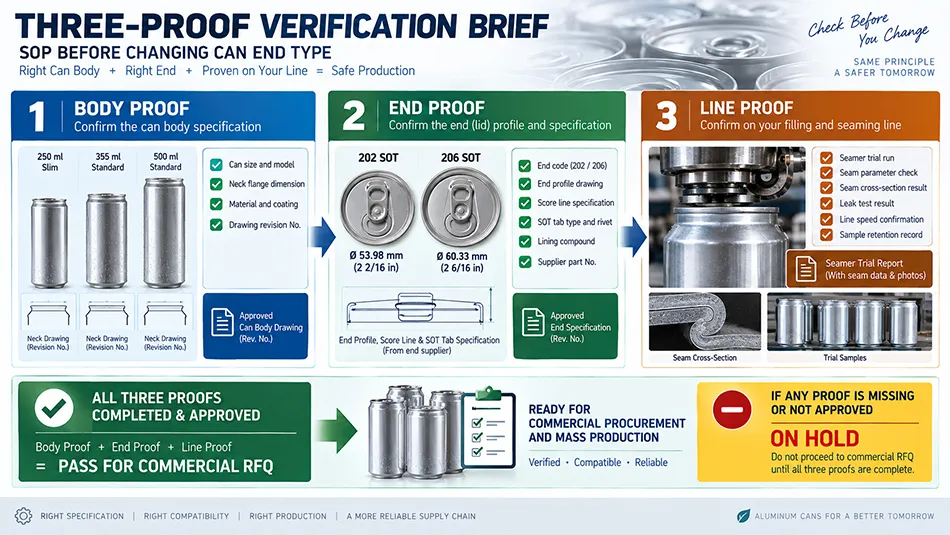
Hold the switch until body-neck, end-profile and line proof are current together. Here, line proof means documented confirmation from the relevant closing or filling setup; it does not mean that a generic end code has been approved everywhere. Put the three records into one comparison brief so the supplier, packaging team, and line owner are deciding from the same scope.
Before an RFQ moves to a capacity, artwork, or commercial discussion, make the three fields readable on the same page. If one record is pending, label the end-family choice as pending too. That avoids an early commercial preference being mistaken for technical approval. When the reference format is larger, Qingdao Baixi Industry (Baixi Cans) readers can use the same three fields and review a 500 mL format with the same three proofs.
Keep the request neutral about the outcome. The brief should not say that 202 is preferred simply because it is smaller, or that 206 is preferred simply because it is larger. Instead, it should identify the approved body record, the requested end profile, and the pending or completed line record. This makes a later change visible: the team can see whether only an artwork field changed, or whether the actual closure components and their supporting records changed too.
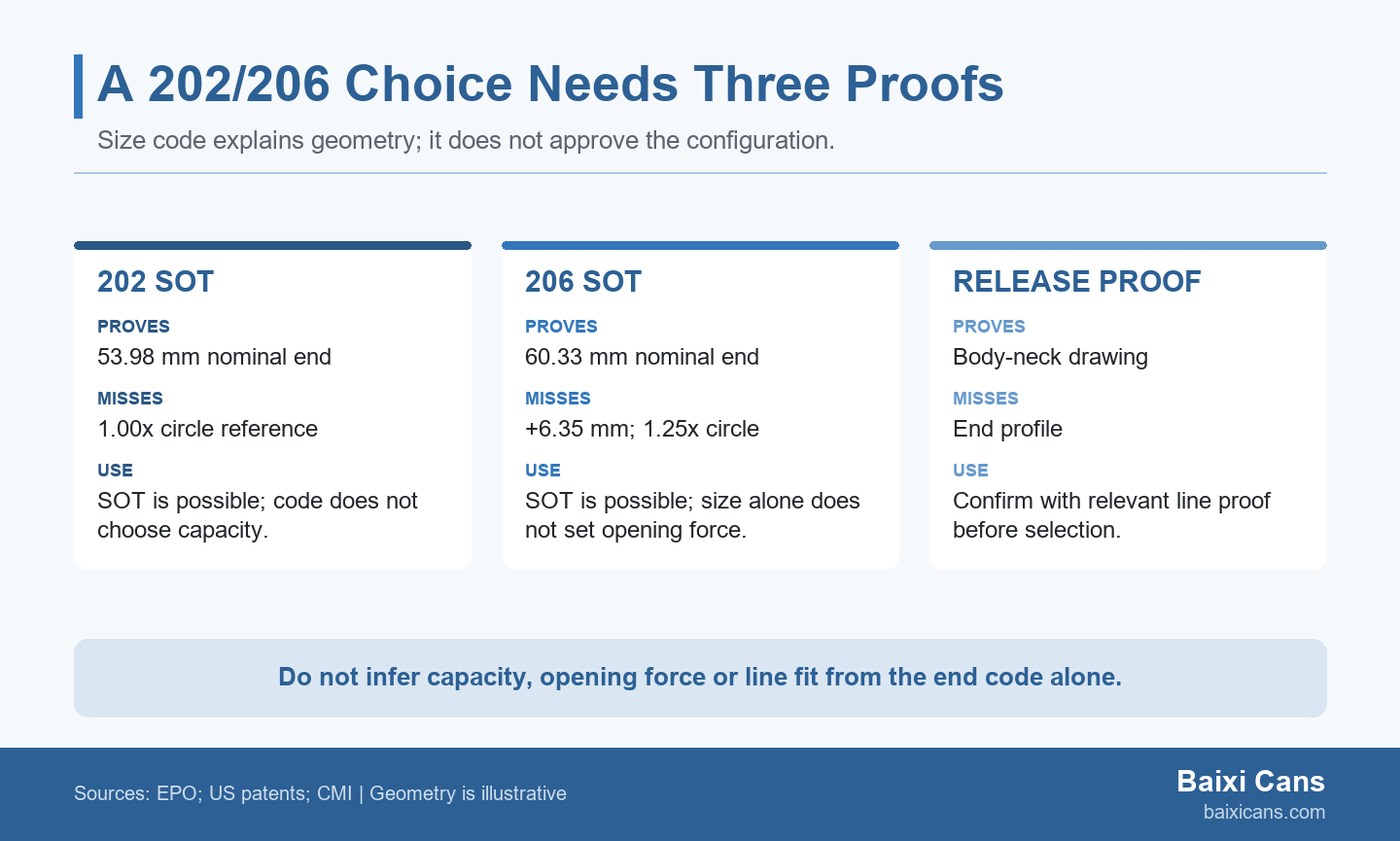
In the illustrative 18,000-can pilot request, the 202/206 decision stays on hold until the body-neck drawing, end profile and line proof are present. A beverage buyer is preparing a pilot request with 2 355 mL references. Artwork, stated capacity, and visible body shape are approved, but the request is not ready to select an end family because the interface records are incomplete.
The two references both state 355 mL but carry different end codes: one says 202 SOT and the other says 206 SOT. Neither includes the body-neck drawing, end-profile drawing, or a relevant trial record. The shared capacity and shared SOT label do not resolve the difference: the missing decision evidence sits at the body–end–line interface, not in the artwork file.
The buyer pauses the component choice and asks for one revised comparison sheet. It names the body-neck drawing, the selected end profile, and the required relevant closing or filling evidence. That step does not choose a 202 or 206 end in advance; it prevents the order from converting visible similarity into an unsupported technical assumption.
The pilot can move forward only when the drawing and relevant trial evidence identify the same configuration. This is an illustrative procurement scenario, not a Baixi project, a specific seamer setting, or an approved production configuration.
No: a 206 code identifies only a nominal end-size family, while score design, tab geometry, rivet arrangement, and panel construction also affect how an SOT end opens. A larger nominal diameter should not be converted into a blanket opening-force, pouring, or drinking claim. Ask which opening configuration is specified and what evidence applies to the intended package.
Yes, one stated capacity can appear with either nominal end family, because volume alone does not select the end-system configuration. A 355 mL, 500 mL, or other fill volume can be part of a format reference, but the relevant match is the can-body neck and end-system configuration. Treat the volume as a format field and the end code as a nominal-size field, then use drawings and relevant line evidence to determine whether the chosen combination is reviewable.
No: 202 and 206 SOT ends should not be treated as interchangeable on a seamer until the body-neck drawing, end profile, and relevant line evidence are checked together. This does not prescribe a universal setting or trial method; it simply prevents a buyer from treating two nominal end families as drop-in substitutes without project-specific confirmation.
An RFQ should name the applicable can body or neck drawing revision, requested end profile, SOT design, and expected line evidence before approval. State whether the request concerns a 202 or 206 nominal family, but do not let that code replace the rest of the specification. This brief is more useful than a capacity-only request because it gives every party the same body, end, and evidence scope to review.

