
Aluminum bottles are not automatically the future of beverage packaging. They become future-ready when the bottle’s material design, every attached component, the recovery or reuse route, the target market, and the words used to describe the pack all point in the same direction. That is a higher bar than “made from aluminum,” but it gives a beverage team a more useful decision: scale a claim, localize it, or hold it while the missing evidence is gathered.
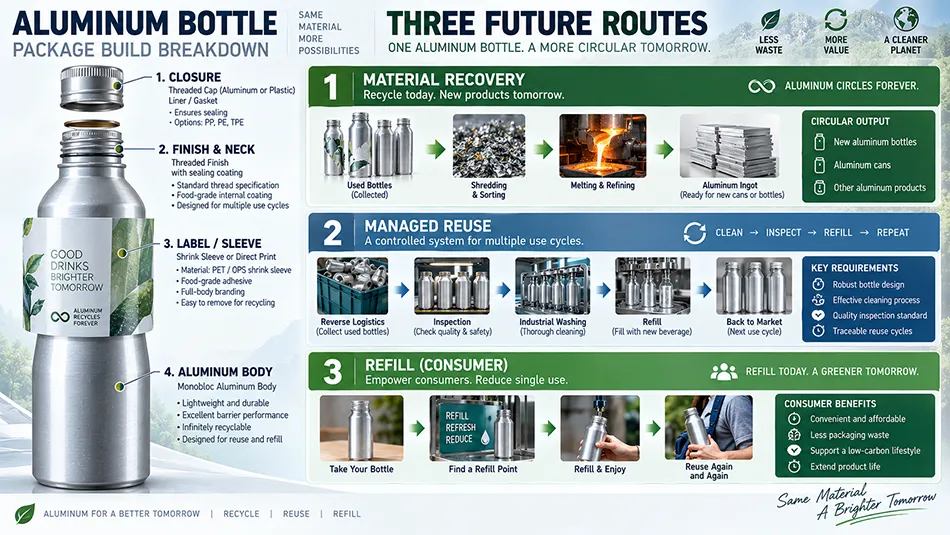
The word future can hide three different decisions. A material-recovery route asks whether the package can enter a collection and recycling system. A reuse route asks whether a managed loop can bring the package back for another trip. A refill route asks how the same package is filled again, by whom, and under what controls. These are related ambitions, but they use different evidence. A buyer comparing a bottle with another beverage format should first review aluminum can formats as a portfolio baseline, then decide which route the brand can actually operate and explain.
Material recovery means collecting and processing a package so its material can return to a recycling stream. It is not a promise that every bottle placed on every market will be recovered. Reuse and refill can reduce the need for a new package in a later cycle, but only if the return and handling system exists. Treating the three paths as interchangeable is what turns a format choice into an overbroad sustainability claim.
The route also sets the project question. A recovery-led project asks what material and component choices can be handled after use. A reuse-led project asks whether reverse logistics, inspection, hygiene controls, and redistribution will be funded and operated. A refill-led project asks whether the point of refill, user instructions, and product-safety controls are defined. Premium shelf presence, portability, or a reclosable opening may be useful format features, but none answers those operating questions by itself.
A material-recovery route begins with a simple boundary: the bottle body is not the same thing as the complete package, and a headline recycling number may not describe bottles at all. The U.S. EPA reports a 2018 recycling rate of 34.9% for a combined aluminum containers-and-packaging category and 50.4% for aluminum beer and soft-drink cans; the EPA table does not provide an aluminum-bottle denominator. Those figures may be useful context for a U.S. recycling conversation, but they cannot validate an aluminum-bottle outcome or a claim in another market.
That boundary changes a practical specification review. Instead of recording only “aluminum bottle,” list the body, closure, label or sleeve, adhesive, decoration, and how each part is expected to be handled after use. If a buyer cannot name those components, the team has a material story but not yet a recovery-compatible build. Local recovery partners or market evidence must still confirm what the route can accept.
Ask a second question before design freeze: what will happen when the intended route cannot take one of those parts? The answer may be a removable component, a revised finish, a local instruction, or a different claim. It should not be a silent assumption. This turns recycling design from a visual preference into a documented choice about the package that leaves the consumer’s hand.
A bottle can be easy to close again and still be a single-use package. A reuse system is the collection, checking, cleaning, and redistribution arrangement that lets packaging be used again. European Commission guidance on reusable packaging, which references ISO 18603, shows a rotation that includes use, collection, sorting, reconditioning, and refilling where applicable. The decision is therefore operational: who receives the empty bottle, who controls its condition, and how does it return to the next fill?
A peer-reviewed review of refillable beverage-packaging LCAs calls for direct and indirect system factors, break-even points, and recycled-material modelling. A later refillable drinking-water bottle study found that washing approach significantly affected its annual-use results. That study is not a verdict on commercial beverage bottles, but it makes the right procurement point: an impact claim must include the real return, washing, and redistribution model rather than the bottle material alone.
Put named owners beside that route before calling the pack reusable. Someone must own take-back instructions, someone must own inspection and cleaning criteria, and someone must own the decision when a returned unit is unsuitable for another trip. If those responsibilities are unknown, describe the package as a bottle concept under evaluation rather than as a proven reuse system.
A future-facing aluminum bottle needs a component review, not a body-only review. The Aluminum Association’s container design guide identifies labels, plastic tops, shrink sleeves, adhesives, and other non-aluminum materials as potential operational, compliance, or safety issues in aluminum recycling systems. Its design direction is to maximize aluminum and minimize non-aluminum materials where applicable. That does not predict the result for one closure or label, but it explains why the recovery stream sees the complete package build: the bottle body plus its closure, label, sleeve, adhesive, and finish.
For a buyer working with Qingdao Baixi Industry (Baixi Cans), this is where a component conversation should sit beside a format conversation. A can or bottle reference may clarify volume and appearance, while the opening component still needs its own review. Use the same brief to review the lid choice alongside the complete package build, then document whether non-body components are removable, minimized, or subject to a market-specific handling instruction. Do not convert that record into an unqualified recyclability statement until the intended route is clear.
The same discipline prevents a decorative choice from becoming an unexamined technical choice. A printed surface can satisfy a brand requirement, while a sleeve or adhesive may introduce a different handling question. The correct response is not to ban every non-body part. It is to make the component’s role, removal method, and route assumption visible before artwork, purchase, and claim approval move forward separately.
A shared bottle drawing cannot create a shared global claim. The European Commission says the Packaging and Packaging Waste Regulation, Regulation (EU) 2025/40, entered into force on 11 February 2025 and generally applies from 12 August 2026; its overview states that the regulation covers all packaging and packaging waste regardless of material and addresses manufacturing, composition, and reusable or recoverable nature. That is an EU example, not a universal rule, but it is a useful trigger for every market: identify the applicable package and claim requirements before the artwork is released.
The regulation’s official text also includes technical-documentation and conformity provisions in its applicable scope, and it addresses safety and hygiene requirements for refill systems. The lesson is not that a bottle automatically meets those rules. It is that a team needs a country-specific evidence sheet: the package version, the intended recovery, reuse, or refill route, the documentation owner, and the wording that the evidence supports. Legal and technical reviewers should decide what applies to the actual market and product.
That sheet should also preserve the version date. Changing a cap, finish, label, fill condition, or market can change the question that the supporting record answers. A practical handoff therefore has a package version, a target-market column, the supporting document or route record, a claim owner, and a status. It gives launch teams a way to distinguish “ready to publish here” from “still being evaluated.”
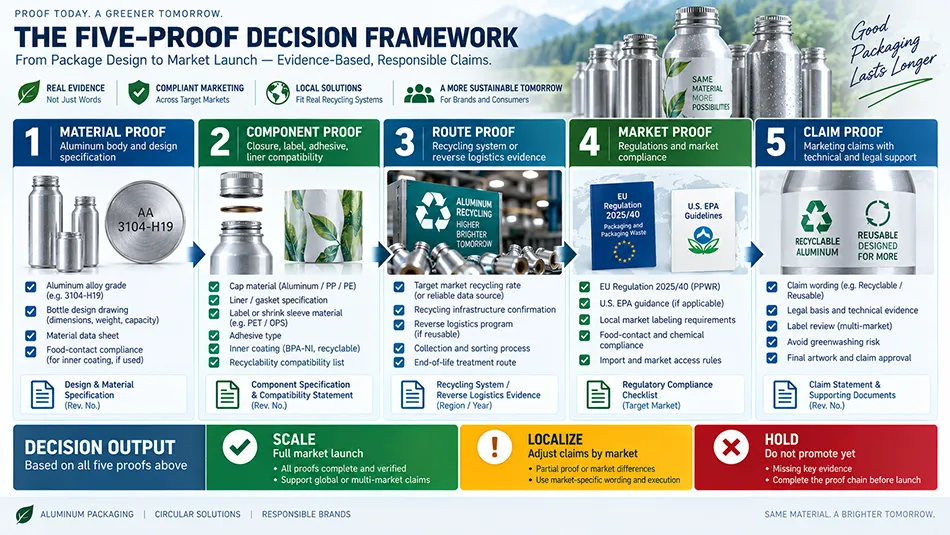
Use five linked fields in one decision record: material proof names the body material and relevant design choices; component proof lists the closure, label, sleeve, adhesive, and finish; route proof identifies material recovery, managed reuse, or refill; market proof records the local system and applicable review; and claim proof is the market-specific record that supports the words used in a public message. This is an editorial decision rule, not an LCA, certificate, or legal test. Its value is simple: a gap in one field is visible before a bottle is presented as a complete future solution. To test whether the rule is format-neutral, test the same evidence sheet against a 250 mL slim can reference; a different silhouette should not erase the need for evidence.
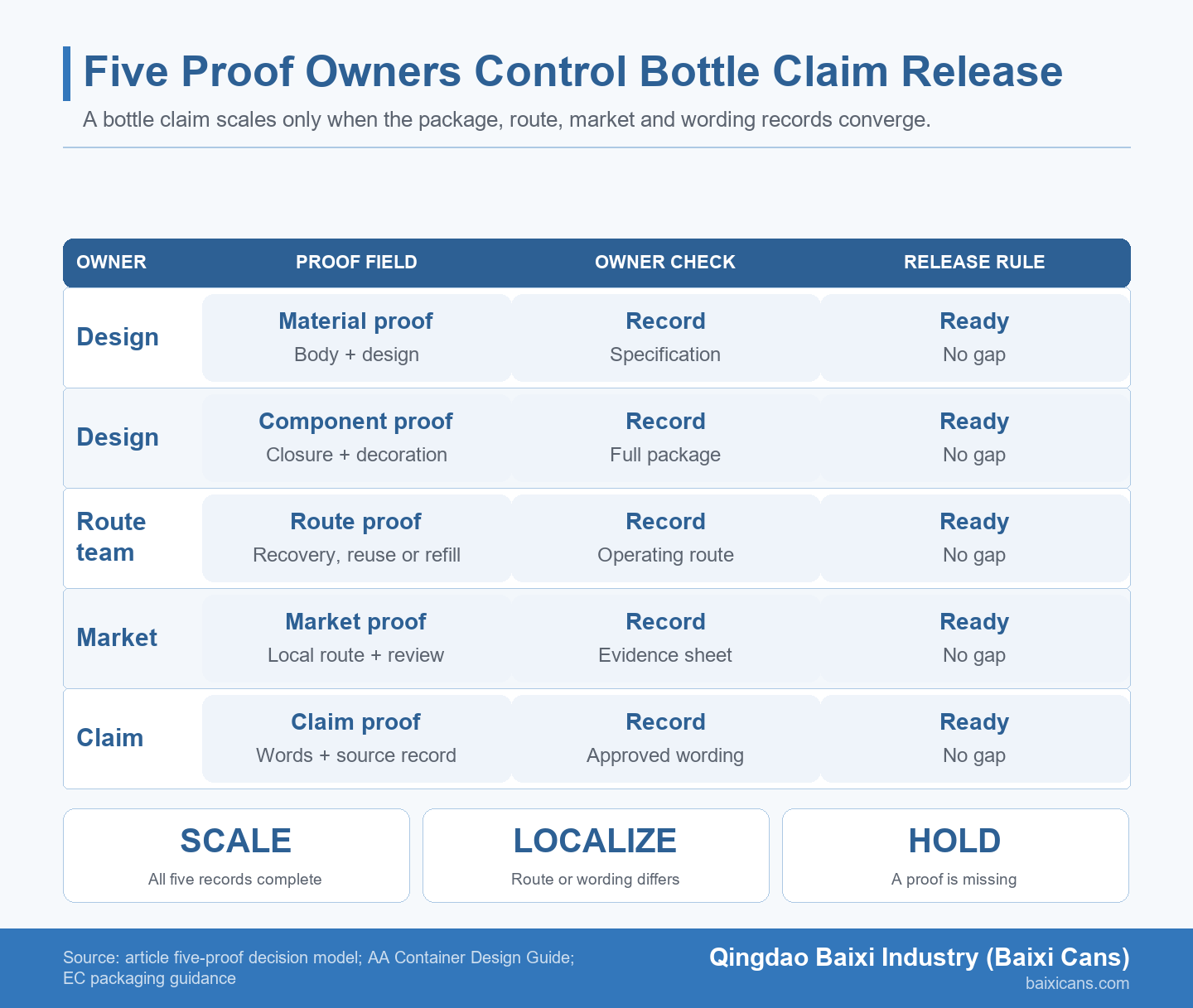
The five fields should travel together, even when different people own them. Packaging and sourcing teams can lock the material and component records. Operations can identify whether collection, washing, reconditioning, or refilling actually occurs. Market and legal teams can test the local evidence and words that will appear on a label, website, or campaign. The release decision is deliberately limited to three choices: scale when the proof is complete, localize when the route or wording differs by market, or hold when the route is only an aspiration. That keeps a promising format from carrying an unfinished claim.
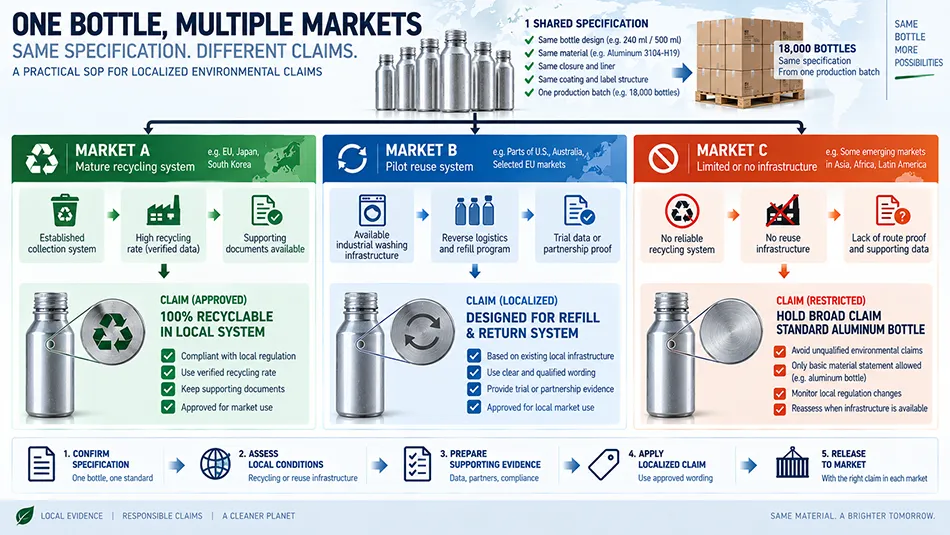
Consider an illustrative premium sparkling-drink pilot: 24000 aluminum bottles are split equally across 3 test markets, with 8000 bottles per market and 1 shared bottle specification. The body design and artwork are ready. The central launch team, however, has drafted one “future packaging” message for all three markets before confirming the local collection or managed reuse evidence behind that language.
The material and graphics are the same in all three markets, but the route evidence is not. One market may have a documented collection path, another may be evaluating a managed return model, and a third may have no record supporting either statement. The risk is not that the bottle changes shape at the border. The risk is that format evidence outruns route and claim evidence, leaving a polished campaign with no local decision trail.
The team should release a route-specific message only where the corresponding market record is complete and hold the broad message elsewhere. The corrective action is to create 3 country evidence sheets under the 1 shared material and component record, then attach route facts, permitted wording, and an accountable owner to each row. A packaging owner, market lead, and claim approver confirm all five fields before release. This is an illustrative decision pattern, not a statement that any specific country accepts, rejects, or operates a particular bottle route.
Before asking a supplier to prepare a future-facing format, build a brief with five lines: the beverage and filling conditions; the complete package build; the intended recovery, reuse, or refill route; the target market; and the exact claim the team wants to use. Add the document owner and a decision date to each line. This makes the unresolved point obvious: a missing closure detail is a component gap, while a missing local collection record is a route or market gap. They require different follow-up, not a broader slogan.
Use the record at each change point, not only at the first design review. If a label supplier changes, a return partner changes, or a launch market is added, reopen only the affected proof fields and document the decision. This helps a pilot stay useful as it expands: the team can retain the evidence that is still valid while identifying the route or market facts that must be checked again.
Qingdao Baixi Industry (Baixi Cans) can then be part of a more focused format discussion rather than being asked to validate a claim the brief cannot yet support. Bring the beverage context, component record, and target market to the conversation, and compare a 500 mL format against a five-proof brief.
No, because a bottle material alone does not establish total environmental performance or the outcome in a local recovery system. A credible comparison needs a defined product, package build, transport and recovery or reuse system, along with a method that matches the question being asked. Treat material selection as one input to a packaging decision, not as a universal environmental ranking.
Not necessarily: a reuse claim requires a managed system for collection, inspection, cleaning, redistribution, and another intended trip. A reclosable bottle may support user convenience, but it should not carry a reuse claim until the return and handling route is defined and supported by the relevant project evidence. It also needs a documented inspection and hygiene process suited to the product and target market.
Yes, because caps, labels, sleeves, adhesives, and finishes enter the recovery route with the bottle body and can change how it is handled. Their relevance depends on the actual design and local route, so buyers should record them rather than assuming the aluminum body settles the question. A component list is not a recycling result, but it is necessary evidence for a responsible review.
Before a pilot, verify material, components, operating route, market evidence, and the exact public claim in one linked brief. Then assign an owner to each field and identify what will cause the claim to be scaled, localized, or held. This avoids a common pilot failure: treating an approved sample and artwork as proof that the same message can be used wherever the package is sold.

