
The costly mistake is not choosing FOB, CIF, or DDP. It is choosing a term whose unassigned work appears only after the cans are moving or have reached the destination. For an aluminum-can order, the useful starting point is control capacity: who can tender freight, prepare clearance information, confirm documents, and respond if a container stops moving. The term should fit that operating reality before it becomes a line in an RFQ.
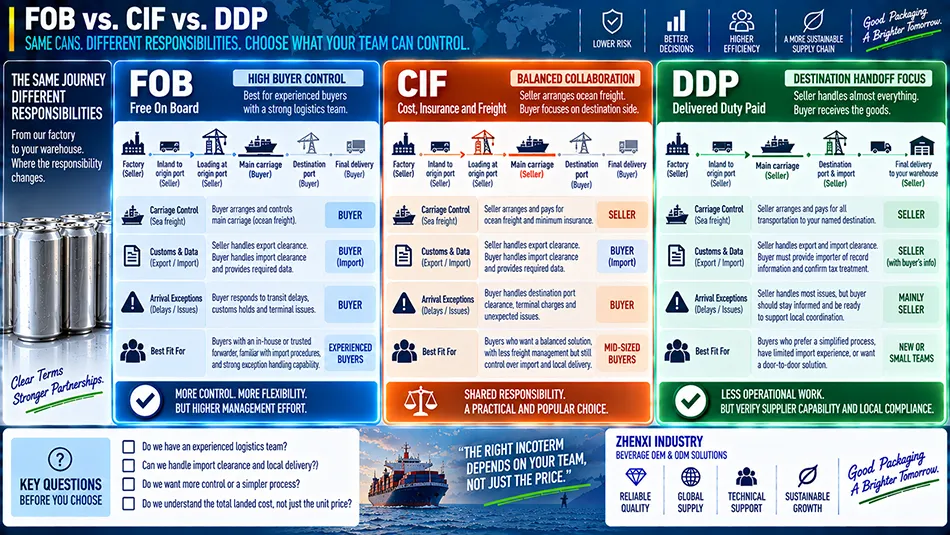
The right term follows the team's ability to control freight, clearance, documents, and exceptions—not the supplier's quote format. Start with FOB when your team already runs the forwarder-and-broker chain. Consider CIF when supplier-arranged main carriage is useful but destination clearance remains firmly owned. Treat DDP as a destination-handoff question, not as a shorthand for “nothing left for the buyer.”
A trade term assigns delivery tasks, costs, and risk, but it does not replace the product specification, payment terms, or destination compliance review. ICC's Incoterms rules are designed to clarify the delivery tasks, costs, and risks passed between seller and buyer. They do not tell a buyer which can size, end type, artwork revision, payment milestone, or destination filing arrangement is commercially acceptable.
Use the term with a precise named place. A named place is the exact location where the agreed delivery task ends or changes hands; “destination port” is often too vague when terminal handling, inland transfer, or final delivery matters. The purchase order should therefore keep two tracks visible: the product packet and the delivery packet. The product packet identifies the can body, lid, coating, printing, quantity, and packing assumptions. The delivery packet identifies the term, named place, carrier path, document owner, and destination contact.
That separation also makes a supplier discussion more useful. A buyer who needs to review the service process before finalizing the delivery handoff can ask where the supplier's order handling ends and where the buyer's forwarder, broker, or consignee takes over. Qingdao Baixi Industry (Baixi Cans) can be evaluated on the same product-and-handoff clarity as any other supplier; the destination's legal and customs treatment still needs confirmation from the appropriate local parties.
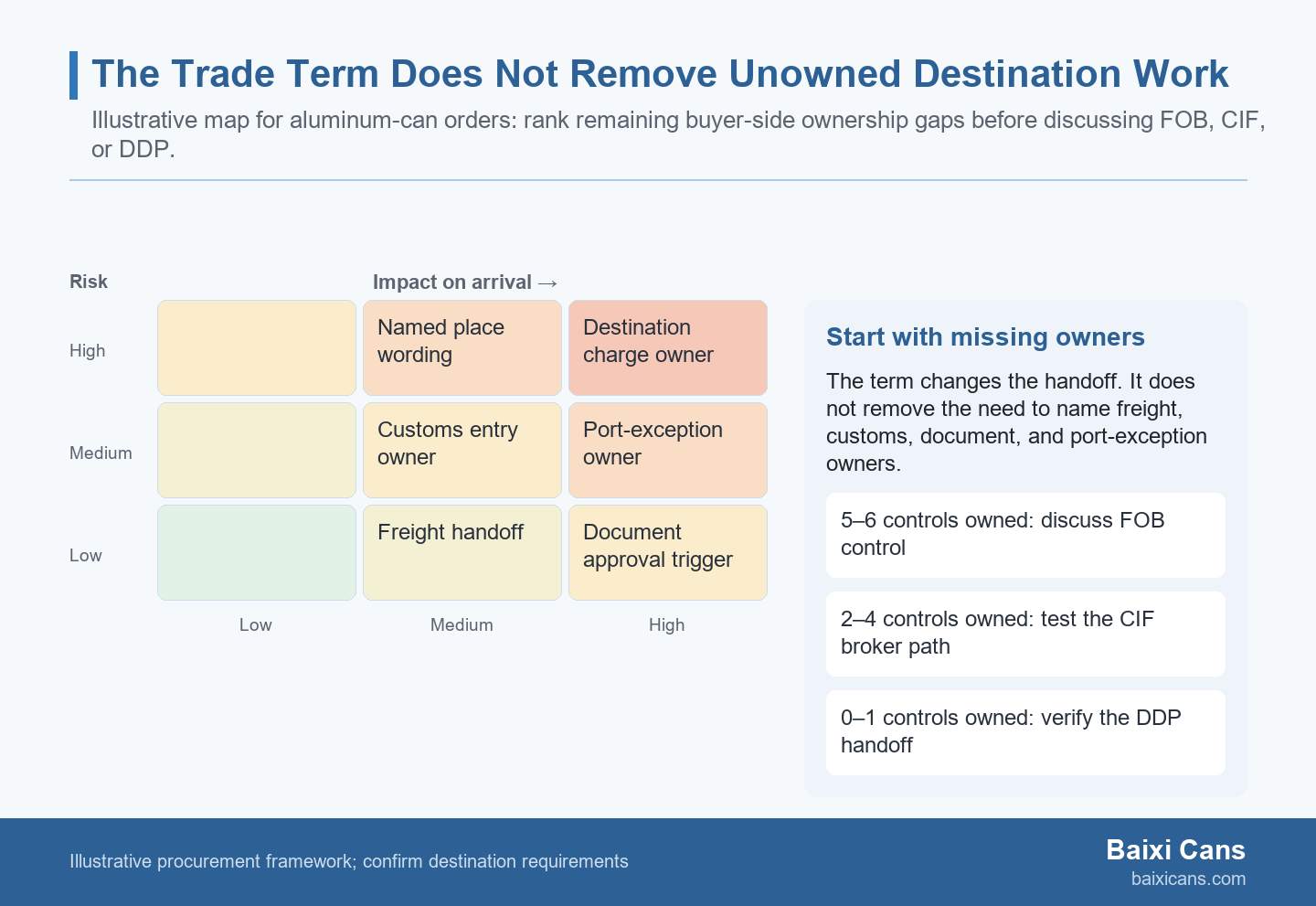
FOB, CIF, and DDP differ most usefully by who arranges carriage, where risk changes hands, who coordinates import clearance, and who owns an arrival exception. The U.S. International Trade Administration's Incoterms guidance specifically lists shipment, insurance, documentation, and customs clearance among the activities these rules allocate. Ask the four questions before you compare a supplier's included-freight number.
| Buyer question | FOB | CIF | DDP |
|---|---|---|---|
| Who normally controls the main-carriage plan? | Buyer-led after the agreed origin handoff. | Seller arranges carriage to the named destination port. | Seller arranges delivery to the named destination, subject to a viable destination handoff. |
| What must the buyer be ready to manage? | Forwarder, destination entry, documents, and exceptions. | Destination entry, documents, cargo arrival, and exceptions. | Destination roles, data, tax and importer assumptions, plus exceptions that the contract does not resolve. |
| What is the practical control trade-off? | Maximum buyer control and coordination work. | Less origin-carriage coordination but continued destination ownership. | Less visible buyer logistics work, but more need to verify the delivery model before dispatch. |
| Best first fit | Experienced importer with a controlled logistics chain. | Buyer with a ready broker path who wants supplier-arranged carriage. | Buyer with low internal logistics capacity and a documented, destination-ready handoff. |
Customs-value treatment must be confirmed for the destination instead of being inferred from the supplier's delivery term. The World Trade Organization's customs-valuation overview notes that estimating value can be as consequential as the duty rate itself. Based on this comparison, the winning quote is the one with an agreed responsibility model and evidence packet—not necessarily the one that appears to include the most transport.
FOB is most useful when the buyer can nominate or manage the ocean-freight path and coordinate the destination clearance packet before cargo is ready. That usually means the buyer has a forwarder who can give origin instructions, a broker or internal specialist who can validate the destination entry path, and an accountable person who can act when the carrier or terminal requests information.
FOB is not automatically the lowest-risk choice. It moves more visible coordination to the buyer, so the buyer needs the specification and shipping handoff early enough for the forwarder to work with an accurate packing plan. For a format-specific purchase, align a 250ml slim-can specification with the freight handoff before a booking instruction is issued. The forwarder does not need every production detail, but it does need the dimensions, packing count, ready date, and named handoff information that affect the movement plan.
Choose FOB when the advantage is real control: your team can compare carrier options, protect a preferred routing plan, and reconcile arrival documents without waiting for a supplier-led logistics chain to explain a change. If one of those ownership points is missing, the term may be premature even if the unit price looks attractive.
CIF can reduce origin-carriage coordination for the buyer, but it does not remove the need to prepare the destination entry, cargo documents, and port-exception response. It is often a reasonable middle ground when a buyer wants the supplier to arrange the main carriage yet already has a broker and a defined arrival workflow.
That workflow should name who receives originals or electronic documents, who instructs the broker, who confirms container availability, and who receives an escalation if the arrival plan fails. The Federal Maritime Commission's detention and demurrage work shows why containerized imports need an exception owner; it does not supply a universal charge or solve a buyer's local port process. “Detention and demurrage” simply means carrier or terminal charges that can arise when containers or cargo remain beyond the permitted time.
CIF also increases the value of a clean product packet. Before the supplier books carriage, check can-lid specifications before the supplier books carriage so the body-and-end configuration, carton count, and revision status match the commercial documents. A booking that is operationally convenient but tied to an outdated lid or artwork version creates a document problem that no Incoterm can fix.
DDP can simplify contractual delivery for a buyer, but it requires the parties to confirm who can lawfully and operationally execute the destination-side handoff. It can be attractive for a first order because more movement appears to sit with the seller. The buyer should still ask who is named for import entry, what data is required for the declaration, how taxes are handled, and who receives the cargo if the original delivery plan is interrupted.
For this discussion, the importer of record is the party identified under the destination's rules to make the import entry and meet the related responsibilities. The role is jurisdiction-specific; do not assume the supplier, the buyer, or a broker can fill it merely because a DDP quote was issued. A precise product configuration matters here as well. Before accepting the arrangement, match a 500ml can order to a confirmed destination handoff so the delivery promise, documents, and actual order are working from the same version.
A DDP order becomes fragile when the seller has a delivery promise but the importer, broker, tax, and document assumptions are still unconfirmed. U.S. Customs and Border Protection frames importing and exporting as a shared compliance responsibility, which is a useful boundary even for buyers operating elsewhere: delivery wording does not eliminate the need to identify the people and records needed at destination.
The gap is usually an information problem, not a transport problem. A quote may name a city while leaving the final address, broker authorization, commodity classification, tax registration, or exception contact unspecified. If those fields are still open seven days before dispatch, the buyer has not completed a DDP handoff; the buyer has only selected a label.
DDP is more defensible when the named destination, importer role, declaration path, tax handling, and exception owner are confirmed in writing before dispatch. For example, GOV.UK's import steps direct importers to decide who makes customs declarations and to establish the commodity code and goods value. That is a UK example, not a universal legal formula, but it shows the kind of concrete questions a destination check must answer.
Ask for written answers in one current document version. If the seller cannot identify the declared destination role or the buyer cannot verify it with the local broker or adviser, keep DDP as an item to review rather than a term to approve. This protects both parties from discovering an ownership gap after the cargo has already been released to the carrier.
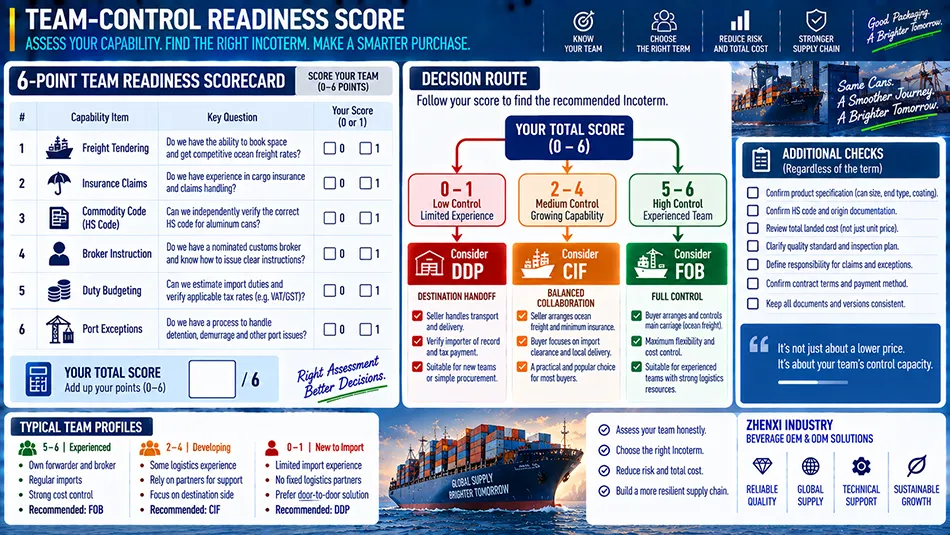
An illustrative six-question control score makes the trade-off visible: low readiness points toward DDP, middle readiness toward CIF, and high readiness toward FOB. This is not a legal formula or a Baixi Cans product. It is a short procurement conversation: count only the tasks your team can evidence before the purchase order, not tasks someone expects to learn after the container sails.
Give one point for each documented capability: tendering freight, handling a cargo-insurance claim, checking the commodity code, instructing the broker, reviewing the duty budget, and responding to a port exception. The six items combine control capacity with a named destination, so a strong freight contact cannot mask an absent clearance owner. The graphic below turns the model into a quick pre-RFQ discussion.
The score should test freight tendering, insurance-claim handling, commodity-code control, broker instruction, duty-budget review, and port-exception response. Each “yes” needs a person, a current contact, and a usable input such as a broker instruction sheet or a route process. A hoped-for capability should score zero. That makes the conversation useful for procurement, finance, and logistics instead of rewarding the team that is most confident in a meeting. It also distinguishes a contact who can answer an email from an owner authorized to decide, release, and escalate when a carrier, broker, or terminal asks for action.
A score of 0–1 suggests verifying a DDP model, 2–4 supports a CIF discussion, and 5–6 supports an FOB discussion, subject to route and destination confirmation. A 0–1 result does not make DDP automatically available; it tells the buyer to test the destination handoff first. A 5–6 result does not make FOB compulsory; it shows the buyer can ask whether direct freight control creates enough value to justify the work. In both cases, record the named place, broker path, and exception contact in the RFQ so the score is tied to evidence rather than optimism.
The RFQ should lock the term, named place, product packet, document fields, destination contact, and exception owner before the supplier books or changes carriage. A commercial invoice is used for import and export clearance and for customs duty-and-tax assessment, while the Harmonized Tariff Schedule is a formal U.S. classification resource. Those sources do not determine another destination's outcome, but they show why classification and document fields must be validated with the applicable broker or adviser before shipment.
For a live order, the useful request is evidence, not a generic promise. If your team has the can format, destination, and proposed term but needs the handoff checked before the PO changes, Qingdao Baixi Industry (Baixi Cans) can review the supplier-side order inputs against the stated product configuration. Send your can format, destination, and proposed trade term for an order-handling review.
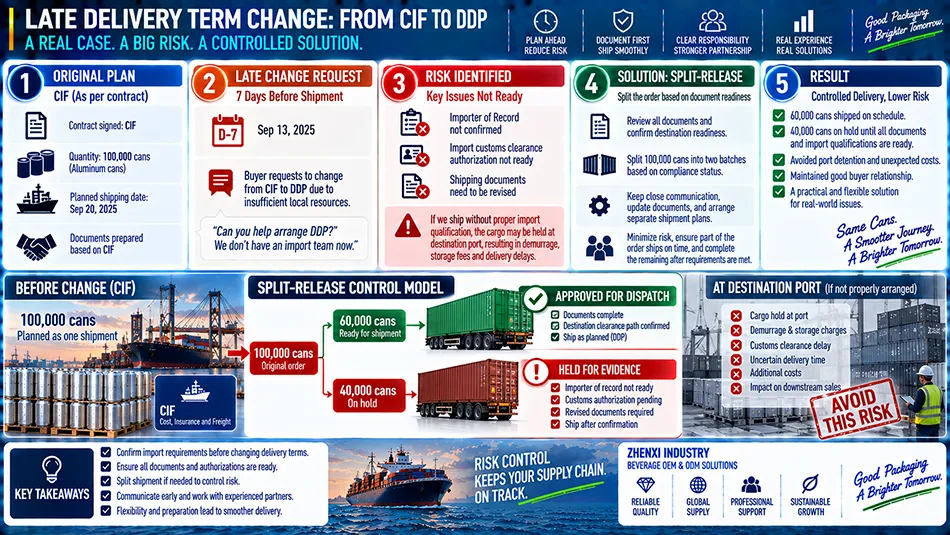
A late change in the delivery term can create different document and destination responsibilities even when the cans, quantity, and production status have not changed. The following composite scenario is illustrative; it is not a Baixi Cans customer record or a destination-specific customs instruction.
An importer has a 100,000-can order across 2 containers and originally accepts CIF. The 330ml can and lid specification are approved. Seven days before dispatch, the buyer asks to move to DDP because the internal logistics team is short-staffed. The newly named destination contact has not completed the broker authorization, so the project now has a different delivery model without a fully evidenced destination handoff.
Two observations change the decision. The revised invoice says DDP but does not identify the importer or declaration path. In addition, only 60,000 cans have a document packet matched to the named destination, while 40,000 cans do not. The cans are physically unchanged, yet treating the revision as a price-line edit would mix a documented route with an unconfirmed route.
The buyer separates the operational release: the documented 60,000-can route remains available for confirmation, while the 40,000-can route is held. The supplier and buyer issue separate document packets, confirm the named place, importer role, broker instruction, and exception owner, then revise the purchase-order wording. This is a split-release control decision, not an allegation that either party caused a compliance failure.
The held route can move only after the destination roles and current document version are acknowledged in writing. The cost is a short delay in the 40,000-can route; the benefit is that the team does not send cargo into a delivery model that has no confirmed owner. This illustrative composite example does not determine actual contract, customs, tax, or importer requirements for the destination.
No—DDP can shift contractual delivery tasks to the seller, but the buyer still must confirm destination-specific importer, tax, and compliance responsibilities. The exact legal and operational allocation depends on the country, named destination, and parties involved. Before approving DDP, identify the import-entry role, declaration path, document owner, and escalation contact in writing. A term can allocate delivery work without replacing the checks required by local customs, tax, or product rules.
CIF can fit a buyer with a broker, but the buyer still needs a clear arrival workflow for documents, clearance instructions, and port exceptions. A broker is one owner, not the whole operating model. Confirm when the broker receives documents, who approves any change in the arrival plan, and who responds if cargo or container timing becomes a problem. If those contacts and instructions are ready, CIF can offer useful carriage convenience.
The named place defines where the agreed delivery task ends, so a vague location leaves freight, terminal, or inland-handoff expectations open to dispute. Naming only a city or country may not resolve whether the delivery promise ends at a port, terminal, warehouse, or final address. Use the agreed term version and a specific location together, then make sure the product, document, and carrier instructions use the same wording.
A buyer can request a change, but it should be treated as a new document-and-destination review rather than a price-line edit. Reconfirm the named destination, importer role, broker path, tax assumptions, document version, and exception owner before dispatch. If the new handoff cannot be evidenced for the entire order, separate the confirmed scope from the unconfirmed scope and release only after the missing information is resolved.

