
Aluminum vs. plastic water bottles is the wrong comparison if it starts and ends with the material name. For a beverage brand, hospitality program, or promotional-bottle buyer, the meaningful question is whether the finished bottle will be used as intended, kept clean, supported by a suitable food-contact configuration, and recovered through a real collection route.
That is why neither option earns an automatic health or environmental win. An aluminum bottle used once is not a proven reuse solution; a plastic bottle is not defined by one health narrative. The useful choice is the system whose operating assumptions can be documented before the claim, artwork, and purchase specification are released.
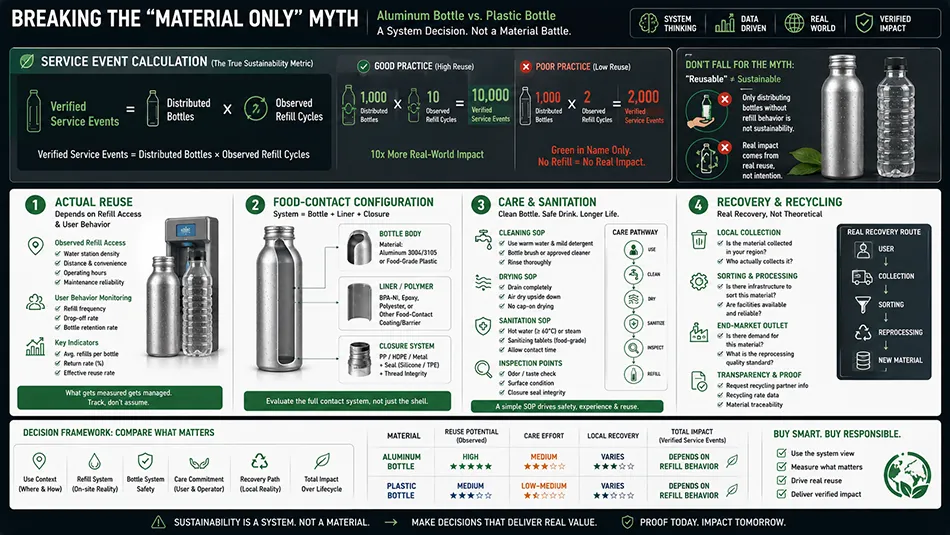
The material name is only one input; the operating system determines what it can prove. Start by defining the same service for both options: who receives the bottle, whether it will be refilled, how it will be cleaned, what touches the water, and what happens after use. A reusable bottle program and a sealed single-serve water product can both be valid, but they answer different operational questions. Treating them as the same comparison creates a misleading verdict before any material is evaluated. For Baixi Cans, that distinction is the starting point for any relevant packaged-beverage format discussion.
Verified service events equal distributed bottles multiplied by observed refill cycles. Here, a service event means a documented occasion on which a distributed bottle is actually used. For example, 1,000 bottles that each reach ten verified refills create 10,000 service events; the same 1,000 bottles used twice create 2,000. That fivefold difference is a simple usage-accounting illustration, not a life-cycle assessment. It does show why a lifetime-use claim should wait for evidence that the actual program can collect.
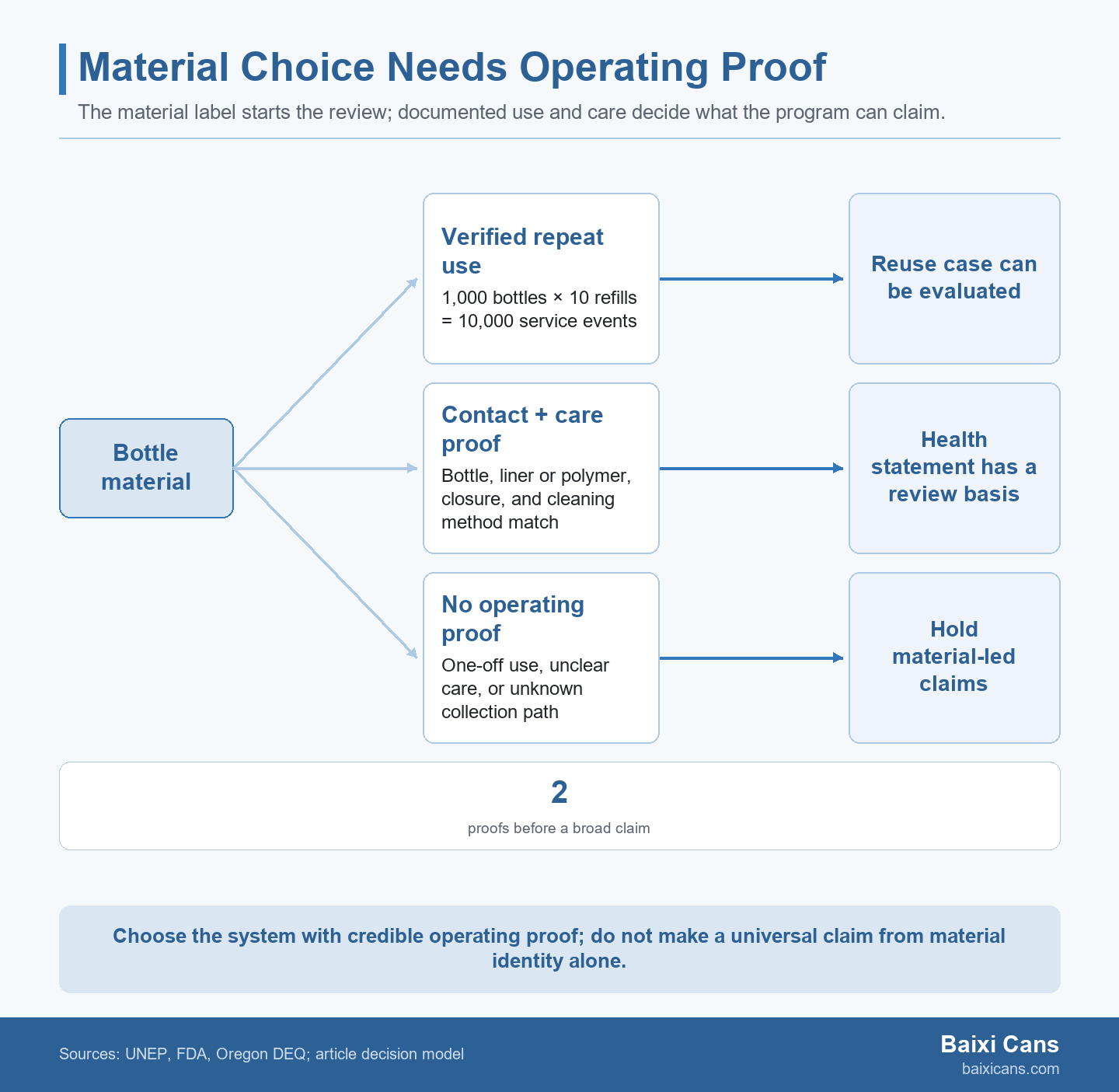
Functional Equivalence Comes Before Material Ranking
A life-cycle comparison is only useful when it compares functional equivalence, meaning options that perform the same job over the same period. That means the water source, container use, refill behavior, washing, transport, and end-of-life pathway need to be visible in the comparison. UNEP's life-cycle review makes this limitation explicit. UNEP's review found limited robust comparative evidence and says results depend on the comparison system. It is a reason to state assumptions, not a reason to invent a universal aluminum winner.
A Refill System Can Matter More Than the Bottle Body
The water-delivery model can change the environmental question before material enters the picture. In the Oregon study, the best bottled-water scenario had 46 times the global-warming impact of the best tap-water scenario. Oregon DEQ's study summary also reports lower impacts for its tap-water options than its bottled-water options. It is a useful regional example, not a global ratio or a ranking of all bottle types. For a brand, the practical implication is to compare a credible refill loop with the actual packaged-water alternative, rather than comparing empty containers in isolation.
Reuse and Recycling Solve Different Problems
Recycling can reduce the need for virgin material only when collection and processing work in the places where the program operates. Reuse takes a different route: the same intact package serves again. FDA's packaging education material makes the distinction plainly: reuse is source reduction because an intact package is reused rather than destroyed and reformed. That distinction matters in a supplier brief. Ask for the expected refill behavior and the post-use collection route separately; do not let a technically recyclable material stand in for a missing reuse plan. It also helps a buyer avoid claiming that recycling access proves repeat use.
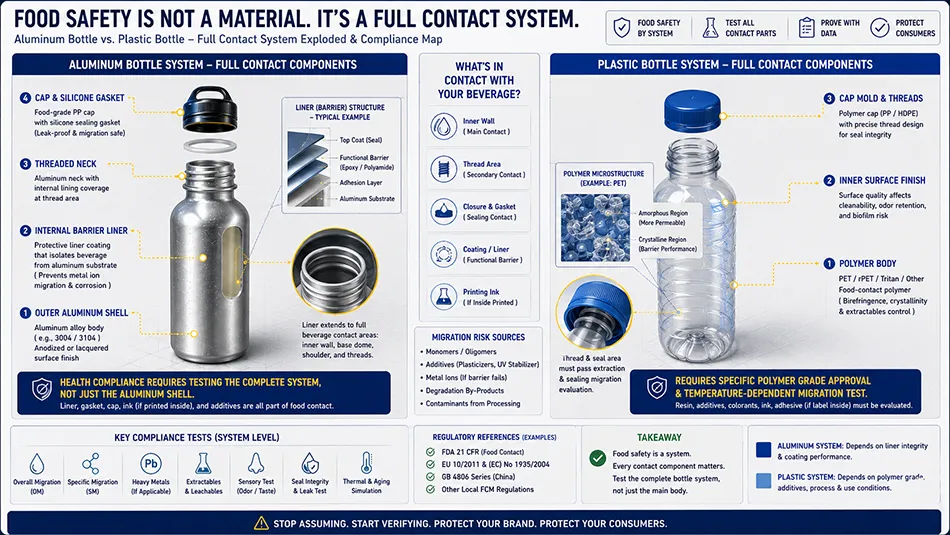
Look Beyond the Bottle Body
A food-contact system is the bottle body, liner or polymer, closure, and other parts that can touch the water. The relevant health question is whether that finished system fits its intended use, not whether a headline calls it metal or plastic. FDA identifies packaging and other intended components as food-contact substances and evaluates intended use. FDA's food-contact explanation provides the relevant context. A buyer choosing an aluminum bottle should therefore request evidence for its actual liner and closure; a buyer choosing plastic should request the same configuration-level clarity for the specified polymer, closure, and use conditions.
This is also where marketing language often outruns the evidence. “BPA-free” can describe a narrow attribute, but it does not by itself establish the final contact configuration, cleaning practice, durability, or health outcome. Likewise, an aluminum exterior does not make an unspecified liner irrelevant. The disciplined question is: what materials contact the water, under what conditions, and what documentation applies to that exact version of the bottle?
Microplastics Need Evidence, Not a Slogan
Microplastics are a legitimate evidence topic, but they are not a shortcut to declaring every plastic bottle unsafe. WHO reviews possible health implications and knowledge gaps for microplastics in drinking water. WHO's report on microplastics in drinking water is a useful boundary for the discussion. For a product decision, that means avoiding fear-based claims and reviewing the intended material system, use conditions, and applicable requirements. Uncertainty should produce a more specific evidence request, not an unsupported health promise for the competing material.
Sealed Product Safety and Reuse Care Are Different Checks
For sealed bottled water, product safety is a finished-product and sanitary-processing matter. FDA's bottled-water guidance states: FDA says bottled-water current good manufacturing practice regulations require bottled water to be safe and produced under sanitary conditions. A reusable bottle program adds another operating question: can users clean, dry, store, and re-use the specified bottle as intended? That care pathway should be written into the program, especially when a team is tempted to treat an old single-use bottle as a designed reusable product.
Choose the system with credible operating proof, not a material label alone. The table below is deliberately conditional: it compares an aluminum bottle program with a specified plastic bottle program, rather than declaring that all aluminum or all plastic containers perform the same way.
| Decision dimension | Aluminum bottle program | Plastic bottle program | What the buyer must verify |
|---|---|---|---|
| Actual reuse | Can support a deliberate refill model if use is observed. | Can also support a refill model when the chosen product is designed and maintained for it. | Expected cycles, refill access, and a way to observe real use. |
| Water-contact proof | Review body, any liner, closure, and intended conditions together. | Review specified polymer, closure, and intended conditions together. | Configuration-specific food-contact evidence for the launch market. |
| Care pathway | Define cleaning, drying, storage, and replacement expectations. | Define cleaning, drying, storage, and replacement expectations. | Instructions the actual user group can follow. |
| End of use | Collection value depends on the local pathway and program behavior. | Collection value depends on the local pathway and the specified polymer stream. | Where the bottle is likely to go after use, not only technical recyclability. |
The choice becomes clearer once the operating model is written down. A campus, hotel, or membership program with refill access, accountable cleaning, and a way to measure repeat use can evaluate a reusable bottle on its real service. A one-off event giveaway with no refill infrastructure should not borrow the language of a long-life reuse model. When that event needs a defined single-serve alternative, buyers can review 250ml slim can options as a defined single-serve trial format. Baixi Cans can use that brief to discuss adjacent packaged-beverage choices without claiming that a can replaces every reusable bottle program.
Hold a material-led claim until the revised sample and evidence match the intended use. The following is an illustrative composite scenario, not a Baixi Cans client case. Its purpose is to show how a product-family change can invalidate an earlier evidence pack even when the sales description still says “aluminum bottle.”
When a review shows no credible return-and-refill loop, teams can compare 500ml aluminum can options against a shelf-life and collection brief as a separate packaged-water decision. Baixi Cans can use those inputs to discuss a relevant beverage-can format; the brand and its responsible quality team retain the final product, market, and claim decisions.
Return the revised configuration for rework and reinspection before material-led claims are released. A bottle body can remain aluminum while a changed liner, closure, or care instruction changes the evidence that the launch team needs to review.
A hospitality brand is choosing a reusable bottle for a 2,400-bottle launch pilot with planned refill stations. It is comparing 1 aluminum bottle configuration and 1 plastic bottle configuration, and it wants a short environmental message plus a safety statement that sales staff can repeat accurately.
The pilot is large enough that a weak specification would be copied into product copy, training notes, and the next purchase decision. The buyer therefore needs a release rule that is usable before the first 2,400 bottles reach guests.
An early drawing exists, but the proposed aluminum option changes its liner and care instructions after the initial review. The material statement still names aluminum, while the component list and cleaning guidance no longer describe the same finished configuration.
First, the supplier's material statement names aluminum but does not match the final liner and closure combination. The old statement could be useful background, yet it cannot by itself establish the proposed bottle's finished contact components.
Second, the reuse message says the bottle is durable, but the pilot has not defined a cleaning method or a way to observe refill cycles. Durability therefore describes a possible capability, not a verified environmental outcome for this program.
The earlier document cannot establish the final contact configuration, and the reuse message has no operating evidence. FDA's food-contact guidance supports a configuration-specific intended-use review. The proposed rework fails the release check for the aluminum product family because the revised system cannot inherit proof that belonged to an earlier sample.
The buyer holds material-led health and environmental language, keeps both candidate configurations open, and returns the aluminum product family for a revised evidence pack before reinspection. This is not a finding that either material is unsafe or inferior; it is a decision to stop an unsupported claim from becoming a launch promise.
The revised request asks for the finished component list, food-contact documentation that matches the bottle configuration, care instructions, and a pilot method that records cleaning and refill behavior. It also makes the intended water, closure, and launch market explicit.
Before release, the buyer reinspects the revised aluminum configuration and document set against the intended water, closure, cleaning method, and launch-market requirements. Only then can the 2,400-bottle pilot use wording that matches the product and the operating plan.
This illustrative example shows a specification-control decision. It does not determine legal compliance, replace market-specific review, or calculate the comparative life-cycle impact of either bottle.
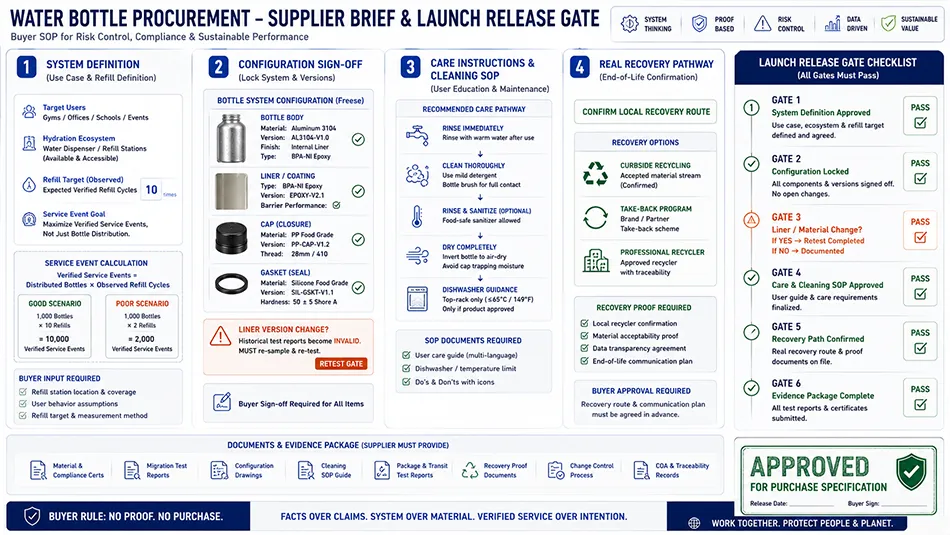
A format request is incomplete until it names the operating assumptions behind its claims. For a reusable water-bottle program, the brief should identify the intended water and user group, the finished contact components, the closure, expected refill behavior, cleaning and storage instructions, launch-market requirements, and the likely recovery route. It should also say what the buyer wants to prove: product suitability, a conservative care statement, a reuse observation plan, or a packaged-water alternative.
Ask each supplier to respond to the same configuration, not to a vague request for the “healthiest” or “greenest” bottle. The response should make clear which documents apply to the proposed body, liner or polymer, closure, and intended use; which care instructions belong to the final version; and which parts still need testing or market review. That turns a material preference into an auditable purchasing record and gives the buyer a basis to review food-contact and quality documentation before locking the format.
Then test the commercial model against the operating reality. Is there a dependable refill point? Who owns cleaning guidance? Can the program observe repeat use rather than merely distribute bottles? Is local collection plausible after the bottle's useful life? If several of those answers are missing, a sealed packaged-water format may be the more honest choice for the launch. In that case, the brand should define shelf-life, closure, filling, and collection requirements instead of making a reusable-bottle claim it cannot support.
Assign a named owner to each unresolved item before artwork or a purchase order is released. The commercial lead can confirm audience and launch timing; the quality lead can confirm documents, component version, and care instructions; and the operations lead can confirm whether refill access and recovery are actually available. Keep the version reference with the drawing, sample, and statement set. If the liner, closure, claim language, or cleaning route changes, reopen the relevant check instead of assuming the original sign-off still applies. This is a modest control, but it keeps a future format discussion tied to the exact program that will go live.
For a reusable-bottle program, the design review should also specify how approved artwork, coatings, closure choices, and batch evidence will stay aligned as the configuration changes. This discipline makes a revised sample easier to compare with the documents and operating assumptions used at launch, instead of allowing a material description to carry more meaning than the confirmed configuration.
When the reusable route is credible, buyers should first settle the relevant components, artwork, testing needs, and operating assumptions without presenting a material label as a completed health or environmental conclusion. Once those inputs are defined, they can request a manufacturing and customization brief for a reusable-format concept.
Use the same evidence boundaries in the direct answers: actual reuse, the completed food-contact system, intended care, and the real end-of-use pathway.
Neither material is automatically healthier, because food-contact safety depends on the finished bottle system, its intended use, and how it is maintained. Review the body, liner or polymer, closure, water contact, care instructions, and applicable market requirements together. A material label can start the conversation, but it cannot replace evidence for the exact configuration being supplied.
A reusable bottle does not automatically have a lower environmental impact, because its result depends on actual repeat use, washing, transport, the baseline, and collection. A durable bottle that is distributed once may not deliver the same result as a bottle that is repeatedly refilled and managed in a credible reuse program. Record what the program can observe before making a life-cycle claim.
A single-use PET bottle should not be treated as a designed reusable container simply because it can physically be refilled. Intended-use instructions, the condition of the cap and bottle, and the ability to keep the system clean remain separate constraints. For a repeat-use program, choose a format with documented care expectations instead of relying on casual refill behavior.
Start with intended use, expected refill cycles, food-contact components, cleaning method, storage conditions, and the real collection route after use. Then request documents and samples for the final configuration, not a prior version. If the program cannot support repeat use or a care pathway, compare a packaged-water format against its shelf-life and collection requirements instead.

