
An aluminum beverage can is a purpose-built package system, not a vessel stamped from pure elemental aluminum. Its metal is predominantly aluminum, but the body and end are commonly different alloys, while the product-contact and decorative surfaces add separate material questions. For a buyer, the useful question is not “Is it 100% aluminum?” but “Which component, property, and document prove the finished can is right for this beverage?”
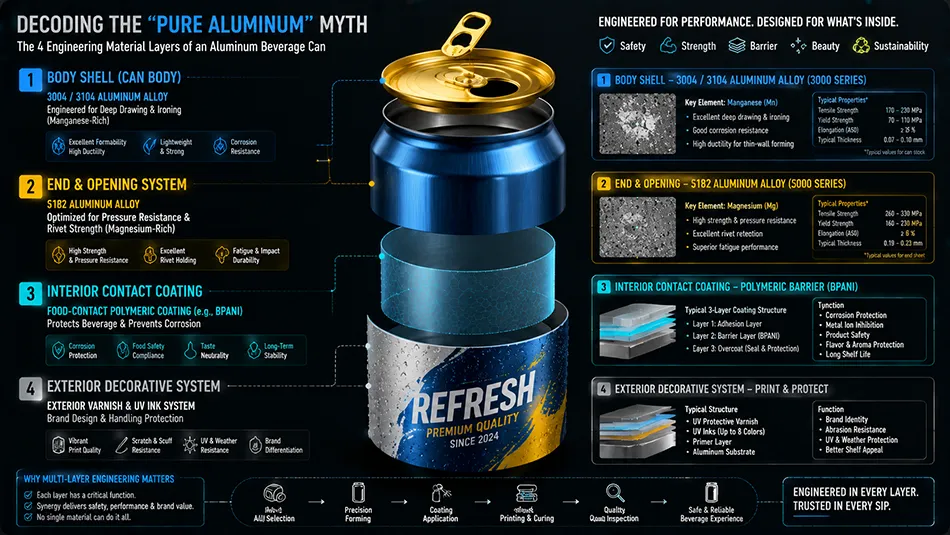
Aluminum beverage cans are not made from one pure metal; they are assembled from purpose-specific aluminum alloys and surface systems. An aluminum alloy is aluminum intentionally combined with small amounts of other elements to achieve a particular job. The Aluminum Association’s alloy overview uses 3004 for the beverage-can shell and 5182 for the lid as common examples, and places those grades in alloy series that include manganese or magnesium. That is why a can can be accurately called aluminum while still not being chemically pure aluminum.
The distinction is practical rather than semantic. A pure-metal request gives a supplier little guidance about forming, opening performance, product contact, or the seam that closes the package. A component-specific request makes it possible to compare like with like: the body that is formed into a can, the end that opens and seals it, and the surfaces that face the beverage or carry the print.
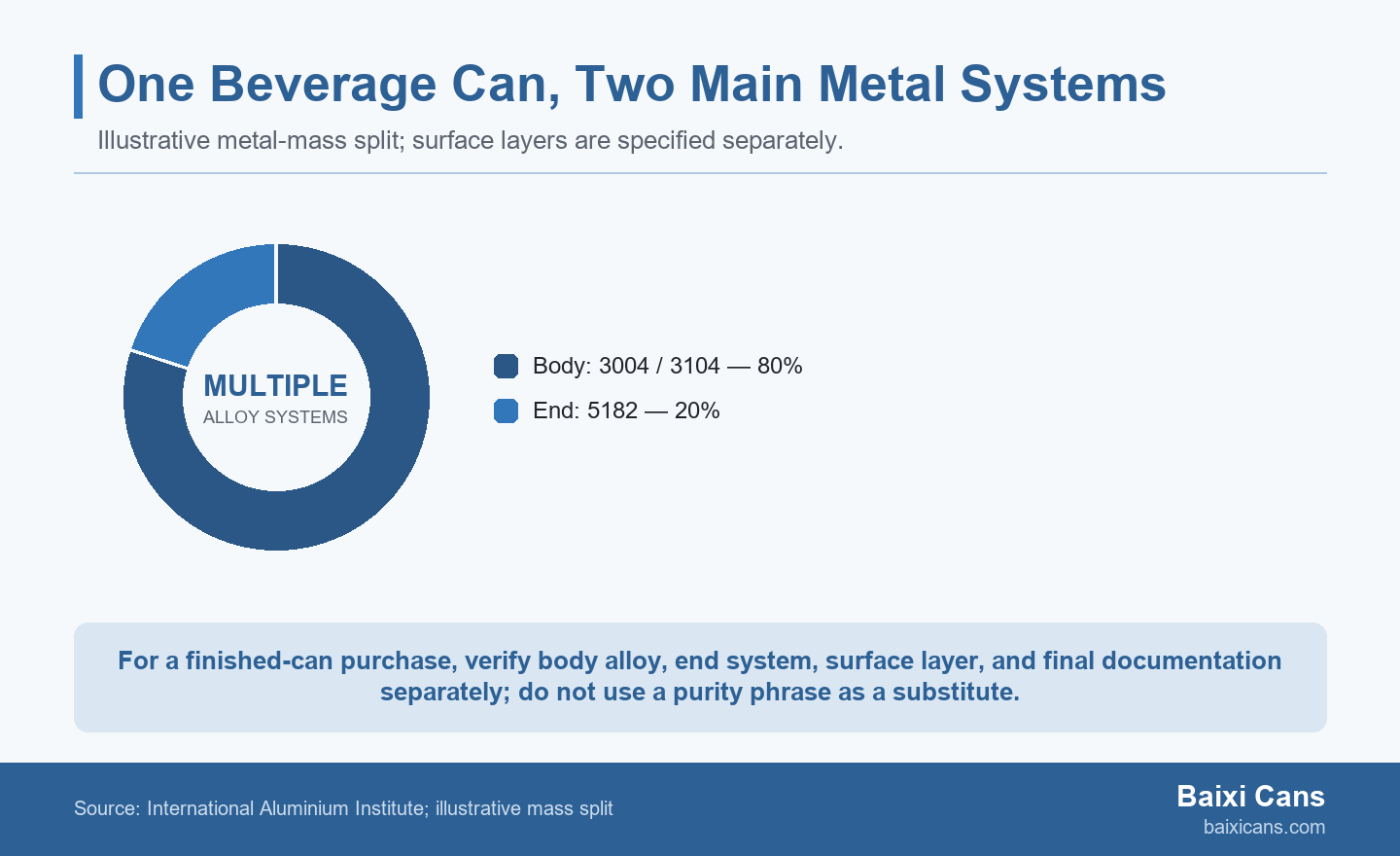
The body and lid commonly use different named aluminum alloys because the can is designed as components with different jobs. The International Aluminium Institute identifies 3004 or 3104 as body-alloy examples and 5182 as a lid-alloy example in its can-to-can recycling factsheet. Those names are useful purchasing references, not a promise that every can maker uses the same alloy or temper. A can end is the separate lid and opening component that is seamed onto the body, while a double seam is the mechanical joint that attaches that lid to the can. This tells the buyer to separate the body requirement from the end requirement before asking for a declaration.
| Layer or component | Common industry example | Primary job to specify | What the buyer should request |
|---|---|---|---|
| Can body | 3004 or 3104 alloy | Forming the thin wall, base, neck, and flange | Finished-can specification and body material reference |
| Can end and opening system | 5182 alloy | Opening function and seam interface | End format, material reference, and matched drawing |
| Product-contact surface | Coating system varies | Interface with the actual beverage | Coating or food-contact declaration for intended use |
| Decorative surface | Printing and exterior treatments vary | Brand appearance and handling performance | Artwork and exterior-finish requirements |
Once the chosen format and end diameter are known, review aluminum can lid options against the end specification rather than selecting an opening component after the body is already fixed. Baixi Cans can then discuss the relevant end option against the stated format and documentation request.
The body alloy is selected for a manufacturing job, not merely for a label on the final package. A two-piece beverage can starts as coil material, then becomes a cup that is drawn and ironed into a tall thin-walled body before later operations form the base, neck, and upper edge. The Can Manufacturers Institute’s manufacturing guide traces that sequence through doming, necking, flanging, and testing. A buyer does not need to prescribe every production setting, but should understand why “aluminum” alone does not identify a body’s forming capability.
A body alloy must tolerate substantial shape change before it becomes a beverage can. The supplier’s finished-can specification is therefore more useful than an isolated alloy slogan: it connects the selected body material to the format, diameter, height, manufacturing route, and final flange. It also prevents a common handoff error in which a buyer approves artwork and volume but leaves the physical construction implicit. If a slim, standard, or large format is still under review, make the body reference part of the same package brief as dimensions, decoration, and filling plan.
The end must be treated as its own opening and seam component, not as an automatic continuation of the body metal. Canadian Food Inspection Agency guidance explains that this joint is created through mechanical interlock and compression, with dimensions affected in part by end and body-plate thickness. That makes the double-seam guidance a reminder to approve a matched end system, not simply a generic lid.
For this reason, the purchase brief should name the desired end format and make clear that the end documentation must correspond to the selected can body and sample. The opening component should stay visible in the approval record rather than disappear behind a general can description.
The surface that contacts a beverage is a separate packaging-material question from the aluminum alloy underneath it. A food-contact coating separates the beverage from the metal. The U.S. Food and Drug Administration defines food-contact substances as components of materials used to manufacture, pack, package, transport, or hold food when they are not intended to have a technical effect in the food. Its food-contact overview gives buyers the correct frame: product contact is reviewed as a material-and-intended-use question, not solved by the word “aluminum.”
A coating declaration should be checked against the actual beverage and market, not inferred from the can's metal name. In the United States, 21 CFR 175.300 covers certain resinous and polymeric coatings for food contact and ties compliance conditions to food type and conditions of use. It is a regulatory example, not a worldwide rule. The broader procurement lesson travels well: state the beverage, relevant process conditions, and destination market before treating any coating declaration as complete.
A laminated end is a specific product example, not evidence that every can uses the same surface treatment. Novelis describes laminated can-end stock and reports an about 33% lower CO2 footprint than a conventional liquid-coating process for that product. This illustrates that an end’s metal layer and its surface design are distinct choices. Use the example to ask what surface system is stated for this finished can, rather than assuming that all ends share one construction or chemistry.
Exterior printing belongs in the same disciplined conversation, even though it does not contact the beverage. Artwork, varnish, abrasion expectations, and handling conditions should be captured as exterior requirements. Keeping interior contact requirements separate from exterior appearance requirements avoids a vague “coating approved” note that leaves both parties unsure which surface and use case it covers.
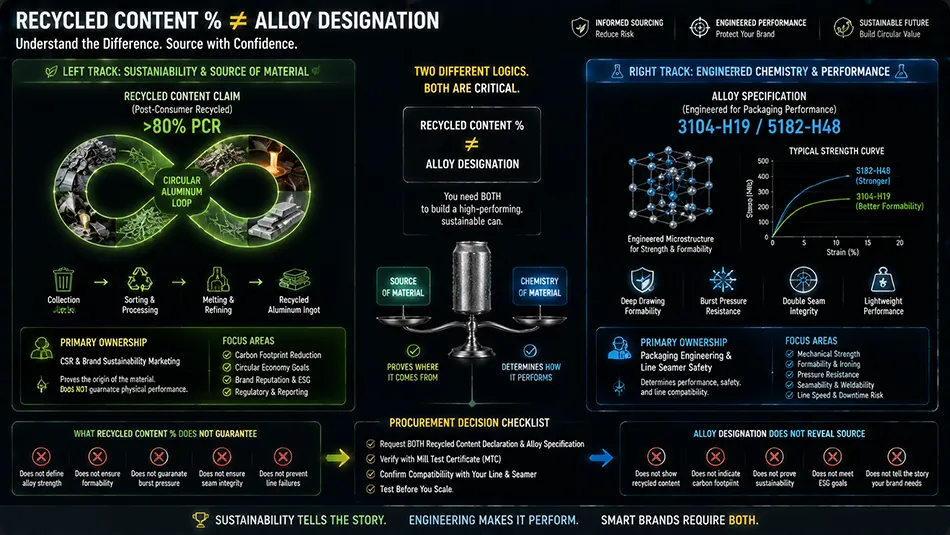
A recycled-content percentage and an alloy designation answer different questions. Recycled content concerns where the metal feedstock came from; an alloy designation concerns the material chemistry and performance recipe. The two claims can coexist in one can, but neither proves the other. Treating a recycled-content statement as proof of “pure aluminum” creates an information gap just when the buyer needs to know which component and property have actually been specified.
A recycled-content percentage should identify the scope and supplier rather than be used as a universal can-composition claim. For example, Novelis says its global beverage-packaging offering contains more than 80% recycled content on its beverage-can sheet page. That supplier statement can inform a sourcing conversation, but it does not define the recycled content, alloy, coating, or final construction of every beverage can in the market. Ask for claim scope, material source, and the record that applies to the selected supply.
The practical rule is simple: place the recycled-content request beside, not instead of, the body and end material request. A sustainability team may need supplier scope and calculation basis. A packaging team may need component references and an intended-use declaration. Combining the documents produces a more complete brief without turning one type of evidence into a substitute for another.
When the format itself is still open, it is useful to compare the available beverage-can product range against the same component brief. The comparison should keep the beverage, end style, print needs, and required documentation constant, so a different size does not become an excuse to restart the material question from scratch.
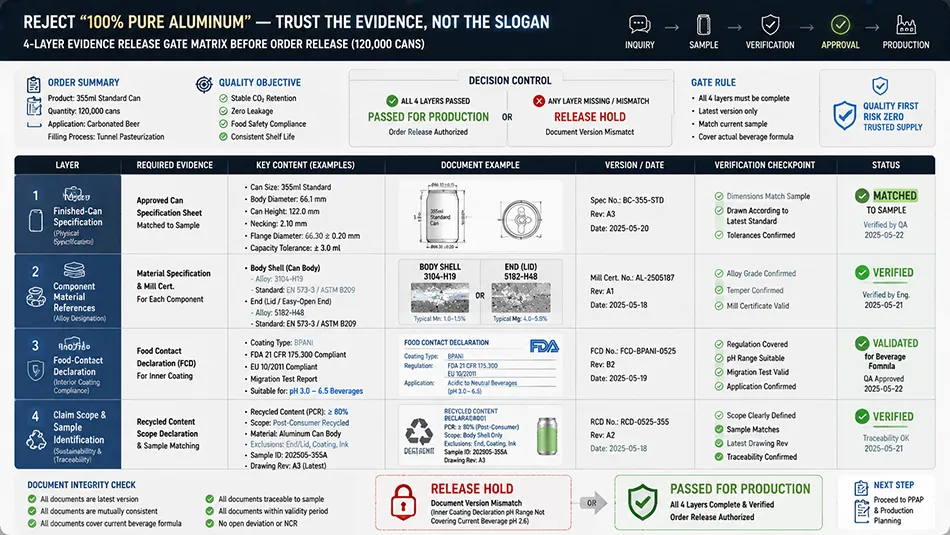
A broad purity phrase becomes useful only after it is replaced by component-specific evidence layers. The following scenario is illustrative, not a customer case or a product certification. Its purpose is to show how a buyer can pause an unclear approval without claiming that the supplier has used the wrong metal.
Holding an unclear specification protects the approval decision without accusing the supplier of using the wrong metal. The buyer is not resolving chemistry by intuition; the buyer is checking whether the commercial wording, component records, sample, and intended product use describe the same finished can.
A beverage startup asks for “100% aluminum cans” for a 355ml launch. It receives a general recycled-content statement and an end drawing, both useful documents, but neither one says exactly what the phrase is meant to prove for the finished can.
The first purchase order is one 355ml launch run of 120,000 cans. The documents do not identify the finished-can body reference, the end system, and the internal coating declaration as one matched package. A vague phrase is now carrying more decision weight than the technical records.
A physical sample and an end drawing are available. The team knows which sample it saw, but the body, end, and food-contact documents have not been reconciled to the same finished-can supply and intended beverage.
First, the request uses “100% aluminum” without naming the property behind it. The concern could be metal identity, recycled content, product-contact suitability, or a marketing claim, and each would require different evidence.
Second, the general statement and end drawing leave gaps: there is no completed set showing the body material reference, the matching end system, the product-contact declaration, and the sample identity together.
The documents are not automatically contradictory. They are incomplete as an approval package because the buyer cannot tell which component or surface claim applies to the delivered finished can. This is a document-version problem: a valid record may exist, but it has not yet been matched to the exact format and order under discussion.
The buyer holds approval of the 120,000-can order until each material layer is mapped to the actual 355ml format and the supplier documents reconcile with the sample. The hold may cost time, but it avoids committing the first launch run to a description that no one can verify after production begins.
The buyer requests the finished-can specification, body and end material references, a coating or food-contact declaration, and any destination-market documentation. The team then compares the part descriptions and format identifiers to the selected sample and end drawing, asking one direct question whenever a document applies only to a component rather than the complete can.
Approval resumes only when the finished-can specification, component references, surface declaration, and sample identity are mutually consistent for the intended product and market. That gate does not certify product compatibility; it confirms that the order description is coherent enough to move to the next product-specific review.
This is an illustrative procurement path, not legal advice, a laboratory assay method, or a substitute for product-specific compatibility testing. Contract requirements, acceptance criteria, and destination-market obligations remain specific to the beverage and supply arrangement.
A finished-can material packet is more useful than a request for '100% aluminum'. It gives a supplier a practical response path and gives the buyer a record that can be compared with a sample, drawing, and commercial quote. The packet does not replace product testing or legal review. It simply ensures that the material question is specific enough to be answered responsibly.
This brief works across formats because it asks for evidence layers rather than a universal purity label. A brand evaluating a narrow format can compare 250ml slim can options with the required material brief, carrying the same body, end, surface, and documentation questions into the format discussion. Baixi Cans can then respond to a decision-ready request instead of guessing what a broad metal claim was intended to cover.
Before approving a quotation, keep the comparison in one version-controlled record. Identify the final format and end, then attach the current drawing, artwork revision, sample reference, and component documents. If a change affects the body, end, beverage, print finish, or destination, ask whether the declaration still applies and record the answer. This simple discipline stops a valid component document from being carried forward as if it described a different finished can.
It also improves the supplier conversation. Instead of asking whether a can is “pure,” the buyer can state the beverage, filling route, destination, expected claims, and documents needed for release. The supplier can respond to known conditions, while the buyer can distinguish availability information from evidence that belongs in the approval packet. That separation reduces rework when packaging, quality, and marketing teams review the same order.
Where a document does not name the final format or use condition, record it as an open point rather than treating it as an automatic rejection. The useful follow-up is specific: ask which component it covers, which revision it follows, and whether it applies to the beverage and market in the purchase brief.
Keep the request proportionate. A first inquiry may only need the format, beverage type, destination, and intended claim. Before release, however, the final sample, finished-can record, component references, and relevant surface declaration should be aligned. If a 500ml format fits the launch, align availability, end selection, and documentation when you check 500ml beverage can options with your complete specification.
Usually not as a single-material assumption: tabs and ends are specified as part of the end system, and the precise alloy or temper can vary by design. A tab has to work with the end’s opening feature and the end must work with the seam and internal pressure conditions. Ask for the end-system specification rather than trying to infer tab chemistry from the body alloy or a general “aluminum can” description.
No, because recycled content describes feedstock origin, while purity and alloy designation describe the chemistry and permitted elements in the finished metal. A can sheet supplier may make a substantiated recycled-content claim while still supplying an engineered alloy. Review the claim’s scope and calculation basis separately from the body and end material references; they answer two different purchasing and marketing questions.
Most beverage-can systems use an internal protective coating, but a buyer should confirm the specific finished-can specification instead of assuming one coating chemistry or performance level. The correct declaration depends on the beverage, filling conditions, intended contact use, and destination market. Do not treat a generic coating statement as proof for every product; ask which finished can and use conditions the record covers.
Request the finished-can specification, body and end material references, coating or food-contact declaration, and any market-specific compliance documents relevant to the product and destination. Also connect those records to the selected format, end system, sample, and drawing revision. This creates a coherent approval packet without implying that paper records alone replace the product-specific tests or contractual checks needed for a real launch.

