
Let us begin with a highly realistic scenario that regularly unfolds in international trade: a shipment of 3,000 cartons of premium soda packed in
The technical root cause of this failure could stem from various subtle discrepancies: the verification grade of the barcode might have dropped below the mandated GS1 Class C standard; the physical label placement might fall outside the strictly regulated 400mm to 800mm vertical window; the Serial Shipping Container Code (SSCC) might be flagged as a duplicate; or the print quality could have degraded due to moisture friction during maritime transport. The immediate consequence remains unyielding—the entire shipment is halted on the cross-docking platform, the supplier is hit with an unexpected financial chargeback, and worse, the brand risks being blacklisted as a "low-quality vendor," threatening future procurement orders.
In the global beverage export ecosystem, this scenario is a daily reality. When an aluminum can rolls off a high-speed production line, it embarks on a complex journey across international oceans, custom checkpoints, bulk wholesalers, and regional distribution networks before finally landing in a consumer's hands. Along this extensive value chain, the barcode functions as the definitive digital passport and a universal language that requires no translation. From the individual EAN-13 barcode on a single
Mastering barcode architecture and manufacturing compliance is a mandatory prerequisite for accessing mainstream international retail markets. Whether you are aiming for shelf space at Target, undergoing vendor audits for specialized distributors like KeHE, or ensuring alignment with the Liquor Control Board of Ontario (LCBO) in Canada, GS1 standards remain non-negotiable. True supply chain capability is achieved only when an exporter understands exactly what barcode structure is required, how to systematically allocate numbers, how to position them to avoid distortion, and how to guarantee a first-time scan.
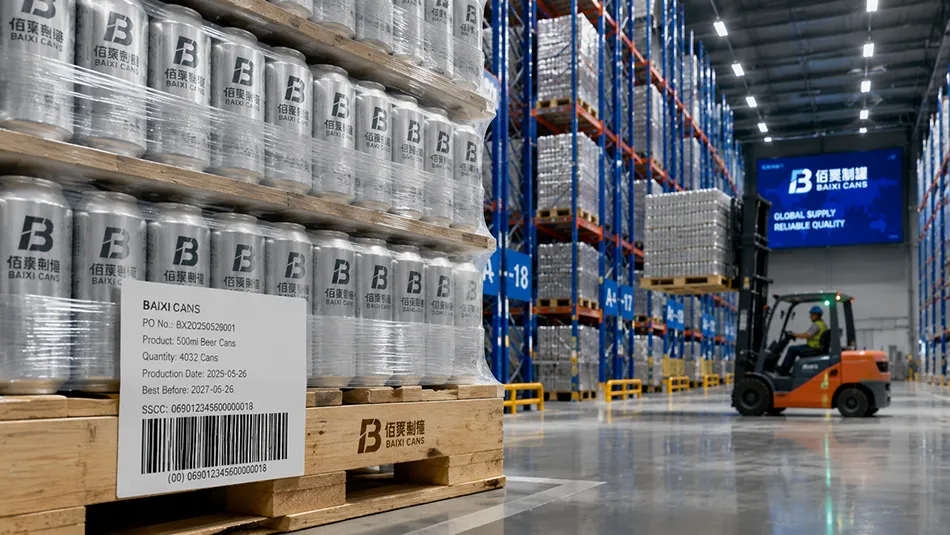
To help different departments quickly identify their specific compliance priorities, we have mapped out the core technical pillars of global barcode implementation:
| Target Audience | Critical Pain Point | Baixi Cans Active Solution |
| Beverage Procurement & Supply Chain Directors | Inconsistent barcode requirements across retailers resulting in customs delays or rejections. | Pre-evaluates target retail compliance matrices at the factory floor to eliminate port-of-entry risks. |
| International Export Business Directors | Managing overlapping, localized barcode regulations across multi-regional global markets. | Provides standardized architecture combining GTIN and SSCC configurations to streamline regulatory compliance. |
| Quality Control & Assurance Managers | Aluminum can surface reflections reducing the barcode print grade below GS1 Class C. | Implements advanced high-contrast printing inks and diagnostic hardware to guarantee optimal scanning rates. |
| Emerging Brands & Export Novices | Lack of structural knowledge regarding GS1 registration, GTIN generation, and SSCC allocation. | Provides technical consultations during structural design to map out complete barcode deployment strategies. |
Within international beverage logistics, a barcode system functions as a multi-layered data architecture. Each structural packaging layer corresponds to a specific barcode type, building an unbroken digital thread from an individual unit to an entire shipping container. If any single link in this hierarchy breaks, the entire data transparency of the shipment collapses.
When a consumer purchases a single can of craft beer, the point-of-sale (POS) terminal reads either an EAN-13 or a UPC-A barcode. This barcode represents a 12- or 13-digit GTIN (Global Trade Item Number) that uniquely identifies the product's brand owner, flavor profile, liquid volume, and physical packaging attributes. While shoppers interact with it at checkout, inventory systems utilize this code to instantly synchronize real-time stock levels, pricing configurations, and manufacturing batch files. GS1 standards mandate that every single commercial aluminum container—whether sold individually or bundled inside a multi-pack—must carry a dedicated GTIN symbol. Generally, North American markets rely heavily on the GTIN-12 (UPC) framework, while EAN-13 remains the standard across Europe, Asia, and global trade.
As single aluminum cans are clustered and packed into corrugated boxes or tray packs, the outer packaging must be labeled with an ITF-14 or a GS1-128 barcode. The ITF-14 format serves as a robust case-level barcode that mathematically links back to the internal product’s GTIN. When a receiving operator scans this carton-level symbol, the warehouse management system instantly identifies the exact product variant, the quantitative count inside the box, and the originating manufacturing plant without needing to unpack the case[cite: 1, 2]. Leading foodservice distributors, such as Gordon Food Service (GFS), strictly mandate GTIN-14 compliance on all outer cases, enforcing exact dimension, placement, and verified contrast qualities.
When individual cartons are stacked onto standard wooden or plastic pallets for ocean shipping, the composite unit must be labeled on adjacent sides with a GS1-128 logistic tag. This is the highest tier within international beverage distribution infrastructure. The foundational data element within this label is the SSCC-18 (Serial Shipping Container Code). This 18-digit identifier serves as a unique serial number for the entire pallet, guaranteed to remain distinct globally for at least 18 months. It enables continuous tracking as the cargo moves from the factory floor, through customs, and into foreign distribution hubs.
Successfully expanding a beverage portfolio into competitive overseas markets requires deep familiarity with the distinct barcode classifications that govern international distribution. Each format possesses specific geometric boundaries and technical tolerances that must be strictly maintained during the container printing and label application phases.
The Global Trade Item Number (GTIN) is the core identifier for all modern barcode asset systems. It acts as a permanent digital serial number for consumer goods. Depending on the packaging tier and target market, GTINs change in length:
GTIN-12 (UPC-A): A 12-digit format utilized primarily across retail checkout systems in the United States and Canada.
GTIN-13 (EAN-13): A 13-digit standard deployed throughout Europe, Latin America, Asia, and Africa.
GTIN-14: A 14-digit sequence specifically engineered for outer shipping cases and bulk pallets; it does not pass through consumer checkout lanes.
To secure valid numbers, beverage brands must register with their national GS1 member organization to obtain an authorized company prefix, preventing duplicate codes in international databases.
The ITF-14 (Interleaved 2 of 5) barcode format is designed exclusively for outer packaging cases, embedding a 14-digit GTIN-14. Characterized by thick, black outer bounding bars (known as bearer bars), this format is specifically engineered to be printed directly onto coarse, corrugated cardboard boxes. It provides reliable scanning even when exposed to dusty or demanding industrial warehouse environments.
Unlike the static ITF-14 format, the GS1-128 barcode is an exceptionally versatile tool in modern food and beverage logistics. It can hold up to 48 alphanumeric characters, allowing it to compress multiple rows of critical data into a single symbol. This data is organized using standardized Application Identifiers (AIs):
AI (00): Specifies the 18-digit Serial Shipping Container Code (SSCC).
AI (01): Identifies the static product GTIN.
AI (10): Encodes the exact manufacturing lot or production batch number.
AI (17): Displays the product expiration or best-by date.
AI (400): Embeds the buyer's purchase order (PO) number.
For exporters managing delicate formulations like functional energy drinks or pasteurized teas, printing GS1-128 barcodes on outer packaging provides automated batch control and rapid tracing capabilities.
The Serial Shipping Container Code (SSCC-18) is a fixed 18-digit code embedded within the GS1-128 barcode framework. When a palletized shipment of
A barcode must be printed with high precision and placed correctly on the packaging to ensure it can be easily scanned. For pallet-level GS1-128 logistics labels, the barcode must be printed horizontally in a picket-fence orientation, meaning the bars stand perpendicular to the pallet base. The code block must sit within a clear vertical window between 400mm and 800mm from the warehouse floor, placed at least 50mm away from any edge. Labels must also be applied to two adjacent sides of the pallet to ensure automated conveyor scanners can read them from multiple angles.
For retail units like aluminum cans, the EAN/UPC symbol should be positioned near the base of the can cylinder. Printing barcodes horizontally along the curve can cause optical distortion during scanning. For compact packaging, like a specialty sleek can, designers may need to reduce the barcode height or use a shorter GTIN-8 format to maintain the required quiet zones (blank spaces) on either side.
While understanding barcode technology is vital, the real challenge for beverage exporters lies in navigating the unique, rigid compliance frameworks enforced by global retail organizations. Navigating these requirements requires localized adjustments for every regional market.
Walmart sets strict logistics requirements through its comprehensive Supplier Routing Guide:
Every incoming pallet must feature a clearly visible SSCC-18 barcode nested within a GS1-128 label.
Labels must include specialized fields, including the Department Number, Item Number, and Distribution Center Routing Code.
Product parameters like the specific Purchase Order number, GTIN details, and total carton count must be clearly legible.
Failure to meet these exact labeling requirements triggers automatic deductions through Walmart's Supplier Quality Excellence Program (SQEP). These custom labeling layouts are strictly non-transferable and will be rejected by competing distribution networks, such as Target.
Target offers more flexibility with its barcode formats but maintains strict validation procedures:
Target accepts three barcode variations on pallets: SSCC-18, GTIN-14, or standard UPC-A labels.
Case labels must be centered on the right-hand side of the longest vertical carton panel, positioned at least 1.25 inches from the base.
Exporters must submit physical label proofs to Target's quality team for formal pre-approval before their initial shipment. Shipping unverified layouts results in automatic chargebacks.
To prevent scanning obstructions, Target strictly prohibits metal bands; all outer shipping cases must be sealed with clear packing tape or industrial glue.
As a leading distributor of natural, organic, and specialty foods in North America, KeHE enforces precise labeling standards:
KeHE requires suppliers to use either ITF-14 or GS1-128 barcode symbols on all outer cartons.
The distributor provides a detailed compliance manual that outlines the differences between GTIN-12, ITF-14, and SSCC-18 to ensure clear tracking at every level of packaging.
For contract manufacturers producing Private Label goods for KeHE, the brand owner provides pre-allocated GTIN sequences directly. Manufacturers must print these codes exactly as provided; any unauthorized changes will result in chargebacks.
KeHE's routing guide explicitly states that any non-compliant labeling will lead to full cost recovery fees for any extra handling required.
The Liquor Control Board of Ontario (LCBO), which manages alcohol distribution in Ontario, enforces exceptionally precise labeling standards:
Every beverage container—whether an individual craft beer can or part of a multi-pack—must display a clear GTIN barcode.
The barcode must be positioned near the flat base of the can to prevent optical distortion from the curvature of the container neck. If a barcode must be placed on a narrow section of the container, it must pass rigorous scan-testing before distribution.
Broadline foodservice distributor Gordon Food Service (GFS) has integrated modern scanning updates directly into its receiving systems:
GFS requires every product case to feature a 1D or 2D barcode containing a valid GTIN-14 sequence that aligns with the upcoming GS1 Sunrise 2027 standards.
When products require detailed tracking—such as exact manufacturing lot numbers or production dates—this information must be embedded directly within the barcode itself rather than just printed on shipping paperwork.
Any labeling mistakes on shipping cartons or pallets result in immediate administrative penalty fees.
To the uninitiated, an unreadable barcode might seem like an administrative detail. In reality, barcode failure acts as a severe supply chain disruption that can immediately halt logistics flow and permanently damage brand value.
When an automated distribution center encounters an unreadable barcode on a beverage shipment, the receiving system often rejects the entire load. In fast-moving consumer goods (FMCG) distribution, supermarkets and retailers enforce strict compliance guidelines. A single labeling error can cause an entire shipment to be rejected, wiping out the profit margin on that order and leaving the exporter responsible for return shipping and warehouse storage fees.
Barcodes do more than speed up checkout; they are essential for food and beverage safety and traceability. If a label contains incorrect batch numbers or expiration dates, it breaks the tracking chain. In the event of a product recall, missing or broken barcode data prevents a company from quickly isolating the affected batch. This can force a brand into a much wider, more expensive product recall, damaging consumer trust and brand equity.
Major retail networks like Walmart and KeHE grade suppliers using automated performance scorecards. Repeated barcode errors lower a supplier's rating, which can lead to reduced shelf space or cancelled contracts. Once a brand develops a reputation for poor labeling compliance, rebuilding trust with major retail buyers is exceptionally difficult.
When an international shipment is flagged for labeling errors, the exporter must spend significant internal resources to fix the problem. Staff must manually review shipping records, coordinate with overseas warehouses, and often pay third-party logistics providers to manually re-label the inventory. These unexpected administrative and rework expenses directly erode product margins.
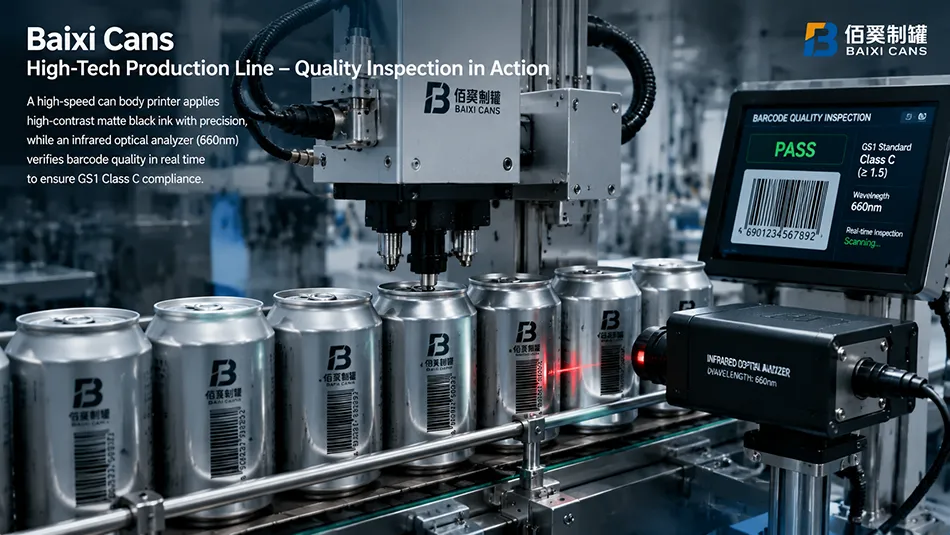
To prevent these financial liabilities, barcode compliance cannot be treated as an afterthought during final packing. It must be integrated directly into the manufacturing process. As an established partner in aluminum container manufacturing, Baixi Cans helps beverage brands secure reliable, retail-ready packaging from day one.
Strategic Data Mapping: During the initial product design phase, Baixi Cans works closely with clients to review the requirements of their target retailers. We help structure the complete barcode setup—from individual item GTINs to case ITF-14s and pallet-level SSCCs—ensuring compliance across different international markets.
High-Contrast Surface Printing: Printing high-quality barcodes on reflective aluminum surfaces requires specialized expertise. Baixi Cans utilizes advanced, low-reflectivity matte black inks paired with high-contrast background bases. Every production run is verified using optical analyzers operating at standard 660–670nm wavelengths, ensuring all printed codes consistently meet or exceed the GS1 Class C threshold.
Automated Packaging Calibration: When assembling multi-packs or palletizing cases, Baixi Cans configures GS1-128 labels to match specific retail routing guidelines. Our production lines utilize real-time verification systems to prevent duplicate SSCC sequences and ensure labels are applied within the required 400mm to 800mm vertical window.
End-to-End Shipping Alignment: Through our logistics verification processes, Baixi Cans ensures that the barcodes printed on physical packaging perfectly match the data in the export documentation and Advanced Shipping Notices (ASNs). This careful coordination minimizes customs delays and protects exporters from receiving chargebacks.
As we look toward the future of global commerce, barcode technology is moving beyond traditional 1D linear formats toward intelligent, high-density data systems. Exporters who adopt these modern standards early will gain a significant competitive advantage.
The international retail sector is currently executing the GS1 Sunrise 2027 initiative, a coordinated global plan to transition point-of-sale systems from traditional 1D barcodes to multi-dimensional 2D symbols, such as GS1 DataMatrix and QR codes. Forward-thinking distributors like Gordon Food Service are already adapting their systems to handle these data-rich codes. This change allows a single barcode to store much more information, including production dates, allergen data, and batch tracking numbers, directly on the packaging.
Regulatory changes, particularly within the European Union, are driving the adoption of Digital Product Passports (DPP). These frameworks require product packaging to provide clear, verifiable data regarding material origin, sustainability metrics, and recycling profiles. By linking secure barcodes with blockchain ledgers, beverage brands can offer complete transparency from the raw material stage to the retail shelf. The global market for smart and traceable packaging reflects this trend, growing from a valuation of $2.5 billion in 2024 to an estimated $6.8 billion by 2033, driven by a strong 11.5% compound annual growth rate.
To turn compliance theory into operational success, beverage brands can use this clear, step-by-step action plan to guide their next international shipment:
Secure Official Company Prefixes: Register directly with your national GS1 organization to secure an authorized company prefix. This prefix allows you to generate completely unique GTIN codes for your entire product line, ensuring your products can be recognized by retail networks globally.
Review Target Retailer Routing Guides: Gather and review the current supplier routing manuals for every retailer and distributor in your distribution channel. Map out variations in label placement, required data fields, and pre-approval steps to design compliant packaging for each target market.
Verify Barcode Scan Quality: Before starting full-scale production, test your barcode designs on actual packaging materials. Work with verified testing partners to ensure your codes consistently meet the minimum GS1 Class C scanning standard, preventing issues with reflective surfaces or ink bleed.
Synchronize Logistics and EDI Systems: Ensure your physical labeling processes are fully integrated with your electronic data systems. The serial numbers printed on your outer cartons and pallet labels must match your Advanced Shipping Notices (ASNs) exactly to prevent processing delays at the retailer's warehouse.
Establish Regular Compliance Reviews: Retail compliance guidelines change frequently. Set up an annual review process to check your labeling software, printing equipment calibration, and data structures against updated retailer requirements and evolving global standards.
Q1: How do reflective aluminum surfaces affect barcode scanning accuracy?
A: Aluminum can surfaces are naturally reflective, which can reduce the optical contrast between the dark bars and light spaces of a barcode, leading to scan failures. To address this, Baixi Cans utilizes highly opaque, low-reflectivity inks on specialized high-contrast base coatings. This process ensures all printed codes maintain the sharp definition required to meet the GS1 Class C standard.
Q2: What Application Identifiers (AIs) are required on a GS1-128 shipping label?
A: Every valid GS1-128 logistics label must include the Serial Shipping Container Code using AI (00) to enable automated tracking. Depending on the specific retailer's guidelines, additional data fields like the item GTIN via AI (01), the production lot number via AI (10), and the best-by date via AI (17) are often required to support safety and inventory tracking.
Q3: Can I use the same pallet label configuration for both Walmart and Target shipments?
A: No, Walmart and Target utilize different data structures and labeling layouts. Walmart requires a specific arrangement that includes purchase order numbers, department codes, and distribution routing data linked directly to their SQEP tracking system. Target offers more flexibility in barcode formats but requires a formal pre-approval process and specific placement on the packaging. Using a single, unadjusted layout across both retailers will lead to non-compliance chargebacks.
Q4: How should I handle GS1-128 labeling if my outer product cartons are too small?
A: If an individual carton is too small to fit a standard GS1-128 label while maintaining the required 0.495mm minimum bar width, the logistics data should be placed on the outer pallet wrapping rather than the small box. Shrinking a barcode below its technical size limits violates GS1 standards and makes the code unreadable for automated warehouse scanners.
Q5: Can Baixi Cans assist with structural barcode design and export documentation?
A: Yes, Baixi Cans provides comprehensive engineering support that covers everything from container manufacturing to final labeling compliance. We help clients configure correct GTIN and SSCC structures, analyze reflectivity characteristics, and verify barcode quality before shipment. We also ensure that physical labels perfectly align with export documents, helping you avoid customs delays and retailer chargebacks.
Managing international supply chain regulations requires a manufacturing partner who understands both packaging production and logistics compliance. Baixi Cans goes beyond simple container manufacturing; we help beverage brands build efficient, reliable, and compliant supply chains for the global market. We offer support at every stage of development to ensure your products move smoothly from our facility to international retail shelves.
Schedule a Technical Consultation: Book a 15-minute introductory technical session with our compliance support team. We will review your export goals, analyze your target market's labeling rules, and help verify your design layouts before manufacturing begins.
Secure Your Production Partnership: Ready to start production? Reach out to our team to request sample materials and a detailed production quote for your project. We produce a wide range of standard and specialized containers—including
Corporate Email: sales@baixicans.com
Web Portal:

