
Custom beer cans should be quoted by route, not by artwork alone, because MOQ, pricing and lead time change sharply between brite, sleeved, digital and offset cans.
A brewery or beverage importer may ask for custom beer cans, but the supplier has to know whether the brand needs blank cans for labels, digitally printed cans, sleeved cans or offset printed cans. Each route changes order quantity, cash tied in inventory, proofing schedule, per-can cost, lid planning and compliance review. Baixi Cans can help buyers connect beer can bodies, matching lids and export documents before a seasonal release or repeat SKU becomes a rushed purchase.
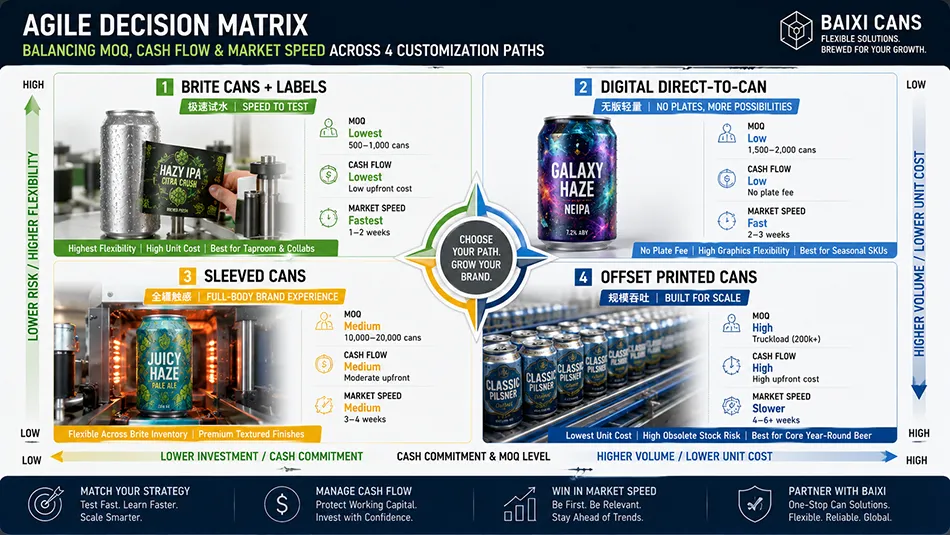
The word "custom" hides several sourcing routes. Brite cans with labels can keep early beer releases flexible. Sleeved cans can give full-can graphics without committing to offset can inventory. Digital direct-to-can printing can support smaller decorated runs. Offset printed cans can become efficient when the beer SKU is stable and the volume is high enough. According to BevSource, a full-truckload printed-can example can be 204,225 cans for a 12 oz standard can, equal to 8,509 24-pack cases. According to Blue Label, digital printed can minimums can run from 1,556 to 2,024 cans depending on size, with pilot and production timing described separately. Those figures show why MOQ is not a single industry number.
Brite cans can be attractive for a taproom release, a seasonal beer, a collaboration, a pilot export batch or a brand that still needs to learn demand. The buyer can decorate with pressure-sensitive labels or sleeves and avoid committing to a large printed-can SKU. The trade-off is that the can is not the finished package until the label or sleeve process works. Buyers need to check label material, adhesive, condensation performance, applicator accuracy, barcode scanning and recycling guidance in the target market. Brite cans protect inventory flexibility, but they move more responsibility into the brewery or co-packer's decoration workflow.
Offset printed cans are strongest when the beer has reliable rotation, stable artwork and enough volume to justify production setup. The per-can decoration cost can become attractive, and the finished can arrives ready to fill without a separate labeling step. The risk is overbuying. If the beer changes recipe, label law, barcode, ABV, market language or brand design, old printed cans can become unusable inventory. According to Blue Label's comparison, large minimum order quantities make offset less suitable for smaller brands or seasonal products. The buyer should not chase lower unit cost until the sales forecast can absorb the inventory.
| Route | MOQ behavior | Pricing behavior | Lead-time risk |
|---|---|---|---|
| Brite cans plus labels | Often lower entry quantity through distributors or stock routes | Can cost plus label, adhesive and application cost | Label material, applicator and condensation performance |
| Sleeved cans | Flexible across SKUs when brite inventory is available | Sleeve film, printing, application and shrink control | Distortion, wrinkles, barcode position and recycling acceptance |
| Digital printed cans | Can support low-thousand decorated runs in published examples | Higher unit print cost, lower tooling and inventory risk | Proofing, pilot approval and press capacity |
| Offset printed cans | Usually high-volume, often truckload-scale | Best unit economics when artwork and demand are stable | Plate, production slot, MOQ and obsolete stock risk |
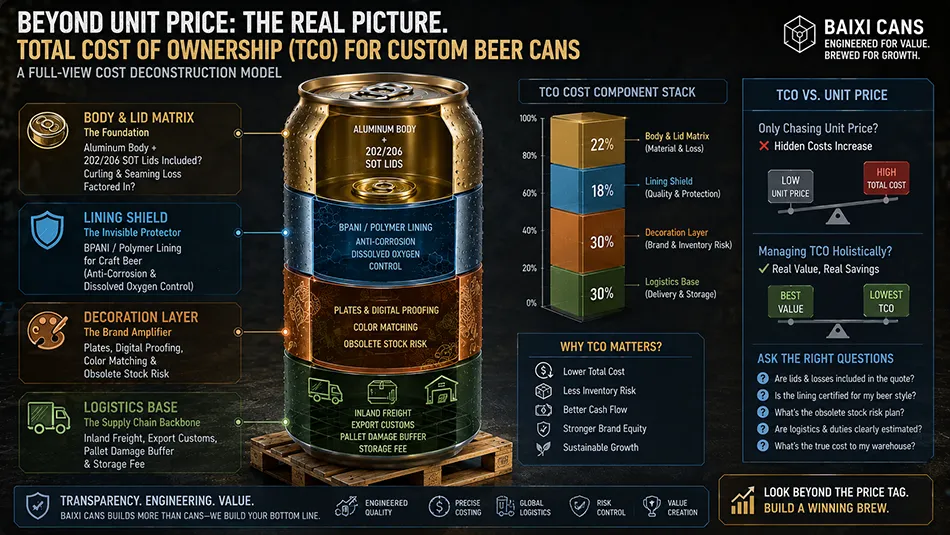
Pricing is rarely only the can body. It includes the aluminum can, compatible end, internal liner, end coating, decoration route, proofing, packing, inland freight, export freight, storage, payment terms and waste risk. Beer also adds category-specific questions: dissolved oxygen control, seam quality, light protection, liner compatibility and label compliance. According to Brewers Association data, aluminum cans accounted for 78 percent of BA-defined packaged craft beer volume in 2025, which helps explain why breweries care about can sourcing discipline. The package is a mainstream beer channel, not an afterthought.
The base quote should specify can size, body profile, lid type, liner, coating, packing and whether lids are included. A small per-can difference can be misleading if one quote excludes ends, uses a different liner assumption or ships in a way that increases damage risk. For beer, the buyer should also consider whether the can format matches the filler and seamer, whether the end is available in the right quantity, and whether the coating system suits the beer. The hidden cost is a mismatch that causes foam loss, seam complaints, sensory issues or production downtime after the buyer thought the can price was settled.
Artwork changes can be more expensive than buyers expect because they affect proofing, plates or digital approvals, barcode verification, carton copy and sometimes regulatory approval. Freight can also erase a small unit-price advantage if can pallets ship inefficiently or if urgent air or partial shipment is needed. A buyer should compare total launch cost: can and lid, decoration, proofing, freight, storage, waste and schedule risk. A lower price on one line of the quotation is not a lower project cost if it increases obsolete inventory or forces a late filling slot, especially when the lower quote also pushes the buyer into a slower route or a larger order than the sales forecast can support.
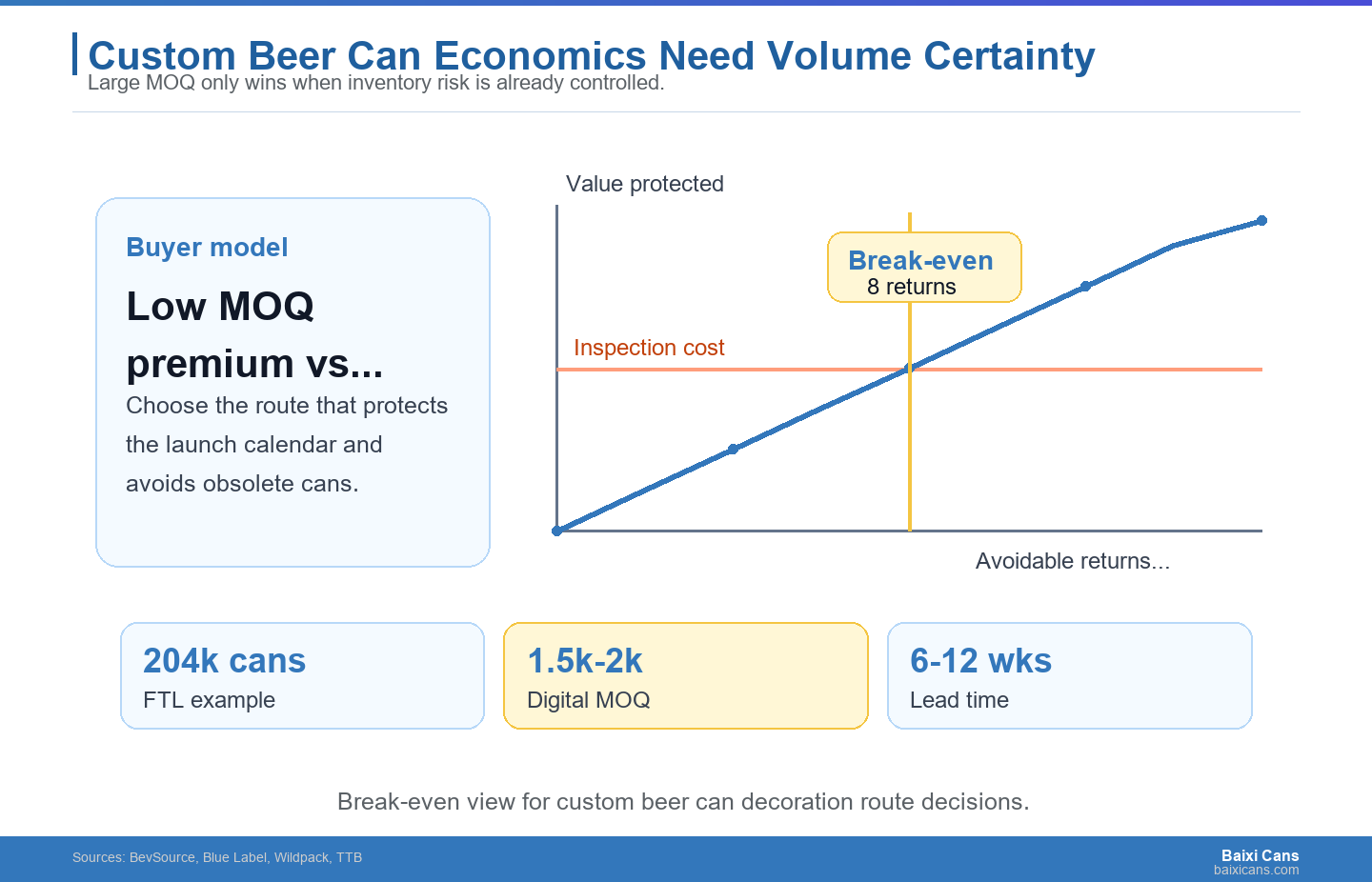
Lead time should be broken into tasks. Artwork and label compliance review, sample approval, digital proof, physical pilot, can production, lid supply, export packing, freight, customs and filling-line booking can all sit on the critical path. According to Wildpack, printed cans may be available as soon as 6 weeks after artwork approval depending on order size, with standard lead times from 8 to 12 weeks. According to Canworks, digital printing avoids plates and opens faster, lower-minimum production possibilities. Those examples do not set Baixi Cans' lead time, but they show why route selection changes the launch calendar.
Digital and sleeved routes can protect speed when the beer SKU is new, seasonal, local, collaborative or still changing. The advantage is not only shorter production time; it is the ability to avoid locking a large amount of artwork-specific inventory before demand is proven. The trade-off is that the per-unit decoration cost may be higher and the buyer has to manage approval details carefully. A digital route still needs art files, proofing and production slots. A sleeve route still needs correct shrink behavior, seam placement, barcode readability and storage conditions. Fast does not mean casual; it means the schedule risk is shifted into different checkpoints.
Offset routes need a cleaner calendar. The buyer should freeze the brand file, confirm barcode and market copy, approve color targets, confirm can and lid supply, and reserve production time before retail commitments become public. For export beer, shipping time and customs buffers should sit in the same calendar as print production. A practical rule is to work backward from the filling date, not the retail launch date. If the filling plant needs cans on a Monday, the buyer should plan for can arrival, inspection, staging and line preparation before that Monday. The quote should separate production lead time from transit time.
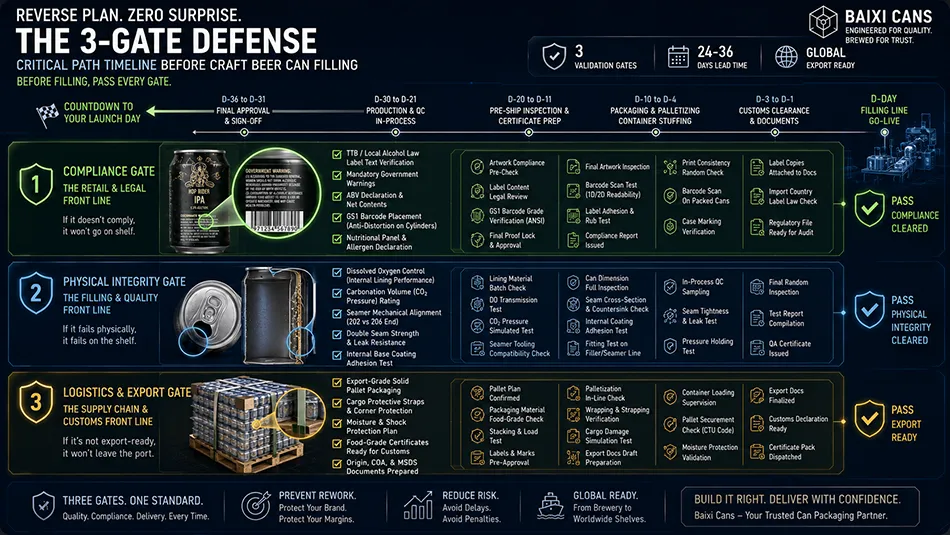
Beer is sensitive to oxygen, seam quality, temperature, carbonation and packaging compatibility. The can protects from light better than glass, but the package still has to be matched to the beer and line. According to TTB, malt beverages must be properly labeled before sale in the U.S. marketplace, which is a reminder that custom artwork is also a regulatory artifact. According to GS1's barcode placement guidance, cans and cylinders need barcode placement that protects scanning, so label review should include retail readability as well as legal text. If the beer will be exported, the buyer should confirm local market requirements, importer label review and carton information before mass printing.
Before paying a deposit, the buyer should confirm beer name, style language, ABV, net contents, producer or importer details, barcode, recycling marks, deposit marks where relevant and any required warnings for target markets. The buyer should also confirm can compatibility: body size, lid, liner, seam checks, pressure expectation and filling route. A deposit paid before those details are settled can lock the buyer into the wrong can or wrong artwork. The decision rule is to treat compliance and package-fit checks as pre-production gates, not as final proofreading tasks. For export programs, the same gate should include importer review and carton copy, because a compliant can still creates delay if the outer pack or barcode data is wrong.
Baixi Cans can support custom beer can buyers by discussing can sizes, print routes, lids, certificates, samples and export packing. Buyers can review the product catalog, compare larger formats such as 500ml beer cans, check certificate information and send project details through Baixi Cans' contact page. The best brief states the beer type, can size, decoration route, filling plant, target market, required date and whether the buyer wants lids included. It should also state whether the order is a pilot, seasonal release or repeat SKU, because that context changes the best MOQ and decoration route.
Custom beer can pricing is a calendar and inventory decision before it is a decoration decision.
When two custom beer can quotes look different, compare them line by line before choosing the lower number. Does each quote include lids, or only can bodies? Does it include the same liner assumption, same decoration route, same proofing process, same packing and same freight term? Is the MOQ per design, per size, per shipment or per annual program? Is the quoted lead time counted from inquiry, artwork approval, deposit, pilot approval or production slot confirmation? A clean comparison table can reveal that one price is lower only because important work has been left outside the quote.
The second comparison is risk. A small digital order may have a higher unit price, but it can protect cash if a seasonal beer sells unpredictably. A large offset order may have a lower unit price, but it can trap money in printed inventory if the beer changes or the distributor cuts volume. The buyer should compare total cost at three demand scenarios: cautious test, expected repeat and strong scale. That simple scenario check often shows why the right answer is different for a taproom collaboration, a regional core beer and a national retail program.
The third comparison is repeatability. A first order can be rescued by extra attention, rush freight or manual coordination, but a repeat SKU needs a cleaner system. Ask whether the supplier can hold color consistency, repeat the same lid and can body, keep the same packing method and provide documents in the same format on the second and third order. Custom beer cans are not just campaign assets. For a growing beer brand, they become recurring production materials, and recurring materials need a repeatable sourcing file.
MOQ depends on route. Digital printed examples can be in the low thousands, while offset printed cans often require much larger, sometimes truckload-scale orders. The supplier, size, market and artwork route determine the real number.
Offset printing spreads setup, plate and production scheduling costs across a larger quantity. Once demand and artwork are stable, the unit economics improve. Before that point, the risk of obsolete printed inventory can outweigh the lower per-can cost.
Lead time depends on artwork approval, proofing, production route, can and lid availability, freight and filling schedule. Published examples range from short digital schedules to 6 to 12 weeks for printed can programs, so buyers should confirm route-specific timing.
Prepare can size, beer type, carbonation, filling plant, lid needs, liner questions, artwork files, barcode, target markets, label compliance requirements, estimated quantity, required arrival date, packing needs and whether samples or pilot cans are required.

