
Custom-printed aluminum cans for the 2026 World Cup can be a powerful seasonal packaging idea only if the brand treats licensing, timing, and can specification as one brief instead of treating artwork as decoration. The tournament creates a rare global viewing season, but it also creates a practical question for beverage buyers: how can a brand join the football mood without creating rights risk, late artwork changes, or cans that do not fit the drink?
The safest starting point is not to copy official marks. It is to design a campaign around viewing occasions, host-city energy, national color stories, social sharing, and chilled refreshment. A buyer can still use custom-printed aluminum cans to create a limited-time sports season, but the brief should separate licensed official activity from generic football celebration. Baixi Cans can support the packaging side of that plan with can size options, printing discussion, lid matching, and export coordination.
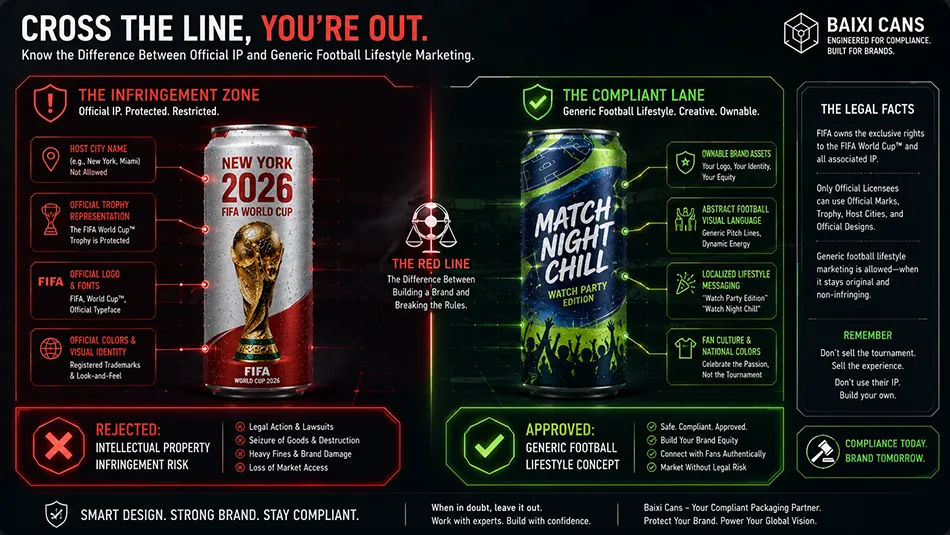
FIFA's World Cup 26 IP Guidelines describe the 2026 tournament as a June-to-July event with 48 teams, 104 matches, three host countries, and 16 venues. FIFA's match schedule frames those 104 fixtures as a full tournament calendar, FIFA's host city page identifies Canada, Mexico, and the United States as host countries, and FIFA's official hospitality page presents the final for July 19, 2026. That scale changes how beverage packaging should be planned. A custom can is not just for one final match; it can support several weeks of retail displays, watch parties, bar promotions, regional flavors, and social content.
Data from FIFA points to 48 teams, 104 matches, 3 host countries, and 16 cities or venues. Data from the official hospitality page lists 104 matches across 16 cities and the final on July 19, 2026. Data from FIFA's IP guidelines also explains that official word marks, host city marks, slogans, and tournament identifiers are protected. Data from FIFA's format article confirms the 48-team expansion, which means more match days and more regional viewing moments. Data from FIFA's host-city information confirms the three-country structure across Canada, Mexico, and the United States. Data from the official schedule confirms that a packaging calendar has to cover dozens of fixtures, not one night. Data from the Aluminum Association supports aluminum cans for chilled, portable, high-volume event occasions. The buyer implication is direct: campaign scale is large, but the legal design lane must be chosen before artwork is sent to print.
A seasonal football can should capture the viewing occasion without pretending to be an official tournament product unless the brand has the rights to do so.
A beverage brand can build a strong campaign without using protected tournament identity. Generic football imagery, celebratory color palettes, regional food-and-drink cues, score-night themes, and watch-party language can create relevance without placing official marks next to a commercial product. The distinction matters because FIFA's brand-protection guidance and the IP guidelines focus on avoiding unauthorized commercial association. In packaging terms, that means the can should not look like an official sponsor can, a licensed product, or a product endorsed by the tournament. If the brand is licensed, the rights holder process and approved artwork route take priority. If it is not licensed, the design lane should be deliberately generic, locally inspired, and reviewed before production.
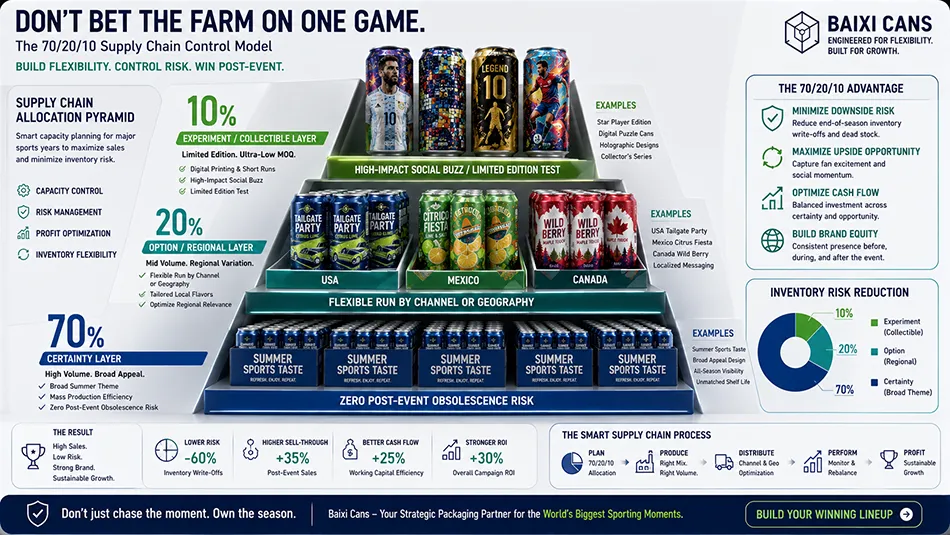
Because the tournament is distributed across North America, regional can ideas can be more useful than one generic global design. A Mexican citrus soda, a U.S. tailgate-inspired sparkling drink, a Canadian berry seltzer, or a match-night energy drink can each feel timely without repeating official marks. The key is to anchor the design in the product's own brand world: color, flavor, city mood, limited-time batch number, or viewing occasion. Regional variants also help procurement. Instead of guessing one large volume, buyers can allocate smaller decorated runs by channel or geography, then reserve repeat timing if the first shipment sells through quickly.
Custom printing works when it adds a reason to pick up the can. For football viewing, that reason may be collectability, party visibility, national color, a limited flavor, a score-night promotion, or a bundle with bars and retailers. Aluminum cans are especially useful because they chill quickly, are portable for social occasions, and provide a full 360-degree print surface. The Aluminum Association also highlights recyclability and light weight as advantages, which can matter for venues, outdoor gatherings, and high-volume seasonal retail programs.
| Campaign idea | Can decision | Buyer risk to control |
|---|---|---|
| Watch-party limited edition | Use bold 360-degree artwork and a common can size | Avoid protected marks and late artwork revisions |
| Host-region flavor set | Split artwork by flavor, city mood, or retail region | Prevent over-ordering slow regional variants |
| Bar or fan-zone RTD | Choose a format that chills fast and opens cleanly | Confirm lid compatibility and seaming setup |
| Collectible multi-pack | Keep size consistent while rotating print panels | Control color matching across designs |
A sports campaign often looks simple on a mood board and complicated in procurement. A brand may want six designs, three flavors, two regions, and a launch date that cannot move. Each variation adds artwork approval, plate or print setup, scheduling, inspection, packing, and shipment considerations. If the buyer does not connect MOQ to sell-through evidence, a short seasonal window can leave decorated inventory with limited value after the final. A more practical plan is to define a core design for reliable volume, then use one or two controlled variants for region or flavor. That gives the campaign enough novelty without turning every idea into a separate inventory exposure.
Sports viewing occasions differ. A non-alcoholic soda, sparkling water, or functional drink may work well in a slim can that encourages trial and moderation. A beer, energy drink, or larger social beverage may need a 500ml format that feels substantial for match night. Baixi Cans' slim 250ml printable aluminum cans can fit trial packs and lighter drinks, while 500ml cans for beer and sports drinks can support bigger viewing occasions. The right choice is not only volume. It is how the can looks in hand, how quickly it chills, and whether the portion matches the drinking moment.
The licensing question should be settled before the buyer asks a can supplier to prepare production artwork. FIFA's IP guidance lists official word marks, slogans, host city marks, the official typeface, and other protected elements, and it explains that commercial use of official intellectual property is reserved for rights holders. That does not mean every football-themed beverage can is impossible. It means the campaign needs a defined lane: official licensed product, approved sponsor activation, editorial reference, or generic football celebration. A beverage can intended for retail sale is a commercial object, so the review should be stricter than a social post.
A practical packaging rule is to remove any element that could make shoppers believe the drink is official, sponsored, licensed, or endorsed when it is not. Avoid official logos, official slogans, trophy imagery, protected typography, host city marks, team/player likenesses without rights, and commercial phrases that imply sponsorship. Use independent brand assets, ownable seasonal names, color systems that do not copy official graphics, and legal review. This protects the buyer and the supplier. It also protects the campaign from last-minute redesigns that can destroy the production calendar.
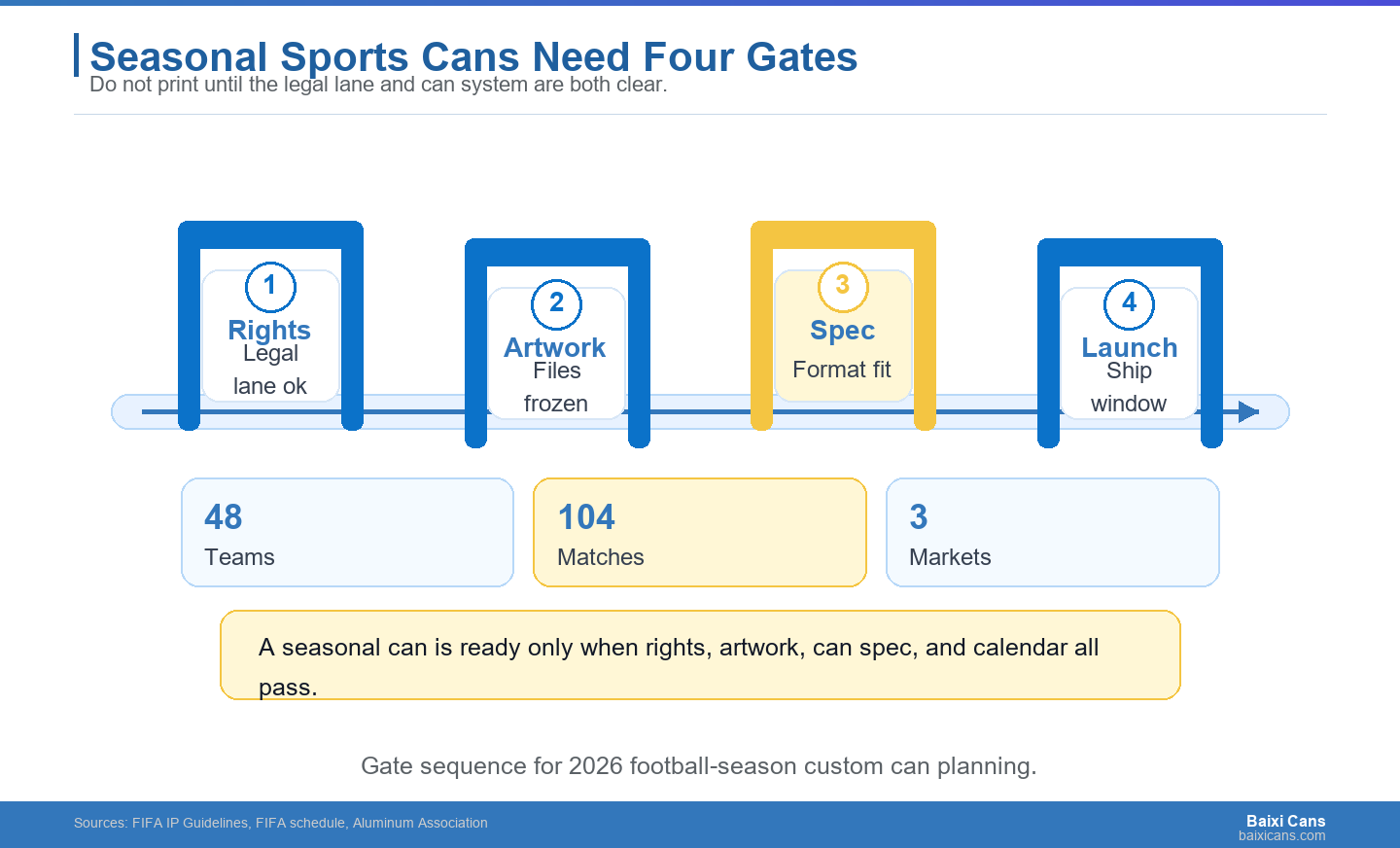
A good custom-can timeline starts with the launch date and works backward. First, define the campaign lane and rights review. Second, freeze the beverage formula, can size, lid type, and target filling process. Third, confirm internal coating suitability, carbonation, filling temperature, and shelf-life assumptions. Fourth, finalize artwork only after the supplier has confirmed print requirements. Fifth, leave enough time for proofing, production, inspection, packing, export, and the buyer's own distribution. When the window is tied to a global event, missed timing can turn a strong idea into unsellable inventory.
For many buyers, a safer model is a three-layer allocation. The certainty layer covers volume that will sell even if one team or match result changes. The option layer is a repeat quantity that can be released if early sell-through is strong. The experiment layer covers bolder variants that create excitement but should not absorb the whole budget. This allocation model is not glamorous, but it protects seasonal packaging from the biggest procurement mistake: assuming the social buzz of the event automatically guarantees demand for every SKU.
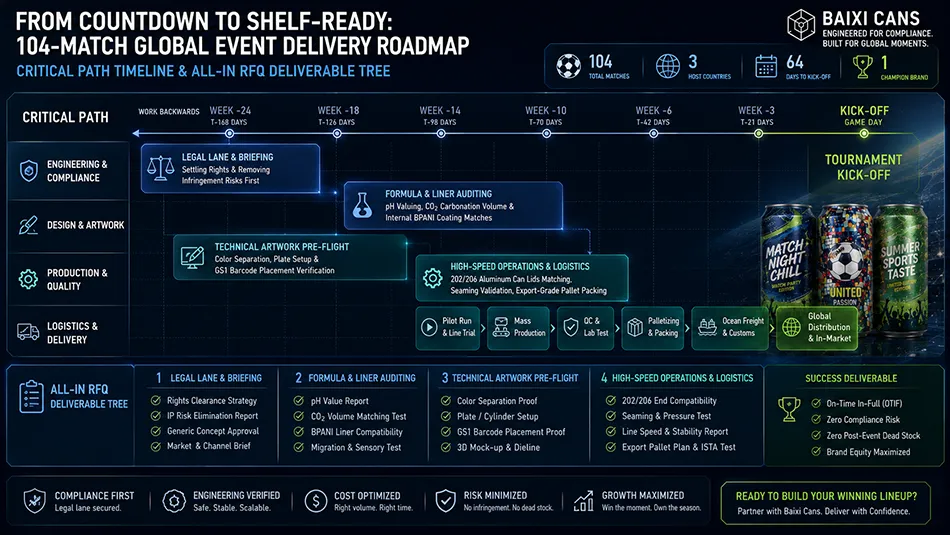
Before ordering, ask Baixi Cans to review the can size, end requirement, artwork method, order quantity, packing, and delivery schedule as one system. Buyers can start with aluminum cans, then match the order with suitable aluminum can lids. For beverage brands still comparing options, Baixi's product range and service pages can frame the early discussion.
The strongest brief includes beverage type, pH if known, carbonation, filling process, desired can size, lid type, artwork count, color expectations, launch date, delivery destination, and whether the campaign is licensed or generic. If there is any uncertainty around rights, artwork should not be treated as final. If the beverage is acidic, carbonated, alcoholic, or functional, coating and compatibility should be discussed early. Seasonal cans succeed when the creative plan, legal lane, and technical specification all point in the same direction.
A seasonal campaign should be designed so the product still makes sense if the tournament result changes, a team is eliminated, or the retail window extends longer than expected. That is another reason to avoid artwork that depends too heavily on one team, one match, or one official phrase. A can built around flavor, refreshment, viewing culture, or city mood can remain sellable after a specific result. The practical rule is to make the design timely without making the inventory too fragile.
Buyers can use a simple 70/20/10 allocation. About 70% of the decorated volume should be a broad design that can sell through the whole season. About 20% can be regional, channel-specific, or flavor-specific. The final 10% can be used for a bolder collectible or limited idea if the brand has the distribution to support it. This is not a universal formula, but it forces the buyer to separate reliable demand from promotional excitement. The risk is not that every variant fails; the risk is that too much money is tied to the least reusable variant.
Artwork should also include a fallback plan. If legal review rejects a phrase, if a color system looks too close to protected material, or if a licensing partner changes requirements, the buyer should know which elements can be removed without redesigning the whole can. A modular design system helps: keep the brand mark, flavor hierarchy, barcode, compliance text, and required production marks stable while changing only the seasonal panel. That reduces the chance that one late issue delays the full order.
The final check is operational. A campaign that depends on chilled retail displays, bars, fan gatherings, or multi-packs needs packaging that can survive the distribution path. Ask about pallet configuration, carton protection, scratch risk, color matching across variants, and whether the same lid will be used across all designs. The decision rule is to protect the product first and the theme second. A sports-season can that arrives late, scuffed, leaking, or legally risky will not feel seasonal; it will feel careless.
That operational check is also useful for post-event learning. If the campaign performs well, the buyer should know whether success came from the flavor, the format, the retail display, the artwork, or the timing. That knowledge turns a one-time event can into a repeatable seasonal packaging playbook.
A brand should distinguish licensed official artwork from generic football-themed artwork. Official marks, slogans, logos, host city marks, and other protected elements generally require proper rights. Generic football celebration, ownable brand graphics, and legally reviewed seasonal designs may be safer, but buyers should seek qualified legal review before production.
Choose the size by beverage type and viewing occasion: slim 250ml cans can work for trial, low/no alcohol, soda, and functional drinks, while 500ml cans can fit beer, energy drinks, and bigger social occasions. The right format should match portion size, channel, price point, launch volume, and filling-line capability.
Buyers should start before final artwork is locked. Rights review, formula details, coating discussion, lid matching, MOQ, proofing, production, export, and retail distribution all need time. For event-driven packaging, the calendar is part of the specification.

