
Custom soda cans should be ordered as a launch system, not as a decoration file placed on a blank can.
The can size, end, liner, print route, barcode, proofing process, carton plan and filling-line format all affect whether a soda launch moves smoothly. A brand can have beautiful artwork and still lose time if the can body does not match the filler, the barcode sits in a weak scan area, the coating question is late or the MOQ does not match demand certainty. Baixi Cans helps beverage buyers connect the brand idea with real aluminum can formats, matching ends and export-ready sourcing details before production commitments become hard to change.
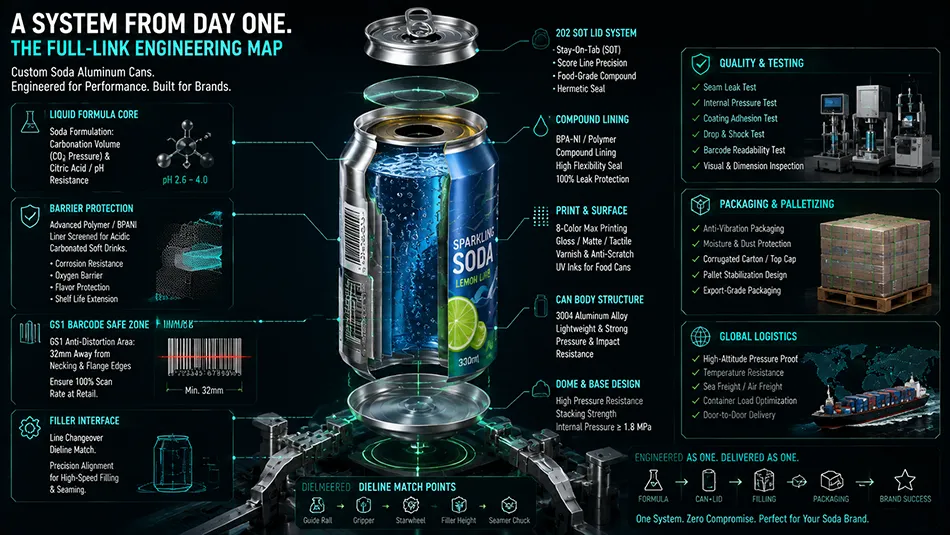
A printed soda can has to perform in two worlds at the same time. It is the brand's most visible shelf asset, but it is also a pressure package that has to be filled, seamed, packed, shipped and scanned. According to Blue Label's comparison of printed cans with labels and sleeves, printed cans arrive decorated and ready to fill, while pressure-sensitive labels require an additional labeling step. According to Canworks' explanation of digital aluminum can printing, digital can printing applies industrial inkjet directly to formed cans and avoids the plate system used in traditional offset workflows. Those routes create different cost, timing and flexibility profiles, so the buyer should choose the route after defining the launch risk.
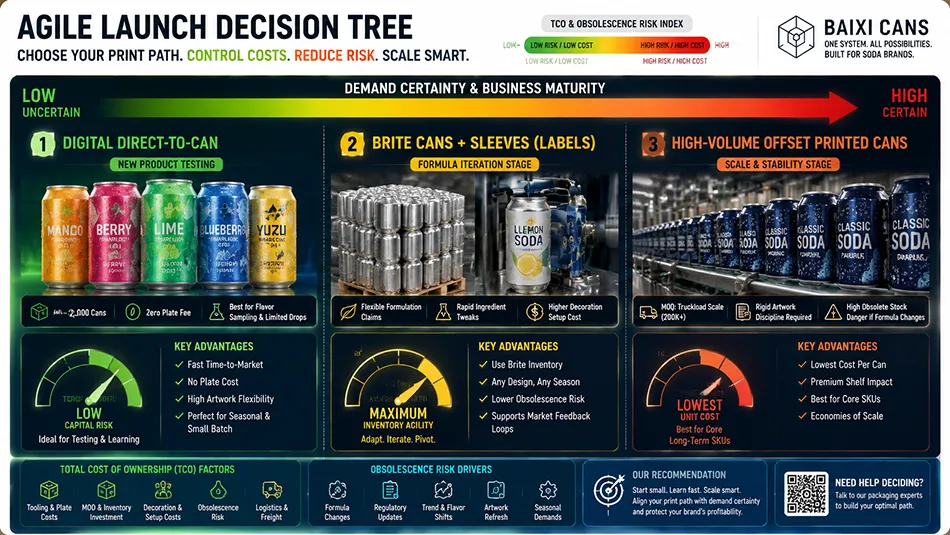
Direct digital printing can be useful when a soda brand needs a low-volume market test, several flavors, seasonal artwork or retailer-specific packaging without carrying a large printed-can inventory. Offset printing can become attractive when the artwork is stable and demand is high enough to absorb the setup and production quantity. Brite cans with labels or sleeves can keep the body inventory flexible, but they move more work into label material, adhesive, shrink quality, barcode scanning and recycling guidance. None of these routes is automatically better. The right route is the one that protects the launch calendar while keeping obsolete packaging risk in proportion to forecast confidence.
Soda artwork often starts with flavor, color and shelf personality, but the sourcing file has to include beverage facts as well. The buyer should record carbonation level, acidity or pH range if available, sweetener system, filling temperature, pasteurization or tunnel process if used, target shelf life, market label rules, case pack, pallet plan and the filling plant's preferred can format. That information is not decoration detail; it determines whether the can body, liner, lid and print route are being specified against the real product. A supplier can respond more accurately when the RFQ says what the soda is and how it will be filled, rather than only saying "custom printed 330ml soda can."
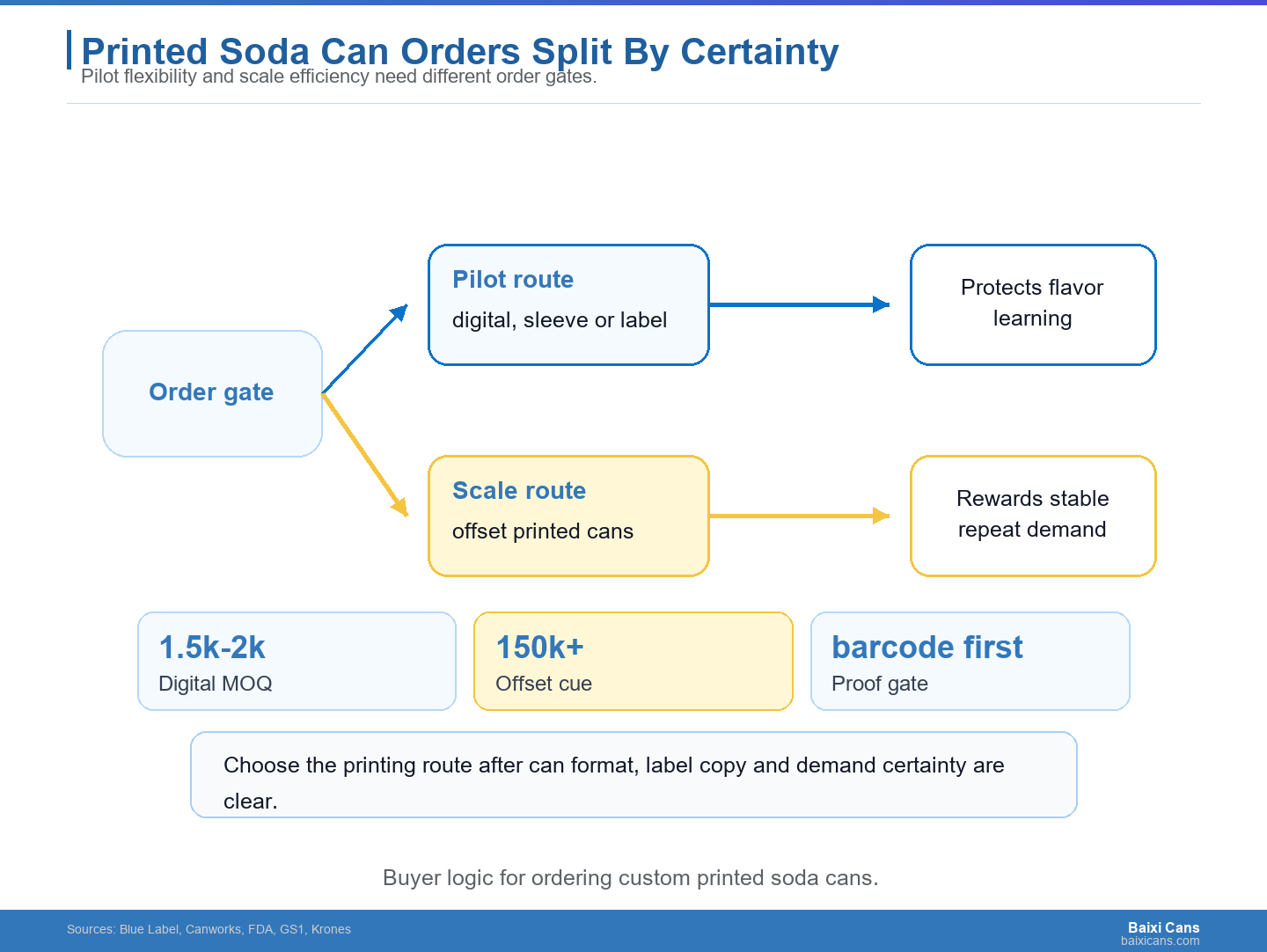
The safest ordering sequence moves from beverage facts to can format, then to artwork, proofing and production. According to FDA food labeling guidance, food labeling guidance summarizes required statements under applicable laws and regulations, so the label copy should be treated as a compliance input, not only as marketing text. According to GS1 barcode placement guidance, cans and cylinders need barcode placement that protects scanability, including quiet zones and placement away from risky edges. These details should be reviewed before the final print proof because they can change the dieline.
A dieline is only useful when it is tied to a confirmed can drawing. A 250ml slim can, 330ml standard can, 330ml sleek can and 500ml can can all carry soda, but they do not create the same line-change, lid, carrier or carton requirements. According to Krones' Craftmate C specifications, the machine lists a standard 211/202 can format and optional 204/202 to 300/209 formats, which shows why buyers should speak in body and end formats, not only in milliliters. The buyer should ask for the drawing, lid match and filling-line confirmation before approving the artwork area, because a wrong dieline can push color proofing, barcode review and production booking back to the beginning.
Proofing should answer practical questions: are colors acceptable on aluminum, is small text readable, does the barcode scan, does the legal copy fit, does the seam area remain clear, does the design tolerate curvature and can the supplier repeat the finish? A digital PDF proof is useful for layout, but it does not always answer color, shine and tactile questions. Physical pilot cans or printed samples can reveal contrast issues, distorted fine lines and unexpected reflections that are hard to see on screen. The buyer should define who approves the proof, what counts as approval and what happens if the proof exposes a problem.
| Order gate | What to confirm | Why it matters |
|---|---|---|
| Beverage brief | Carbonation, pH, fill process, target shelf life | Guides liner, end and pressure assumptions |
| Can drawing | Volume, diameter, height, end, packing | Prevents artwork approval on the wrong body |
| Artwork proof | Color, barcode, legal copy, seam clearance | Reduces reprint and retail scanning risk |
| Production quote | MOQ, lead time, lids, packing, freight | Turns the design into a real sourcing plan |
Custom soda can buyers often ask for the lowest unit price first, but the better question is how certain the brand is about repeat demand. According to Blue Label's digitally printed can data, published digital printed can minimums can run from 1,556 to 2,024 cans per design depending on size, with pilot and production timing listed separately. According to Wildpack's printed can page, printed cans can be available as soon as 6 weeks after artwork approval depending on order size, with standard lead times from 8 to 12 weeks. Those examples do not define Baixi Cans' lead time, but they show why the printing route changes both MOQ and calendar risk.
A new soda flavor may need to prove taste, price point, retailer acceptance and repeat purchase before the brand can responsibly hold a large quantity of artwork-specific cans. In that situation, a flexible route can be worth a higher unit print cost because it protects cash and lets the brand adjust flavor names, label claims, barcode data or market language. The cost to fear is not only the price of a decorated can; it is the cost of storing or scrapping cans that no longer match the product. For pilot launches, the buyer should ask for route options that make learning affordable.
When a soda SKU has stable demand, offset printed cans can simplify filling because the cans arrive as finished packaging and can reduce the need for a separate labeling step. The buyer still needs artwork discipline. A small change to ingredient wording, nutrition information, barcode, deposit mark or importer address can turn a low unit cost into obsolete inventory. Before moving to high-volume printed cans, the brand should freeze the specification file: can body, end, liner, artwork revision, color targets, carton plan, pallet details and approved certificates. Scale works when the repeat order can be repeated.
Soda is usually carbonated and often acidic, so the package has to protect taste as well as appearance. According to Sherwin-Williams beverage coating information, beverage coating systems are listed for carbonated soda, energy drinks and beverages with citric acid, which is a reminder that formula stress belongs in the can conversation. According to The Aluminum Association, aluminum cans are lightweight, stackable and strong, which helps transport efficiency, but only when the can and secondary packaging are specified correctly. The deposit should come after the buyer has checked coating, end, packout and filling assumptions.
A soda buyer should share the category, carbonation level, flavor system and acidity information that the supplier needs for liner discussion. The internal coating is the barrier between the drink and the metal surface, and the lid coating should not be forgotten. Carbonation also puts practical pressure on filling, seaming and storage conditions. If the product is unusually acidic, uses botanical extracts or will be hot filled, the buyer should make that clear before samples are ordered. A good RFQ does not ask the supplier to guess which coating discussion matters.
Printed soda cans can be dented, rubbed or contaminated if packing is treated as a generic detail. Export buyers should ask about pallet configuration, slip sheets, cartons, moisture protection, lid packing and inspection on arrival. They should also confirm whether the order includes can ends and whether the end quantity matches the can quantity with reasonable allowances. Baixi buyers can review aluminum can lid options early so the body and end are discussed together rather than as two separate purchases. This is especially important when cans and lids move through different cartons, because a shortage in either part can stop the filling line.
Baixi Cans can support soda buyers by discussing standard, slim and sleek can formats, printable options, matching lids, certificates, sample needs and export packing. A practical RFQ should include beverage type, can size, target market, filling plant, carbonation, coating questions, artwork route, required date, estimated annual demand and whether the buyer wants a pilot or a repeatable program. Buyers can review Baixi's product range, check certificate information and use Baixi's service process to prepare a cleaner inquiry.
The strongest custom soda can order is not the one with the most dramatic artwork. It is the one where the drink, the can, the lid, the artwork and the filling line all agree before production starts. That agreement is what keeps a custom can from becoming a custom problem.
The first mistake is approving artwork before the can drawing is confirmed. A design built for a generic cylinder can fail when the actual diameter, neck, end and printable area arrive. The second mistake is comparing quotes without checking whether lids, liner, proofing, packing and freight are included. The third mistake is treating the barcode as a final detail. A soda can that looks beautiful but scans poorly creates retail friction. The fourth mistake is ordering a large offset quantity before demand is proven. For a new soda brand, packaging flexibility can be more valuable than a small unit-price saving.
The final mistake is forgetting repeatability. A launch order can be managed with extra attention, but a launch can should also create a reusable specification. A growing soda brand needs a repeatable sourcing file, not only an attractive launch can. Keep the approved drawing, artwork version, color reference, lid, liner, packing method, carton details and supplier documents in one place. That file makes the second order faster, cleaner and easier to audit than the first, and buyers can share it with Baixi Cans when they want a quote tied to a specific repeat order.
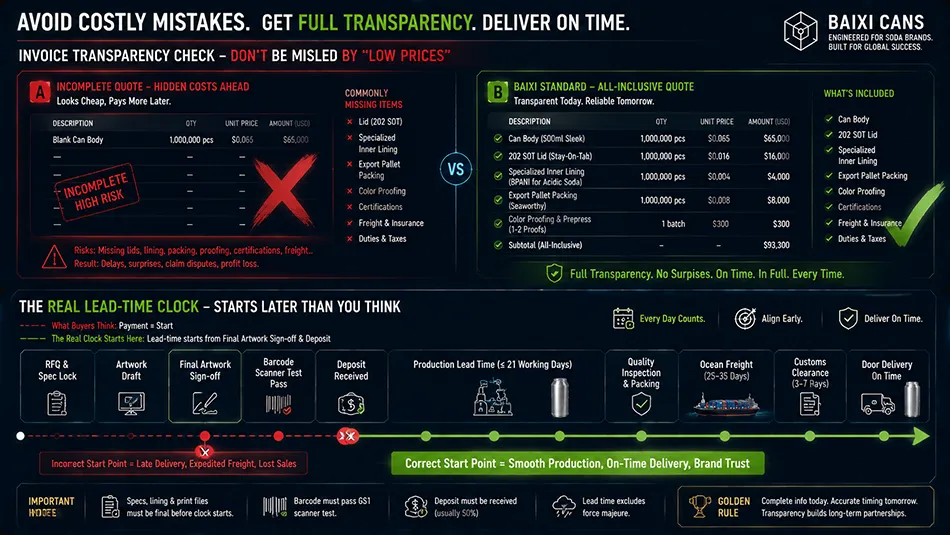
Two custom soda can quotes can look similar while carrying very different responsibilities. One quote may include lids, export packing, artwork proofing and a defined print route, while another may quote only empty can bodies. One supplier may count lead time from deposit, while another counts from artwork approval or physical proof approval. One quote may assume a stock liner and one market, while another may be prepared around an acidic formula and export documentation. Before choosing the lower number, the buyer should put each quote into the same comparison table: can body, lid, liner, print route, proofing, MOQ per design, sample timing, production timing, packing, freight term and document package.
A low per-can price can be misleading if the buyer still has to source lids separately, pay for labels elsewhere, arrange extra packing or absorb a larger production quantity than the sales plan supports. The useful number is the landed cost of a sellable, fill-ready package. That includes the can body, end, decoration, proofing, waste allowance, freight, storage and the cost of any delayed filling slot. A soda buyer should also ask whether the quote is per flavor, per artwork, per shipment or per annual forecast. This simple clarification prevents a quote from winning on a narrow line item while losing on the whole launch.
Lead time is often misunderstood because buyers and suppliers start the clock at different moments. The brand may think the clock starts when the first inquiry is sent. The supplier may start counting from deposit, final artwork, approved proof, confirmed production slot or receipt of packaging accessories. A better soda can calendar separates design review, proof approval, production, quality checks, export packing, inland transport, ocean or air freight, customs and delivery to the filling plant. This makes delays visible early. It also lets the buyer decide whether a flexible route is worth a higher unit cost because it protects a seasonal launch date.
A growing soda brand needs a repeatable sourcing file, not only an attractive launch can.
Prepare beverage type, carbonation, pH or acidity details if available, filling process, target market, can size, lid type, coating questions, artwork route, barcode, estimated quantity, required date and shipping destination.
Printed cans can look cleaner and arrive ready to fill, while labels or sleeves can protect flexibility for small tests and multi-flavor launches. The better route depends on demand certainty, artwork stability, budget and filling workflow.
Offset printed cans make the most sense when the SKU has stable demand, fixed artwork and enough volume to justify the production quantity. Early launches often benefit from flexible routes before moving to offset.
Liners help protect the beverage from direct metal contact. Carbonated and acidic sodas should include formula and process details in the RFQ so the supplier can discuss the right coating and lid assumptions.

