
A functional drink should be treated as a named launch configuration, not as a category label. A can may look suitable beside a pilot sample, yet that impression is not the evidence needed when acidity, mineral salts, extracts, processing, storage, or the can end change. The practical starting point is a formula exposure card that keeps those conditions connected.
A functional beverage category label is not a formulation exposure profile or a commercial pack-test plan. Here, a pack test is a planned evaluation of a filled package under stated conditions. Before a launch team treats a result as commercial evidence, it should be able to identify the tested drink, the exact can and end, the process and storage route, the intended market, and the specific record that connects them.
This is an evidence-control approach, not a declaration that any one ingredient or can format will fail. It helps R&D, packaging, quality, and procurement ask the same question: does the result actually belong to the launch configuration being discussed?
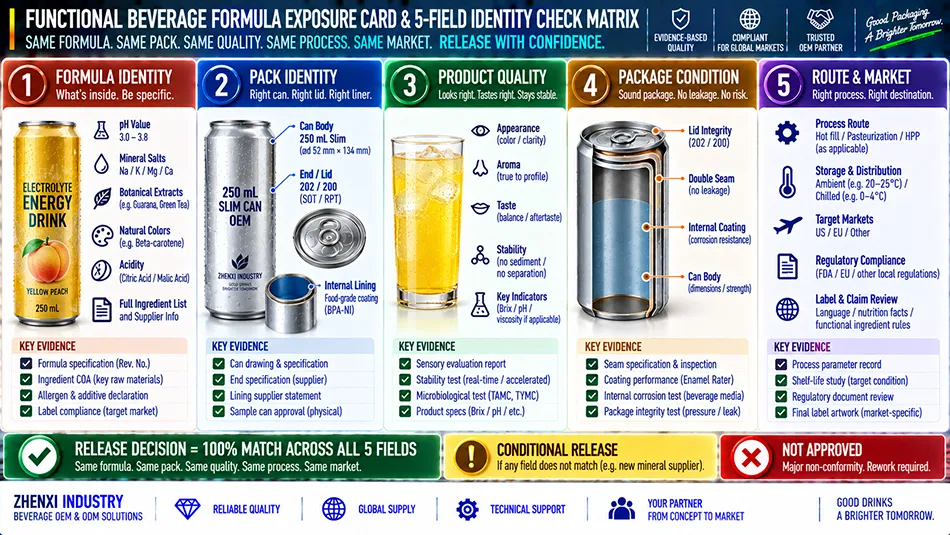
The test brief should record the beverage matrix, not just the functional ingredient named on the front label. Put the current formula version, target pH range, mineral-salt system, extracts, colors, sweeteners, emulsions or oils, carbonation, fill conditions, and intended storage route in one controlled record. FDA notes that the status of a food-contact material component depends on the individual substance and its intended use, reinforcing the need to keep a defined product and pack context together.
A useful card also names the proposed can volume, body, end, filling sequence, market, and what the team wants the work to answer. For example, “screen whether the revised mineral premix changes package-condition observations” is a testable question; “confirm the can works for wellness drinks” is not. Teams can then review aluminum can format options against the formula card without detaching format choice from the actual beverage.
Functional beverage stability can change with the beverage matrix, processing, storage, and interactions among added ingredients. The Brewers Association notes that polarity, temperature, pH, and oxygen can affect functional-ingredient solubility and stability. That does not predict an outcome for a specific can; it explains why a full matrix belongs in the brief.
List what is known and flag what is still being finalized. A botanical extract may introduce haze or color questions. A mineral premix may change the formula branch that a prior pilot represented. A natural color may need its own product-quality observation. The purpose is not to turn every variable into a failure theory. It is to make sure later observations can be traced back to the product that was actually filled.
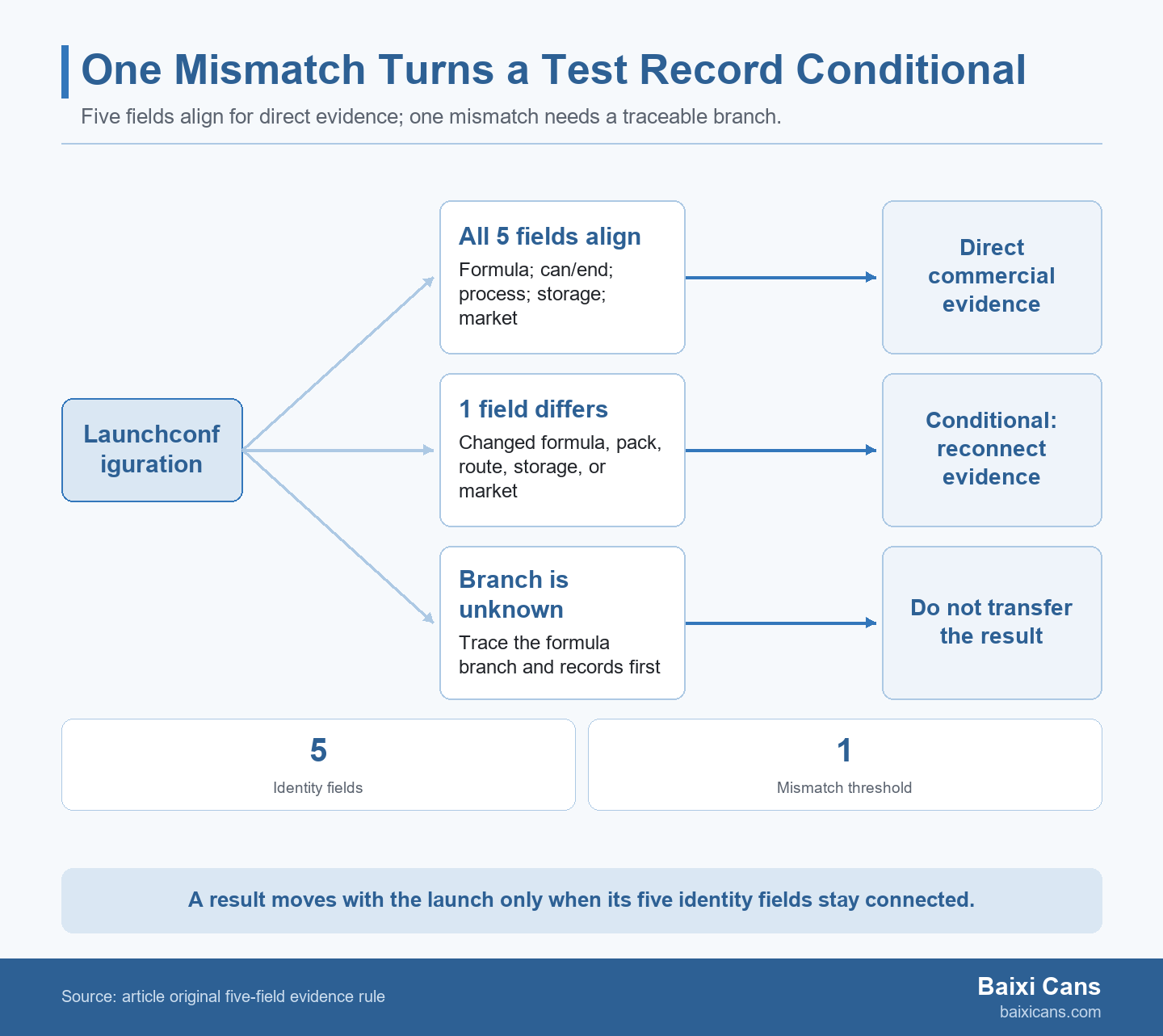
A change in a formula field should make a prior record conditional until the team documents why the change does not affect its intended evidence use. A revised carrier, flavor system, mineral source, process temperature, or storage route does not automatically invalidate earlier work, but it does create a question that should have an owner and a written answer.
Use version identifiers rather than verbal assurances. The comparison should show the old and current formula exposure cards side by side, then state whether the can body, end, process, storage route, market, and observation plan are still aligned. That simple comparison is often more useful than trying to infer compatibility from a broad “functional beverage” category.
FDA food-contact references distinguish food types and conditions of use, including nonalcoholic beverages and different heat or storage routes. The agency’s food-type and conditions-of-use tables make the useful point: “beverage” is not a complete intended-use description. The record should name the relevant route rather than relying on an undifferentiated packaging statement.
A food-contact substance is an item in a package that touches what people consume. For a packaging brief, that plain definition leads to practical fields: the beverage type, the can and end, whether the product is hot filled or otherwise processed, expected storage conditions, and the market where the product will be sold. These fields help technical and regulatory parties review the right question; they do not themselves classify a formula or approve a finished product.
When preparing a can-specification discussion with Qingdao Baixi Industry (Baixi Cans), carry those route fields with the product brief. They keep format options connected to the product and market being considered, while the responsible technical and regulatory parties retain their product-specific review roles.
A U.S. food-contact reference is a documentation input for the intended market, not a substitute for a finished-product approval or a different market's requirements. The FDA’s food-contact resource hub links to guidance and reference tools, so a buyer should identify the destination market early and have the responsible regulatory team assess the applicable route.
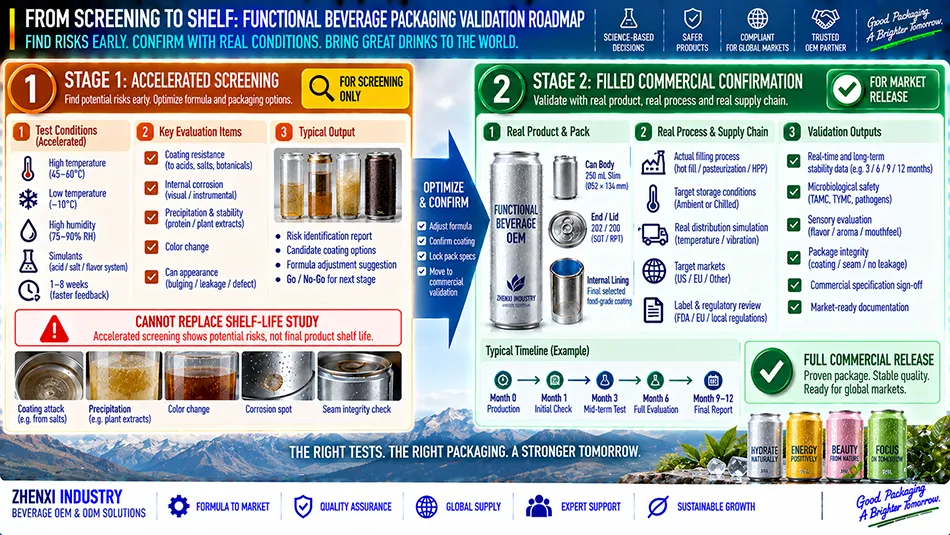
Use a screening stage to answer a stated exposure question, then use a filled-pack confirmation stage to test the commercial configuration you intend to sell. A 2024 aluminum-can study investigated coating behavior and aluminum migration in a specified Chinese-liquor system, illustrating why a test sequence must preserve the matrix and conditions it is meant to represent. Separating the two stages keeps a quick learning exercise from being described as the same evidence as a commercial shelf-life result.
Before work starts, write the question, the sample identity, the planned observation points, the party responsible for interpretation, and the decision the result may support. That structure does not set a universal duration or acceptance limit; it prevents a test from acquiring a larger meaning after the fact. If the project uses a slim format, compare the planned 250 mL can configuration before pilot filling before the next stage begins.
An accelerated exposure result is useful only for the stated exposure it represents; it does not automatically establish the finished beverage's shelf life. Here, accelerated exposure means a deliberately stated test condition used to screen a defined risk faster than normal storage. Its value depends on the written relevance bridge between the condition and the decision.
That boundary matters whenever the screen differs from ordinary storage or the product being sold. The liquor study used a 52% alcoholic matrix at 60°C for 30 days, which is a useful reminder that an unlike condition needs a documented relevance bridge. Document why the condition was selected, which formula branch it represents, and which result would lead to the next stage.
Food-contact migration evidence can be designed around a specified article and intended conditions, which makes the named commercial configuration more relevant than a formula-adjacent surrogate. FDA chemistry guidance describes matching migration evidence to intended use and, in one approach, filling a specified food-contact article with a food simulant under those conditions. See the FDA chemistry guidance for that testing context.
For the commercial confirmation, preserve the exact formula version, can body, end, fill volume, process, storage route, and intended market in the record. The package named in the pilot discussion should be the package named in later purchasing decisions, not a look-alike format or a revised fill configuration.
A pack-test result is direct commercial evidence only when the formula exposure card, can and end, process, storage route, and target market match the proposed commercial SKU. This five-field identity check is an original decision rule for organizing records: a mismatch does not diagnose a product problem, but it tells the team that the evidence must be reconnected before it is used for the launch decision.
A ready-to-drink aronia study tracked chemical composition, antioxidant activity, and color through pasteurization and four months of storage, while CFIA guidance identifies named double-seam details for inspection. The underlying aronia study and CFIA guidance show why product-quality and package-condition observations should not be conflated.
A shelf-life matrix should keep product-quality observations, package-condition observations, and record-identity checks in separate fields. These are distinct observation lanes, not interchangeable pass signals: one favorable appearance or one instrument reading should not be treated as complete evidence.
| Evidence lane | What to record | Decision use |
|---|---|---|
| Formula identity | Version, relevant matrix variables, and blend or premix traceability | Shows whether the record belongs to the proposed drink |
| Pack identity | Can body, end, volume, and filling configuration | Keeps the tested pack attached to the commercial pack |
| Product quality | Pre-agreed appearance, color, sensory, or formula-relevant observations | Separates beverage outcomes from package observations |
| Package condition | Defined can, end, and seam observations | Creates an inspectable package-condition record |
| Route and market | Process, storage path, intended market, and record owner | Defines the scope of any later reliance |
Based on this matrix, the useful question is not “did the test pass?” It is “which evidence lane supports which launch decision, and which lane still has a mismatch?” When the can end is part of the configuration, match the can end specification to the tested body before treating the package record as complete.
In the composite scenario, an undocumented mineral-premix branch makes the pilot record conditional for the affected subset. The example shows how a traceability question can change the scope of an otherwise stable-looking pilot result.
Before a release decision, teams can inspect the manufacturing context behind the requested can specification as one part of a precise inquiry. A facility view is not formula validation, but it can help keep the requested can, end, and production discussion accurately described.
A wellness-drink brand is preparing a 90000-can regional launch in 250 mL carbonated cans after stable-looking pilot samples. Of the launch run, 30000 cans are linked to a shared-tote mineral-premix record, while 60000 cans remain traceable to the documented branch. The retained pilot samples cannot be tied to the shared-tote subset.
The batch record shows two mineral-premix lot codes entering the same blending tote for the first 30,000 cans. The second lot has a different carrier declaration, although the product label and can specification did not change. The visible package therefore cannot resolve the evidence gap: the team needs to know which formula exposure card the pilot result represents.
The affected subset should remain conditional until the formula branch is reconnected to the pack, route, storage, market, and evidence record being relied on. In this example, the team separates the 30,000-can subset from the traceable branch, reconstructs blend allocation from receiving and batching records, and creates a card for each branch before responsible product and packaging teams decide whether targeted filled-pack confirmation is needed.
The conditional subset can close only when those five fields are documented against the result being used. This is a composite decision example, not a Baixi customer outcome. It does not establish contamination, safety risk, regulatory noncompliance, or a universal hold rule; it shows how a traceability gap can change the scope of a pilot record.
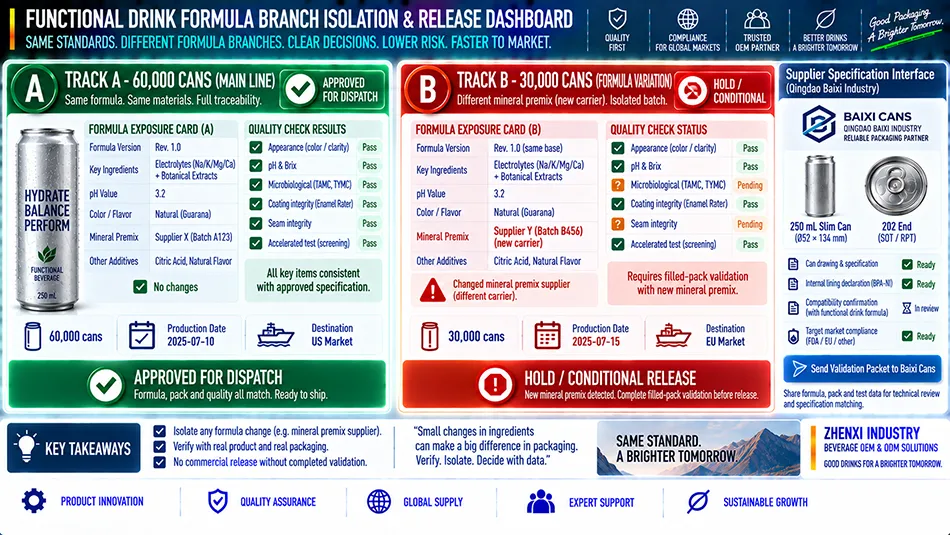
A complete validation packet names the formula, package, route, market, and prior records before a final can quote is treated as a specification conversation. Assemble one current formula exposure card, the proposed can body and end, the fill volume, the process and storage route, destination market, prior reports with their actual conditions, and a list of open questions.
That packet gives Qingdao Baixi Industry (Baixi Cans) a clearer basis for discussing a relevant can specification without implying that a supplier alone approves the beverage. When the fields are ready, buyers can send the formula and pack-test brief for a can specification review.
No; a liner statement is relevant only when its intended-use conditions and the actual formula, pack, process, and market remain aligned. A declaration may be a useful document for the specific component and intended use it covers, but it should not be treated as a blanket result for future formula versions, different ends, changed processes, or another destination market. Keep the scope alongside the formula exposure card and the relevant records.
Start with the full formula, then flag acidity, mineral salts, botanical extracts, natural colors, carbonation, oils or emulsions, and every intended processing or storage condition. The list is a briefing tool, not a universal incompatibility list. What matters is whether a variable changes the beverage matrix, the commercial route, the observation plan, or the connection between a prior record and the proposed SKU.
No; a fast, pre-agreed screening condition can help investigate a defined risk, but it does not replace shelf-life evidence for the actual finished beverage and commercial route. State what the condition represents, which formula and pack it covers, and what decision it can support. Then use filled-pack work to confirm the launch configuration rather than relabeling the screening result as broad shelf-life proof.
Send the current formula version, target market, processing and storage route, can volume and end, and any prior stability record with its exact test conditions. Include the launch configuration and identify unresolved formula changes. This allows the conversation to focus on a defined package configuration and makes it easier to identify which technical or regulatory questions remain with the responsible teams.

