
The future of beverage packaging is not one winning material; it is a proof race between recyclability, filling-line flexibility, food-contact confidence, and launch speed. Trend lists are useful for boardroom language, but beverage buyers need a second step: which trend changes a purchase order, artwork approval, liner requirement, or filling-line trial?
A trend only matters when it changes a buyer check before PO approval. That is why the 2026 conversation should not be reduced to "paper versus plastic" or "aluminum versus PET." McKinsey's 2025 packaging research shows that sustainability expectations are real but still filtered through price, performance, and availability. For beverage packaging, the winning plan is the one that turns consumer and policy pressure into evidence a procurement team can actually check.
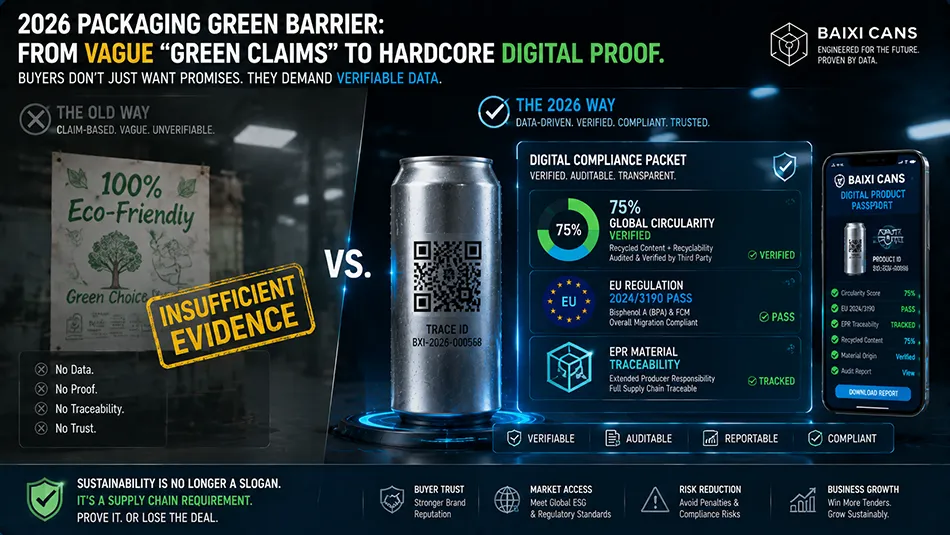
Sustainability language used to tolerate broad claims. By 2026, the safer assumption is that every claim has to survive a document review, a retailer question, and a recycling-system reality check.
A future-ready beverage package is not the one with the loudest green claim; it is the one with the clearest proof path.
The European Commission's Single-Use Plastics page is a good example of the new direction: plastic beverage packaging is judged by collection, recycled content, and specific restrictions, not by a vague wish to be greener. The EU packaging waste framework pushes the same habit across packaging types by connecting waste prevention, recyclability, and recovery.
This means beverage buyers should stop asking only whether a package is "sustainable." Ask whether the package has a credible recovery story in the target market, whether label and ink choices support that story, and whether the supplier can provide the documentation needed by the importer, retailer, or internal compliance team.
Consumer interest is not a blank check. McKinsey's 2025 consumer packaging work points to the tension buyers feel every day: sustainability matters, but it competes with cost, convenience, product protection, and what is available at launch scale. The trade-off is not a reason to ignore sustainability. It is a reason to specify it clearly.
A practical rule is to write each sustainability claim as a pass/fail question. Can the package be sorted? Is the decoration route compatible with recovery? Does the destination market accept the claim? Can the supplier explain recycled-content wording without overstating it? If the answer is unclear, the trend has not yet become a procurement requirement.
Aluminum cans are not new, but their strategic value keeps changing because circularity, lightweighting, shelf experience, and filling-line compatibility all sit in the same package.
The International Aluminium Institute reported a 75% global aluminum beverage can recycling rate in 2025. That number is powerful because it gives can buyers a measurable system claim, not just a generic material claim. At the same time, it also reminds buyers that the remaining 25% depends on local collection, sorting, consumer behavior, and scrap-market execution.
CMI's recycling-rate targets push the same point with 70% by 2030, 80% by 2040, and 90% by 2050 targets for U.S. aluminum beverage cans. The decision rule is not "aluminum is done." It is "aluminum gives the brand a strong circularity base when the design, label, and market recovery path support it."
Every packaging team likes lower material use, but beverage cans are thin-wall pressure packages, not decorative shells. A thinner or lighter pack can be attractive only when axial load, dome reversal, seam behavior, and filling-line handling remain inside the supplier and filler limits. Lightweighting without strength evidence can move cost out of material and into downtime, leakage, or transport damage.
This is where Baixi Cans belongs in the trend conversation. A buyer comparing aluminum can formats should pair capacity with diameter, lid type, pressure condition, carton method, and filling-line speed. Trend language becomes useful only when the selected can still runs cleanly on the customer's line.
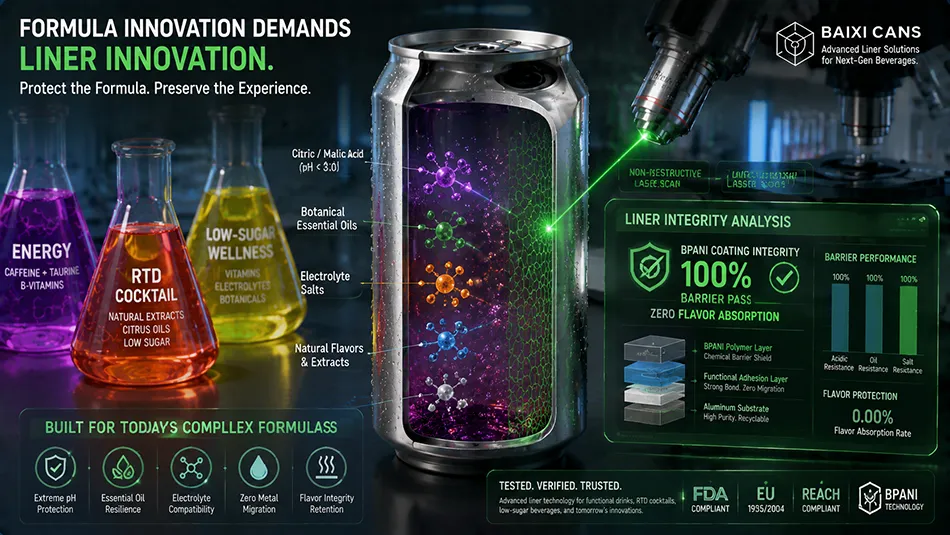
The future of packaging is also being pulled by the drinks themselves. Wellness claims, energy formulas, RTD cocktails, lower-sugar profiles, carbonation, colors, and acids all change the evidence burden.
NIQ's 2025 beverage analysis shows why the package cannot be chosen after the formula. Consumers are buying around taste, function, channel, and occasion. That creates more varied beverages, and varied beverages put more pressure on liner selection, corrosion control, flavor protection, and shelf-life testing.
Food Packaging Forum's can-coatings explainer is useful because it frames coatings as barriers between the drink and the package. The key insight is simple: the more specialized the beverage, the less safe it is to treat the liner as a generic background detail. Acid, alcohol, salt, color systems, and carbonation should be disclosed before can approval.
Food-contact chemistry is moving into the commercial conversation. The European Commission's 2024 BPA food-contact announcement shows why BPANI, BPA, and coating evidence cannot be handled as late wording. A beverage buyer may need the evidence for retailer approval, importer files, brand claims, or customer due diligence.
In practice, the buyer should ask for the intended liner route at the same time as can size and artwork. If the product is acidic, carbonated, alcoholic, salty, or rich in botanical extracts, sample approval should include filled-product observation rather than only blank-can appearance. The package trend is not "better coatings"; it is earlier formula disclosure.
The point of trend analysis is to reduce launch risk. A trend that cannot be converted into a buyer check is only a presentation slide.
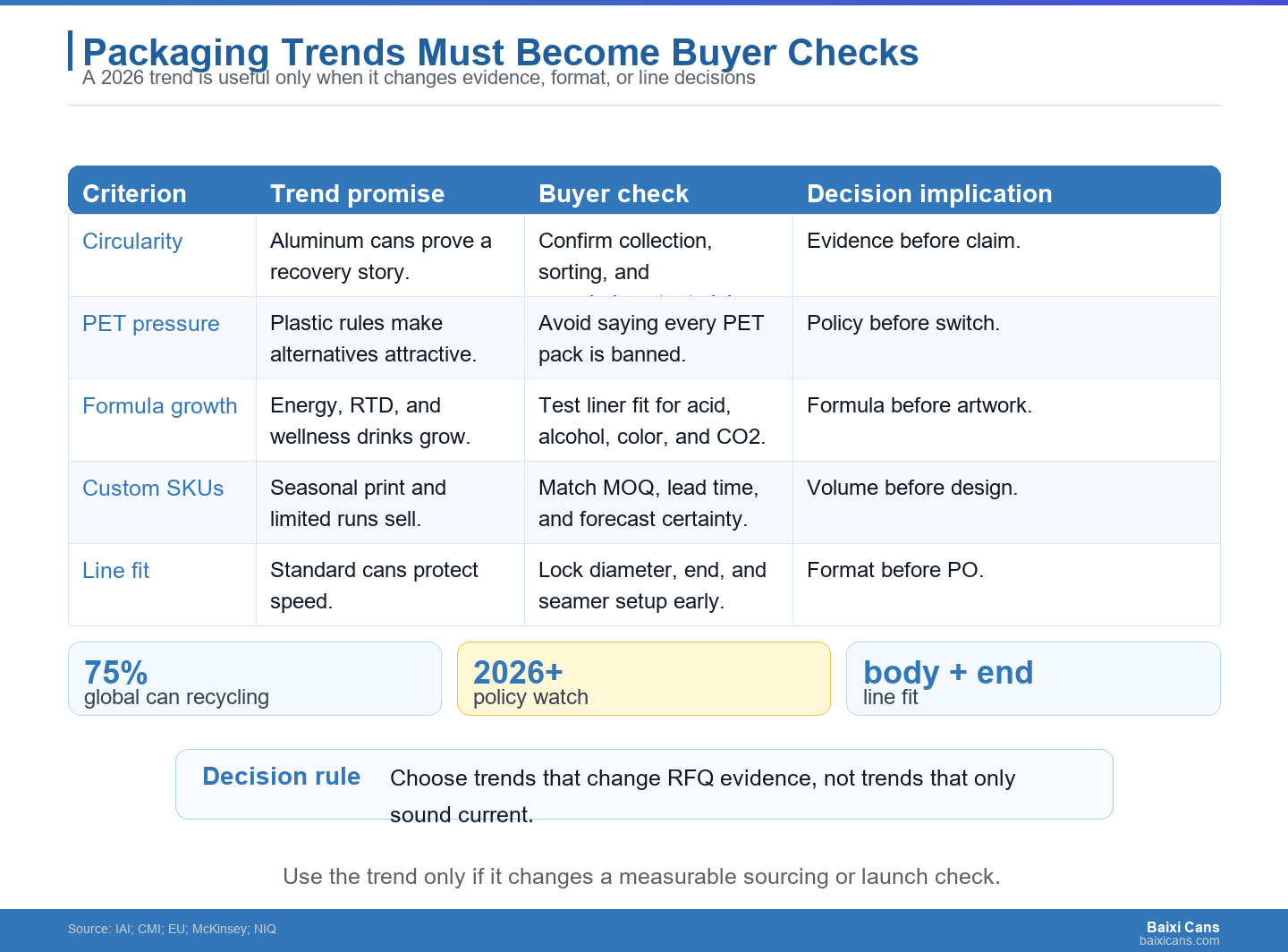
Before design work expands, list each packaging trend and the evidence it changes. For example, circularity changes recycling and decoration questions. PET policy pressure changes claims and market review. Formula innovation changes liner testing. Limited-edition marketing changes MOQ and print route. Filling-line speed changes diameter, end, and seamer compatibility.
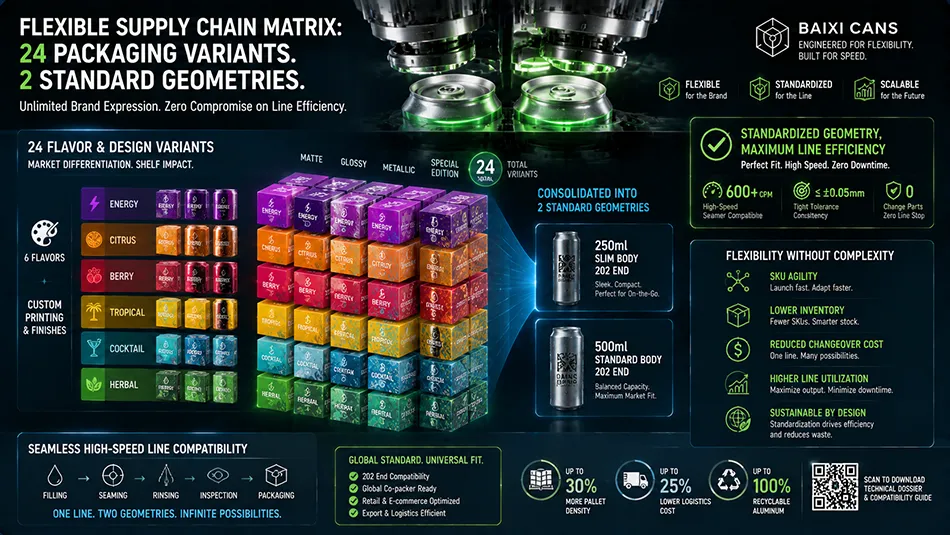
Calculated from 6 SKUs, 2 pack sizes, and 2 decoration routes equals 24 packaging variants before the first commercial lot. That scenario is not unusual for a brand planning several flavors, seasonal artwork, and separate channel packs. The limitation is that the exact cost depends on MOQ and print method, but the decision boundary is clear: simplify package architecture before every SKU gets its own can decision.
| Trend | What buyers should verify | Why it affects can selection |
|---|---|---|
| Design for recycling | Decoration route, ink/label choice, destination-market recovery path | Direct printing may reduce label-separation questions for stable SKUs |
| Functional beverages | pH, carbonation, alcohol, salts, colorants, liner compatibility | Coating evidence becomes a release gate, not an afterthought |
| Right-size packs | Capacity, diameter, end size, multipack, shelf channel | Line fit and consumer occasion need to agree |
| Custom printing | MOQ, lead time, artwork approval, color proof, forecast certainty | Print flexibility can help or hurt launch timing |
The table is deliberately practical. It asks whether a trend changes a measurable purchasing field. If it does not, keep the trend in marketing language and do not let it complicate the first PO.
For a carbonated sports drink or a beer-style RTD, a buyer may start with the 500ml custom aluminum can option. That is a sensible starting point only if the lid, pressure condition, line guide, and seamer setup follow quickly. The aluminum can lids decision should not wait until the artwork is done.
Baixi Cans is most useful when trend language becomes a specification for body size, end diameter, liner evidence, print route, and destination market. A buyer considering printable 250ml slim aluminum cans should share forecast volume, flavor count, launch market, and filling-line information before choosing the final print route.
The readiness check should feel practical, not academic. A beverage team should be able to place each trend beside a responsible owner, a document, and a timing gate before the first commercial order.
Data from the International Aluminium Institute puts global aluminum beverage can recycling at 75%, while data from CMI frames 70%, 80%, and 90% as staged U.S. industry targets for 2030, 2040, and 2050. Those numbers are useful only if the buyer names the launch market and disposal pathway.
Data from the EU Single-Use Plastics framework also shows why plastic policy should be translated into a local rule, not a global assumption. If a buyer cannot say which recycled-content, collection, label, or EPR requirement affects the launch, the trend is not ready to drive packaging selection.
Data from the EU packaging waste framework points in the same direction: packaging choices should be connected to waste prevention, recyclability, and recovery. For a 2026 launch, that turns the trend review into 3 owner questions: who owns the legal reading, who owns the supplier evidence, and who owns the claim on the final artwork?
Data from NIQ's 2025 beverage analysis points to changing beverage occasions and shopping behavior, which often means more functional ingredients, smaller packs, and more SKU experimentation. That makes formula disclosure a schedule item. The can supplier and filler need pH, carbonation, alcohol, salt, color, and shelf-life targets before liner and process decisions become expensive to change.
Data from Food Packaging Forum supports the same operational point: coatings are barriers, so the barrier should be selected before the brand locks artwork. If a 2026 launch has 4 flavors and 2 pack sizes, even a single late liner change can touch 8 artwork and sample paths. The risk is not only technical; it is schedule multiplication.
Data from the European Commission's 2024 BPA food-contact announcement adds one more timing lesson: liner language belongs in the first compliance review, not in the final sales deck.
Useful internal starting points are Baixi's aluminum cans collection, aluminum can lids, and workshop display. They help connect a future-facing trend discussion with the body, end, print, and production details buyers actually need.
Send Baixi Cans the beverage type, pH or alcohol condition, carbonation level, can size, end size, artwork route, SKU count, target market, and filling-line model. Ask Baixi Cans to confirm which evidence belongs before sampling and which evidence belongs before mass printing. Add the owner for each open item, because a trend that has no owner usually becomes a late approval problem. That is how a packaging trend becomes a launch-ready specification instead of a delayed debate.
The biggest trend is proof-led packaging. Buyers need evidence for recyclability, food-contact safety, formula compatibility, print method, and filling-line fit rather than broad claims about being sustainable or modern.
No single material will replace every PET bottle. Aluminum cans become stronger candidates when carbonation, shelf format, recycling story, direct printing, and filling-line economics fit the product and market.
New beverage formulas can include acids, alcohol, salts, colors, botanicals, and carbonation. Those conditions can affect coating choice, corrosion risk, and flavor protection, so liner evidence should be reviewed early.
Compare MOQ, artwork lead time, SKU stability, destination recycling rules, and forecast certainty. Direct printing can be cleaner for stable runs, while labels may help very small or uncertain test launches.
Include can capacity, diameter, end size, liner requirement, beverage chemistry, carbonation or pressure condition, artwork method, filling-line information, destination market, and document needs before sample approval.

