
For a team comparing hot fill vs cold fill cans, the decisive question is not which route sounds more demanding. It is when heat reaches the aluminum can, end, liner, and sealed product—and whether the evidence being reviewed covers that moment. A can sampled at ambient conditions has not automatically been assessed as a completed package moving through a heat-and-water cycle.
The process authority remains responsible for the beverage and applicable market requirements. The packaging discussion should make the body, end, seam, coating, fill condition, and route visible together. The practical question is narrower and more useful: what package evidence must be tied to this route before launch?
For buyers working with Baixi Cans, this framing makes an early format conversation more useful: first define the route and evidence boundary, then compare format and end options against that documented need.
The same discipline also makes late changes easier to manage. A revised formula, a different end, a new fill volume, or a change from ambient handling to a tunnel route does not automatically cancel all prior work. It tells the team to identify exactly which portion of the earlier record still matches the commercial configuration and which portion now needs a focused review.
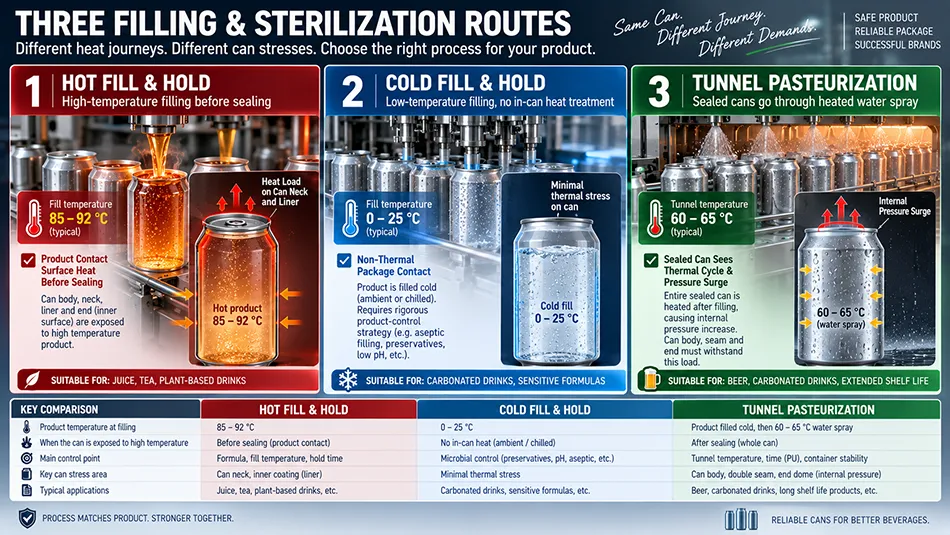
The route changes when the can is tested, so it changes the evidence the team needs. Hot fill puts heated product in contact with the package. Cold fill, in the limited regulatory context below, does not heat the container. Tunnel pasteurization sends the filled and sealed can through the thermal cycle. Those are different exposure points even if the nominal can size is unchanged.
For covered U.S. shelf-stable products, FDA identifies product, container size and type, and processing method among filed information. That is not a universal beverage rule, but it is a useful discipline: name the product, package, and route together before treating a prior result as transferable.
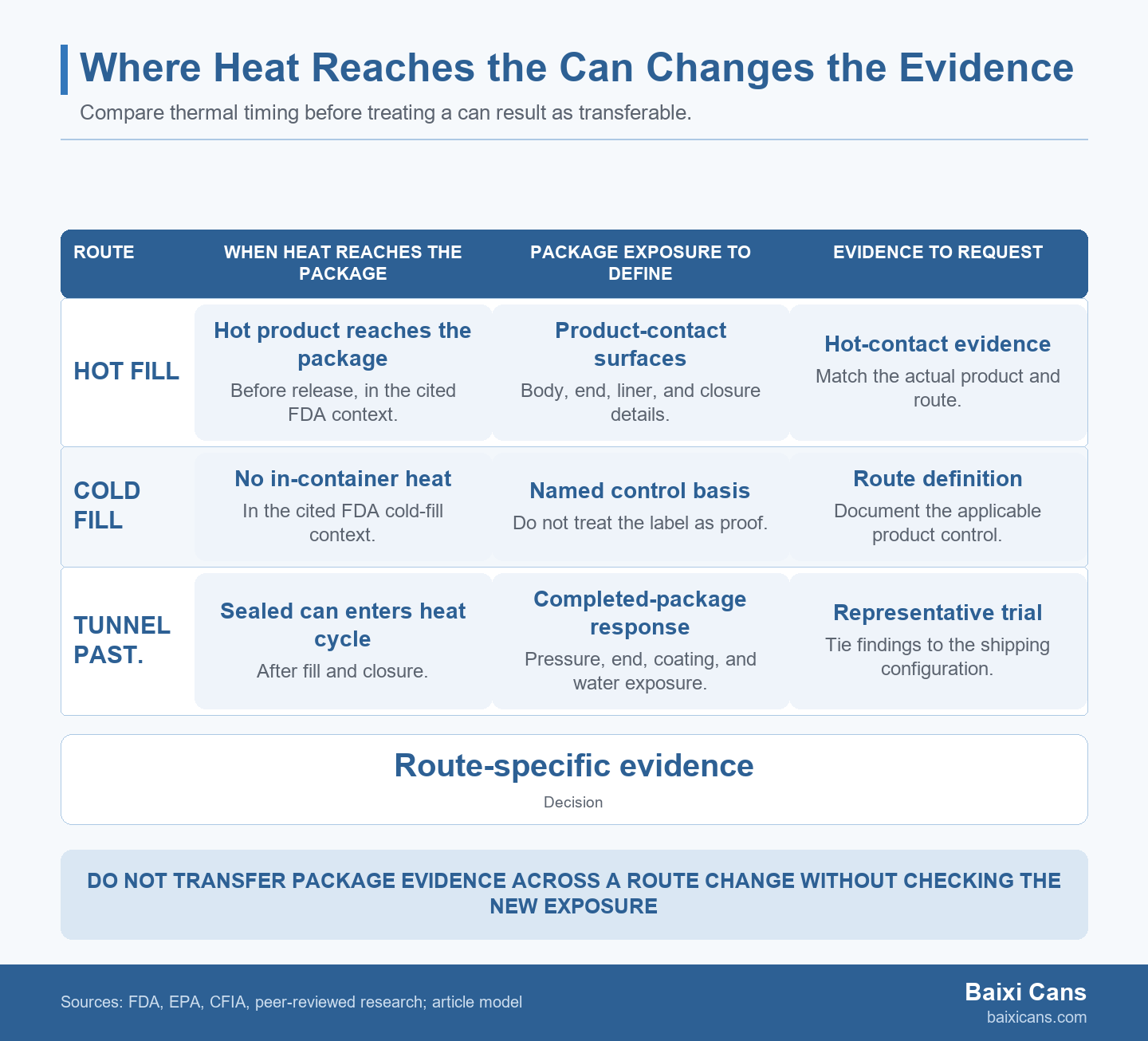
| Route question | What changes | Evidence to connect |
|---|---|---|
| When heat reaches the package | Before release, not in-container, or after sealing | Body, end, coating, and product condition under that exposure |
| What remains common | The selected body-and-end system | Applicable seam and configuration records |
| What cannot be assumed | That one sample covers a changed route | A representative trial or documented boundary |
FDA describes hot fill and hold, cold fill and hold, and heating-tunnel treatments in its acidified-food filing instructions. The following comparison uses those definitions to clarify thermal timing; it does not prescribe a safety process for a particular beverage or market.
In the FDA form's hot-fill-and-hold definition, thermally processed product is filled hot so the product-contact surface is subsequently treated by the heated product. In plain language, hot fill and hold is a route where processed product reaches the package hot. The package question is therefore not limited to an empty-can specification: identify the beverage condition, fill moment, selected end, closure sequence, and the package surfaces exposed to the hot product.
A useful review asks whether the information applies to the intended beverage and body-and-end combination, not whether another project used a similar volume. Acceptance criteria belong to the responsible technical owners and selected package system; generic temperature, coating, or seam numbers should not be transferred without that configuration context.
In that FDA form's cold-fill-and-hold context, the container receives no heat treatment and the form calls for supporting challenge-study information. That wording is deliberately narrow: it describes a specified filing context, not every room-temperature canned beverage. A buyer or co-packer should ask what product-control basis applies, which records establish it, and whether the can evidence is scoped to the actual beverage and storage plan.
Cold fill is not automatically aseptic fill. FDA's aseptic-processing guide identifies the packaging system and packaging material as scheduled-process elements. Use a precise route name. If the route is genuinely aseptic, document that separately; if it is not, do not borrow aseptic language to close a cold-fill evidence gap.
A canned-beer in-package-pasteurization study evaluated can thickness, fill volume, carbon-dioxide content, and pasteurization temperature in relation to internal pressure. Its values are study-specific, not beverage-can limits. The transferable lesson is narrower: when a filled and sealed can enters the heat cycle, product condition and package response belong in the same evidence conversation.
For a tunnel route, define the commercial fill format, carbonation or another pressure-relevant condition, selected body and end, heat-and-water exposure, and post-process observations. A process record can show the line ran to its profile; it does not by itself show how the exact sealed can-and-end configuration responded.
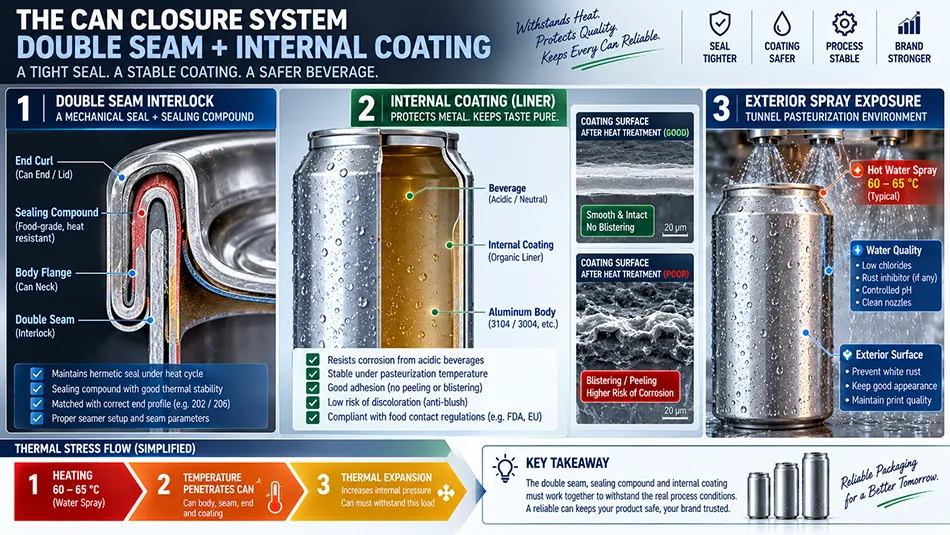
CFIA describes visual, measurement, teardown, and cross-section checks for double seams, with guidance that varies by can size and style. A double seam is the mechanically interlocked closure joint between the can body and end. Thermal timing changes the additional questions, but it does not turn the body and end into unrelated purchasing decisions.
Keep the supplier-approved specification and inspection method for the chosen configuration with the route notes. Record the end type actually used, not only a generic lid description. When preparing the package discussion, match the selected can end to the same package configuration as the body and planned line conditions. Manufacturer-specific limits—not a generic online number—are the relevant reference.
EPA describes pasteurization as a post-coating heat-cycle context and notes heat exposure for exterior beverage-can coatings. That source does not approve a coating for a particular product. It does support a careful question: which coating observations and supplier records are relevant to the heat cycle actually planned?
FDA separately classifies hot-fill or pasteurized conditions and room-temperature filling without thermal treatment in the container. Treat these as exposure categories, not compatibility declarations. The selected supplier and technical owners still determine whether the evidence covers the actual beverage.
| Route | Extra package question | Useful evidence request |
|---|---|---|
| Hot fill | Which surfaces see hot product? | Product condition, body/end configuration, and hot-contact package record |
| Cold fill | What named control basis applies? | Route definition, relevant product control, and packaging scope requested |
| Tunnel pasteurization | How does the completed package respond? | Representative body/end, product condition, water exposure, and observations |
Start format selection after this route question is clear. You can review aluminum can format options against the chosen process route, then check the 250 mL slim can format before locking the trial if that is the intended commercial configuration. Similar geometry is useful for development; it is not proof that a new route has been covered.
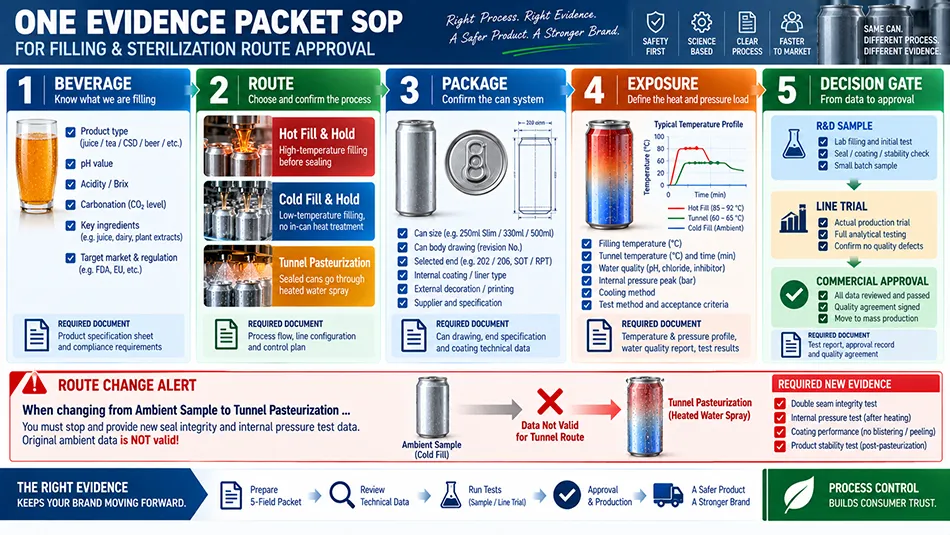
FDA's low-acid canned-food guide lists processing method, thermal equipment, temperature, time, critical factors, and container type among schedule-related information. The packet below is not a regulatory filing template, but it applies the same useful discipline: a route decision should not be separated from the package and conditions it must cover.
Before requesting a sample, quotation, or compatibility discussion, put these fields in one short technical brief:
Volume belongs in the packet because it is part of the tested configuration. For example, include the 500 mL can format in the process evidence request when that is the commercial SKU rather than assuming a smaller sample covers it. Documentation can be framed responsibly: review the available certification documentation context, then ask which product- and route-specific evidence is still required.
Illustrative example: an ambient-route sample does not automatically evidence the completed-package conditions of a later tunnel-pasteurization run. A beverage founder and co-packer are preparing a carbonated fruit drink in one slim-can format. The first commercial order is 18,000 cans for 1 SKU in one selected 250 mL can-and-end configuration. An ambient-fill development sample has already been reviewed, but the distribution plan changes and the co-packer now proposes tunnel pasteurization.
The reviewed sample did not pass through a heating tunnel. The commercial product will use the same nominal body but a different route that heats the completed, carbonated package. The earlier sample does not demonstrate pressure response, end behavior, coating condition, or water-exposure observations under the new route. Keep it as development evidence and hold route-specific package approval until the evidence covers the proposed completed-package cycle.
The earlier sample can inform format development, but it cannot close a later route-specific completed-package evidence gap. Prepare a representative trial or equivalent review for the commercial configuration that will ship, with technical owners defining observations and acceptance criteria. Before production release, compare the recorded route with the exact beverage condition, body, end, and exposure evaluated. This illustrative example is not a Baixi Cans customer case study or a universal release rule.
A useful supplier question names the product, route, body, end, exposure, and the evidence requested together. That framing avoids an unanswerable request such as “Is this can suitable for pasteurization?” It gives the beverage team, process authority, co-packer, and packaging supplier the same boundary.
A concise handoff can read: “We are evaluating this beverage condition in this can volume and selected end. The candidate route is [route]. The completed package will see [exposure]. Please identify the available package documentation, the configuration details needed for review, and the observations that should be assessed before a commercial decision.” This does not outsource process authority; it makes the packaging question specific enough to investigate.
Baixi Cans can help buyers organize the package questions through Baixi's service process once the route and configuration are clear. When the brief is ready, send the route and package inputs for a packaging compatibility discussion.
The route label alone does not establish a universal can requirement or product-control outcome. Not automatically, because the relevant requirement depends on the actual product, route, can system, end, coating, and storage conditions rather than the route label alone. Hot product contact and no in-container heat create different evidence questions, but neither label establishes a universal winner. Define the commercial product and exposure first, then use the responsible technical owners and supplier-specific package criteria to decide what must be demonstrated.
Cold fill needs a named product-control basis, because room-temperature filling without heat in the container is not by itself a complete process description. In the FDA filing context cited above, cold fill and hold has specific conditions and support expectations. For a real beverage, identify the route, market requirements, product controls, and package configuration rather than treating “cold fill” as a stand-alone compatibility or safety statement.
Tunnel pasteurization requires package testing whenever the completed can, end, coating, or product conditions are exposed to a heat-and-water profile that the launch decision must cover. The precise test depends on product, process, equipment, can body, end, and market. An ambient or differently configured sample does not automatically evidence the sealed commercial package in a tunnel route.
Share the beverage condition, chosen or candidate route, intended can body and end, target fill format, and the package evidence you need before asking for a compatibility discussion. Add the expected exposure and the decision being requested—sample, trial, documentation review, or commercial release. This gives the supplier a defined packaging question while leaving food-process validation with the appropriate technical owners.

