
A can design is one part of a commercial SKU, not proof that the product is ready to launch. A private-label energy drink launch becomes ready when the market route, formula, components, label, and filling plan describe the same commercial SKU. Treating those as one coordinated release protects a new brand from printing a beautiful package for a beverage that is still changing underneath it.
The 250ml slim format is a strong starting point for a compact, high-value energy-drink presentation. It should not become the entire brief. The practical job is to set a clear decision sequence, assign each decision to the right owner, and keep every approval attached to one revision.
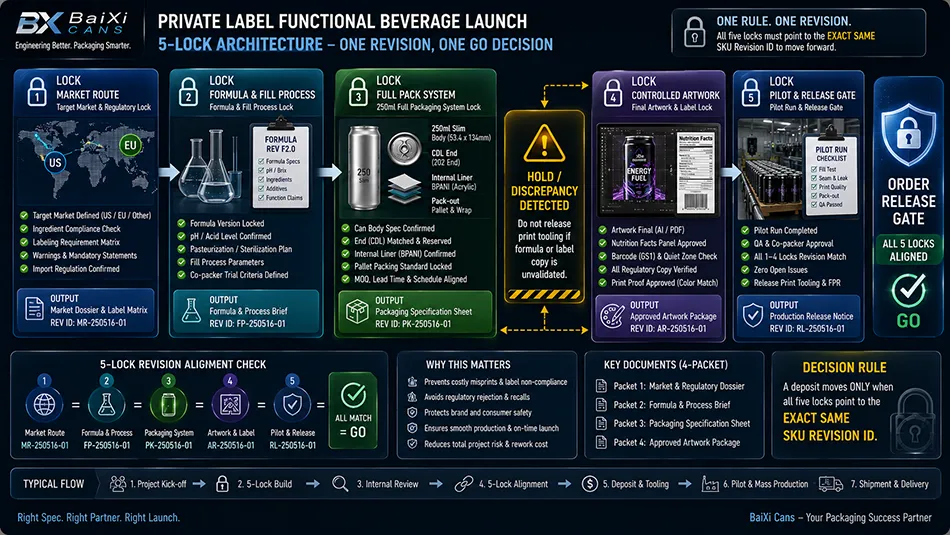
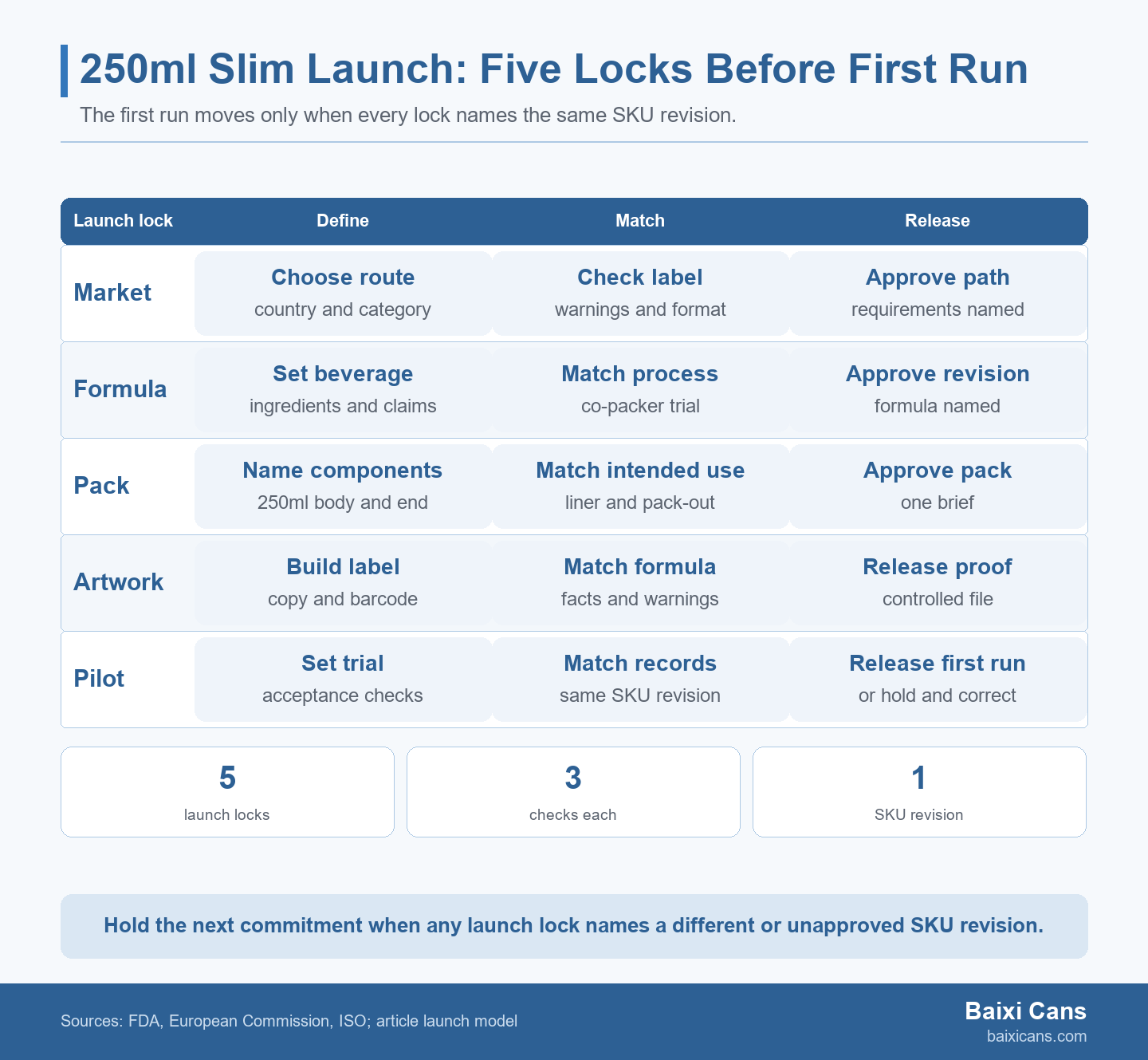
The five locks should point to the same SKU revision before the next commercial commitment. For a private-label beverage, meaning a drink sold under your brand by an external manufacturer, those locks are market, formula, pack, artwork, and pilot/release. They are not five departments to notify at the end. They are five decisions that set the conditions for the next one.
| Launch lock | Decision owner | Record that must match | Hold condition |
|---|---|---|---|
| Market | Brand or regulatory lead | Target country, product route, label requirements | Destination or required wording is unresolved |
| Formula | Beverage developer and co-packer | Formula revision, process, trial criteria | Formula or process remains unvalidated |
| Pack | Packaging buyer | 250ml body, end, liner request, decoration, pack-out | A component is assumed rather than named |
| Artwork | Brand and label reviewer | Approved copy, facts, warnings, barcode, print proof | Content still changes after print approval |
| Pilot and release | Cross-functional launch owner | One controlled SKU revision and acceptance checks | Trial records refer to different versions |
Name the 250ml slim format early, then complete the package and product fields around it. Baixi Cans can use a defined format request as the basis for packaging coordination; start by reviewing 250ml slim can options for private-label launches after you know the beverage use, target market, intended end, decoration route, and packing need. That gives a supplier something more useful than a volume and a mood board.
The main discipline is simple: each lock should answer a different question, yet every answer should carry the same SKU name and revision. A new flavor, a different caffeine statement, or a changed end is not a small local edit when it changes the commercial product. It is a reason to reopen the affected lock before the next commitment.
FDA says it has no specific regulations for energy drinks; general rules on safe ingredient use apply. That is a useful U.S. boundary for a launch brief. Do not look for a single energy-drink approval checklist and then assume the label, ingredients, claims, and manufacturing questions have disappeared. Assign someone to classify the product and own the destination-market review before packaging artwork is final.
FDA also says caffeine must be listed in the ingredient list when it is added as a stand-alone ingredient. That is not a formulation recipe or a universal label ruling, but it illustrates why caffeine content and wording belong in the label-content lock. The formula owner supplies the current information; the market reviewer decides what must appear; the designer works from that approved copy.
For the European Union, For relevant non-coffee or tea beverages above 150 mg/l, the EU rule prescribes a high-caffeine statement and caffeine content per 100 ml. It has scope and exceptions, so use it as a market-specific check, not as a template to paste onto every export label.
The same logic applies to nutrition information. The information must be expressed per 100g or per 100ml. Build a target-market label matrix before final design: required languages, ingredient presentation, nutrition format, warnings, claims substantiation, barcode, and any local recycling or deposit information. Your qualified regulatory owner should confirm the exact requirement for the named beverage and market.
The brand and its qualified beverage-development and filling partners must own formula and process validation. A can supplier can quote the package components, but it cannot validate beverage stability, process compatibility, or shelf life for a formula it does not control. Make that separation explicit in the launch brief; it is a sign of good coordination, not a gap in the plan.
Give the beverage developer and co-packer one current formula revision, the target market, intended claims, target fill volume, carbonation or other relevant product conditions, process outline, and trial objective. Ask what information they need before they can define a pilot. Their answer may affect the label, line setup, pack component request, or all three. The packaging buyer should receive only the controlled beverage-use information needed to define the pack, without turning a can RFQ into an unsupported technical approval request.
Work backward from the first trial. What will the co-packer measure? What makes the trial acceptable? Which formula revision is being filled? Which label proof is being checked? A practical launch brief makes these questions visible before print tooling, not after a production slot has been reserved. If the formula changes, decide whether that also changes the label content or pack request, then reissue the affected records under the next SKU revision.
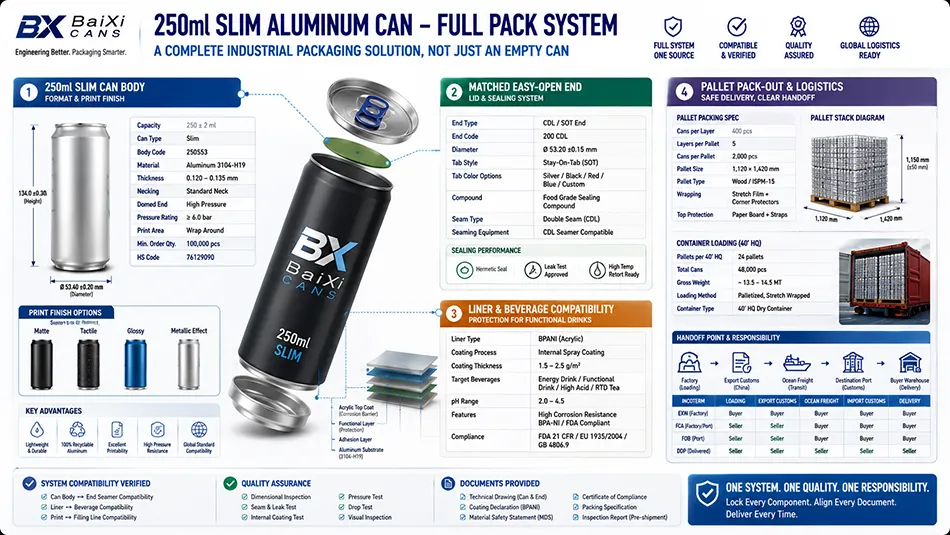
FDA includes food packaging and its components in food contact substances. Here, the term means a material meant to touch drink during its intended use. For the launch brief, that is a reason to describe the full package, not a reason to make a blanket suitability claim for every beverage or market.
Treat the 250ml slim body and its attached components as one package system. The quote becomes usable only when its components, intended use, and first-run packing plan are visible on the same controlled brief. Record these fields together:
This approach also keeps future portfolio decisions tidy. A brand may later consider 500ml custom aluminum can options, but that is a separate pack decision, not a reason to blur the first 250ml slim SKU. Give each format its own named component set and approved artwork revision.
The Nutrition Facts label includes added sugars in grams and as a percent Daily Value. For a U.S.-bound drink, that is a direct reminder that formula-dependent label content cannot be handled as a late design adjustment. The same principle holds elsewhere even when the local label format differs: the designer needs an approved content source, not a best guess from an earlier product brief.
Do not release production artwork while formula-dependent label content is still changing. Use one controlled artwork proof that identifies the SKU, market version, formula or label-content revision, barcode, mandatory copy, print colors or finishes, and approval owner. Keep working files separate from the production-ready file. If a target market or formula changes, mark the prior proof superseded and return to the appropriate lock rather than asking a printer to interpret a message thread.
Before approving the file, compare the visible label with the current approved content line by line. Then compare the file name and revision on the artwork proof with the packaging quote and pilot brief. That small version check is often more valuable than another broad review meeting because it catches a mismatch at the point where it can still be corrected without turning into printed inventory.
ISO 22000 sets out requirements for a food safety management system. It is relevant to a co-packer screen. It does not make the can supplier and co-packer interchangeable. The co-packer needs to control beverage production. The can supplier needs to quote and supply the defined body, end, decoration, and pack-out. The launch owner needs to control the interface between them.
Certification of FSMS is not an attestation to the safety or fitness of products. Use a certificate to screen a management system, legal entity, site, and scope where relevant. Do not use it as an approval stamp for a formula, a market-facing label, or a particular trial can.
For U.S.-bound food, The importer must perform supplier verification activities appropriate to the identified risk under FSVP. That is not global import advice. It shows why the importer and the beverage supplier should be named in the launch file, rather than leaving compliance ownership implied.
At the package interface, keep the end visible too. Review aluminum can lid options as a named component in the quote and pilot brief, then confirm who owns the final body-and-end pairing, receiving checks, and line compatibility review. A body-only price can be useful for an early budget, but it is not yet a first-run pack specification.
A pilot should not be used to validate a commercial SKU that is still changing on paper. The pilot is the first place where the formula, label, body, end, packing, and filling process are tested as a combined operating choice. Make the pilot brief a release gate, not a loose collection of the latest files.
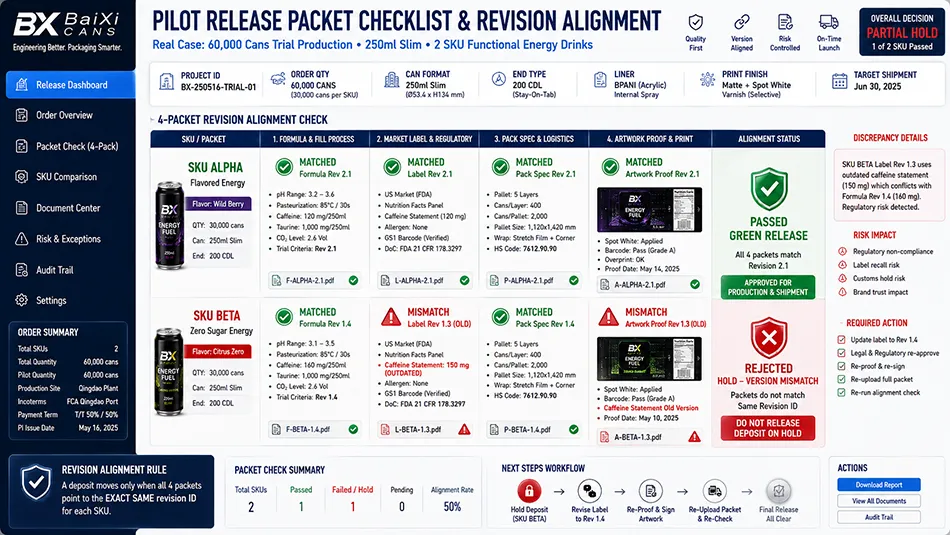
Issue one controlled pilot brief before the co-packer, label reviewer, and packaging buyer proceed. The following is illustrative, not a client case. A new brand is preparing its first private-label energy-drink launch in 2 flavors.
The illustrative order covers 60,000 empty 250ml slim cans for 2 flavor SKUs, 1 target market, and 1 co-packer pilot.
The visual design and body format have been approved, but one market's caffeine wording and the final nutrition values remain open.
The co-packer has the newest formula sheet. The printer proof still carries the prior caffeine statement.
The can quote names the slim body and decoration, yet the end and lining request do not appear on the same pilot brief.
The project looks nearly ready because every team has a reasonable file. It is not ready as a whole. A pilot could create evidence for a beverage, label, or package combination that will not be the one sold.
The right decision is to hold the booking until the formula owner, market reviewer, co-packer, and packaging buyer accept the same controlled revision.
Issue one pilot brief that names the two SKUs, target market, formula revision, label proof, 250ml slim body, end, lining request, decoration, and trial acceptance checks. That is the kind of packaging handoff a packaging coordination process can support once the launch packet is defined.
The pilot can move when the formula owner, market reviewer, co-packer, and packaging buyer all confirm the same SKU revision. The trial then has a meaningful acceptance basis.
This is an illustrative control point only; it does not guarantee regulatory clearance, filling performance, or shelf life.
Release the first run only when every owner approves the same named SKU revision. Call the resulting set of matched records a release packet: it is the market, formula, packaging, artwork, pilot, and production information used to decide whether one SKU can move to its next production step. It is a project-control tool, not a substitute for legal, technical, or quality approval.
Keep the packet short enough to use. It should show the product name and revision; target market; formula and co-packer reference; final label proof; 250ml slim body, end, lining request, and decoration reference; pack-out; pilot outcome; open deviations; and release owners. Each record does not need to repeat every detail. It does need to point unambiguously to the same SKU revision.
Before scheduling the first run, ask one final question: if a receiving team, co-packer, printer, or market reviewer opens this packet, will they see the same commercial product? If not, hold the next commitment and return the conflicting file for correction. When the packaging fields are already defined, you can request a launch-packet review from Baixi Cans.
A useful launch brief names the target market, beverage formula owner, 250ml slim pack, end, label status, co-packer, pilot criteria, and release revision. It should also state who approves each field and what must be held when the field changes. This keeps a packaging quote, label proof, and filling trial connected to the same sellable SKU rather than to separate assumptions.
No; a 250ml slim can defines a package format, while the beverage developer and co-packer must validate the formula, process, liner suitability, and shelf life. The format informs the packaging brief and the intended fill volume. It does not validate ingredients, claims, market compliance, or the production process on its own.
Usually not without review, because ingredient, nutrition, warning, language, and recycling or deposit requirements can change by target market. Start from a controlled core design, then create market-specific label versions where the qualified owner requires them. Give every approved version a clear SKU and artwork revision so the printer and co-packer cannot use an outdated file.
Run a pilot after the formula, intended pack components, label content, and co-packer process are controlled well enough to test one actual SKU revision. A pilot is most useful when its acceptance checks, samples, and records can support a release decision. If a formula, end, market statement, or artwork file is still changing, hold the trial and reissue the brief first.

