
Most governments are not simply banning PET; they are making single-use plastic packaging prove recycled content, collection, and design-for-recycling performance, which changes when aluminum cans become the cleaner procurement route. That distinction matters because an inaccurate "PET is banned" claim can create legal, sourcing, and marketing risk.
PET policy pressure is a decision conflict, not a simple material switch. Data from UNEP's plastic-pollution process reinforces why brands should prepare for changing rules before every market has identical wording.
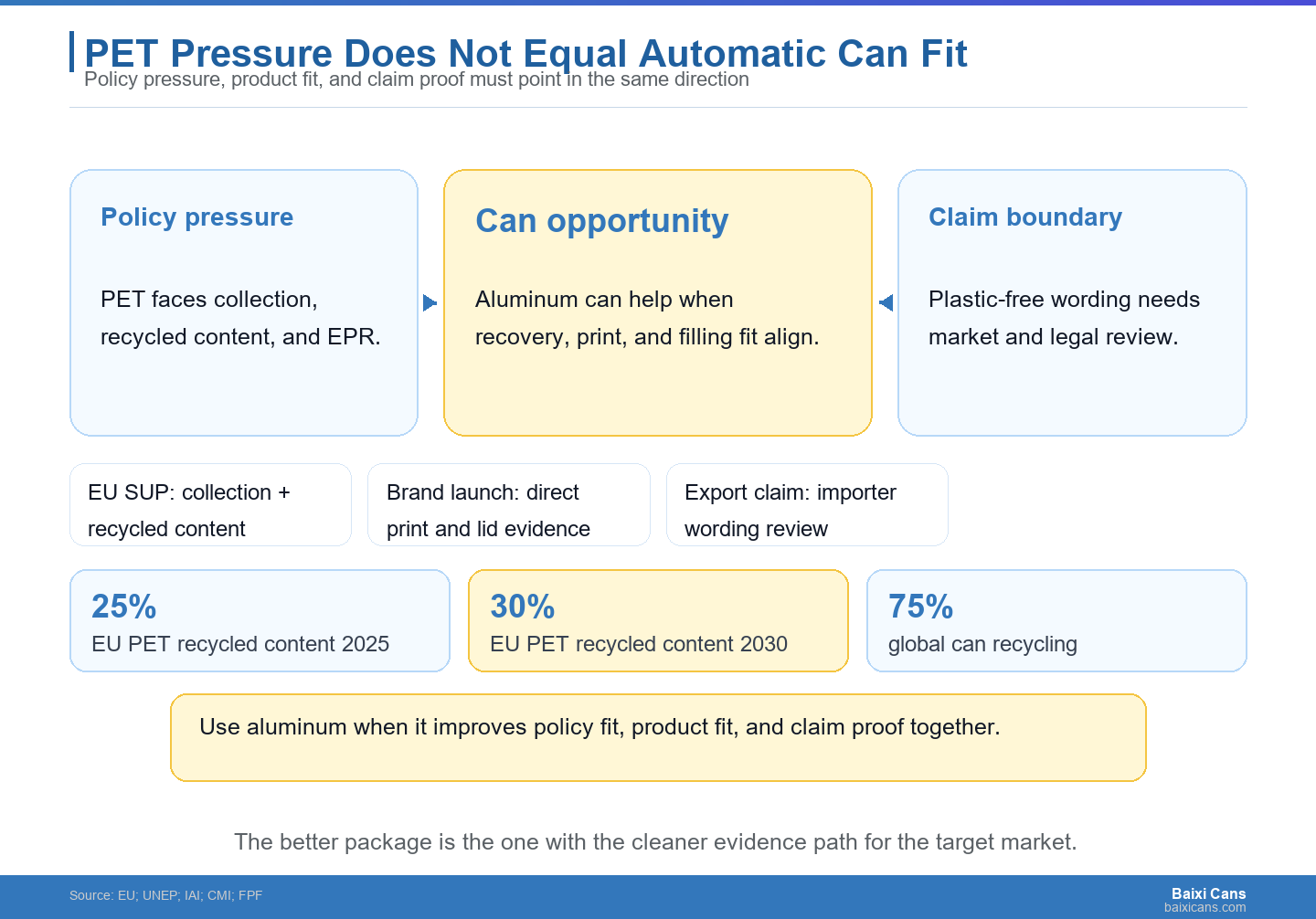
The better question is when PET policy pressure makes aluminum cans a stronger beverage-packaging choice. The European Commission's Single-Use Plastics page shows a policy pattern built around specific products, collection, and recycled-content targets, not a blanket end to all PET beverage packaging.
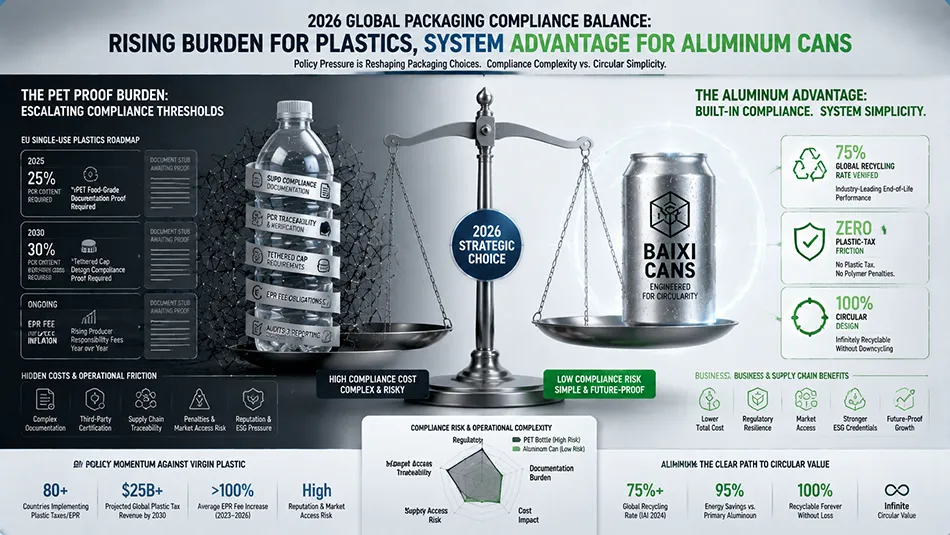
Policy pressure on PET is real, but buyers need to name the rule before changing packaging. The details affect cost, artwork, supplier evidence, and claim wording.
A PET restriction is usually a proof requirement before it is a material ban.
The EU Single-Use Plastics framework includes collection and recycled-content requirements for plastic beverage bottles. For example, PET bottles in the EU context are associated with 25% recycled plastic from 2025 and 30% from 2030. That is a procurement and documentation issue as much as a packaging-design issue.
Calculated from 1,000,000 PET bottles at 20 grams each equals 20 metric tons of PET packaging. A 25% recycled-content scenario creates a 5 metric ton recycled-input documentation question. The limitation is that the example is not a universal rule, but it shows why policy pressure quickly becomes a supplier-evidence problem. For buyers, that difference changes the RFQ.
The EU packaging waste policy direction shows that all packaging is being asked to do more: prevent waste, improve recyclability, and support recovery. That means switching away from PET does not remove the need for evidence. It changes the evidence package.
This means aluminum cans should be presented accurately. A brand can say it is moving away from PET in a specific product or market, but it should avoid implying that every country bans PET or that every aluminum package is automatically better. The claim should match the market rule and the actual package.
PET is under pressure because single-use plastic packaging sits at the intersection of litter, fossil-resource concern, recycling capacity, and consumer visibility.
The UNEP intergovernmental negotiating process on plastic pollution keeps plastic packaging in the global policy spotlight. Even before a final global instrument is fully translated into local rules, the direction of travel affects retailers, importers, brand owners, and packaging buyers.
The decision rule is to watch not only bans, but also extended producer responsibility, deposit systems, recycled-content rules, tethered-cap rules, label requirements, and design-for-recycling guidance. These measures can affect PET economics even when PET remains legal. They also change which supplier evidence should be collected before artwork approval. Data from the UNEP process matters because policy direction can move before every local rule is rewritten, leaving brands to prepare earlier than the formal deadline.
McKinsey's 2025 packaging research suggests that sustainability concern remains meaningful but practical. Consumers may respond to plastic-reduction stories, but they also notice price, convenience, and trust. A brand that overstates a claim can lose credibility.
This is why the packaging buyer should involve compliance and sales teams before artwork is locked. "Reduced PET," "plastic-free," "recyclable aluminum," and "lower waste" each carry a different proof burden. The hidden cost of vague wording is late artwork rework or a retailer challenge after the product is already planned. A claim that cannot be proven should stay out of the design file.
Aluminum cans can be a strong response to PET policy pressure, especially for carbonated, chilled, impulse, event, and direct-print beverage formats. They are not a magic exemption from packaging responsibility.
The IAI 75% global aluminum beverage can recycling rate gives aluminum a measurable advantage in circularity discussions. CMI's 70%, 80%, and 90% recycling-rate targets add a forward-looking performance frame for the can industry.
That evidence makes aluminum cans attractive when a brand wants to reduce PET exposure. The trade-off is that the can still has to be suitable for the product. The buyer must confirm pressure requirements, liner compatibility, end type, print route, and filling-line fit before claiming the switch is operationally better. The recycling advantage should be paired with a technical release file.
Cans are excellent for many beverages, but they are not right for every drink. Still water, large resealable packs, thick products, hot-fill processes, or products needing transparency may have different constraints. A can also needs correct end diameter, seaming control, carton strength, and filled-product stability.
Baixi Cans should enter the conversation when aluminum improves policy fit, product fit, filling-line fit, and claim proof together. A buyer can start with Baixi's aluminum cans collection and then narrow the discussion by beverage type, target market, lid, liner, and line model. That sequence prevents a policy headline from becoming a rushed package change.
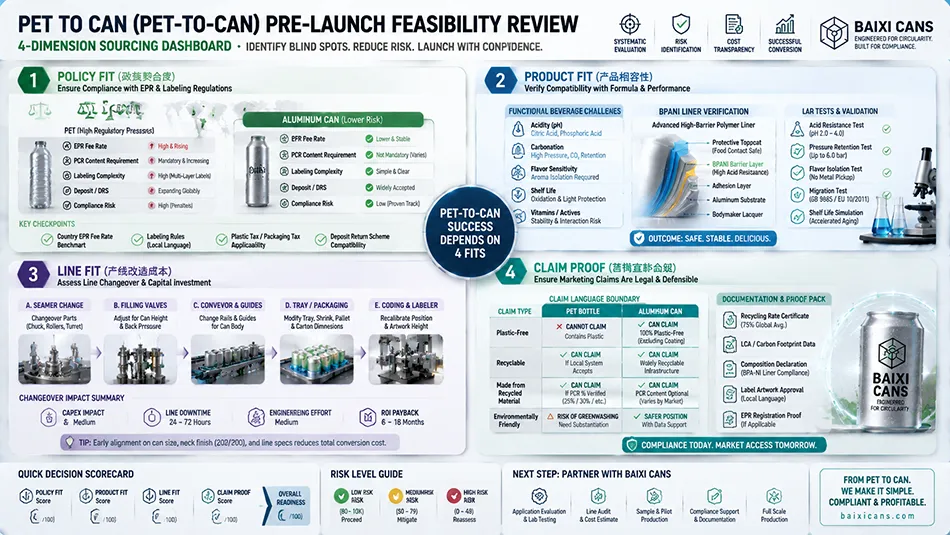
The comparison should not begin with ideology. It should begin with the launch conditions.
The first part is policy fit: what does the target market require or discourage? The second is product fit: carbonation, pH, alcohol, shelf life, closure needs, and consumer use. The third is line fit: filling equipment, seamer capability, speed, and changeover. The fourth is claim proof: what can the brand responsibly say?
Food Packaging Forum's coating explanation belongs in this comparison because aluminum cans rely on internal coatings for food-contact performance. A can may reduce PET exposure but still need careful liner evidence for acidic or alcoholic beverages. Product fit should be proved as early as policy fit.
The buyer should turn the comparison into an RFQ table rather than a debate. If PET pressure is the reason for the change, list the policy issue beside the can evidence that answers it. If consumer perception is the reason, list the exact claim and the proof needed. If line speed is the reason, list can diameter, end size, and seamer expectation.
| Decision field | PET question | Aluminum can question |
|---|---|---|
| Policy | Does the market require recycled content, EPR fees, or collection targets? | Does the can claim match local recovery and labeling rules? |
| Product | Does the bottle need resealability or transparency? | Does the beverage need pressure, liner, or corrosion testing? |
| Line | Is the bottle line already qualified? | Can the filler run the selected diameter and lid? |
| Claim | Can the brand prove recycled content and collection language? | Can the brand prove circularity, direct print, and liner evidence? |
The table does not pick a universal winner. It forces the buyer to show where the aluminum route actually reduces risk.
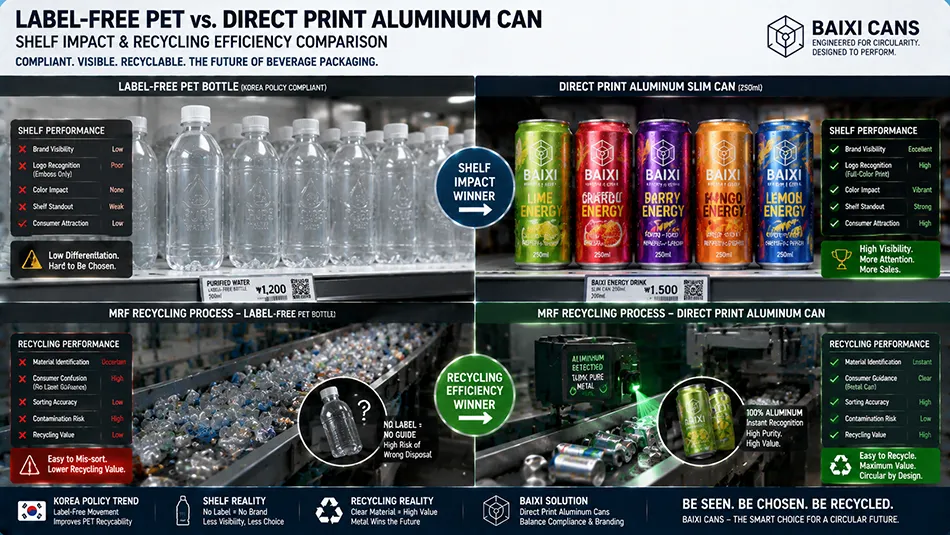
A plastic-free story can be commercially useful, but it becomes risky when it sounds broader than the package or market supports.
PackagingInsights' report on South Korea's label-free bottled-water move is a useful example of how specific a packaging policy can be. It points to label-free bottled water, not a universal ban on every plastic label or every PET package. Buyers should treat each market rule as specific until local counsel or an importer confirms otherwise.
This matters for aluminum can projects because some brands want to convert policy headlines into marketing claims. The safer path is to say what changed in the package: PET bottle removed from this SKU, direct-printed aluminum can selected, liner evidence available, or recovery claim limited to the target market.
For a brand moving from PET to cans, Baixi Cans can help compare standard formats, custom printing, and lids. A sports drink or sparkling product may start with the 500ml custom aluminum can option, while a smaller functional drink may review printable 250ml slim cans.
Before ordering, send Baixi Cans the PET policy concern, destination market, beverage formula, filling-line details, desired can size, end choice, and claim wording. Ask whether can lids, liner evidence, and print route fit the intended claim before the artwork says more than the package can prove. That question belongs before sampling.
A PET-to-can move should finish with a readiness file, not only a format decision. The file should show why the switch reduces risk for the actual market and product.
Data from the EU Single-Use Plastics framework gives one type of evidence: what the market asks plastic beverage packaging to prove. Data from the EU packaging waste framework gives another: how packaging should be designed for recovery. The buyer needs both views before saying aluminum is the better option.
The practical output is a two-column file. One column names the PET pressure, such as recycled content, label rule, or EPR fee. The other names the aluminum proof, such as can recovery claim, direct print, liner evidence, or filling-line qualification. If a row has policy pressure but no aluminum proof, the switch is not ready.
Data from CMI's can recycling targets and data from the IAI recycling update support the circularity case, but the launch still has to pay for new samples, seamer checks, artwork proofing, cartons, and possible line trials. The decision is commercial as well as regulatory.
If a brand changes 3 flavors from PET to cans and each flavor needs 2 artwork proof rounds, the team has 6 artwork proof events before filled-product trials. That simple count helps explain why compliance, procurement, design, and the filler should meet before the claim is printed on the pack.
Useful pages include Baixi's aluminum cans collection, aluminum can lids, and contact page for market-specific RFQ discussion.
Send Baixi Cans the target market, policy concern, beverage type, can size, end size, liner requirement, artwork route, filling-line model, and claim wording. Ask for a package proposal that separates legal claim review from technical can suitability. Data from policy examples such as South Korea's label-free bottled-water move should be treated as a watch item, not a shortcut. That split keeps the PET-policy opportunity useful without overpromising.
No. Many rules target specific single-use plastic items, recycled content, collection, labels, EPR, or design-for-recycling. Buyers should confirm the exact rule in each market before changing packaging.
Sometimes. Aluminum cans are stronger when the beverage, market, line, and recovery claim fit. They are not automatic substitutes for every PET bottle or every use case.
Only after reviewing the whole package and market wording. Internal coatings, inks, compound, labels, carton materials, and local claim rules may affect what can be responsibly said.
Check policy requirements, beverage formula, carbonation, liner compatibility, can size, lid type, filling-line capability, artwork route, recovery claim, and destination-market documentation.
The lid affects opening style, seaming, pressure performance, consumer experience, and line compatibility. It should be specified with the can body, not treated as a later accessory.

