
Metal taint in canned craft beer is rarely solved by blaming "aluminum cans" as a category; it is prevented by matching the beer chemistry, internal coating, seam integrity, oxygen control, and retention testing before the product reaches the market. A well-specified aluminum can can protect beer well, but a mismatched liner, aggressive beer style, high dissolved oxygen, or damaged seam can turn a packaging choice into a flavor complaint.
The Brewers Association's best-practices guide to craft beer quality emphasizes oxygen pickup and package handling as major flavor risks, while its sour beer guidance treats highly acidic beer as a special handling and quality category. Research on packaged sour beer published in Beverages also shows that pH, acidity, and storage conditions matter for packaged sour styles. For can buyers, the lesson is direct: coating selection must follow the actual beer style, not a generic beer label.
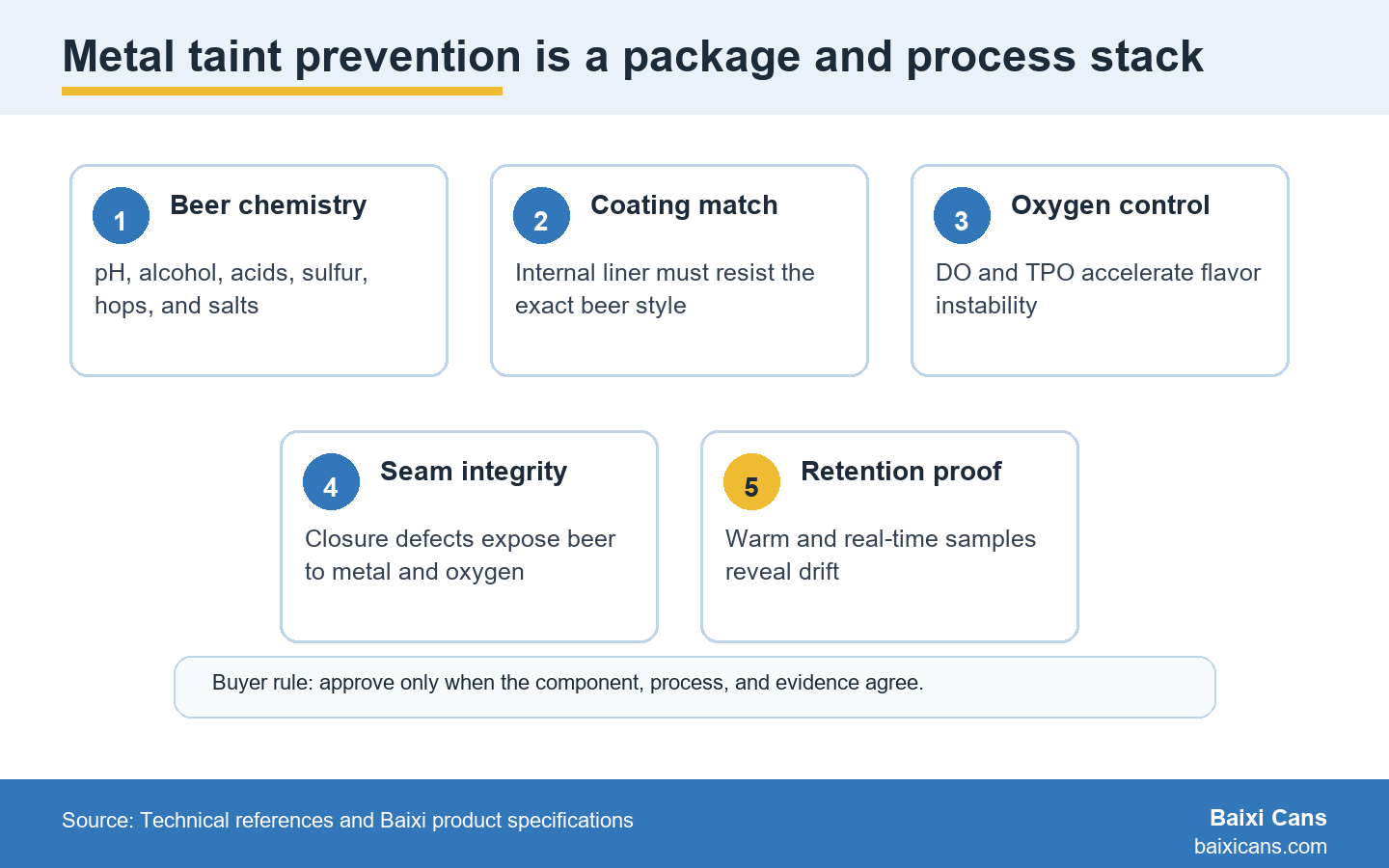
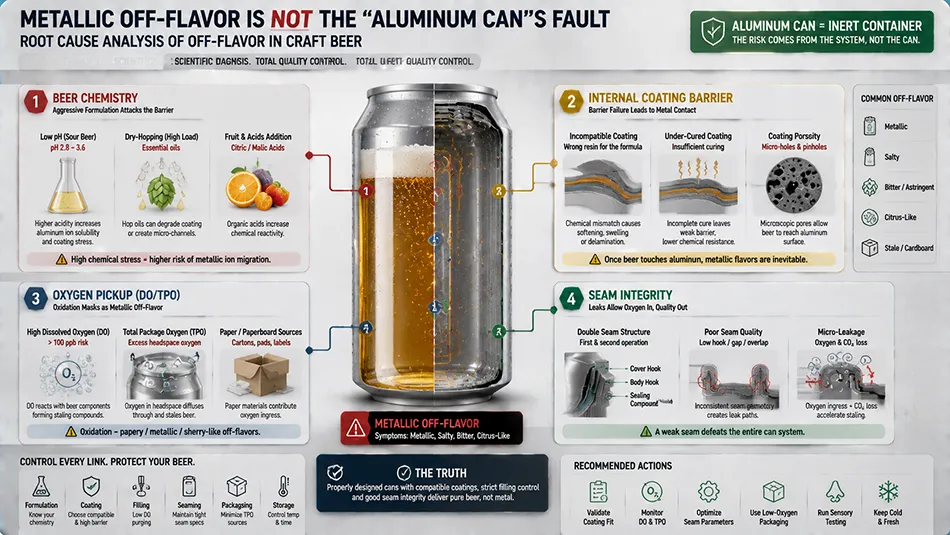
The same can that works for one craft beer can be wrong for another if pH, alcohol, acids, hops, salts, or storage temperature change.
Craft beer is not one chemistry. A crisp lager, heavily dry-hopped IPA, barrel-aged stout, fruit sour, hard seltzer-style beer, and low-pH kettle sour all create different package demands. Alcohol level, pH, acidity, dissolved oxygen, hop compounds, sulfur notes, fruit additions, and carbonation can all affect flavor stability and coating risk. If a brewery changes the recipe but keeps the same can assumption, the package may no longer match the product.
Metal taint can also be confused with other off-flavors. Oxidation, sulfur, hop burn, microbiological issues, or ingredient interactions may taste metallic to some consumers. That is why breweries should investigate the package and the beer together. If only the can is blamed, the real cause may stay hidden. If only the beer is blamed, coating or seam issues may be missed.
The first best practice is therefore a product-risk screen. Record pH, alcohol, carbonation, dissolved oxygen target, beer style, pasteurization or cold-chain plan, shelf-life target, and destination market before choosing the can and liner.
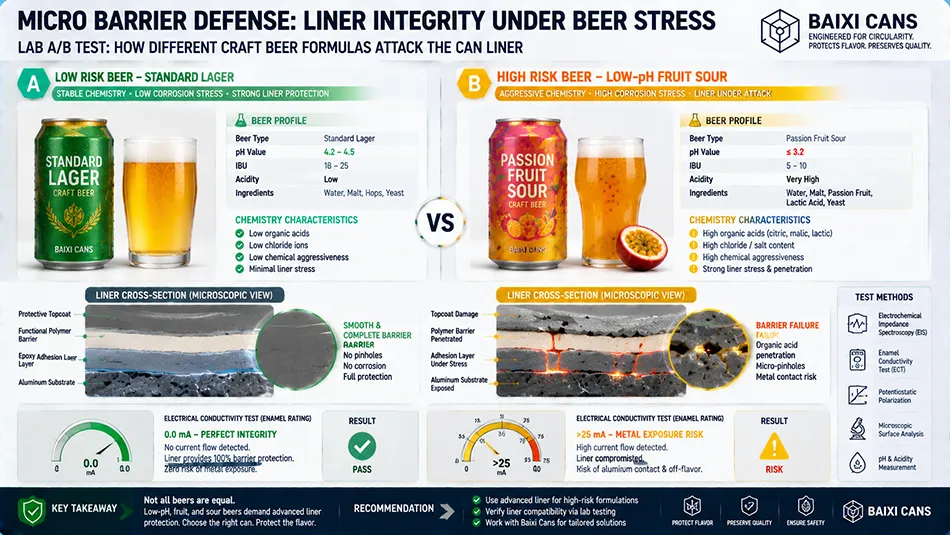
Aluminum beverage cans rely on internal coatings to keep beer away from bare metal. The coating protects flavor and reduces corrosion risk. If the coating is mismatched, porous, scratched, under-cured, damaged during forming, or stressed by the beer, metal exposure can become a pathway to off-flavor, gas generation, corrosion, or leakage.
Smithers' lacquer integrity testing materials and Sencon enamel-rating guidance explain why coating integrity is tested with methods such as enamel rating or conductivity testing. These tests do not replace sensory or shelf-life work, but they help identify exposed metal or coating porosity before filled beer creates a market complaint.
For breweries using custom printed cans, coating review should happen before artwork and inventory are locked. Printed can stock is expensive to change. If the beer style later proves aggressive, the brewery may be stuck with cans that look perfect but need a different coating path.
Low pH does not automatically create metal taint, but it removes the safety of generic packaging assumptions.
Sour beer and fruit beer often carry lower pH, organic acids, fruit solids, color compounds, and longer flavor-evolution expectations. The Brewers Association's sour beer guidance treats sour production as a distinct quality and handling category, and the packaged sour beer study shows that acidity and storage conditions are part of packaged product behavior. For can selection, that means sour or fruit beers should receive coating compatibility review, retention sampling, and sensory monitoring before broad release.
A brewery should not assume that a can proven for a standard pale ale is automatically proven for a passion-fruit sour. The base material may be the same, but the product chemistry is different. The buyer should request coating compatibility evidence for the beer category or run filled-product retention samples that reflect the real formula.
An illustrative scenario shows the risk. A brewery approves 50,000 printed cans after a short cold trial with a fruit sour. The beer tastes clean after two weeks cold, but warm retained samples show metallic notes after six weeks. The cost is not only can inventory. The brewery may lose a seasonal launch window, retailer confidence, and finished beer. A longer retention plan would have delayed the decision but revealed the risk before market release.
Metallic flavor complaints should trigger oxygen review. The Brewers Association quality guide emphasizes dissolved oxygen and total packaged oxygen because oxygen can accelerate staling and flavor change. Oxidized beer can taste papery, stale, harsh, or sometimes metallic to consumers. If a brewery focuses only on coating while ignoring DO or TPO, the investigation may be incomplete.
For canned beer, oxygen can enter through process pickup before seaming, poor purge, foam control issues, lid placement, seam defects, or package handling. Seam integrity matters because the closure is the oxygen and leakage boundary. A can with good coating can still create flavor complaints if oxygen pickup is high or the seam is unstable.
The practical investigation should compare three records: sensory notes, coating or enamel rating evidence, and packaged oxygen data. If metal notes rise with high DO, process oxygen may be the root cause. If metal notes correlate with high conductivity readings or visible internal corrosion, coating or compatibility becomes more likely. If complaints cluster around one production day, seam and lot traceability become central.
| Best practice | Evidence to request | Why it prevents metal taint |
|---|---|---|
| Match liner to beer style | Beer pH, alcohol, acid profile, carbonation, shelf-life target. | Prevents generic can assumptions from hiding chemistry risk. |
| Check coating integrity | Enamel rating, conductivity data, coating declaration. | Finds exposed metal before beer contacts it for months. |
| Control oxygen | DO, TPO, purge, fill height, seam release data. | Separates oxidation flavors from true metal exposure. |
| Inspect seams and ends | Double seam teardown, leak checks, lid lot traceability. | Protects closure integrity and reduces oxygen ingress. |
| Run retention samples | Cold, warm, and real-time samples with sensory notes. | Shows whether flavor drifts before the market complains. |
The best-practice table is deliberately operational. It gives the brewery a way to decide whether a metal note is likely coming from the beer, the coating, the seam, oxygen, or storage.
When a brewery receives a metallic-flavor complaint, the first move should be to protect evidence. Pull retained cans from the same fill date, the same can lot, and nearby dates. Pull empty cans and lids if they were retained. Record the complaint storage condition, package age, beer style, batch number, and whether the can shows swelling, leakage, corrosion, or abnormal opening behavior. Sensory notes alone are not enough because metallic perception can overlap with oxidation, sulfur, astringency, and package corrosion.
The investigation should then split into three paths. The beer path checks recipe, pH, alcohol, acids, dissolved oxygen, TPO, microbiology, and filtration or centrifuge changes. The package path checks internal coating, enamel rating, can body, lid, seam data, and visible corrosion. The route path checks temperature abuse, warm storage duration, pallet damage, and retail handling. If the complaint appears only in warm-retained samples, storage and chemistry become stronger suspects. If complaint samples show high metal exposure or internal corrosion, coating compatibility moves higher.
An illustrative decision rule is useful: if both sensory drift and high package oxygen appear, investigate oxygen first; if sensory drift appears with low oxygen but high conductivity or visible internal attack, investigate coating compatibility; if only market samples show the issue and retained samples remain clean, investigate route temperature and retail handling. The rule is not a substitute for lab work, but it prevents the brewery from chasing one cause without evidence.
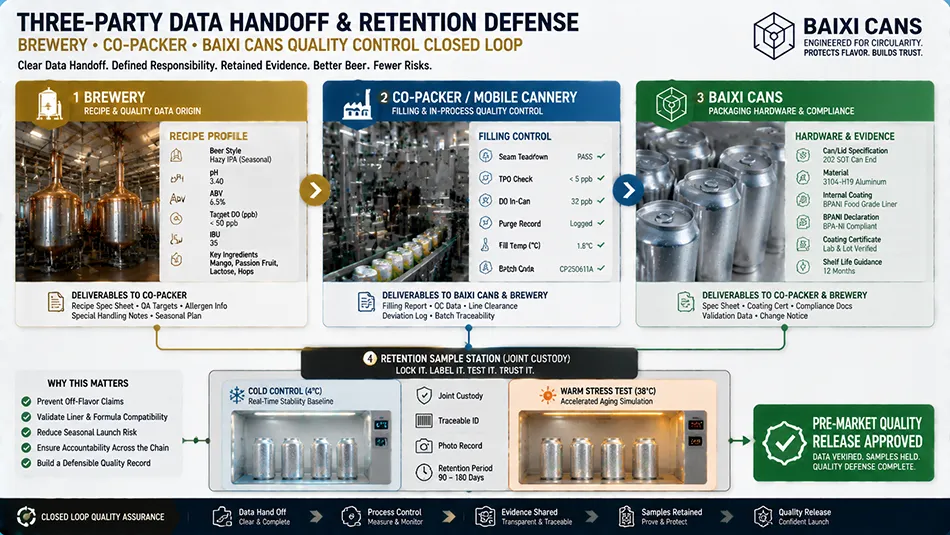
Many craft breweries use mobile canning services or co-packers. The can supplier may never see the beer, and the filler may not know the full formula boundary. That creates a responsibility gap. To prevent metal taint, the brewery should share enough technical information for package selection without disclosing unnecessary proprietary detail. At minimum, share beer style, pH range, alcohol, carbonation, fruit or acid additions, hop load, dissolved oxygen target, shelf-life target, and whether the product will be pasteurized or stored warm.
The co-packer should respond with purge method, fill temperature, fill height, DO or TPO control, seam inspection, lid and can lot traceability, and retained-sample plan. The can supplier should provide can and lid specification, coating evidence, food-contact or BPANI documents when relevant, and guidance on whether the beer category needs compatibility checks. When those three parties work from the same packet, metal-taint prevention becomes a controlled process rather than a blame loop after launch.
This handoff is especially important for seasonal beers. Limited releases often move quickly from recipe to artwork to fill date. The speed is commercially useful, but it should not skip coating and oxygen evidence. A small delay before printed can commitment is cheaper than recalling a seasonal beer that tastes metallic after six weeks.
Baixi Cans is relevant because craft beer brands use aluminum cans and lids where liner compatibility, seam integrity, and route conditions affect flavor stability. According to company materials, Baixi Industry supplies aluminum beverage cans, including formats suitable for beer and sports drinks, plus matching lids. The responsible role is not to claim that one can solves every beer style. The useful role is helping the brewery specify can body, lid, coating evidence, and sample plan before production.
If the brewery is filling a standard beer format, Baixi's 500ml aluminum beer can option may be part of the format discussion. If the brewery uses specialty lids or custom ends, Baixi's aluminum can lids should be reviewed alongside seam and coating evidence. The body and lid are both part of flavor protection.
Before ordering printed cans, send Baixi Cans the beer style, pH range, alcohol level, carbonation, fruit or acid additions, oxygen target, filling process, storage route, can format, lid requirement, and shelf-life expectation. Ask which can and lid evidence should be reviewed for coating compatibility, seam integrity, and retention samples. Use Baixi's contact page to discuss craft beer can coating requirements before printed stock becomes a sunk cost.
Aluminum cans can contribute to metallic taste if the internal coating is damaged, mismatched, or exposed, but many metallic complaints also involve oxidation, beer chemistry, or storage. Investigate coating, oxygen, seams, and retention samples together.
Sour beers can be packaged in aluminum cans when the liner, seam, and retention plan match the beer chemistry. Lower pH and fruit acids justify stronger coating compatibility checks than a standard low-risk beer.
No, enamel rating helps detect exposed metal or coating porosity, but flavor stability also depends on oxygen, recipe, storage, carbonation, and shelf life. It is one release gate, not a complete sensory program.
Yes, warm retained samples can reveal coating, oxygen, or flavor-drift issues that cold samples may hide. The warm condition should be justified and paired with real-time samples so the brewery does not overinterpret one stress test.
The supplier should know beer style, pH range, alcohol, carbonation, acid or fruit additions, filling process, storage route, lid type, and shelf-life target. Those inputs help select coating evidence and avoid generic packaging assumptions.

