
The story of SuperEnd is not just a story about a lighter lid; it shows how easy-open ends turned the beverage can from a sealed metal container into a consumer experience, a seaming system, and a material-efficiency decision. For beverage buyers, that history matters because the lid is not a minor accessory. It controls opening feel, leak risk, filling-line compatibility, consumer trust, and the total metal used in every finished can.
SuperEnd is best understood as a named industry example of lightweight easy-open end design, not as a generic specification that every supplier automatically provides. A buyer should treat the term as a reference point for the broader question: which end, score design, tab geometry, curl, compound, coating, and seaming setup are right for the drink? Baixi Cans' role is to help buyers discuss aluminum can lids and matching can bodies in a practical procurement brief.
Smithsonian Magazine traces the pop-top story to Ermal Fraze and the problem of opening beverage cans without a separate tool. CanTech International describes easy-open end development from the 1970s onward and explains why score control, tab design, and production speed became central to the market. The Canmaker reported in 2017 that a SuperEnd beverage end was said to be 10% lighter than conventional 202 ends. The thread connecting these sources is simple: convenience only became standard because engineers learned how to make opening controlled, repeatable, and manufacturable.
Data from Smithsonian places the consumer need in the late 1950s and follows the development toward stay-on-tab designs in the 1970s. Data from CanTech describes easy-open end lines moving from around 800 ends per minute to more than 5,000 ends per minute in modern production. Data from CanTech also says almost 100% of carbonated beverage easy-open ends are aluminum with non-detachable tabs. Data from The Canmaker reports a SuperEnd example said to be 10% lighter than conventional 202 ends. Those numbers show why end design is both a user-experience and manufacturing-speed problem.
Data from Smithsonian identifies 1976 and 1977 stay-on-tab patent milestones that helped move the market away from detachable tabs. Data from CanTech connects the 1970s beverage-can expansion with the need for matching easy-open end capacity. Data from the patent record shows that improved scoring was important enough to become a dedicated manufacturing method. Data from AZoM places aluminum cans inside a longer lightweight packaging history, while data from ReMA and CMI connects used beverage cans with circular material recovery. This means the end should be evaluated as a pressure part, an opening device, and a material-efficiency lever at the same time.
An easy-open end is successful only when it feels simple to the drinker and remains difficult to fail in the factory.
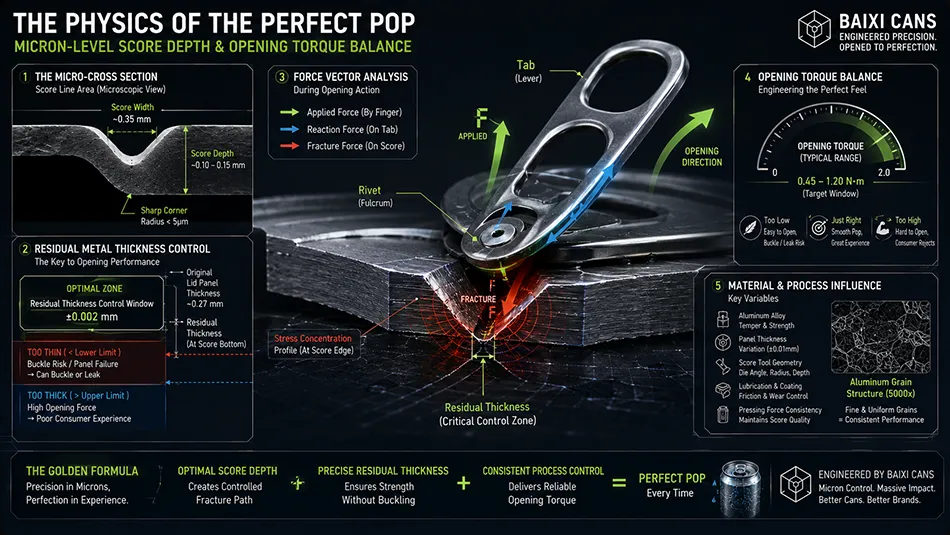
The early pop-top solved the immediate problem of needing a separate opener, but it created new concerns around detached tabs, sharp edges, litter, and ingestion risk. The stay-on-tab idea changed the consumer contract: the drinker could open the can quickly while the tab stayed attached to the end. That sounds obvious today because the design became normal. Technically, however, it required the end panel, rivet, tab, and score to work together. The tab had to become a lever, the score had to tear predictably, and the panel had to survive internal pressure before opening. Controlled opening is the real invention buyers should care about.
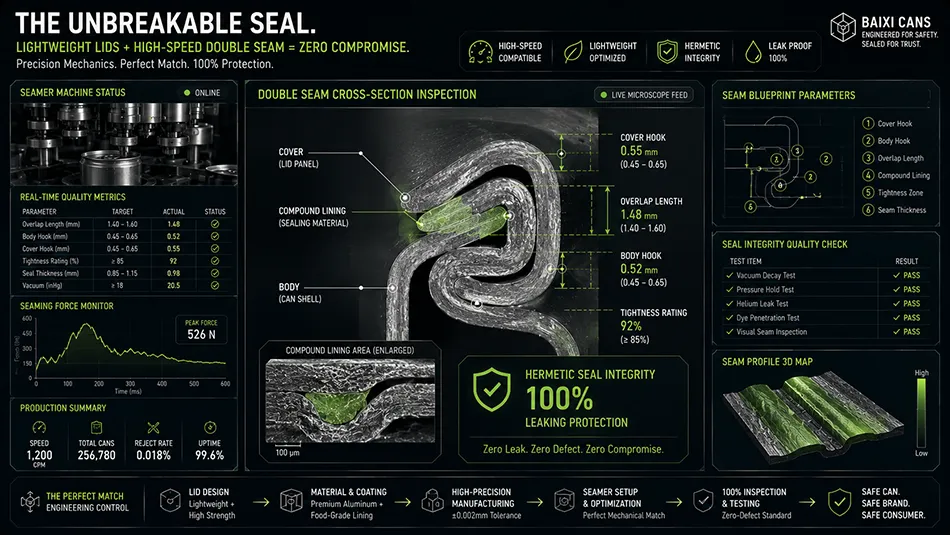
Lightweighting was already a long-term beverage-can goal before SuperEnd appeared in trade reporting, but a named lightweight end helped procurement teams see the lid as a cost and sustainability lever. If an end can be lighter while still meeting pressure, seaming, transport, and opening requirements, the benefit repeats across every can. The danger is assuming a lighter end is automatically better. A buyer still has to ask whether the end matches the can body, filling line, beverage pressure, score performance, and export handling. Lightweighting is useful only when it preserves the full performance system.
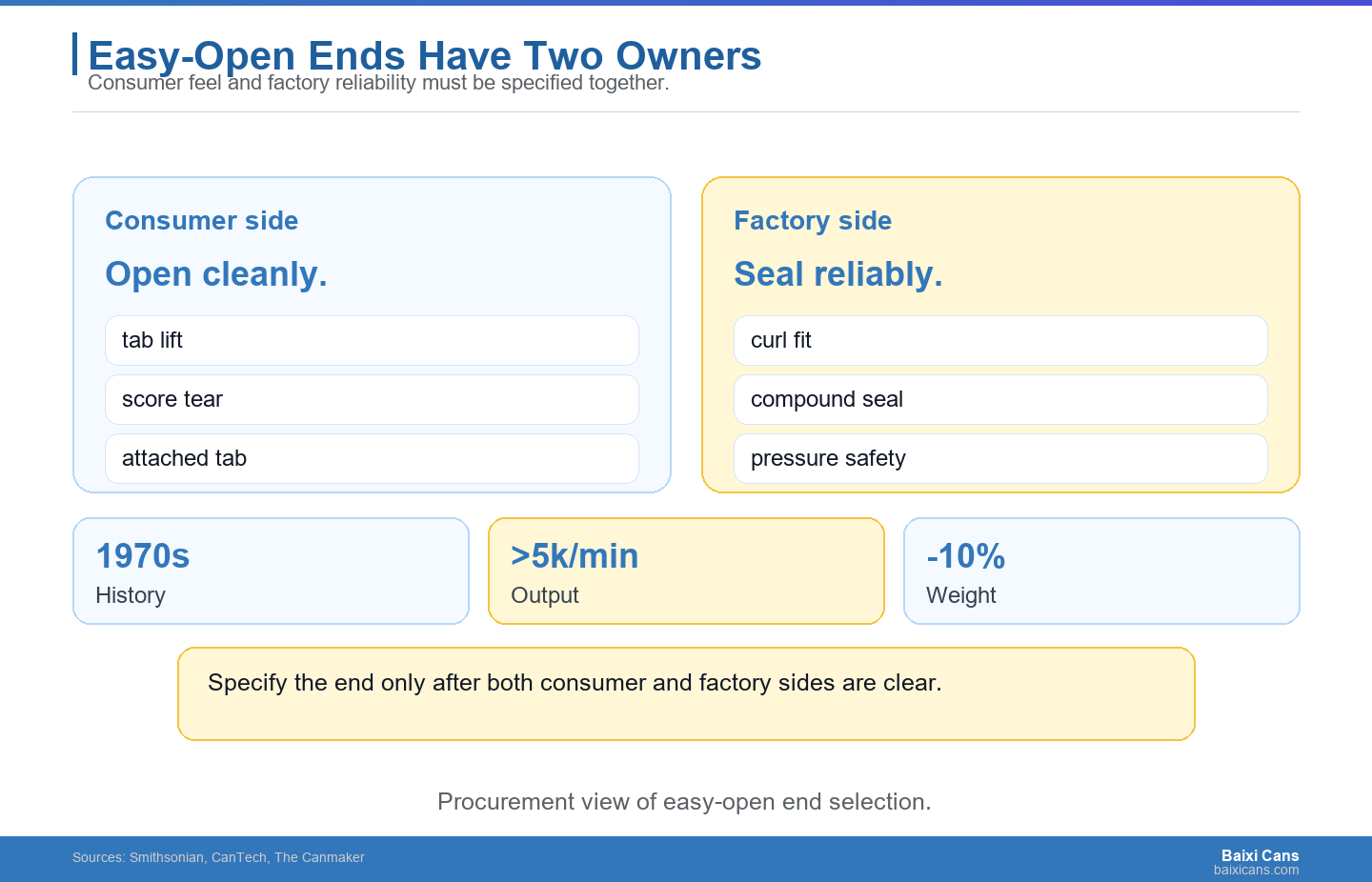
A beverage buyer sees the lid as a part number, but the drinker experiences it as a sound, a lifting force, a clean aperture, and confidence that the can was sealed. The filling plant experiences it as seaming stability, buckle resistance, score safety, and line speed. The same piece of aluminum must satisfy both sides. That is why end selection should be discussed before the buyer commits to a large custom printed can order.
| End feature | What it affects | Buyer question |
|---|---|---|
| Score line | Opening force, tear path, and premature opening risk | Is score depth controlled for this end type and beverage pressure? |
| Rivet and tab | Lever action, finger feel, and tab retention | Does the tab feel match the target consumer and channel? |
| Curl, compound, and seam | Seal integrity and double seam performance | Has the end been matched with the filling line seamer? |
| Gauge and alloy | Material efficiency, pressure resistance, and handling strength | Does lightweighting preserve transport and filling performance? |
CanTech calls the score incision one of the most delicate operations in easy-open end manufacturing. If the residual metal is too strong, consumers may struggle to open the can or tear the aperture poorly. If the residual metal is too weak, the end can become vulnerable during filling, pasteurization, transport, or consumer handling. patent literature on improved scoring reinforces the same point from another angle: scoring is a manufacturing method, not just a line drawn on a lid. For buyers, the practical question is not "does it open?" but "does it open consistently without sacrificing safety before opening?"
The easiest mistake is to compare ends only by weight or price. A lighter end may look attractive on a cost sheet, but it still has to handle can pressure, seamer setup, filling speed, palletization, warehouse temperature, and export vibration. engineering research on lid opening behavior shows that opening and tearing can be studied as a mechanical process. In procurement language, that means the end is part of a system. If the body, end, compound, coating, or seamer setup changes, the buyer should not assume previous double seam results still apply. Testing protects the savings from becoming a leakage problem.
Many beverage projects discuss 202 stay-on-tab lids because they are common in modern beverage-can systems and familiar to filling plants. The value of a consistent 202 SOT lid is not only consumer convenience. It is repeatability. A lid that opens cleanly, stays attached, and seams consistently allows the brand to focus on the beverage rather than apologizing for leaks, sharp tears, or difficult opening. That is especially important for carbonated drinks, beer, RTD cocktails, energy drinks, and export products where pressure and handling risk are higher.
Buyers should connect the lid conversation with the can body and drink type. For a large beer or sports drink, Baixi's 500ml beer and sports drink cans may need a different discussion than a slim soda or functional drink. For lighter launches, slim 250ml printable cans may support trial and portion control. In both cases, the lid should be selected with the filling line, carbonation, coating, and distribution environment in mind.
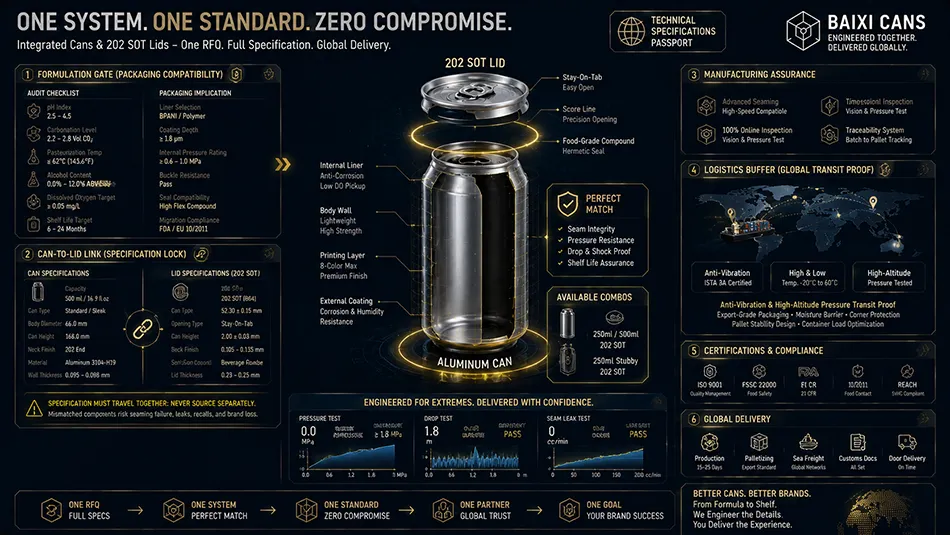
A strong end brief starts with the beverage. Share carbonation level, filling temperature, pasteurization or tunnel requirements if any, pH, alcohol content, functional ingredients, expected shelf life, and target markets. Then define the can body and lid requirement together. Ask about available end types, compatible can sizes, coating options, score consistency, seaming requirements, certificate documentation, packing, and minimum order quantities. If a buyer asks only for "a 202 lid" without the beverage and line context, the supplier has less information to prevent failure.
Baixi Cans can help buyers turn that brief into an order discussion through its product range, certificate references, and contact process. The useful supplier conversation is not whether a lid sounds modern. It is whether the selected lid and can body can repeat the same opening, sealing, and handling performance at the buyer's real volume.
Before placing a beverage-can order, check five things. First, confirm the lid size and end type match the can body. Second, confirm the internal coating and end coating fit the beverage formula. Third, confirm the score line and tab design are suitable for the required opening feel and pressure profile. Fourth, confirm the filling plant can seam the end consistently at the target speed. Fifth, confirm quality documentation and sample testing before scaling. These questions may sound technical, but they protect brand experience.
End design has also become part of material-efficiency thinking. AZoM's aluminum can overview places aluminum cans in a long arc of lightweight packaging development, and ReMA and the Can Manufacturers Institute explain the circular value of used beverage cans. A lighter or better-designed end can support that direction, but only when it does not compromise leakage, opening, or filling reliability. The best buyer decision is not the lightest lid in isolation. It is the most reliable can-and-end system for the beverage.
One of the most useful procurement habits is to stop treating the can body and lid as separate purchases after the first quotation. The lid specification should travel with the can body through sampling, artwork approval, filling-line preparation, and repeat orders. If the buyer changes the body diameter, can height, carbonation, tunnel process, or filling plant, the end discussion should be reopened. The decision rule is that a lid is not confirmed until it has been confirmed against the actual can body and filling route.
This matters for export buyers because a can may face more than one stress profile before the consumer opens it. It may be seamed at high speed, held in warm storage, shipped across long distances, handled through pallets and cartons, then chilled quickly before consumption. A score that opens beautifully in a calm sample room still has to remain safe through that chain. A curl that seems compatible in theory still has to create a repeatable double seam at the plant. A lightweight end that saves metal still has to avoid turning pressure or handling into a field complaint.
Sampling should therefore include both consumer and production checks. On the consumer side, ask people to open the can cold and at realistic serving conditions, then listen for difficult tab lift, ragged aperture tear, sharp edges, or unusual splash. On the production side, confirm seam measurements, visual inspection, pressure-related checks where relevant, and line behavior at target speed. The practical rule is to test the end as a lived experience and as a machine interface, because the same part has to satisfy both.
Documentation should be part of the same package. Buyers can ask for certificate references, lid type confirmation, compatible can-body information, packing details, and inspection expectations. For repeat orders, the buyer should keep a record of the end specification that worked, not only the can artwork that sold. That record helps prevent accidental substitutions when the next order is urgent. It also makes supplier communication faster: instead of restarting the lid conversation, the buyer can confirm whether the same can-and-end system will be repeated or whether a change requires validation.
The same record is useful when a brand expands from one beverage to another. A lid that worked for a still drink may not be the right assumption for a carbonated or alcoholic variant. A new formula should trigger a new check, even if the can diameter looks familiar. Familiar dimensions reduce uncertainty, but they do not remove the need to validate the whole package.
For that reason, the best end discussion is specific rather than fashionable. A buyer does not need the most famous lid name; the buyer needs the end that opens cleanly, seams reliably, supports the drink, and arrives with documentation the filling plant can use. Baixi Cans can help buyers keep that discussion tied to real can bodies, real lids, and real filling requirements instead of abstract lid terminology. That is the practical legacy of easy-open end innovation.
No. SuperEnd is a named industry example associated with lightweight easy-open end design. Buyers should use it as a reference point for discussing weight, score control, opening feel, and seaming compatibility, not as a generic substitute for a confirmed lid specification.
Score depth controls the balance between easy opening and pre-opening safety. If the remaining metal is too strong, consumers may struggle to open the can. If it is too weak, the lid may become vulnerable during filling, handling, or transport.
Confirm can body compatibility, beverage pressure, coating suitability, filling-line seaming setup, opening force expectations, sample testing, certification documentation, and packing. The lid should be selected as part of the whole can system.

