
The real MOQ for custom printed cans is the quantity that can be printed, released, and used under the same confirmed conditions. When buyers ask for it, they usually want one number they can put into a launch forecast. The useful answer is more conditional. MOQ, or minimum order quantity, is the smallest quantity a supplier will accept under stated conditions. For a decorated beverage can, those conditions can include the print route, can body and end, artwork version, release date, packing plan, and destination market. A low number without those conditions is not yet a comparable quote.
The practical goal is not to chase the lowest headline quantity. It is to identify how much of a launch can be released without committing unapproved artwork, unlike can formats, or unfinished proof work. That makes MOQ a sourcing decision with three different floors.
The real MOQ is a release decision, not a single number. A supplier may be able to print a particular quantity, but the buyer still needs to know whether every unit has an approved artwork, a fixed body and end, and a route that can be released on the required date. The number that matters is the quantity that satisfies all of those conditions together.
These are buyer-side labels for reviewing a quote, not an industry-standard definition imposed on every supplier. Their value is simple: they turn a vague question, “What is your MOQ?” into a set of conditions that can be checked in writing.
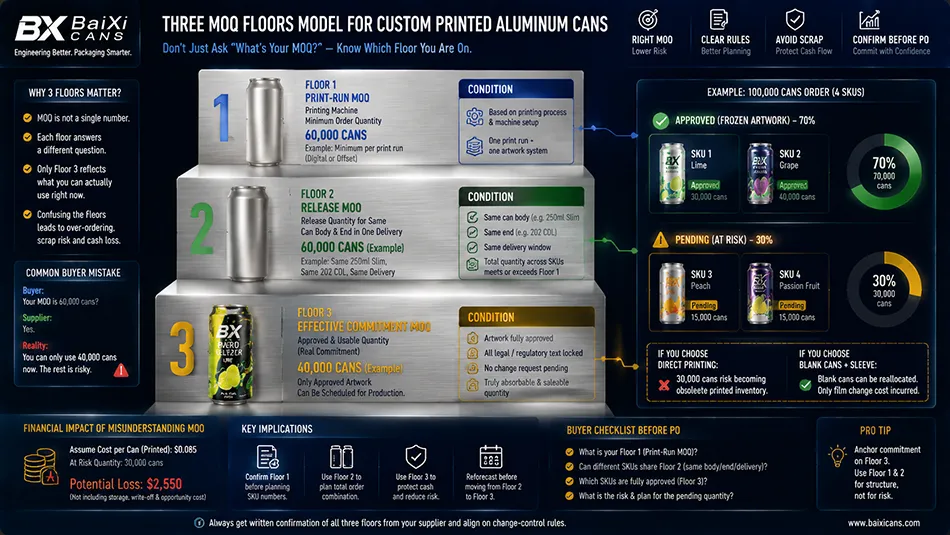
A custom can quote has three MOQ floors. The first is the print-run MOQ: the smallest run accepted by the decoration route under its own commercial rules. The second is the release MOQ: the quantity that can share one defined can body, end, artwork state, and production instruction. The third is the effective commitment: the part of that release that approved SKUs can actually use now.
Those floors may happen to be the same in a mature, single-SKU project. They often diverge during a launch. A buyer may have demand for 60,000 cans, receive a print quote for the same number, and still have only 40,000 cans of approved artwork. Treating all three numbers as one creates a false sense that the order is ready when only its forecast is ready.
“Per design” deserves particular attention. It may mean each artwork version is counted separately, it may mean several versions can share a program under stated limits, or it may mean the supplier needs to review the artwork mix before confirming anything. Write the exact count unit beside every number in the RFQ. That one habit makes route and supplier comparisons much less slippery.
A no-minimum direct-to-can offer is a provider-specific commercial program, not an industry standard. For example, one digital can printer describes its no-minimum offer as a no-plates, direct-to-can program. That is useful evidence that the decoration route can change the commercial floor; it does not establish what another supplier, can size, finish, or delivery lane must accept.
Before using a published number in a budget, ask four questions: Is the quantity for direct printing, an offset-style route, or another decoration method? Is it per artwork or across the order? Does it assume a stocked body and end? Does it include samples, proofs, or packing requirements? The answer may move the practical minimum even when the printed number looks attractive.
Do not frame a digital option as automatically “cheap” or “better” for every small run. It may reduce setup exposure, while a different body, special finish, freight pattern, or approval workflow sets the actual buying threshold. The purchase decision should follow the confirmed route scope, not a generic claim about the technology.
A shared forecast is not automatically a shared custom-can release. Volumes can be added only after the buyer confirms that the can drawing, fill-volume format, neck and end requirement, coating scope, decoration route, and release timing are genuinely the same. Different products may both be called “printed cans” while still needing separate instructions.
Start with a physical definition rather than a marketing description. Baixi Cans publishes a format reference that lets a team considering an energy-drink launch review the 250ml slim printable can format, then ask whether that body, the selected end, and the intended beverage are fixed for the whole proposed run. A product page is a useful starting point; supplier drawings and the project brief are what establish compatibility.
This is where an apparently low MOQ can become misleading. Combining two formats just because their total quantity is larger may conceal two different bodies, two ends, two sets of artwork tolerances, or two release dates. Keep them separate until the supplier confirms what can be aggregated and why.
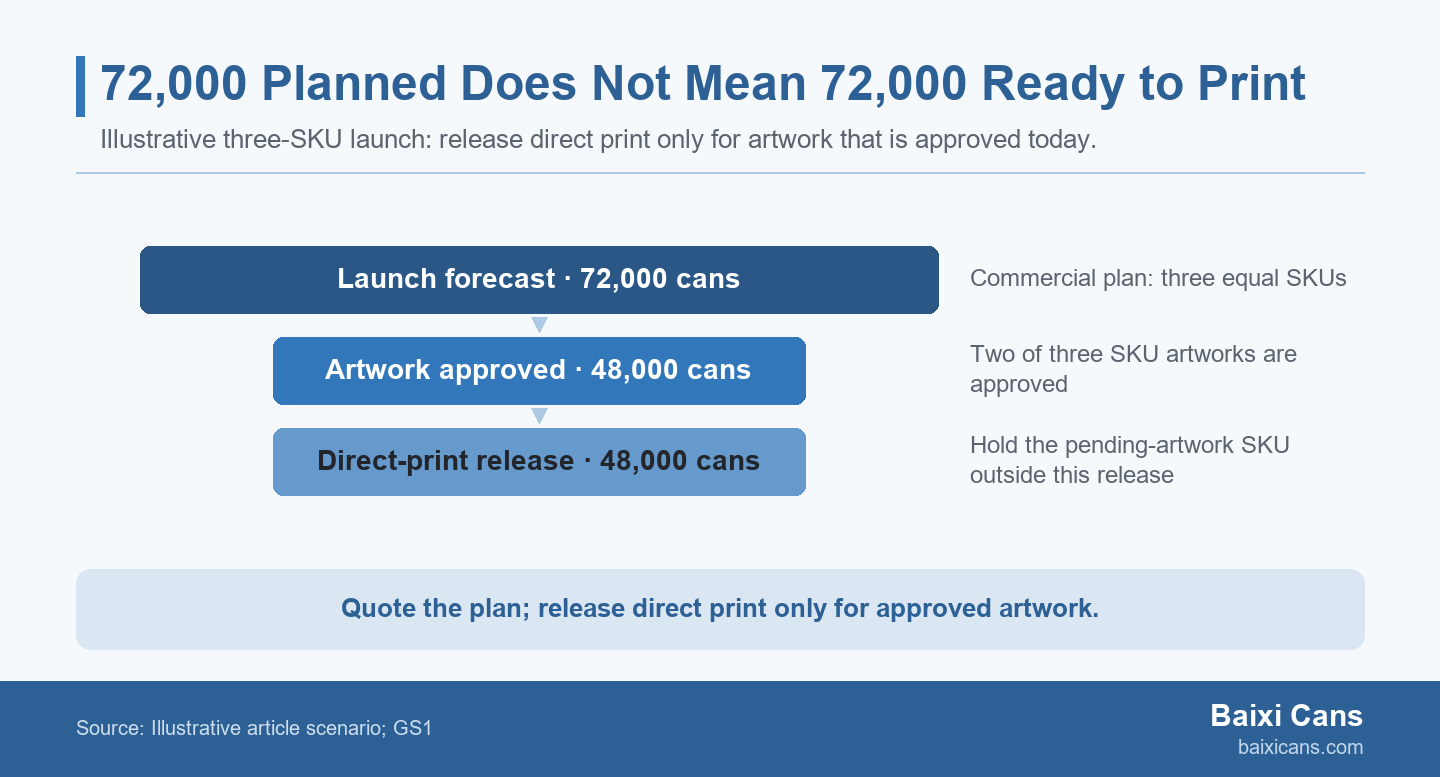
Effective commitment is the quantity approved SKUs can absorb now. An SKU is one sellable product version with its own artwork and identity, such as a flavor, formula, market variant, or campaign design. If a SKU has not cleared its artwork and proof gates, its planned volume should not be treated as ready for direct printed-can release.
This distinction matters even when every SKU uses the same can body. A brand can have a sound annual forecast and still need to release only the stable portion first. Before comparing another format, confirm whether its diameter, height, end, pallet pattern, and artwork template remain inside the same production instruction. If any of those conditions change, its demand belongs in a separate quote line until the supplier says otherwise.
For a larger-format comparison, buyers can compare the 500ml custom can format before they combine demand with a different size or end requirement. The purpose is not to promote one size; it is to keep format changes from hiding inside an artwork MOQ discussion. It also gives the buyer a concrete reference for deciding whether the forecast is one release or two.
Ask the supplier to state the effective commitment in the same quotation as the print-run number: which SKUs are approved, how each is counted, what can be held, and what needs a new proof or release. That gives the buyer a number that can be acted on today rather than a total that assumes every later decision will go smoothly.
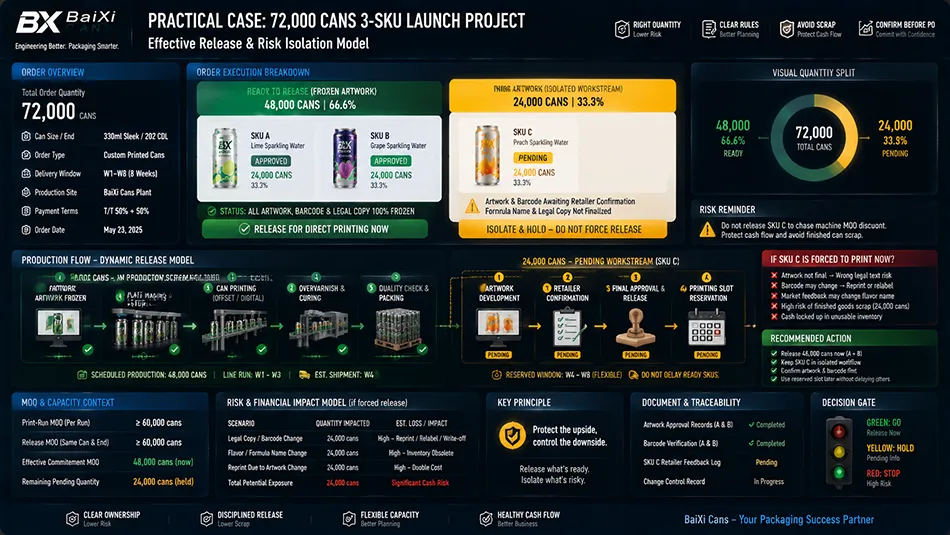
72,000 x 2/3 equals 48,000 release-ready cans. The arithmetic below is an illustrative sourcing scenario, not a customer order, supplier quote, price, capacity statement, or fixed MOQ.
Buyer context: A beverage brand is preparing a three-SKU launch using direct-printed cans and wants a quote before every label detail is final.
Order context: The planning forecast is 72,000 cans, divided equally across three SKUs, so each SKU represents 24,000 cans.
Readiness state: Two artworks are approved. The third is waiting on a formula-name and barcode decision, even though the can body and selected end are shared.
Observation: The can body and end are shared across the three SKUs. Two approved SKUs represent 48,000 cans, which are the only units whose artwork can be released today under the stated assumptions.
Observation: The remaining 24,000 cans belong to the pending SKU. Including them in a direct-print release would turn a planning assumption into a graphic commitment.
Analysis: The print-run discussion can still cover the full 72,000-can plan, but the effective commitment is 48,000 because only two of three equal artworks are ready. The difference is not a loss estimate; it identifies where approval work remains.
Decision: Quote the full planning case for visibility, then authorize only the 48,000-can direct-print release until the third artwork passes the same gate.
Corrective action: Put the 24,000-can pending SKU into a separate artwork and proof workstream with its own release date, rather than forcing it into the first production instruction.
Verification gate: Before the pending SKU is added, approve its final barcode placement, finished-pack proof, can drawing and end confirmation, and the applicable beverage and market documentation.
Boundary: This transparent calculation is illustrative only. A supplier must confirm the actual route, artwork handling, packaging, delivery, and commercial conditions for a live order.
Small-batch technology and supplier programs are useful only when their stated scope matches the project. The Aluminum Association notes that affordable inkjet printing can support small-batch canning, while also discussing the recycling implications of added plastic labels. Separately, a supplier's digital printed-can program describes runs starting at a few thousand cans per SKU. These are route- and provider-specific examples, not market benchmarks.
There are three practical ways to lower commitment without weakening the project. First, separate approved artwork from pending artwork, as in the scenario above. Second, keep as many technical variables as possible common across the initial release: one fixed body, one confirmed end, one beverage-use scope, and a clear packing plan. Third, ask whether a digital or other flexible route is available for the project instead of assuming that one route applies to every size and finish.
What should not be reduced is the information needed to produce and verify the pack. Do not replace a finished proof with a verbal approval, omit the destination market from the brief, or combine unapproved SKUs just to reach a nicer number. A smaller commitment is valuable only when the release remains technically clear and commercially traceable.
MOQ does not replace finished-pack verification or intended-use documentation. GS1 guidance calls for testing barcodes on the final production substrate and packaging, rather than relying only on an artwork file. In other words, the test belongs on the finished can that will enter the intended scan environment.
Material decisions also stay in scope. The Aluminum Association's container-design guidance recommends maximizing aluminum and minimizing non-aluminum materials, with attention to removability when plastic is used. That does not settle every package's recycling outcome, but it is a useful reminder to make decoration and component choices visible in the project definition.
The can end belongs in the same review. Buyers can check compatible aluminum can lid options alongside the selected body, then have the supplier confirm the exact end specification in the quote and proof plan. Barcode performance, artwork registration, can/end compatibility, intended beverage, target market, and packing sequence are separate release questions. None becomes irrelevant because the order is smaller.
Food-contact documentation must be scoped to the packaging component and intended beverage use rather than inferred from order quantity. FDA food-contact information explains that packaging components and applied substances may be food-contact substances, with intended use part of the safety assessment. Use that as a scope check, not as approval for a specific can.
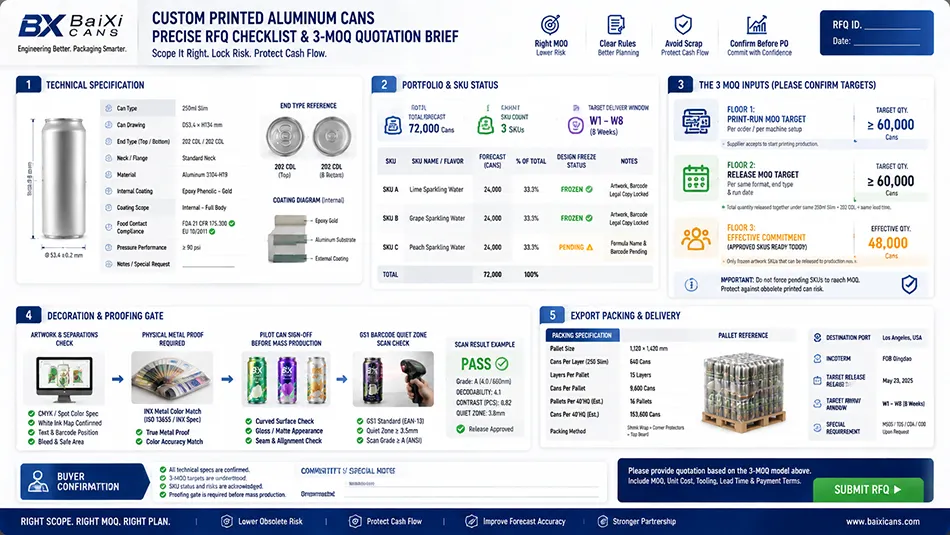
Ask for three quantities, each with its condition. Request the print-run MOQ and its count unit; the release MOQ for the exact body, end, route, and artwork state; and the effective commitment that approved SKUs can use immediately. Then ask the supplier to name the proof, packing, and delivery assumptions attached to each one.
A completed brief lets the supplier identify which documentation and proof steps apply to the actual beverage and market. It also exposes whether a proposed low MOQ is tied to the relevant body, artwork, end, and delivery conditions, or only to an incomplete description of the project. When those details are ready, buyers can send Baixi Cans a scoped custom-can brief.
A supplier's confirmed scope controls the final MOQ. The questions below help narrow the next conversation, but the written quote and approved specifications remain the governing project record.
There is no single standard MOQ for custom printed cans because it is a supplier-specific release condition shaped by route, format, artwork status, and shipping scope. One provider's digital service can be designed for short runs while another supplier's route, size, or packing arrangement has a higher floor. Compare the conditions behind the number, especially whether it is per design, per SKU, or for the total order.
One MOQ can cover several designs only when the supplier confirms how each artwork version, can body, end, and release date are counted within the order. Shared physical specifications can make aggregation possible, yet artwork approval can still divide the quantity that is safe to print now. Put each SKU's status in the RFQ rather than assuming a combined forecast is one releasable run.
Digital printing does not always mean a low MOQ because formats, proof gates, shipping arrangements, and the provider's program still define the workable quantity. It is a route to evaluate, not a universal promise. Ask whether the offered number includes the specific body, finish, artwork count, proof cycle, packing requirement, and delivery point your project needs.
Before comparing minimums, fix the can drawing, end, beverage and market, SKU split, artwork status, approval route, and finished-pack checks. You can still request a planning quote while one SKU is pending, but label it clearly and ask for a separate release condition. That preserves the useful forecast without treating unfinished artwork as a production instruction.

