
A slim beverage can is not a lightweighting shortcut; it is a system change that is only valuable when the serve, end, line, and route still work together. Its narrow, tall silhouette can give a drink a distinct shelf role, but shape alone cannot establish lower material use, easier production, or stronger demand. Buyers get a more useful answer by treating the format as a testable package choice with a defined drinking occasion and a documented operating boundary.
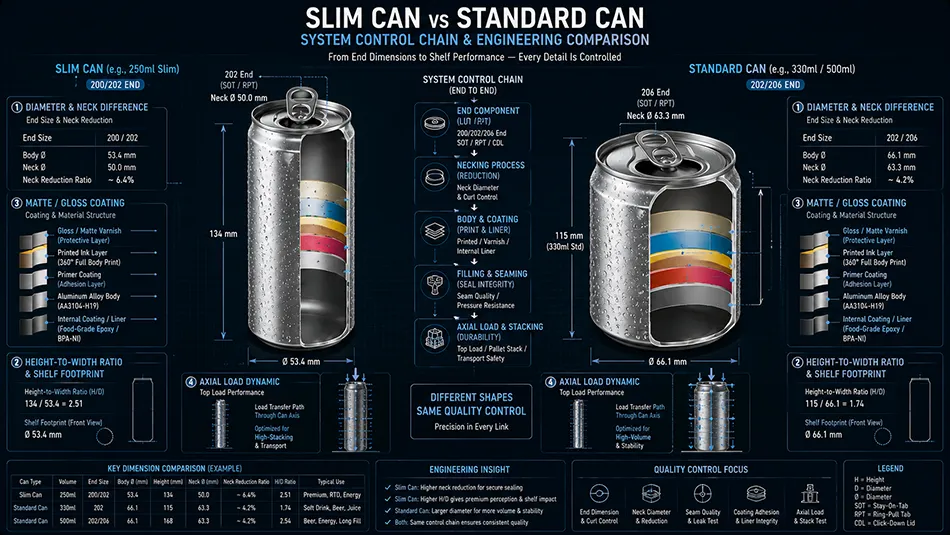
Can Makers describes beverage cans as available in a wide range of sizes and notes a 360-degree printable surface. On its cited industry page, the range runs from 15cl to 56.8cl. That range gives a brand room to make a compact serve look deliberately different on shelf; it does not say which format a market will prefer. A slim can is a narrow-diameter, tall beverage-can format, and its first job is usually to make a specific serving proposition visible before the consumer reads the label.
A slim silhouette is a format signal, not proof of a material or commercial result. A taller body can make a small single serve feel considered, portable, or premium, while a wider standard body may suit a more familiar sharing or value cue. Those are hypotheses about presentation and occasion. They should not become claims about mass, freight cost, or consumer demand until the exact volume, gauge, end, beverage, channel, and route have been compared.
Start with the role the pack must play. Is it a chilled, finish-now drink at a convenience counter? A mixer in a bar program? A functional beverage meant for a desk drawer or a gym bag? Each answer changes the sensible volume, the required visual hierarchy, and the tolerance for a taller pack. If the role is still described only as “premium,” the brief is not ready; premium is an effect to validate, not an operating instruction.
For a concrete starting point from Baixi Cans, a buyer can review a 250 mL slim-can format and ask whether that size supports the intended serve, not whether the silhouette automatically solves the launch. This keeps artwork, sampling, and procurement discussions anchored to a real package option instead of to a generic trend.
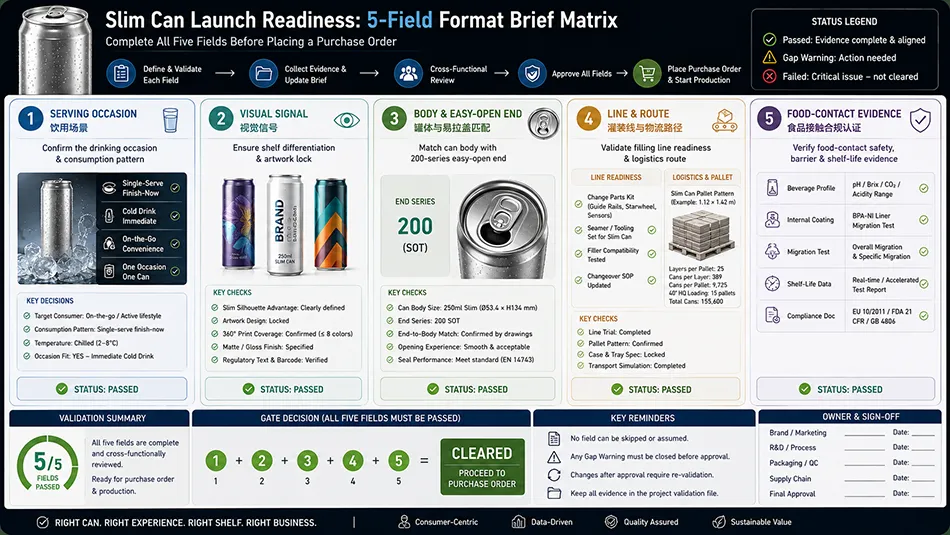
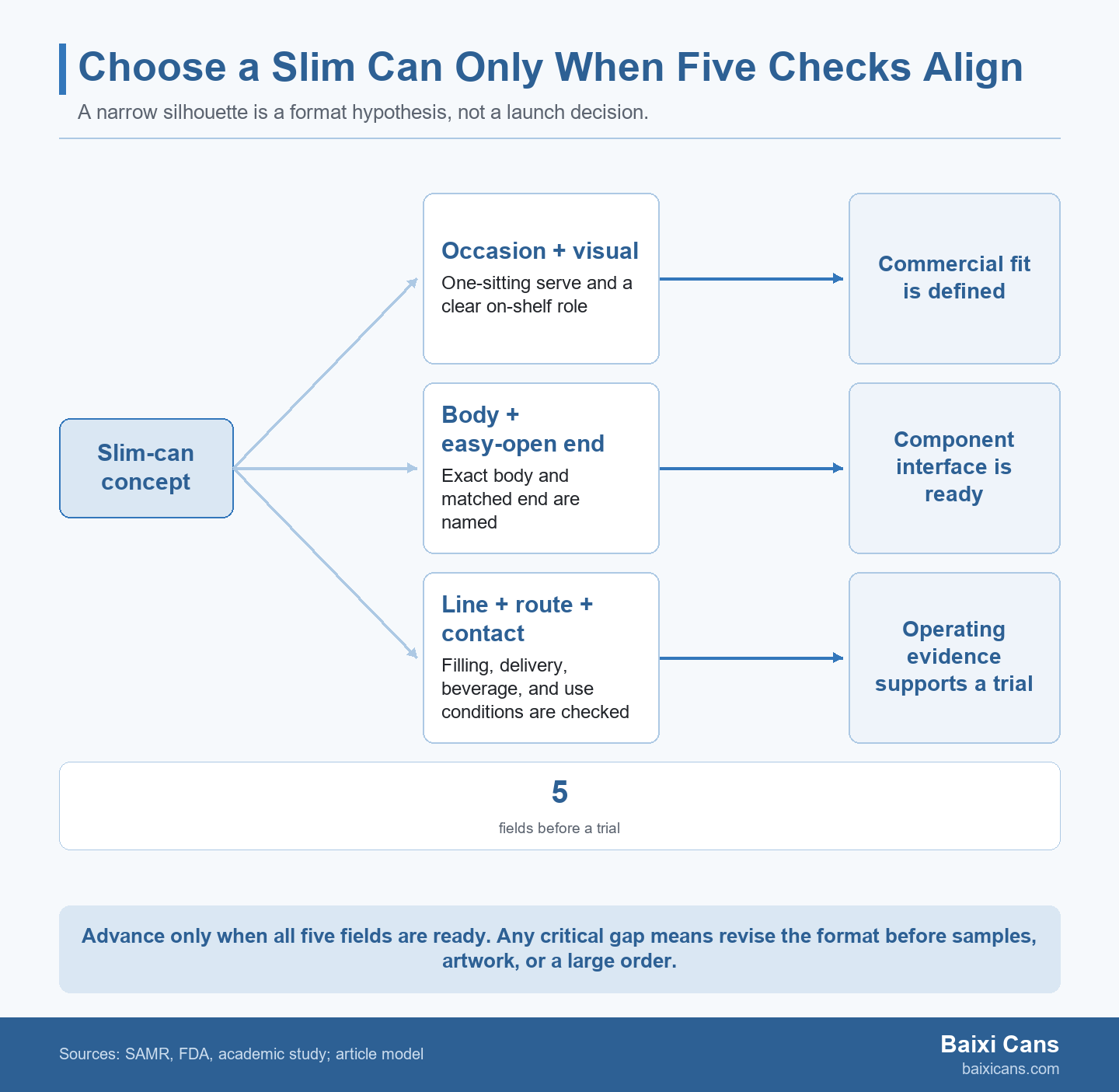
A slim format should pass five fields—occasion, visual signal, body and end, line and route, and food-contact evidence—before it advances. This is a buyer decision rule, not an engineering standard: its purpose is to expose the one unanswered question that could make a visually appealing format impractical. A green light means each field has a named owner and evidence; a critical gap means the launch pauses until that evidence is available.
| Field | What the team must name | What stops the choice |
|---|---|---|
| Occasion | Where, when, and how quickly the drink is consumed | No clear single-serve role |
| Visual signal | What the tall, narrow pack must communicate at shelf | Artwork is compensating for an undefined proposition |
| Body and end | The exact body specification and matched opening component | Body and lid are being chosen independently |
| Line and route | Filling, handling, carton, pallet, and delivery assumptions | Samples have not run through the real operating path |
| Food-contact evidence | Beverage, fill, storage, and market requirements | Intended use is not documented for review |
The value of this sequence is that commercial and technical teams can work from the same page. Marketing can state the serving promise, packaging can freeze the body-and-end pair, operations can define the handling path, and quality or regulatory colleagues can specify the beverage and use conditions. A slim can should move to a production trial only when those statements describe one coherent use case.
A Chinese national-standard project for drawn-can material covers requirements, testing, inspection, packaging, transport, storage, certificates, and ordering documents. That scope is a practical reminder that a can format sits inside a purchasing and verification system. A product photograph or a capacity label cannot replace the specification, inspection plan, and order documentation needed for the exact body.
For the buyer, the useful question is not “Is slim technically better?” It is “Which body dimensions, material details, coating system, neck, end, and performance checks are being supplied for this beverage?” Put those items in the sample request. It gives the supplier a defined target and gives the buyer a basis for comparing samples without assuming that two cans with a similar silhouette are interchangeable.
A SAMR consultation draft groups two-piece can identifiers into 200, 202, and 206 mouth series. Because it is a draft, it is best used here as a nomenclature example rather than evidence of final legal status. It still illustrates a key point: the opening is a defined component interface, not a decorative afterthought.
An easy-open end is the lid component seamed to the beverage-can body and opened by the tab. The body and end therefore need to be agreed as a pair: the buyer should request the exact end series, opening style, lining or coating details where relevant, and the sample configuration being evaluated. Before artwork is approved, compare aluminum can lid options for the selected body against the expected opening experience and the supplier's documented compatibility.
A published experimental study evaluated five commonly used beverage-can sizes with quasi-static axial compression tests. An axial load is the top-to-bottom compression force used to evaluate can strength. The study's test set and method do not predict how a particular slim SKU will perform, but they show why strength should be measured for the chosen geometry rather than inferred from its height.
Ask what happens after filling as well as on the empty sample table. The useful test boundary may include filling pressure, temperature, seaming, accumulation, carton loading, pallet stacking, and the actual delivery route. A tall pack may behave well in one route and need a different secondary-pack configuration in another. The test report should say which condition it represents, so a reassuring result is not quietly applied to a different body, end, beverage, or logistics profile.
A slim body is most coherent when the intended serve, channel, and drinking window all support a compact one-sitting format. That is an editorial decision rule, not a prediction that consumers will prefer every slim can. Its job is to make the team write down the moment of use before it treats a package shape as a brand strategy.
Consider two launches for the same beverage. A chilled 250 mL drink sold at a transit hub may benefit from a pack that feels compact in one hand and clearly finite in one sitting. The same drink sold for a long family meal may need a different volume, reseal expectation, or value cue. Neither use case is inherently better. They are different consumption jobs, and the can should be selected against the job rather than against a visual fashion.
Turn that observation into three questions: What is the buyer doing immediately before purchase? How long is the drink expected to remain open? And what does the consumer compare it with in the same shelf set? The answers help decide whether the slim body is a deliberate signal, a distraction, or simply a more expensive way to reproduce a standard-format occasion. They also protect a brand from assigning a local launch result to “slimness” when price, channel, refrigeration, or promotion changed at the same time.
Sampling should reflect the intended moment. Test a chilled single serve where it will actually be chosen, and let respondents handle the finished package with the planned artwork and fill volume. If the format promise disappears outside that moment, use it narrowly. A specific occasion can still support a profitable and coherent format choice; it just should not be generalized into a universal consumer preference claim.
The Aluminum Association reports that average aluminum beverage-can weight in North America has fallen 38% since the 1970s. This historic association statistic describes a regional, long-term lightweighting trend. It is not a China-specific freight claim, and it does not establish the mass or route performance of any individual slim SKU.
A material lightweighting trend cannot replace a format-specific check of the line, carton, pallet, and delivery route. A narrow body can alter guide contact, change-part needs, pack count per case, headspace in a carton, pallet pattern, and the way loads are secured. The practical question is whether the finished, filled pack completes the intended journey without unacceptable damage, instability, or operating disruption.
Build the trial around the real path. Record the line configuration, filler and seamer settings, accumulation points, inspection checks, case dimensions, pallet pattern, and destination conditions. Then compare the slim and standard candidates under matched beverage and operating conditions. If the team changes the product, line settings, case count, and delivery route all at once, it cannot tell which variable caused the result.
Production context also matters before a buyer turns a sample into a purchase commitment. Use a visit or documentation to ask where body and end checks are recorded, how nonconforming cans are isolated, and what information follows the lot into packing. The aim is not to demand one universal factory process. It is to confirm that the proposed format has an observable path from manufacture through delivery; buyers can then see the can-production workshop context.
FDA describes food-contact review as considering migration and toxicological data for an intended use. This is a U.S. regulatory context, not a global compliance approval. It explains why a buyer must identify the applicable market and exact material system rather than asking a supplier whether a generic “slim can” is compliant.
FDA food-contact tables distinguish beverage categories and use conditions including hot fill, room-temperature storage, refrigeration, and freezing. The food-contact reference tables are likewise a U.S. reference, but they make the input categories clear. The beverage, carbonation or acidity where relevant, fill process, storage temperature, intended shelf life, and target market should be recorded before material suitability is reviewed.
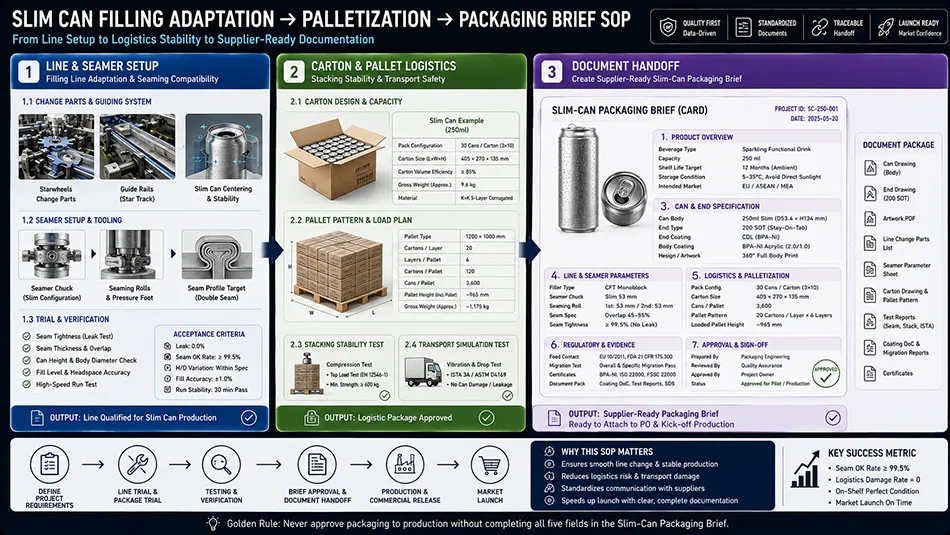
A supplier-ready slim-can brief names the occasion, visual role, body and end, line and route, and beverage-contact conditions. Add the requested volume, planned artwork, sample quantity, test criteria, launch channel, and decision date. This turns an open-ended request for a “premium slim can” into a document that lets sales, technical, quality, and operations teams respond to the same set of assumptions.
A useful brief is short enough to be used and complete enough to reveal omissions. Begin with the beverage and intended serve; follow with the body and end; then state the line and distribution path; finally, name the market-specific food-contact review needed. This order avoids a common handoff failure in which artwork is finalized while the beverage conditions or end configuration are still unknown.
Once those fields are stated, shortlist aluminum can formats against the brief rather than choosing the first tall silhouette that appears to match the artwork. Baixi Cans can then discuss a product configuration against the submitted requirements, while the buyer retains a clear record of which assumptions must be confirmed by samples and tests.
A matched slim-versus-standard trial should hold the beverage and operating conditions constant before the brand attributes a result to the format. That means keeping the formula, fill target, test setting, channel, price treatment, and measurement window as stable as practical. The comparison will not guarantee demand or technical performance; it gives the team a disciplined way to find out which observed differences belong to the package choice.
Set the trial decision before samples arrive. For commercial fit, define the purchase moment, target channel, sell-through observation, and the comparison format. For operations, define the line run, change parts, fill and seam checks, case and pallet configuration, and delivery route. For food-contact review, identify the beverage and use conditions that must be assessed for the target market. A result without those boundaries may sound positive while answering a question nobody actually needs to decide.
Use three records together: the approved brief, the sample specification, and the trial report. The brief states the intended use; the sample specification says what was made; the report says what happened under stated conditions. When those documents disagree, pause before scaling. When they agree, the supplier conversation can be specific about volume, end, artwork, timing, and evidence. At that point, buyers can review the Baixi Cans service process.
The final decision should separate a pass from a promise. A pass means the chosen package met the defined checks for this beverage, this run, and this route. It does not mean every market, volume, or future line change will behave the same way. Record what was held constant, what changed, what evidence was reviewed, and which conditions would trigger a retest. That record makes a later change in body, end, beverage, or logistics visible instead of allowing it to inherit an old approval by assumption.
For the comparison itself, choose a small set of measures that the team can act on. Commercial measures might include off-shelf visibility, purchase conversion in the intended channel, and whether the selected volume is finished in the expected window. Operating measures might include reject reasons, changeover time, seam checks, case damage, and pallet stability. Review the results by condition, not as one blended score. A strong shelf response cannot erase a line problem, and a smooth production run cannot prove that the occasion proposition is credible. The useful outcome is a documented decision about whether to proceed, revise the configuration, or stop the trial. Keep that decision record with the order file so later changes begin from the same evidence.
If the five fields are complete, the next conversation can be productive: bring the intended volume, beverage and fill conditions, selected body-and-end pair, artwork status, line assumptions, route, sample need, and target market. To move from an attractive silhouette to a supplier-ready decision, review your slim-can brief with Baixi Cans.
No. A slim silhouette does not by itself tell you the finished can's mass or total packaging efficiency. Mass depends on the exact body dimensions, material specification, end, and manufacturing design, while packaging efficiency also depends on case count, pallet pattern, and the delivery route. Compare the finished package specification and test evidence instead of inferring a result from shape.
Sometimes, but the line should be confirmed for the exact body, end, guides, change parts, and operating conditions before production. A successful empty-can check is not enough. Run representative filled samples through the relevant filling, seaming, handling, case-packing, and pallet stages, then document the settings and conditions represented by the result.
A slim format can suit beverages built around a compact single serve, but the beverage, fill process, carbonation, storage, and channel still need format-specific review. The commercial fit starts with the drinking occasion; the technical fit then depends on the exact package system and intended use. Do not treat the format as a universal match for a beverage category.
Name the volume, beverage and fill conditions, body-and-end choice, line and route assumptions, channel, artwork, and sample or test request. Also state the target market and the evidence needed before approval. A complete brief gives every party the same working assumptions and makes it easier to identify what still needs confirmation before a production commitment.

