
The reliable way to avoid bulging food cans is to control the product and package system before distribution—and to treat any bulge that does appear as a containment signal before trying to name its cause. A changed can shape can be linked to microbial gas, product-metal chemistry, or physical distortion. Those routes can look similar from the outside, yet they require different records and a qualified food-safety decision. Appearance alone cannot clear the product.
A bulging food can is a hold signal, not a visual root-cause label. Keep the affected product traceable, preserve the matching records, and let the responsible food manufacturer decide the next step through its qualified process. Prevention becomes more dependable when the team reviews the product and approved process, the closure, product-container compatibility, and handling or storage as one connected record set.
Swelling can result from chemical reaction or bacteria, so appearance cannot establish a safe cause or disposition. FDA inspection guidance notes that gas production and swelling may come from chemical reaction or bacteria, including bacteria that may or may not produce toxins. It also distinguishes several visible swell conditions; those labels help an investigation describe what it sees, but they do not replace the investigation itself.
For a commercial product, a hold means removing the affected coded product from normal use while keeping its identity and associated evidence intact. That evidence can include the product code, production and packaging records, closure observations, retained material where the approved program provides for it, and the storage or distribution history. The purpose is not to create a blanket recall rule from a single visual sign; it is to stop an unqualified release or explanation from outrunning the evidence.
For consumers, the boundary is simpler: FDA says not to buy a food can that looks swollen or bulged because the condition may indicate dangerous bacteria. The agency’s consumer guidance supports a cautious response, not a do-it-yourself diagnosis. A commercial team should likewise avoid treating a smell, an external dent, or a statement that the issue is “only corrosion” as the final answer.
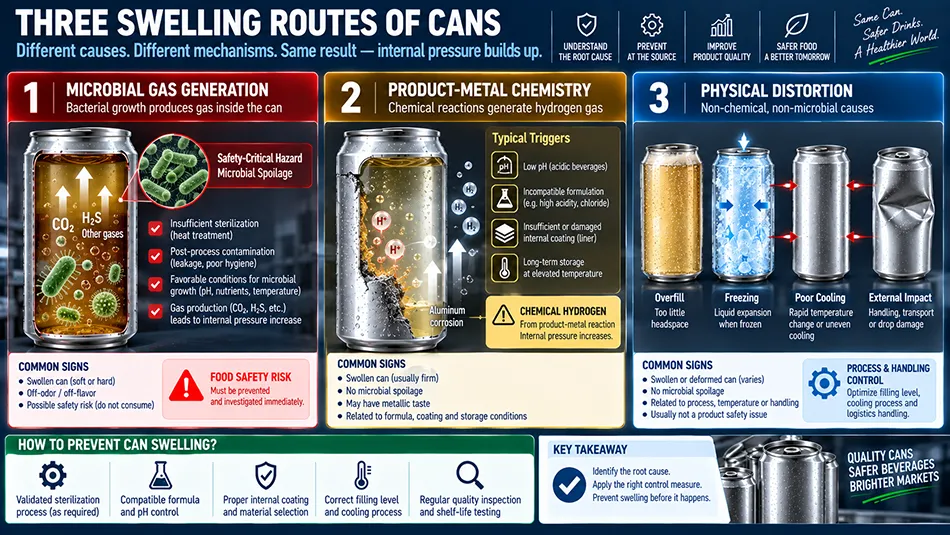
Microbial spoilage, product-metal chemical reactions and physical distortion need different records before corrective action is selected. FDA’s canned-food examination guidance identifies microbial spoilage and hydrogen from product-metal interaction as principal swelling routes, while also noting non-spoilage shape changes. The useful question is not “what does this bulge look like?” but “which evidence path could confirm or rule out the relevant route for this exact product, container, code, and distribution history?”
A possible microbial route remains safety-critical and cannot be cleared by an apparent alternative explanation. FDA’s Bacteriological Analytical Manual identifies microbial spoilage and hydrogen produced when product acids interact with can metal as principal causes of swelling. It also points to leakage or underprocessing as paths relevant to microbial spoilage. FDA’s canned-food examination guidance therefore supports a simple operating rule: preserve the product and process context first, then let qualified food-safety personnel determine what evidence and disposition process apply.
This distinction matters because a packaging observation is only one part of a food investigation. A visibly intact body does not independently prove that the process was effective, and a suspected product reaction does not independently remove a microbial concern. The food manufacturer or responsible processor must retain control of that assessment, including the scope of any further review.
Hydrogen, fill, cooling, freezing and damage need different records; exterior appearance does not confirm which route applies. FDA’s laboratory guidance notes that hydrogen can arise from interaction between product acids and can metal, while overfill, cooling effects, dents, freezing, and other handling conditions can change a container’s shape. That is why an investigation should request the matching record family rather than infer a cause from the profile of one can.
For example, a product-container question belongs with the formula, internal package system, intended storage, and any approved compatibility evidence. A fill or cooling question belongs with the applicable production record. A freezing or impact question belongs with the traceable storage and distribution path. Each route may produce a different corrective action, but none authorizes a safety conclusion before the responsible food manufacturer completes its review. Qingdao Baixi Industry (Baixi Cans) can consider a later beverage-format request only as a documented packaging question, not as a food-safety decision. For that future project, it is still useful to review aluminum can lid formats against the documented package requirement; that component discussion must remain separate from the food-safety investigation.
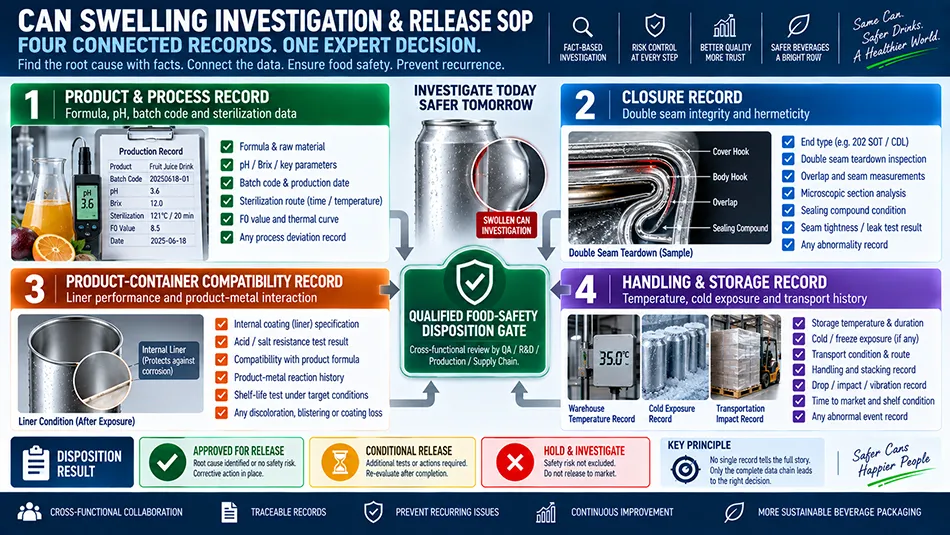
In US low-acid canned-food context, prevention controls begin with a defined product, container method, process and record scope. FDA describes scheduled processes in relation to each product, product style, container size or type, and method. FDA’s low-acid and acidified-food guidance and 21 CFR Part 113 are US-specific context, not global legal advice; they illustrate why a generic can checklist cannot replace the approved controls for the exact food and package.
The following four records are a practical editorial model for keeping prevention and investigation connected:
Closure observations and complete analysis matter because one observed seam defect does not establish the cause of a swelling event. FDA guidance calls for regular observations for gross closure defects during production, while its seam-defect policy says a complete analysis is needed to determine significance. Read those points together: closure observations and complete seam analysis are evidence inputs, not a single-feature verdict.
Four connected records—product/process, closure, compatibility and handling/storage—make prevention and investigation more decision-ready. The model is not a regulation, sampling plan, or release standard. Its value is that it tells the team what must travel together before a suspected cause, corrective action, or packaging change is discussed as if it were settled.
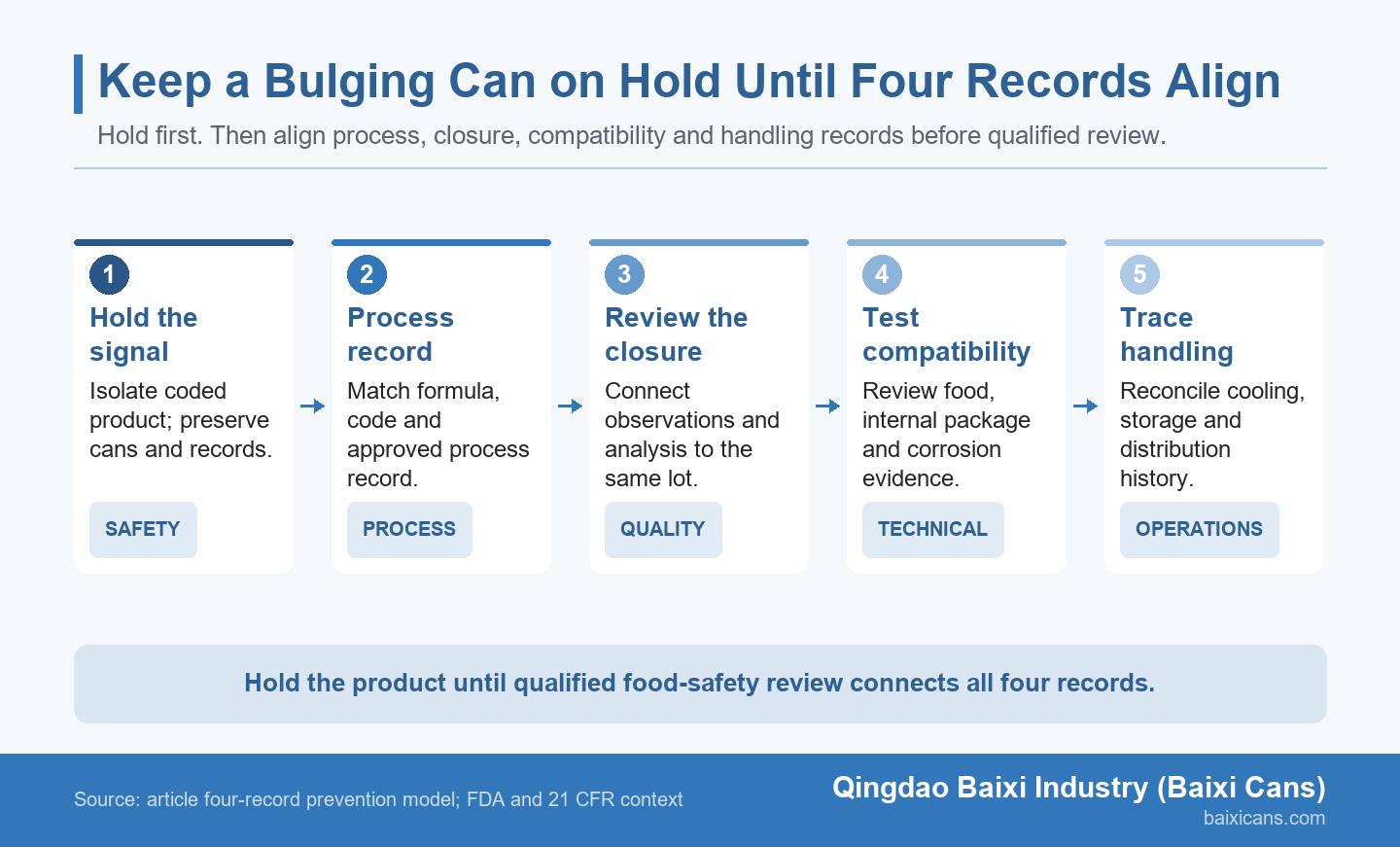
A coded-window trend should be contained and reconciled across records before qualified personnel decide scope or disposition. The following situation is an illustrative example, not a customer case or a recommended sampling procedure. It shows how a traceable signal becomes an evidence review rather than an immediate guess about corrosion, handling, or a closure issue.
The illustrated code-window reports remain in hold status until qualified evidence connects product/process, closure, compatibility and handling records. A coded distribution window means the traceable group sharing a product code and distribution timing; it defines where the review starts, not where the conclusion ends.
A food manufacturer and a beverage-format buyer share a shelf-stable product project, but the food manufacturer owns the product process and disposition decisions. In this illustration, a 20,000-unit shelf-stable sauce run has entered distribution when three bulged cans are reported from one coded distribution window. The team has the code and shipment timing, but it has not yet linked the reports to closure analysis, product/process evidence, compatibility review, or handling records.
The 3 bulged-can reports provide a trend worth containing, not a confirmed mechanism. The reported cans are held, and the team preserves the code relationship rather than discarding the observations or classifying them from exterior appearance. The closure and product/process records have not yet been reconciled with the distribution history. It also identifies matching normal containers and the relevant record owners under its own approved program.
The shared code makes a focused review possible but not conclusive. The responsible food manufacturer isolates the coded distribution window and directs a qualified review of the four record families. No one uses apparent corrosion, handling damage, or a supplier statement as a release decision. The aim is to establish whether the evidence supports a cause and an affected scope—not to choose the fastest explanation.
The team reconciles the product and approved-process record, closure observations and analysis, product-container compatibility evidence, and cooling, storage, and distribution history. The beverage-format buyer separately defines any body-and-lid question for a later supplier conversation. Qualified personnel determine the appropriate disposition under the responsible food manufacturer’s program. If the safety question is closed and the buyer needs a new beverage packaging discussion, they can compare aluminum can formats after the product requirement is defined. This is an illustrative example, not a food-safety determination, regulatory advice, product-release instruction, or Baixi customer case.
A packaging supplier can discuss a defined beverage body-and-lid format, while food process, safety investigation and disposition remain with the food manufacturer. A buyer can bring a documented beverage requirement, intended format, and component scope to a packaging conversation without implying that the supplier has approved the food or the production process.
That separation gives both sides a cleaner job. The food manufacturer keeps the approved product and process evidence, the incident review, and the final product decision. The packaging conversation can focus on the requested can body and lid scope, specifications, and the information needed for an agreed format review. It can also record which commercial question remains after the safety work is closed: a format comparison, an end-component choice, or a specification discussion. This extra definition is useful because it keeps a supplier response connected to a stated requirement rather than to an unresolved product condition. It also makes clear whether the buyer needs a format reference, a component comparison, or a specification discussion before asking for any commercial response. The request should state the product category, intended format, component scope, target market, and the record owner for every remaining technical question. Buyers who need that controlled handoff can follow a packaging service process built around an agreed specification rather than treating a general product page as food-safety proof.
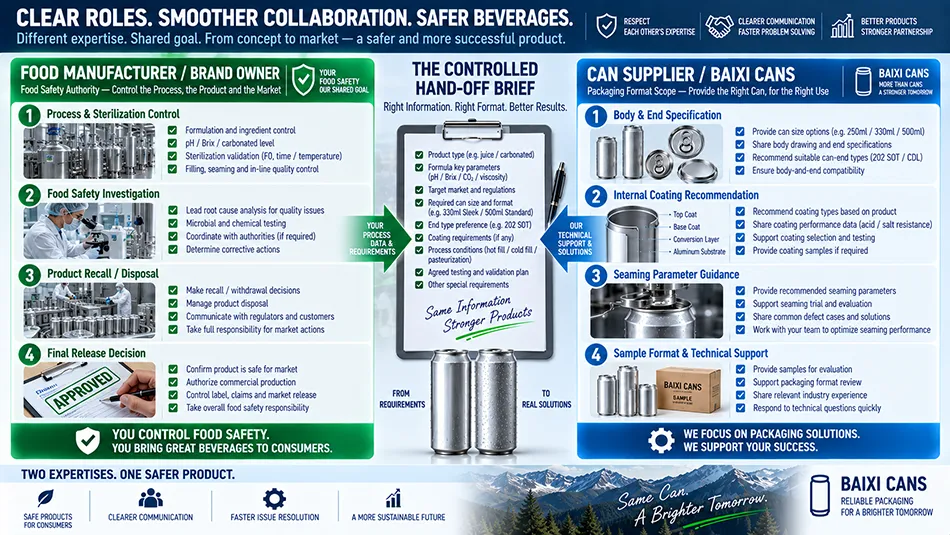
A four-record brief lets a buyer request a bounded beverage-format review without asking the supplier to make a food-safety decision. Before discussing a can body or lid change, state the intended beverage and filling context, the exact body-and-lid scope, the target market, and which product/process, closure, compatibility, and handling facts are already owned by the responsible food team.
A useful brief also states what is still unresolved. If a bulging-can review is active, say that plainly and keep the food-safety investigation with its responsible owner. If the investigation has closed and the commercial question is about a future beverage pack, define the action sought from the supplier: format comparison, component scope, or an agreed specification discussion. This prevents a supplier request from carrying hidden expectations about laboratory diagnosis, product release, or process approval. It also lets the buyer state who owns each remaining item, when the package decision is needed, and which document should accompany the request.
Qingdao Baixi Industry (Baixi Cans) can review a defined beverage can body-and-lid format against the information supplied for that project. Assemble the intended beverage, format, lid scope, target market, and documented package requirements before starting that conversation. When the responsible food team has completed its own safety and process work, request a format-and-evidence review for a beverage can project.
No safety conclusion should be made from an apparent corrosion explanation alone. Product-metal chemistry can be one route worth reviewing, but a bulge does not independently rule out microbial spoilage, closure concerns, or a process issue. The responsible food manufacturer should keep the product in its qualified review path and determine the appropriate disposition from evidence for the exact product and package.
Check four connected records: the product and approved process, closure evidence, product-container compatibility, and handling or storage history. The practical value comes from linking each record to the same product, code, and distribution timing. A file that lists only a can observation or only a suspected cause is incomplete because it cannot show how the visible signal relates to the full system.
Yes. Fill conditions, cooling effects, dents, freezing, and physical damage can affect can shape, but they do not settle the safety question from appearance alone. Treat the observation as a reason to preserve the matching process and handling evidence. The responsible food manufacturer then determines whether the evidence supports a physical route, requires another review path, or defines a wider affected scope.
A supplier can review a defined beverage can body-and-lid requirement, including the requested format and component scope. The food manufacturer retains responsibility for product safety, approved process records, incident investigation, and product disposition. Keeping those roles separate lets the buyer have a useful packaging conversation without suggesting that a can format or supplier statement has resolved an unresolved food-safety question.

