
Beverage can reorder planning starts with the production mix, not the total number of empty cans in the warehouse. Check each SKU’s usable bodies against its demand, allocate compatible shared ends once, and count incoming components only when they will be available for use. Then separate the immediate material gap from the trigger for the following replenishment.
The worksheet below shows why those distinctions matter: both printed-body stocks cover their planned runs, yet the common end pool is short. It also shows how a buyer can need to review another body order before the current bodies run out.
What the Replenishment Calculation Should Tell You
- Which body SKU or shared end pool first falls short, and on which use date.
- Whether replenishment needs review even while the scheduled run remains covered.
- Whether the proposed receipt quantity fits the actual packing and available storage.
Start With Production Demand by SKU
Build the component balance from SKU-level production demand after accounting for usable finished goods and forecast overlap. SKU means stock keeping unit: here, a specific beverage variant and packaging format. Orders already covered by finished goods do not create another empty-can requirement; orders already represented in the forecast should not be added to that forecast in full.
For each planning period, record committed orders, the remaining forecast that those orders have not consumed, and the good units still to be produced. “Good units” means acceptable filled units required from the run, before adding packaging consumption that will not become good output. Keep the demand date attached to the quantity: next week’s beer promotion and a juice launch later in the quarter create different replenishment deadlines.
Forecast treatment depends on the planning method. Microsoft’s Dynamics 365 documentation describes transaction-based reduction of forecast requirements by qualified demand within defined periods. Its None option leaves forecast requirements unreduced. The useful lesson for a manual worksheet is to establish which orders overlap the forecast, rather than assume software has removed every overlap.
For example, suppose a hypothetical SKU has a forecast of 130,000 good units, including 90,000 already ordered. With no finished goods available and no change to the total forecast, the requirement is 90,000 committed units plus 40,000 remaining forecast units: 130,000 to produce. Adding the full forecast to those orders would incorrectly create 220,000 units of demand. If the new order is genuinely additional to the forecast, record that exception explicitly instead.
Keep Printed Bodies Separate and Count Shared Ends Once
Printed bodies belong to their artwork SKU. Two flavours can share a physical can format while still requiring separate body inventories. Ends can form a common pool only where the actual body-and-end combinations are confirmed compatible; that common pool is then allocated across the runs once.
Give every body line its format, specification reference and artwork revision. Give each end pool its exact specification and the body SKUs it can serve. Do not merge end stocks simply because a catalogue uses the same nominal size, or merge printed bodies because both beverages use the same volume. These identifiers determine what the stock can actually supply.
For a repeat 500ml programme, Baixi Cans’ 500ml can reference can identify the product route for an enquiry. Use the current project drawing to establish the matched end; volume alone is insufficient to select it.
The equipment connection is concrete. Dixie Canner’s tooling guidance says additional can sizes require change parts on its double can seamers and requests sample ends for a chuck. That is a statement about the described equipment, not proof of any proposed Baixi combination. For this stock plan, use an already established combination; unresolved compatibility remains a separate supply question.
Finally, define the opening balance consistently. Exclude damaged or otherwise unusable components, nonmatching stock and quantities committed outside the demand shown in the worksheet. Commitments inside the illustrated window belong in that window’s demand; do not subtract them from opening stock and then subtract the same production requirement again. Keep stock awaiting a usability decision separate until its status is known.
Count Receipts in the Period When They Become Usable
Attach an available-for-use date to every incoming lot. A dispatch date, vessel booking or port arrival is not the same as components ready for the planned filling run. For imported supply, allow for the actual transport route, destination handling and delivery to the plant when setting that date.
A useful starting distinction appears in Oracle’s MRP glossary: projected on hand is nettable on-hand quantity plus scheduled receipts minus gross requirements, without creating new planned orders. This differs from a balance that assumes the planning system’s proposed new orders will happen. In the worksheet here, proposed replenishment stays outside the confirmed-receipt base case.
Even a transport booking has a status: Maersk’s booking guidance distinguishes unconfirmed bookings from confirmed bookings. Neither status by itself establishes plant availability. Ask for the current shipment position and expected usable receipt date, and keep uncertain arrivals visible in a separate scenario.
Use a dated ledger for each body SKU and each end pool: closing balance = opening balance + eligible receipts − gross component use. Carry the closing balance into the next period. If a receipt comes after a run within the same week, split that week at the run date; a positive weekly total can otherwise hide a midweek shortage. A later receipt cannot repair an earlier negative balance without changing the production plan.
Useful ledger columns are period or run date, opening units, receipt units, usable receipt date, gross use and closing units. Record the first date the balance becomes negative. That date is more actionable than a month-end shortage alone because it states when additional supply or a revised run is needed.
Keep the exact end identity beside its inbound schedule. When preparing the component request, use Baixi Cans’ can-end specifications and opening options as a catalogue reference, then identify the actual end already established for the project.
Calculate the Body-and-End Gap for the Planned Mix
Consider a hypothetical four-week plan for two printed SKUs, A and B. Good-output demand is 130,000 A units and 90,000 B units, already net of finished goods and forecast overlap. Both use one confirmed compatible end specification. All receipts counted below are assumed available before the first production use in week one. Another 50,000 ends become usable in week five and are excluded from this window.
The loss allowances are assumed component units for this plan: 5,000 A bodies, 4,000 B bodies, 3,500 ends for A and 2,500 ends for B. They are not measured industry rates. Each component budget includes its relevant losses, including paired body/end losses where applicable; do not add a second general loss percentage to the same consumption.
| Planning input or result | A bodies | B bodies | Shared ends |
|---|---|---|---|
| Usable opening inventory | 120,000 | 80,000 | 180,000 |
| Confirmed receipts before first use | 25,000 | 20,000 | 30,000 |
| Total available | 145,000 | 100,000 | 210,000 |
| Planned good output served | 130,000 | 90,000 | 220,000 |
| Component loss allowance | 5,000 | 4,000 | 6,000 |
| Gross component requirement | 135,000 | 94,000 | 226,000 |
| Available minus requirement | +10,000 | +6,000 | −16,000 |
| Immediate component gap | 0 | 0 | 16,000 |
The calculations are deliberately in component units: available = usable opening inventory + eligible confirmed receipts; gross requirement = planned good units + component loss allowance; gap = the greater of zero and gross requirement minus available. Repeat the calculation by date when receipts or use are staggered.
A’s 145,000 bodies cover its 135,000 gross requirement, and B’s 100,000 cover its 94,000. The single pool of 210,000 ends must cover 226,000, leaving a 16,000-end gap. Buying more bodies would not remove that constraint. At the same fixed allowances, bodies support 140,000 A plus 96,000 B good units, or 236,000 combined; ends support only 204,000 against the 220,000-unit plan.
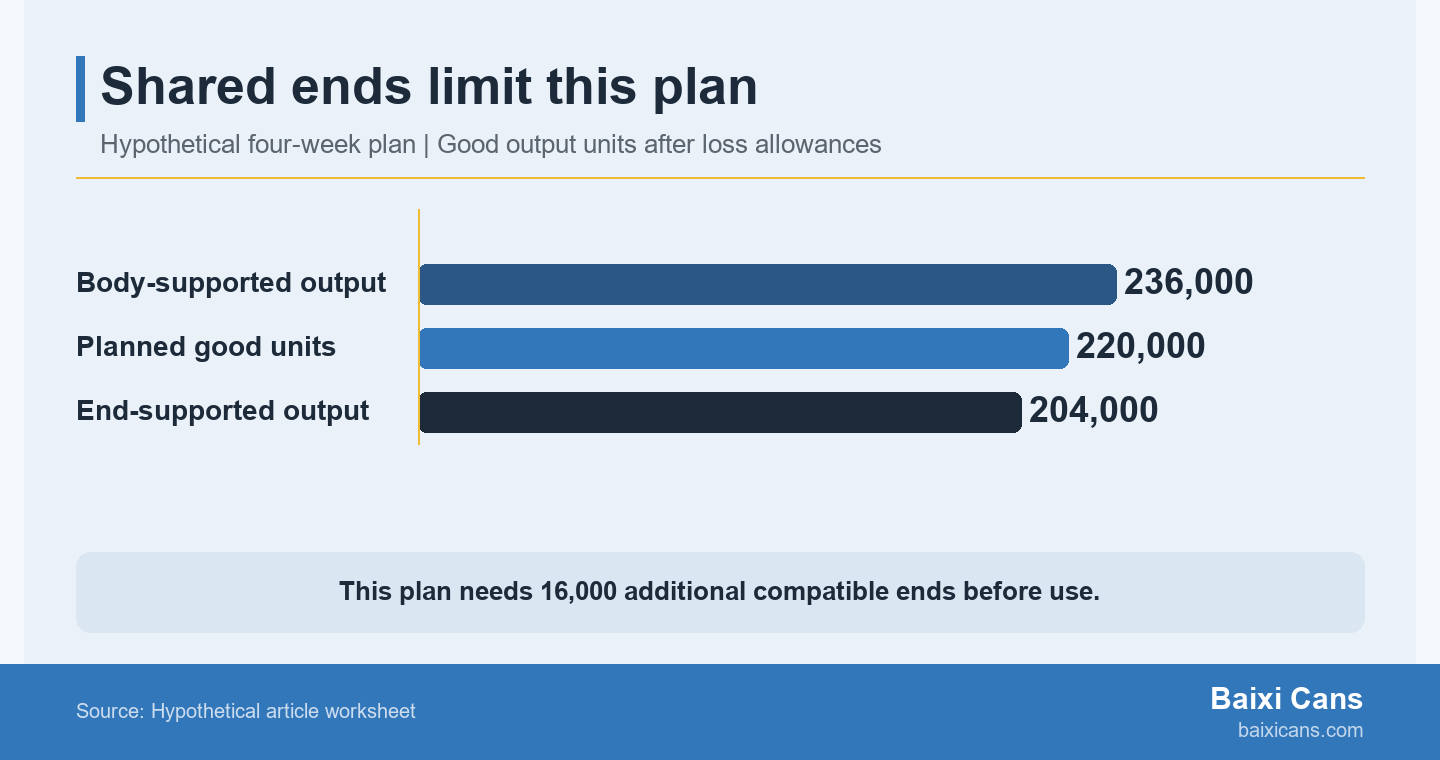
To make the shared pool explicit, allocate B 92,500 ends: 90,000 good units plus its 2,500-end allowance. That leaves 117,500 ends for A; subtract A’s 3,500-end allowance to obtain 114,000 good units, 16,000 below its demand. The allocations sum to 210,000, not two copies of the pool. This is an illustrative allocation, not a recommendation to favour B; a different split changes which SKU is short.
For each SKU, good output supported by the assigned components is the smaller of available bodies minus the body allowance and allocated ends minus the end allowance, floored at zero. These are fixed-budget planning limits, not validated line yields. Recalculate allowances if the run mix or scale changes; the aggregate body figure alone cannot prove a different mix is covered.
If the replenishment proposal changes the manufacturing site, check the applicable certificate holder, site, scope and validity rather than assuming an earlier site document covers the new route. For that specific information, request the applicable manufacturing-site certification documents.
Separate Today’s Shortage From the Reorder Trigger
A material gap asks whether the scheduled run is covered. A reorder trigger asks whether replenishment needs attention while existing material is being consumed. A body can have no immediate gap and still require action for the next cycle.
SAP Learning defines the reorder point as expected material requirements during replenishment lead time plus safety stock. Use the complete time until components become usable in the plan, rather than a production lead-time quotation alone.
For the hypothetical A bodies, gross use is 135,000 over four weeks, averaging 33,750 bodies per week. Assume four weeks of replenishment lead time and a chosen buffer of 20,000 bodies. A continuously monitored trigger is 33,750 × 4 + 20,000 = 155,000 bodies. With no backorders, the example’s inventory position—on-hand units plus firm open receipts minus backorders—is 145,000, below that trigger even though the current body gap is zero.
If the plan is reviewed only weekly, allow for consumption before the next review as well as during lead time. Under the same steady-use assumptions, a periodic-review target is 33,750 × (4 + 1) + 20,000 = 188,750 bodies. This is a protection target, not the same continuous-review trigger. Compare it with the current inventory position when estimating a replenishment need; then check actual dates, order increments and supplier constraints.
An extra week of lead time changes that weekly target to 33,750 × (5 + 1) + 20,000 = 222,500. The example already includes the body loss allowance in gross weekly use; adding it again would overstate consumption. The assumed lead time and buffer are teaching inputs, not Baixi commitments or a statistically validated service level.
Forecasting: Principles and Practice explains that prediction intervals usually widen as the forecast horizon increases. This supports checking uncertainty over the replenishment horizon; it does not establish the 20,000-body buffer. Replace that assumption using relevant demand variation, delivery performance and the chosen service objective. For concentrated promotions or irregular runs, use the dated ledger instead of relying on the smooth weekly average.
Check Storage Space at the Next Receipt Peak
Test storage at the delivery peak, not only at month end. The closing balance may look manageable after production has consumed the stock, while the warehouse cannot accommodate the incoming lot on its arrival date. Related format and packing questions can be explored in Baixi Cans’ beverage-packaging guidance.
Request the actual packing arrangement for bodies and ends separately: units per pallet or other handling unit, footprint and permitted stacking arrangement. For unstacked pallet positions, divide receipt units by confirmed units per pallet and round upward for partial pallets. Adjust the layout calculation only for an agreed stacking arrangement; a generic can count cannot establish floor-space demand.
Carry opening occupied positions forward, deduct positions genuinely freed by consumption before the receipt, and add the incoming packing units. Include the end delivery and other stock sharing the area. Partly used pallets may still occupy full positions, so converting a net component balance directly into fractional floor positions can understate the peak.
A shorter receipt cycle may reduce each arrival’s space requirement, but it also requires feasible supplier quantities, packing and delivery dates. A larger body lot cannot compensate for missing ends. If the proposed lot will not fit, send the actual space constraint and consumption schedule to the supplier and ask what packing or delivery proposal is possible. Treat any alternative as unconfirmed until its quantities and dates are established.
Turn the Rolling Plan Into a Specific Supplier Request
At each planned review, update actual consumption, usable balances, order changes and receipt dates. Recalculate the first shortage date, then rerun the reorder and storage checks. Bring the review forward if a major run is added or a confirmed receipt slips; waiting for the normal cycle would leave the plan based on outdated inputs.
Send a packaging request that includes:
- Can and end specification references, beverage use and current body/end combination.
- Total quantity, quantities per SKU and design, and the first-use dates.
- Printed or unprinted cans, number of designs, artwork revision and existing artwork status.
- Usable stock, current confirmed receipts, the calculated component gap and any storage constraint.
- Project stage, destination, required usable receipt date and contact details.
Ask Baixi Cans to review the requested packaging and confirm what quantities, packing and dates can be proposed, including any unresolved specification or availability questions. Baixi Cans supplies beverage packaging; the request should make the can-and-end need clear without assuming reserved stock or a guaranteed arrival. With those inputs, request a packaging replenishment proposal.
Frequently Asked Questions
What if reliable loss data is unavailable?
Use a clearly identified provisional allowance for the component, and test a higher-loss scenario before relying on the result. Record the component and period to which it applies, then replace the assumption with relevant consumption records when available. Do not describe the provisional value as measured line performance or quietly use zero because the data is missing.
Can surplus printed bodies for one flavour cover another?
Not when the artwork identifies different products. Keep those bodies separate even if their physical format matches. If an existing unprinted-body route supplies several variants, track its shared body pool once and separately check the required label or sleeve quantities and dimensions. Unprinted does not mean bare or uncoated aluminum.
Does the calculated shortage equal the purchase quantity?
No. The gap must be reconciled with supplier minimums, packing increments and usable receipt dates. Baixi Cans’ custom-can minimum is 300,000 cans, with no below-minimum exception. The per-design or combined-order basis is unconfirmed; do not apply that figure to every end or unprinted-can order. The example’s end gap therefore does not establish an end-order minimum or a confirmed order quantity.

