
Before a filling plant moves a candidate end to a live run, it needs a short, traceable decision path. A nominal size can open the conversation, yet the answer depends on the controlled end specification, the configuration on the actual station, and a documented trial outcome. This scope prevents a promising sample from becoming an unexamined production change, while leaving release criteria with the plant and the supplier’s package guidance.
A production candidate needs agreement between the end drawing, installed tooling, and a station-specific proof seam. Nominal size is only a screening field: it does not show whether the curl—the turned-in outer edge of the can end that becomes part of the seam—will meet the chuck and roll profiles in the same way as the current end. Before a live run, put the drawing, the tooling identities, and proof-seam evidence beside one another so the team is deciding on one package condition rather than three disconnected records.
That comparison is especially important when a new lid, a different end revision, or a change of filling plant is being considered. A catalogue label can tell a buyer where to start, but it cannot confirm curl geometry, roll contact, or station-to-station repeatability. Treat compatibility as a bounded engineering question: does this identified end run with this identified body and this installed tooling under the supplier’s package guidance?
A useful interface packet identifies the actual end profile and the installed station tooling before a line trial. It should travel as one controlled request between procurement, the end supplier, and the filling plant; otherwise, a drawing can be approved in one email while a different chuck or roll set is assumed on the floor. Qingdao Baixi Industry (Baixi Cans) can be part of that document conversation, but the final acceptance still belongs to the supplier’s package guidance and the plant’s approved seam process.
The countersink is the recessed area of the end that receives support from the chuck during seam formation. Put its specified profile beside the curl and panel information in the packet, then identify which fields come from the supplier’s controlled drawing and which fields must be observed at the filling plant. This distinction is useful when a buyer receives several apparently similar lid options: a commercial description may help shortlist them, while a controlled drawing states the interface that must be compared.
Start by naming the proposed lid format and its document revision, then request the dimensions that govern the working interface. If the purchase team is still choosing a component, first review the available aluminum can lid options and tie the selected option to a drawing request instead of asking whether a generic diameter is “compatible.” The packet should also name the can body, the seamer or station, the purpose of the trial, and who will retain the seam record.
A beverage-can-end geometry description connects curl, countersink, panel, and chuck-wall features. In practical terms, ask for the controlled end drawing or the supplier’s approved geometry record, including its revision, rather than copying dimensions from a quotation or a sample label. A beverage-can-end geometry description illustrates why those features are described as connected parts of one end, not as interchangeable catalogue fields. Record the requested curl dimensions, countersink profile, and any supplier notes that limit the end to a particular tooling family or body configuration. Also ask which revision supersedes an earlier sample, because a correct dimension copied from an obsolete drawing can still lead to the wrong comparison.
The plant-side record identifies the installed chuck, roll set, and station that the candidate end will actually meet. Capture the seamer make or line, active head or station identifier, chuck part number or profile, first-operation roll identifier, second-operation roll identifier, and the last verified tooling condition. Photographs can help resolve labels, but they do not replace the machine record. If a station is being rebuilt, replaced, or adjusted, mark that change in the packet so an earlier proof seam is not silently carried forward. Include the tooling owner or maintenance record reference as well, so a label that cannot be reconciled has a named route for verification before the trial.
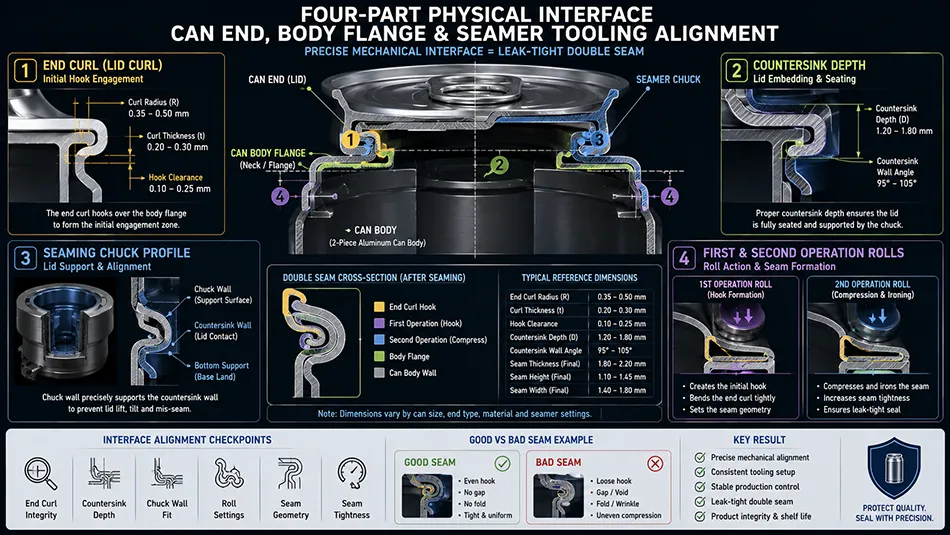
Variation in curl dimensions, countersink depth, and panel height can change interchangeability and the finished seam result. A technical discussion of double-seam interchangeability likewise identifies these end parameters as factors that can interact with tooling condition and setup. The comparison should therefore ask whether the candidate end has the same relevant geometry as the end on which the current set-up evidence was based—not merely whether both use a familiar nominal diameter.
The seaming chuck supports the countersink area while the roll grooves must align with that supported interface. A seaming chuck is the machine support that sits inside the end while the rolls form the seam; its function makes the countersink-to-chuck relationship central to the review. A can-closing-machine description explains the support and roll-alignment mechanism, but it is not a universal setting sheet. Use the supplier’s actual tooling guidance for the package under review.
Roll, curl, body flange, and chuck-wall geometry function as a mechanical interface rather than independent labels. That is why a proven set-up for one body-and-end combination should not be transferred by name alone to another package. The apparatus discussion in this seaming-geometry patent shows the physical relationship between the roll, curl, body flange, and chuck wall. For example, a buyer considering a 250ml slim can format should carry the named body and end into the review rather than assuming that a familiar lid label settles the interface question.
A controlled proof seam tests whether the identified end and installed tooling produce evidence for the same package condition. Here, the term means a controlled trial seam made to test a specified end, body, tooling set, and station—not a general sign-off for every later production run. State the objective before starting: confirm the proposed end-to-tooling interface, compare a changed end revision, or establish evidence for a specific active head. Before bringing the product-format example into the trial, confirm that samples, line condition, and inspection ownership are available; this reduces the cost of rerunning an ambiguous test. Add a short station sheet that records the intended body and end pairing, relevant drawing revision, head number, tooling identifiers, sample count, and inspection route. Record whether the trial is a screening comparison or a decision-support check, because those purposes need different next actions when a result is incomplete. Where the plant has several active heads, assign each sample to a head before teardown rather than reconstructing that detail later from memory. Note the exact line speed, observation method, and any adjustment made during the run. These operational details do not create a universal setting, but they let reviewers reliably determine whether a later result represents the same configuration or needs its own controlled comparison. A buyer evaluating the 500ml custom can format under consideration should use the same discipline: name the body, end, station, and trial objective in the record.
Keep the proof bounded. Record the end and body identifiers, tooling IDs, operator or technical owner, date, line condition, sample identifiers, and the observations required by the plant and supplier. If several stations are active, a good seam from one station is evidence for that station only until the others are represented. This turns a “trial passed” statement into an inspectable record that another team can review.
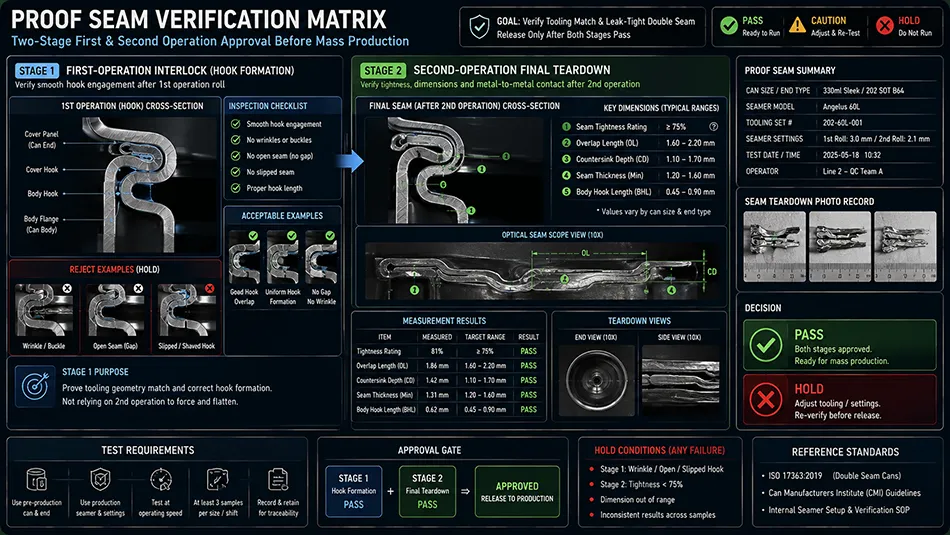
The first operation establishes the initial interlock, and a final seam should be judged with the supplier’s guidance plus visual and teardown evidence. The first-operation roll is the roll that starts the interlock between the end curl and the body flange, so it can reveal an interface issue before final compression makes the seam look more finished. The FDA’s seam-inspection guidance describes the basic formation and evaluation logic: measurements work alongside visual examination and teardown, within the applicable process and supplier criteria. Record what was observed before the second operation, because that note makes it easier to distinguish an interface question from a later compression adjustment.
A proof seam supports only the documented end, body, tooling set, and station condition that it actually represents. The second-operation roll is the roll that finishes and compresses the seam; it should confirm a properly formed interface, not be used to rationalize an unresolved first-operation concern. When the first-operation observation, teardown, or supplier guidance points to a mismatch, hold the trial record open, identify the condition that changed, and request the next evidence step. Do not copy a passing result to a different head, body, end revision, or tooling change without a documented basis.
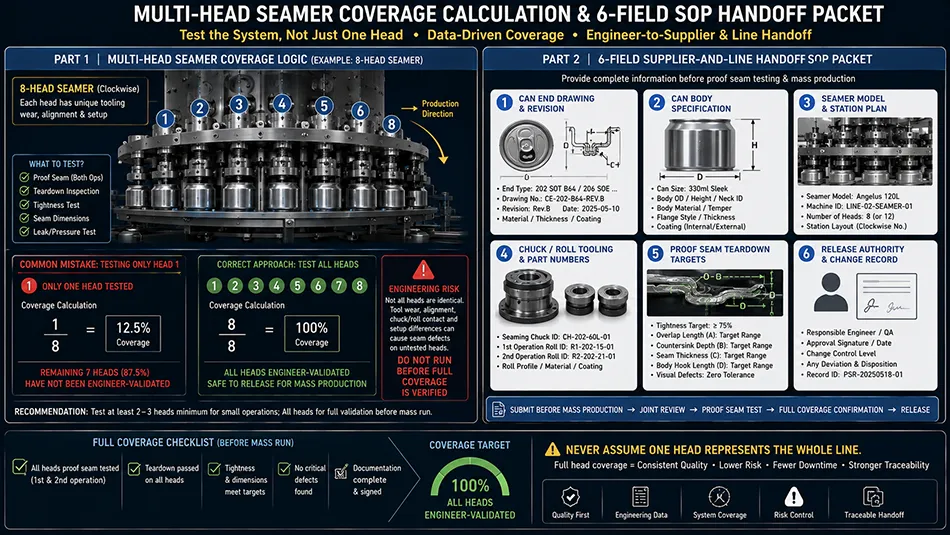
Dimensions alone do not complete seam evaluation; visual and teardown observations are also needed, and damage to the curl can interfere with formation. The Canadian Food Inspection Agency’s metal-can defect guidance provides the same useful boundary: curl, flange, overlap, tightness, and physical observations belong in the evaluation. Apply the plant’s and supplier’s approved criteria; this checklist does not introduce a defect threshold or replace their technical authority. The practical cost of missing an observation is an unresolved compatibility decision and a possible repeat trial; the verifiable outcome is a complete record for the named condition.
On an illustrative eight-head seamer, one active head without a proof record leaves 12.5% of head coverage undocumented, not a 12.5% defect-rate estimate. This is simple coverage arithmetic: one unrepresented station divided by eight active stations. It is useful because it prevents a team from describing a line as fully covered when an active head has no matching evidence. It does not predict defects, set a sampling plan, or replace the release decision for the actual package.
The trade-off is practical: a short hold can delay a changeover, but proceeding with an unnamed drawing, unknown tooling, or incomplete station coverage makes any later result harder to explain. The verifiable outcome is a record that names the approved comparison condition and the active heads it covers. Continue only when the required records agree for the stated condition. Adjust only when the changed setting and the next verification are both recorded. Hold when the team cannot identify what changed or what evidence would close the gap. Qingdao Baixi Industry (Baixi Cans) can then receive a bounded technical question instead of an unsupported request for a universal setting.
| Evidence condition | Next action | What the record can support |
|---|---|---|
| Drawing, tooling identity, and representative proof seam agree | Continue under the approved package guidance | A documented compatibility discussion for the named condition |
| One record conflicts or a condition changed | Adjust only with a stated reason, then repeat the appropriate check | A bounded investigation, not an automatic transfer of the old result |
| A drawing, tooling identity, station record, or required observation is missing | Hold the live-run decision | A clear request for the evidence still needed |
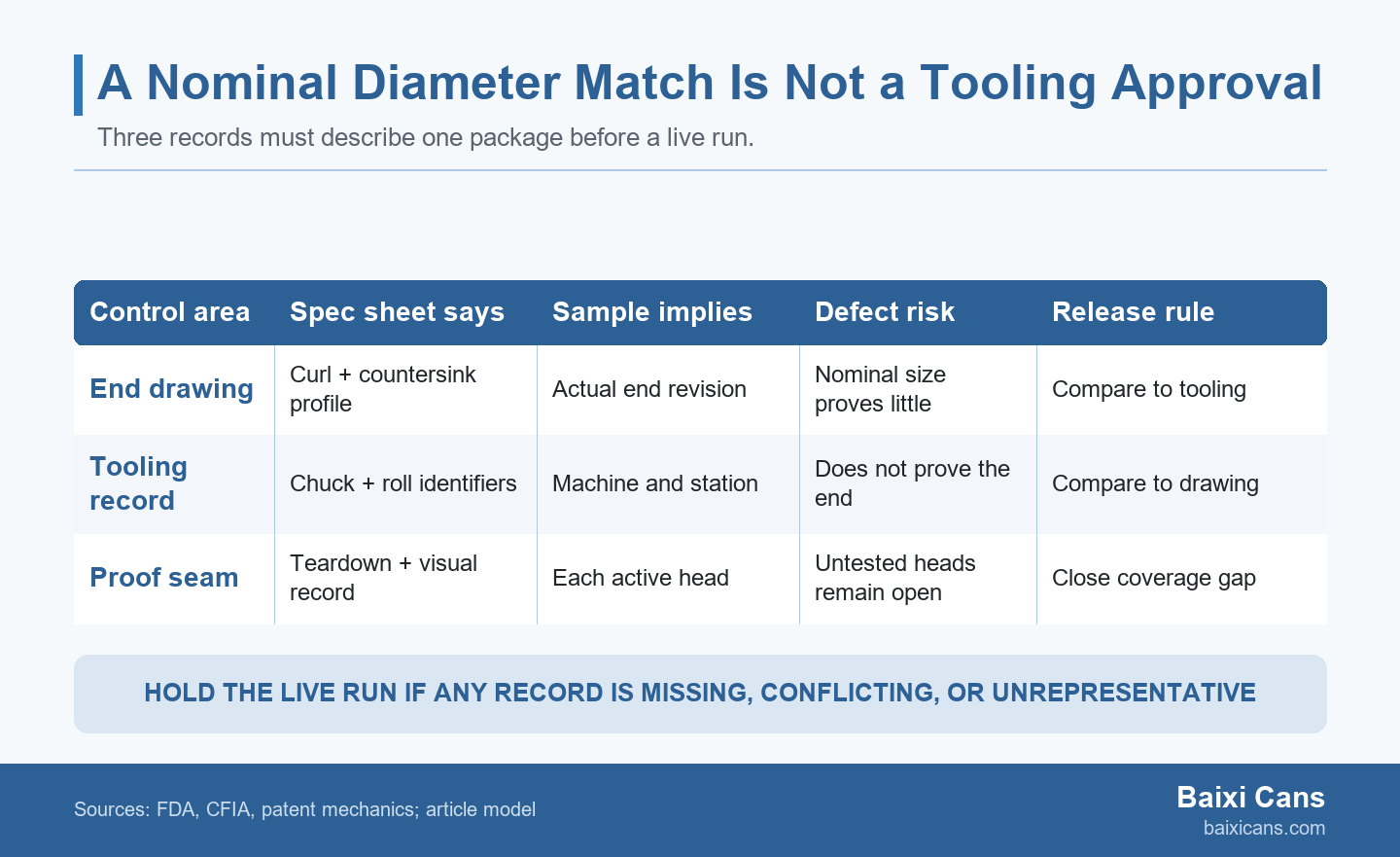
A supplier-and-line handoff should carry the identified end, body format, tooling record, proof objective, and outstanding evidence together. Use one file name or request number so the buyer, supplier, and line team can confirm they are discussing the same revision and station. For a structured commercial-and-technical request, follow a documented supplier-service process after the package details have been assembled; the process should preserve the unresolved compatibility question rather than reducing it to a diameter-only inquiry.
Make the handoff decision-oriented. State whether the team is asking for drawing confirmation, tooling comparison, a controlled proof seam, or help interpreting a documented observation. Attach the revision-controlled end drawing, the can-body format, the seamer and station IDs, chuck and roll identifiers, and the specific issue observed. Then identify the evidence owner and the next deadline. This avoids a common loop in which procurement requests confirmation, engineering asks for a drawing, and the supplier receives a photo with no station identity or trial purpose.
Include a small change log with the request. It should distinguish the candidate end from the current end, list any altered tooling component, and state whether a prior sample is still representative. If the commercial team needs a lead-time or availability discussion, keep that request separate from the technical decision so it does not imply approval. The technical owner can then return one of three clear answers: the paperwork is complete, a comparison is still needed, or the change must be held pending a controlled trial.
Separate supplier documentation from a claim that a component is already approved for the plant’s application. Published documentation can support due diligence; it does not replace a package-specific tooling and seam review. Keeping that boundary explicit helps the supplier respond to the actual question and helps the plant retain ownership of its release criteria. For documentation context that accompanies, rather than substitutes for, the technical packet, review the published certificate information.
Six named inputs make a compatibility discussion format-specific before a supplier or plant changes a setting. Put these items into one request before a technical call so that the answer can be limited to the proposed package and actual line condition. If an item is unknown, mark it as unknown rather than filling the gap with a nominal-size assumption.
Before sending the request, compare the drawing revision and body description against the sample label. Confirm that every tooling identifier belongs to the station that will run the trial, not simply to another head on the same line. State which observations the plant will make, which information the supplier is being asked to provide, and who can decide whether a hold is lifted. This preparation lets the technical discussion begin with a complete question instead of a series of clarifying emails.
With those six inputs prepared, Qingdao Baixi Industry (Baixi Cans) can discuss the candidate format with the right context, while the plant retains its own acceptance and release authority. Keep the request focused on the named body-and-end combination and the stated line condition, then retain the response with the trial documentation. For a format-specific conversation supported by the drawing and line records, request a format-specific lid compatibility review.
No, a matching end diameter cannot establish seamer compatibility on a production line by itself for every active station. It does not show whether the curl, countersink, chuck, body flange, and roll profiles will form an acceptable seam together. Use the diameter to identify the candidate format, then compare the controlled drawing and installed tooling record. A documented trial is still needed for the specific body, end, and active station under review.
Send the seamer make, machine or station identification, current chuck and roll identifiers, body format, the candidate end drawing, and the proof-seam objective. Add the drawing revision, sample identification, and the reason for the comparison, such as a new end revision or line transfer. If the tooling condition has changed, say so. That information helps the supplier respond to the named interface rather than to a generic size request.
No, a good second-operation appearance cannot approve the production setup without the matching first-operation record and teardown evidence. Final compression can make a seam look tighter, but the plant still needs the first-operation observation, applicable teardown findings, and supplier-specific guidance for that package. When an earlier operation shows an unresolved issue, record it and hold the decision until the required follow-up is complete. A final-looking seam is not a substitute for the complete compatibility record.
Hold the line trial when the end drawing or installed-tooling identity is missing, a station has no proof-seam record, or inspection shows a recurring defect outside the approved package guidance. Also hold when the current sample cannot be tied to its body, end revision, or active head. The next action is to name the missing item, assign an owner, and determine whether a controlled repeat trial or a supplier comparison is needed before changing the setting.

