
A QR code on a can lid is not a traceability system. It becomes one only when the marked symbol, the record behind it, and the post-production scan check identify the same lot or unit. The same distinction matters for campaigns: a lid can open a promotion and still fail to retrieve the batch information that operations expected. Treat the mark as a four-part implementation—data, physical symbol, live response, and record—before it becomes a production approval.
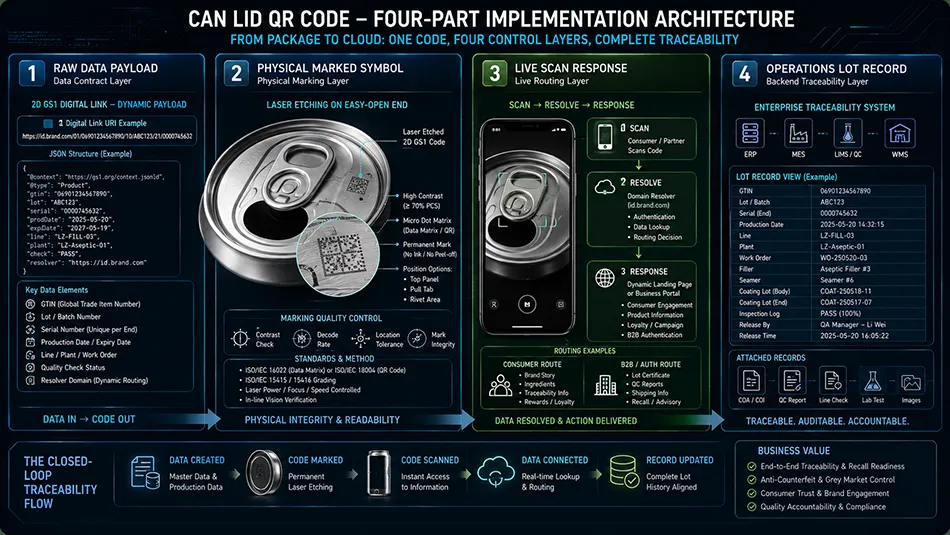
Choose the code's job before deciding what data it carries or how it will be marked. The first supplier question is not simply “Can you put a QR code on this lid?” It is “What must this code do after it is scanned?” A campaign doorway, a lot locator, and a unit-level interaction use different data and require different proof. That is why a buyer should review aluminum can lid options with the code brief in hand, rather than treating the code as a late artwork detail.
| Code job | What the code needs to connect | What the buyer must prove | What it does not prove |
|---|---|---|---|
| Campaign access | A controlled URL or resolver and the intended campaign destination | The marked code decodes and opens the right page on a real device | That a production lot can be identified or recalled |
| Lot lookup | A lot identifier and the record system that returns the matching batch information | The decoded identifier retrieves the intended record for the right authorized user | That a consumer landing page is current or attractive |
| Serialized interaction | A unique identifier, a rules engine, and an exception process | Duplicates, re-scans, and missing records are handled as the program expects | That a generic sample mark represents the final production file |
The practical decision is to name one primary job and any secondary job in the brief. If a marketing team needs a campaign page while quality needs a lot lookup, do not call both requirements “the QR feature.” Give each one an owner, a test result, and a release condition. For a Baixi Cans packaging enquiry, that clarity lets the buyer describe the lid requirement without implying that any marking method or data service has already been approved. It also keeps a short consumer scan from hiding an unresolved operations requirement.
A structured 2D code can carry identifiers and a URI, but the online destination still needs an accountable owner and live test. GS1’s 2D readiness guidance describes QR Code use with Digital Link URI syntax, and the GS1 General Specifications set application requirements for those kinds of data carriers. Those references are useful when a buyer needs a structured identifier; they are not a substitute for confirming what a particular lid and marking process can support.
Write the contract in three lines before a code file is generated. First, state the exact data string or data pattern, including what changes from lot to lot. Second, name the system or person responsible for generating it. Third, state the expected scan response: campaign page, authenticated lot lookup, product information, or another outcome. GS1’s Digital Link guidance explains the value of linking an identifier to online information; the buyer still needs to decide who maintains that information when a campaign changes or a record must be retrieved.
A useful contract also prevents an avoidable sample error. A short static web address may produce a different code pattern from a final payload that includes a lot or serial value. Do not ask a supplier to approve “the same QR” unless the sample file represents the data structure that will actually be marked.
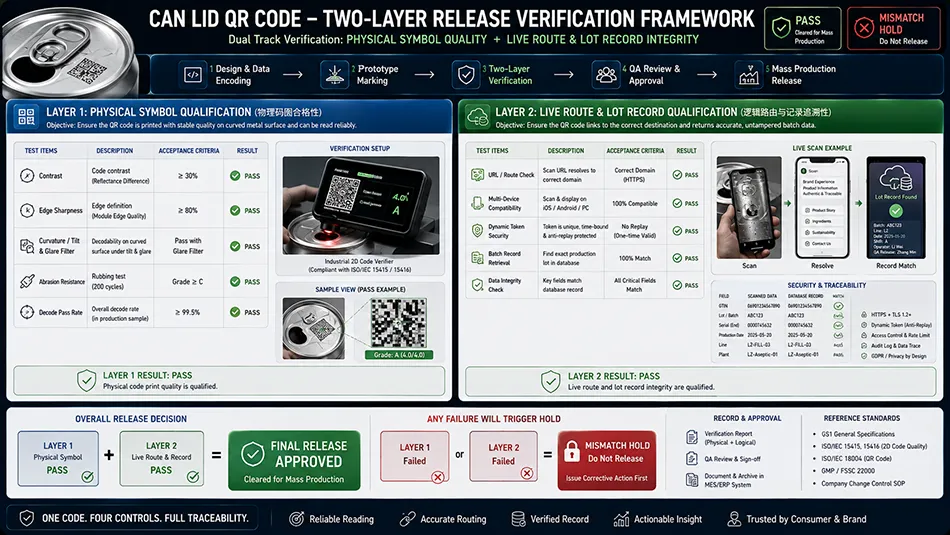
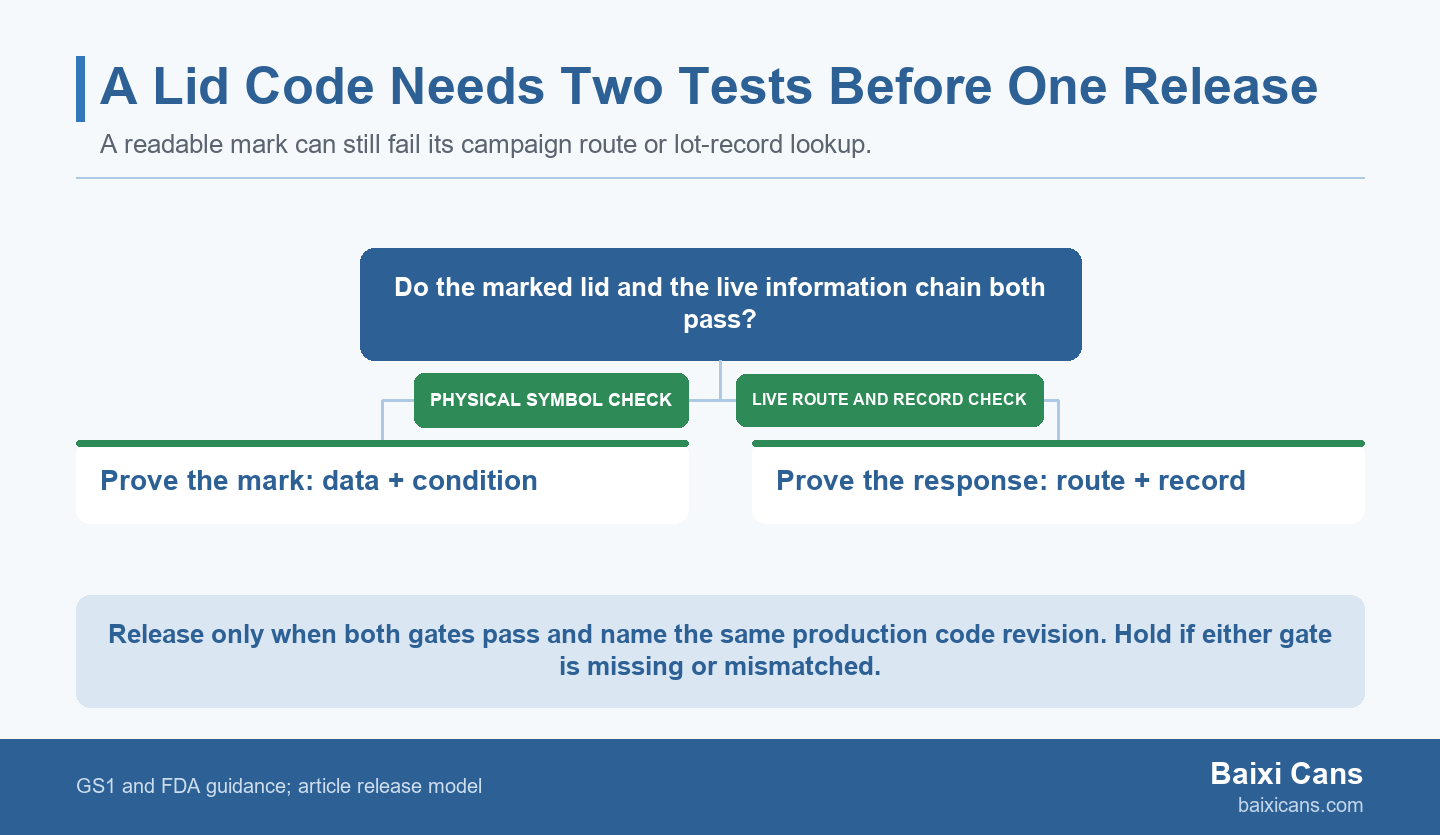
Physical verification checks code properties and decoded data under defined conditions, not just whether one phone scan happened to work. GS1’s 2D readiness guidance explains that 2D verification reports can include decoded data and symbol-quality parameters. The release rule is simple: the production-like symbol must decode as intended, the live scan must reach the intended destination, and the returned lot record must match the code revision that was approved.
Barcode verification does not validate how or where a code sends a scanner on the web. The physical code check and the live response check must remain separate. A production lid can deliver the intended data while the campaign redirect, user permission, or lot-record retrieval still produces the wrong operational outcome. GS1’s 2D retail guidance provides the verification boundary used for this release rule.
Record the physical code's decoded data and quality result under agreed conditions. Symbol verification means checking the physical code and its decoded data under stated test conditions. GS1’s 2D verification guidance frames the work around data and print quality and notes that reflective surfaces can affect measured code quality. For a metal lid, record the actual end, the code content, the viewing or scan condition, the test device or method, and the acceptance decision. A visual mark that looks crisp in a flat photograph may behave differently when the lid is tilted, handled, or exposed to glare.
That does not mean every buyer needs to impose a universal grade, laser setting, or minimum square size. Those values depend on the application and should be agreed with the marking and packaging parties that will produce and use the code. The buyer’s durable requirement is evidence: a result that identifies the marked data, the sample or lot, and the conditions under which it was assessed.
Test the actual destination and lot lookup after the code decodes. A code can decode correctly and still lead to a broken, outdated, unauthorized, or incomplete response. The campaign owner should test the actual redirect and page response, while the operations owner tests whether the decoded identifier retrieves the intended lot record. Record the device, URL or resolver outcome, expected record fields, date, and accountable owner so the response can be retested after the pilot changes.
This two-layer sequence is the article’s central release model. Layer one asks, “Can the physical lid deliver the intended data?” Layer two asks, “Does that data cause the correct live response?” When the program includes traceability, add a third operational observation inside layer two: does the identifier return the correct record, with the correct permission and revision? A green tick on a scanner does not answer that question.
A traceability system depends on linked records and does not require barcode scanning as its only technology. The FDA’s Food Traceability Rule FAQ says that FDA does not prescribe barcode scanning technology for traceability records. Its guidance is a useful boundary for packaging teams: a visible code can improve access, but it does not replace the system that assigns, stores, maintains, and retrieves the record.
For foods within the rule’s defined scope, FDA’s rule overview connects traceability plans and records to critical tracking events, key data elements, and traceability lot codes. That food-rule scope does not automatically impose a beverage-lid QR requirement. The operational question remains specific: after a code is scanned, which system returns which lot information, and who can correct a mismatch?
A record join connects a scanned identifier to the matching production record. For example: “When the pilot code is scanned by the authorized operations user, the returned record identifies the pilot lot, production date, code revision, and exception owner.” The fields will vary by business and market. The important point is that the test returns a named expected result, not just a web page. When campaign data, sample data, and packaging inputs must be coordinated, buyers can also review the packaging service process for coordinated project inputs.
A mark on a specific lid should be qualified with the actual end, code content, marking method, and scan environment rather than a generic sample. The request needs to identify the lid surface proposed for the mark, the exact data pattern, whether the code is static or variable, the anticipated handling path, and the devices that will be used for release checks. The supplier then has a concrete question to confirm, revise, or decline.
Do not turn this into an assumed capability statement. The workable zone, contrast, abrasion resistance, serialization approach, and effect on production cadence all require project-specific confirmation. That is particularly important when a brand pairs a lid-led campaign with a named body format. A buyer considering a slim format can review the printable 250 mL slim can format before finalizing the code brief, then ask how the requested end, body, and code requirements should be evaluated as one package.
Baixi Cans is relevant here because the packaging enquiry should start with a defined can-and-lid requirement, not an open-ended request for “laser QR lids.” The enquiry should be explicit that final process suitability, code placement, and acceptance evidence are subject to supplier confirmation. That protects both the brand’s campaign timetable and the quality team’s release responsibility.
A static sample can pass its limited test while a production-like file still fails the code-to-record release chain. The following example shows why the data pattern, physical lid, live destination, and lot record should be tested together before a pilot moves forward.
A static sample can differ from the production-like data pattern. This illustrative example follows a beverage brand preparing a 12,000-can pilot across 3 held pallets for one named can-and-lid configuration. The team wants the lid QR code to open a campaign page and help operations identify the filled lot. A small sample contains only a short static campaign URL and scans successfully. The pilot file adds a lot-specific identifier, making the code pattern different from the demonstration version. The sample result is useful, but it has not tested the final data pattern.
Before production, the buyer should compare the two files, not just the two images. Does the pilot payload decode to the intended data? Does the actual lid still scan under the agreed viewing and handling conditions? Is the campaign route still correct? The buyer can compare the 500 mL custom can format when defining the pilot scope if that is the named body in the request, but the format page does not replace a trial of the actual end and production-like code file. In the example, the campaign page opens, but the initial lot lookup returns no record, so the buyer holds the 3 pallets rather than distribute a code that cannot deliver the agreed lot response.
The correction is to generate a controlled pilot file, agree the scan conditions, test the decoded string and live destination, and connect the lot identifier to the retrievable production record. The restart threshold is concrete: representative pilot lids decode under the agreed conditions, the live route returns the intended campaign destination, and the identifier retrieves the matching pilot record. The 4 linked implementation checks are the production-like symbol, the live scan, the campaign response, and the matching lot lookup. This is an illustrative decision example, not a Baixi Cans customer case or a claim that this volume, code density, or marking method applies to every project.
A live page is insufficient when its lot identifier cannot retrieve the intended record. The hold remains in place until the code, route, and lookup return one matching pilot result.
This is not a disagreement between marketing and quality; it is a defined release mismatch. The hold gives the owner time to repair the data export, repeat the result on representative pilot lids, and document the restart decision. It does not turn a successful campaign page into an approval for an untested production variation or a general supplier capability claim.
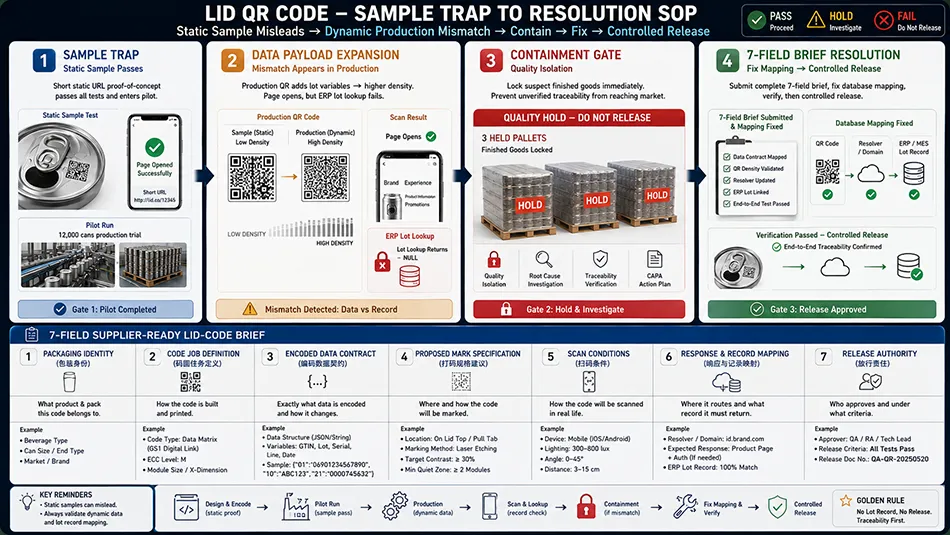
A brief with data, end, mark, scan, record, and owner fields enables a supplier to scope the actual question. It does not prove a capability in advance, but it avoids the costly loop in which a supplier receives a visual concept while operations holds the requirements needed to approve the result.
Baixi Cans can use this level of detail to understand the packaging context of a proposed can-and-lid request; final markability and production suitability still need to be confirmed against the specific project. When the seven fields are ready, send Baixi Cans a lid-code brief for a scoped packaging discussion.
One QR code can serve both a campaign and traceability only when code data, consumer route, and operational record lookup are separately managed. The same scan may open a campaign page and carry an identifier, but the campaign owner still has to maintain the destination and the operations owner still has to prove that the identifier returns the matching lot record. Decide in advance what happens when the page works but the lookup fails, or when the lookup works but the campaign route changes. Treat the combined use as two linked jobs, not one automatic feature.
No, a code can decode correctly while its redirect, page availability, analytics tag, consent behavior, or campaign logic still fails. Test the destination on the devices and conditions that matter to the program, then record the tested URL, result, date, and owner. If the destination can change after production, decide who monitors it and how a broken response is escalated. A campaign test should also confirm that a user reaches the right localized page, not merely that a browser opens a URL. Confirm the intended language, market page, and fallback behavior before the campaign is declared ready.
No, appearance is only one observation and should be paired with agreed symbol, scan, and project-specific suitability checks. A visual review may identify obvious placement or finish concerns, but it cannot establish decoded data, route behavior, lot lookup, or durability under a particular handling path. Ask the supplier to state what can be tested on the named end and what remains to be confirmed. Keep the approved sample, code file revision, and result together so a later mark can be compared against the same decision. The approval sheet should identify the exact end and code revision used for each check.
A useful brief names the end format, code purpose, encoded data, placement request, scan conditions, record owner, and acceptance decision. It should also say whether the production file changes by lot or unit and which live response must be returned after scanning. Add the target market, campaign owner, chosen test devices, pilot quantity, and revision-control method when they affect the requested approval. Those fields let the supplier, marketing team, and operations team identify the same release decision instead of approving separate pieces of the project in isolation. These additions prevent a correct sample from being treated as approval for an untested production variation.

