
Colored can ends and pull tabs give a beverage a recognisable top view before a shopper reads the can body. For a Baixi Cans enquiry, the risk is confusing a color name, a digital rendering, and a production-ready treatment. A useful request identifies the visual target, the evidence appropriate to the route, and the release record for the named end.
Use four linked records: a physical reference, relevant surface evidence, intended-use documentation where it matters, and a final-end release record. None substitutes for another. This lets a buyer ask a supplier clear questions without assuming a color, coating, test result, or approval that has not been confirmed for the project.

Choose the treatment location before you choose a shade, because shell color, tab color, and contrast treatments create different approval questions. The end shell is the formed lid surface around the opening feature. Color on it is a broad top-view signal; color on the pull tab focuses attention on the opening action; a contrast treatment requires both components to look intentional together.
| Treatment | Branding job | Approval focus | Shortcut to avoid |
|---|---|---|---|
| End shell | Large top-view cue | Color, finish, sample revision | Using body artwork as proof of end appearance |
| Pull tab | Opening-detail contrast | Tab treatment and handling evidence | Approving from a rendering alone |
| Shell and tab | Two-part visual system | One combined reference and final record | Approving each component in isolation |
Once the component is clear, it is reasonable to review aluminum can lid options alongside the color brief. Treat the resulting conversation as a request for confirmation, not evidence that every treatment is available.
According to ASTM D2244, purchaser and seller should agree the permissible color tolerance and the procedure used to judge it. A color tolerance is useful only when the reference, method, finish, and review condition are agreed together. That is why a numeric target without a reference and finish is weak procurement language.
Name the colored component, physical swatch or sample, finish, revision, comparison condition, and release owner. Also name the viewing geometry or instrument setting, the sample orientation, and whether the comparison is to a tab, shell, or assembled end. Those fields turn a color request into a record that can be repeated after an artwork handoff, rather than a judgment made from memory. If a campaign combines body graphics with an end treatment, buyers can review the printable 250 mL slim can format before locking the palette; record the body format and end treatment in the same brief rather than relying on a mock-up.
According to the CIE description of CIELAB, the system specifies coordinates for lightness, chroma, hue, and represented color differences. CIELAB is a color-coordinate system that can represent a measured difference between the approved reference and a sample. It provides a shared notation, not a universal pass value.
A glossy shell and a matte tab can look commercially different even when a team sees a similar numerical result. Put the instrument or agreed visual condition, finish, and method into the record. Ask what conditions the supplier can support instead of importing a color-difference limit from another material or print process.
A golden sample becomes a useful control only when its treatment, finish, revision, and review condition are recorded. A golden sample is the signed physical reference used for comparison. It should state what is colored, when the revision was approved, and what sample condition the next lot must be compared against.
Keep the physical reference rather than only a photo. A photo can help trace a revision, but it does not preserve the finish or viewing behavior. Store the reference with its approval date, drawing or artwork revision, component description, and the identity of the approving party. A simple reference register also makes it clear whether a later sample is being compared with a shell, a pull tab, or a complete end assembly. When a coating, finish, or treatment changes, create a new revision instead of treating a color family as a released specification.
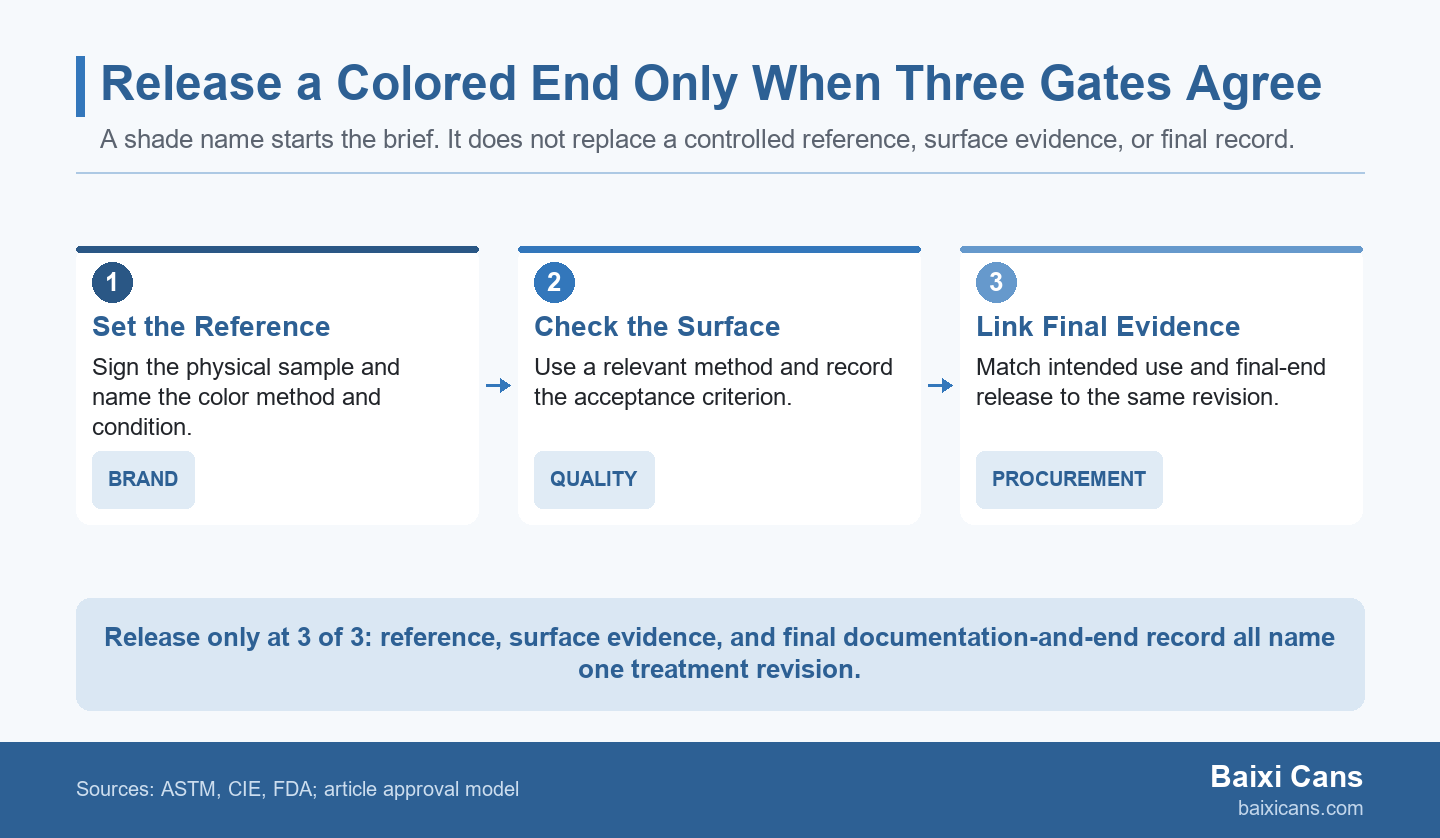
A surface check can support one defined question, but it cannot replace color approval, intended-use documentation, or final-end release evidence. Choose the check because it addresses a real handling or route risk, not because a long test list looks reassuring. The expected route, storage condition, and buyer acceptance rule should be named first.
Readers who need adjacent packaging terminology can browse related aluminum can packaging guidance. The key decision remains narrow: what surface behavior needs evidence for this treatment and this route?
According to ASTM D3359, tape methods assess whether a coating’s adhesion to a substrate is adequate for the intended application, rather than measuring a complete durability outcome. Adhesion evidence answers a defined coating-separation question; it is not a universal durability certificate for the colored treatment. The standard’s 2017 listing also explains that the method does not give an absolute bond-rupture force.
Record the chosen method, sample condition, result, and agreed decision. Include which coating layer was examined, who performed the check, and which visual classification or pass rule applies. Do not turn a pass into an unsupported “scratch-proof” or “durable” claim. That distinction avoids handing an end treatment a promise the test was never designed to make. It also lets the buyer compare a repeat check with the same procedure instead of a label that only says “tested.”
According to ASTM B117, salt fog is a controlled corrosive environment and should not be used alone as a natural-environment predictor. According to ASTM G154, ultraviolet exposure must be interpreted with its stated conditions. Use exposure evidence only with its stated conditions and route relevance; do not treat it as a stand-alone prediction of every service outcome.
An indoor short-run promotion may need a different conversation from a product facing long storage, bright light, or coastal distribution. Request only evidence that fits the actual route, then record the conditions and owner. Generic exposure language cannot replace a project-specific acceptance decision.
According to the FDA’s guidance on food-contact material components, review turns on the individual substances in the article and their intended use. If food-contact documentation is relevant, ask for records that identify the actual component and intended conditions of use.
This is a sourcing boundary, not legal advice. State the beverage, market, component, and intended conditions in the enquiry. General credentials can be useful due diligence, but they do not automatically answer a component-specific question. You can review available certification information for supplier due diligence while keeping the project documentation request separate.

Release a colored end treatment only when the reference, surface evidence, intended-use record, and final-end release all identify the same revision. This is a buyer control, not a new standard. It prevents a signed swatch, test sheet, statement, and final-end record from silently describing four different treatments.
Use a short release sheet to connect the signed physical reference; the surface evidence chosen for the actual route; the intended-use documentation if it applies; and the final end or closure record. According to the FDA closure-inspection guidance, final-container review combines visual examination with measurements. That is a useful reminder that an appearance sample alone is not the final evidence for a finished end.
Assign a release owner who can answer one question: do all four records name this exact treatment and end revision? When a project needs coordinated artwork, samples, and technical inputs, buyers can review the packaging service process for coordinated inputs.
Include the can format too. A color treatment does not replace a body-and-end requirement. For a second visible format reference, compare the 500 mL custom can format in the release brief.
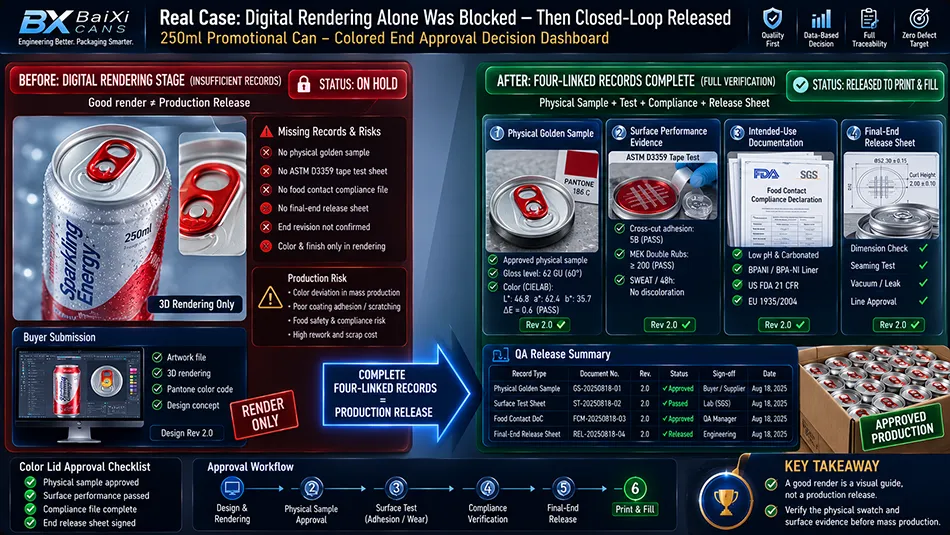
This illustrative approval case is a buyer-planning example, not a Baixi Cans customer result or a product-availability claim. A beverage brand is choosing between a colored shell and a contrast pull-tab treatment for a 250 mL campaign can. The render looks approved, but it has no signed physical reference, defined finish, or final release owner.
Three people own parts of the decision: brand, quality, and procurement. The brand team knows the intended visual. Quality has no agreed sample condition or surface criterion. Procurement has not connected the render to a named end, intended use, and final record. The creative direction is useful, but the evidence chain is incomplete. For context on a packaging inquiry, readers can see the workshop context behind packaging production.
In the illustrative case, the team first creates a signed physical reference record before evaluating any lot for release.
The case covers 2 proposed treatments for one 250 mL campaign format. It has 3 approval owners: brand, quality, and procurement, and requires 4 linked release records. The internal rendering had been accepted, but it lacked a signed physical reference, named finish, measurement condition, and final end owner. The technical reviewer also could not tell which end revision the visual direction was meant to govern.
Both options remain on hold. That is not a rejection of color; it is a correction to the evidence chain. The next sample can be compared with a known physical reference and evaluated against the handling and documentation questions that apply to the specific program. The team creates the signed comparison sample, assigns the release owner, and ties every file to the same end revision. It releases no option until all four records agree. This remains an illustrative case, not a customer result.
In this illustrative case, only the treatment with four linked records is released.
The correction creates 4 linked records: signed reference, route-relevant surface evidence, intended-use documentation where relevant, and a final-end release sheet. The release gate requires all 4 to name the same revision. Before release, the owner compares the record identifiers, not just the stated shade, and holds the treatment if a supplier test sheet or final-end record points to another revision. That comparison is a practical way to stop a visually convincing option from moving ahead on an incomplete file. This is a composite teaching model, not a claim about a Baixi Cans run, customer result, or measured performance.
A reviewable color-and-end brief names the component, reference, method, intended use, acceptance evidence, and release owner. Add the can format, end drawing or requirement, target market, treatment location, finish, sample revision, handling route, and the party authorized to approve a change.
Baixi Cans can review those inputs against the specific packaging request, while availability, technical specifications, and final approval remain project-confirmed. When the brief is ready, send Baixi Cans a color-and-end brief for a scoped review.
No. A digital rendering can guide intent, but production approval needs an agreed physical reference and documented viewing or measurement conditions. Screens, settings, finish, and ambient light can change apparent color. Use the rendering for direction, then use the signed reference as the release control.
The buyer and supplier should agree the tolerance, reference, method, finish, and viewing conditions instead of copying a universal color-difference limit. The right value is an agreement for the specific treatment. A number without its reference and method will not settle a later disagreement.
No. Adhesion evidence addresses resistance to coating separation, while the finished end still needs its own intended-use, closure, and project-release evidence. Treat it as one useful record, not as ownership of every approval decision.
Include the end drawing, treatment location, physical color reference, measurement method, beverage use, market, handling tests, and release owner. Add the can format, finish, sample revision, and acceptance decision so the supplier can review the real request.

