
In the precision-driven world of beverage packaging, a mismatched lid isn't just a minor technical hitch—it's a catastrophic operational risk. Imagine a production line running at 150,000 cans per hour; a single seamer failure can trigger an immediate 30-minute line stop, resulting in 75,000 units of lost production and thousands of dollars in mechanical repair costs. Yet, many energy drink brands continue to source can bodies and lids from separate vendors, inadvertently creating a "compatibility gap" that threatens their bottom line.
As we navigate 2026, the landscape is becoming even more unforgiving. New EU BPA regulations, the push for ultra-lightweight materials, and the demand for high-speed efficiency are forcing a rethink of traditional procurement. This guide explores why the synergy between can and lid is the silent heartbeat of your production line, and how Baixi Cans integrated model provides the ultimate insurance against the hidden costs of mismatch.
While marketing teams focus on the vibrant graphics of the can, production managers know that the real battle is won or lost at the seamer. The compatibility between the can end (lid) and the can body is a systemic risk that remains invisible until a "leaker" reaches a customer's hands or a pallet collapses in a warehouse due to compromised structural integrity.
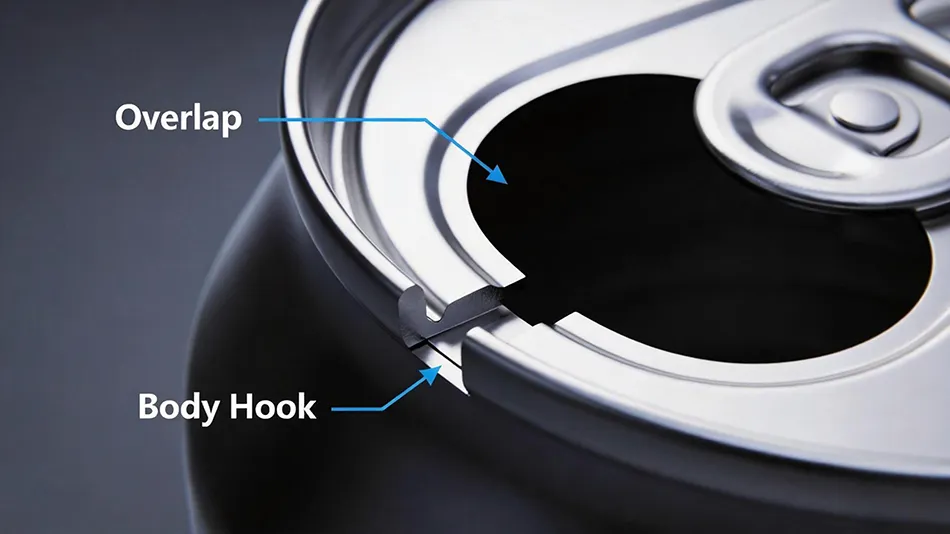
The integrity of an aluminum can depends entirely on the double seaming process. This is a two-stage mechanical operation where the can flange and the end curl are meticulously interlocked. If the neck diameter of the body and the curl of the lid deviate by even fractions of a millimeter, the resulting seam will lack the necessary overlap to resist internal pressure—especially critical for highly carbonated energy drinks.
When brands treat these components as separate commodities, they lose "systemic visibility." A change in the alloy of the can body to save weight might slightly alter its flange behavior, which, if not matched by a corresponding adjustment in the lid's curl profile, can lead to a sudden spike in micro-leaks. By the time these are detected in the retail chain, the brand damage—and the cost of recalls—is already permanent.
For R&D and filling managers, selecting the right specifications is a balancing act between consumer ergonomics and production line stability. In 2026, the industry is seeing a consolidation of standards to ensure global interoperability.

Understanding the "Common Language" of can ends is vital for procurement. In North America and increasing parts of Asia and Europe, the 202 CDL has become the dominant standard due to its optimized weight-to-strength ratio.
| Can End Code | Nominal Diameter (mm) | Common Can Styles | Market Context | Matching Can Neck |
| 200 | 49.5 ±0.1 | High-growth (Hard Seltzers/Minis) | 200 Neck | |
| 202 | 52.3 ±0.1 | Standard, Sleek, Slim | The Global Benchmark (47%+ Share) | 202 Neck |
| 206 | 57.0 ±0.1 | Wide mouth, King cans | Traditional Large Volume (Beer) | 206 Neck |
At Baixi, our integrated manufacturing process means that the neck of our
To truly master quality control, one must look beyond the surface. A failed seal is rarely the fault of a single component; it is a failure of geometry. QA managers must focus on the interplay between Seam Thickness and Body Hook Length, as these are the pillars of hermetic sealing.
Mismatched components often lead to defects that are difficult to spot with the naked eye. "False Seams," where the hooks are tucked but not interlocked, or "Droops," where excess material creates a leak path, are frequently rooted in the use of lids that were not designed for the specific flange elasticity of the can body.
Baixi bridges the gap between the lab and the production line by conducting destructive seam testing on every integrated batch. While the industry allows for a ±0.076mm tolerance in seam thickness, Baixi tightens this to ±0.050mm. This precision translates to a 99.87% pressure test pass rate, meaning Baixi clients experience significantly fewer "shelf-leakers" than those sourcing from split vendors.

As we approach the July 2026 deadline, compliance is shifting from a "technical detail" to a "market access" requirement. The most significant change is the total phase-out of Bisphenol A (BPA) in the European Union.
The Regulation (EU) 2024/3190 represents the strictest food safety standard in history. By July 20, 2026, every component—from the internal liner of the can to the compound gasket in the lid—must be BPA-NI (Non-Intent). Baixi has already fully transitioned its export production lines to satisfy these requirements. Furthermore, our sealing compounds are PFAS-NI, ensuring that your brand is protected against the rising tide of "forever chemical" litigations.
The financial impact of packaging failure is often underestimated because it is spread across different departments. However, when aggregated, the "cost of mismatch" can be the difference between a profitable quarter and a loss.
The $1,500 cost to replace a damaged seamer head is only the tip of the iceberg. The true cost lies in the opportunity cost of downtime. In a high-speed energy drink facility, a 30-minute stop isn't just lost time; it's 30,000 unproduced cans that could have been on retail shelves.
Furthermore, the "Logistics of Failure" is devastating. A single leaking can in a cardboard 12-pack will soak the packaging, causing it to tear. This leads to unsalable inventory and, more dangerously, erodes the trust of your distributors. In an industry where shelf space is premium, a reputation for "messy shipments" is a fast track to delisting.

Integrated manufacturing is the industry's response to the complexities of modern beverage production. By placing the responsibility for the "perfect fit" on a single partner, brands eliminate the traceability gaps that plague multi-vendor models.
When Baixi manufactures both the can and the lid, we serve as your outsourced engineering department. We pre-calibrate the seaming parameters, which can reduce your production line setup time by over 50%. Instead of weeks of trial and error with two different technical teams, you get a "Plug and Play" solution.
| Feature | Multi-Vendor Fragmentation | Baixi Integrated Model |
| Vendor Management | High Complexity (2-3 Vendors) | Simplified (1 Partner) |
| Compatibility Risk | Borne by the Brand | Validated at Factory |
| Calibration Speed | 4-8 Weeks | 2-3 Weeks |
| Total Procurement Cost | Hidden Overruns | Optimized (20-35% Lower) |
Based in China, Baixi Cans has scaled its operations to meet the rigorous demands of global energy drink leaders. We specialize in the two-piece aluminum format, providing a seamless bridge between high-volume manufacturing and precision customization.
| Metric | Specification Detail |
| Supported Ends | 200, 202, 206 (SOT / RPT / CDL / B64) |
| End Material | Premium 5182 Aluminum Alloy (H19/H48) |
| Body Precision | 3004/3104 Alloy (0.265-0.285mm thickness) |
| Compliance Kit | BPA-NI, PFAS-NI, FDA, EU 2024/3190 Ready |
| Commercial MOQ | 1 x 40HQ (Agile scaling for growing brands) |
| Track Record | 98% OTIF, 33% Customer Reorder Rate |
Navigating the transition to an integrated supply model requires a strategic approach. We recommend a 5-step roadmap:
Regulatory Audit: Confirm your target market's compliance status (e.g., the 2026 EU BPA-NI mandate).
Line Parameter Sync: Share your seamer specs with Baixi's technical team to ensure day-one compatibility.
Validation: Request Baixi’s comprehensive Compliance Pack, including FDA/EU certificates and seam destructive test results.
Pilot Run: Order a single 40HQ container to validate filling speeds and seal integrity on your specific equipment.
Integration: Lock in a long-term supply contract to leverage 98% On-Time-In-Full (OTIF) delivery.
The risk of can-lid mismatch is not theoretical—it manifests as ruined pallets, angry distributors, and idle machines. As the 2026 EU BPA deadline approaches and lightweighting pushes material tolerances to new extremes, the margin for error has disappeared. Baixi Can Manufacturing provides more than just metal; we provide a "Perfect Fit" guarantee. One order. One supplier. Zero mismatch.
Ready to de-risk your production line?
Q1: How does Baixi’s integrated model specifically resolve "leakers" compared to using multiple vendors?
A: In a multi-vendor setup, the "responsibility gap" is your biggest risk. If a leak occurs, the can body supplier may blame the lid's curl profile, while the lid supplier blames the can’s flange elasticity. At Baixi, we eliminate this friction by controlling the mechanical synergy of the two components. We pre-tune the "Double Seam" parameters in our factory, ensuring the interlocking hook lengths are mathematically optimized. By owning the entire mechanical interface, we provide a Single Point of Accountability, reducing potential leaking incidents by at least 370 per 100,000 cans compared to industry averages.
Q2: Are BPA-NI and PFAS-NI coatings standard across all formats, including the 500ml and slim cans?
A: Yes. To future-proof our clients' brands against the July 2026 EU BPA mandate, we have standardized our export production to include BPA-NI (Non-Intent) and PFAS-NI options across all sizes—from the flagship
Q3: We operate high-speed filling lines (60k+ CPH). How does your packaging handle mechanical stress?
A: Our cans are manufactured using high-strength 3004/3104 H19 aluminum alloy with a precision coil thickness of 0.265-0.285mm. This provides the ideal balance between "lightweighting" and "structural rigidity." For high-speed lines, we maintain a strict ±0.050mm tolerance on seam-critical dimensions. This extreme consistency prevents "jamming" at the seamer and reduces the wear and tear on your $1.5k seamer heads, maximizing your OEE (Overall Equipment Effectiveness) and preventing the catastrophic 30,000-can-per-hour downtime loss.
Q4: Can we customize the visual elements of the lid, such as colored tabs or laser engraving?
A: Absolutely. We recognize that for energy drinks, the "opening ritual" is part of the brand experience. Baixi offers a wide array of customization for 202 CDL and 206 B64 ends, including:
Colored Tabs: Red, black, gold, and blue to match your brand's primary palette.
Laser Engraving: Logos or QR codes on the tab for consumer engagement.
Matte or Gloss Lids: Specialized coatings on the lid surface to provide a premium tactile feel when the consumer first touches the product.
Q5: What is the typical lead time, and how do you ensure the cans arrive without dents?
A: Our standard lead time is 20-30 days from artwork approval. To protect the integrity of the thin-walled aluminum, we use automated palletization with reinforced corner protectors and high-tension shrink-wrapping. This ensures our 98% On-Time-In-Full (OTIF) delivery rate isn't just about timing, but about the quality of the product upon arrival. Every shipment includes a "Stability Declaration" to facilitate smooth customs clearance in Europe and North America.

