
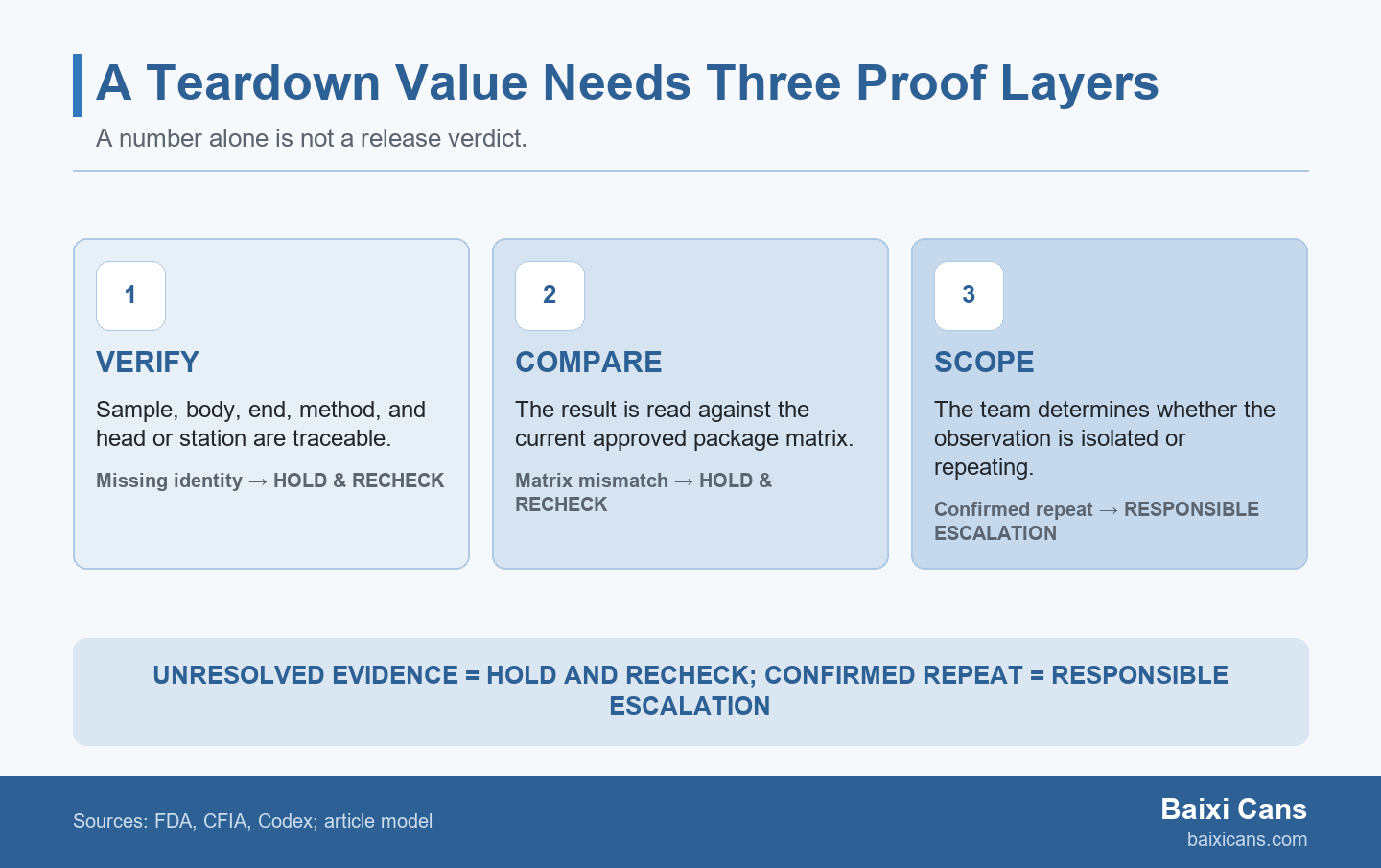
A teardown value becomes decision-ready only when its identity, comparison boundary, and scope are clear. A result may be accurate and still be too incomplete to release product or justify an equipment change. First verify what was measured and on which package; then compare it with the active approved matrix; finally, determine whether the observation is isolated or repeating. Those three checks turn a number into a controlled decision rather than a reflex to adjust the seamer.
A teardown is valuable because it opens the closure for examination, not because it supplies a universal pass/fail number. The reader needs a controlled comparison: the actual body and end, the current revision of the seam matrix, the method used, and the location on the line that made the sample. Without that context, a familiar value from another format, supplier, or machine can create false confidence.
Use this sequence when an inspection record needs a disposition. It does not replace the line owner's procedure, the can and end supplier's approved data, or the equipment maker's instructions. It gives QA, production, and a packaging supplier one way to state what is known, what still needs confirmation, and why a run is either releasable, on hold, or ready for responsible escalation.
Three aligned proof layers support release; an unresolved layer supports hold and recheck; a confirmed recurring deviation triggers responsible adjustment under the active procedure. The layers are simple: verify the sample and method, compare the result to the current package matrix, and scope the observation across the relevant closure position or station. This is an operational decision rule, not a substitute for the limits or corrective-action rules approved for a specific package system.
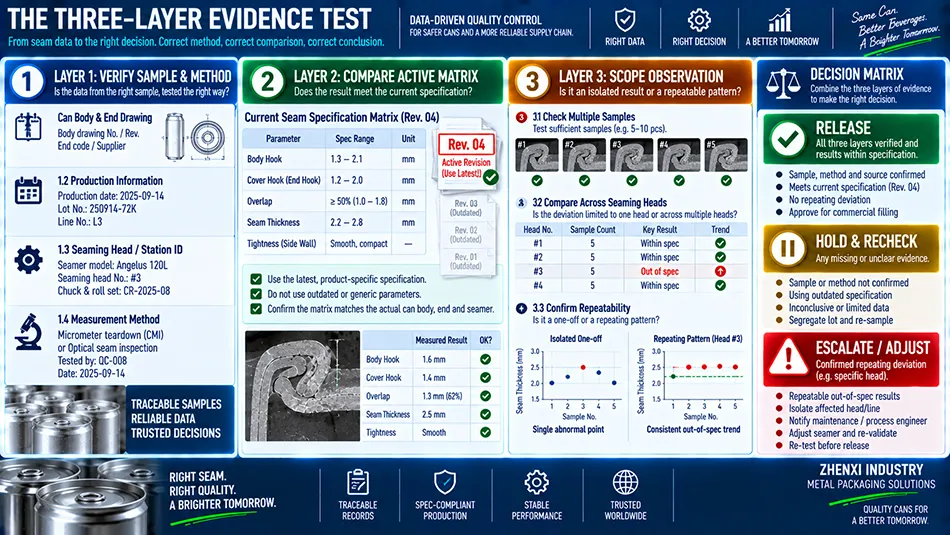
The comparison starts with the live matrix for the package in front of the technician. CFIA states that can-maker guidelines vary by construction and that seam quality cannot be judged on dimensions alone. Its metal-can guidance makes clear why a body-hook, overlap, thickness, or tightness observation gains meaning only against the actual container design and the rest of the evaluation; it is not a license to copy a limit from an unrelated can.
Before reviewing the sample, reconcile the body format, end configuration, matrix revision, approved method, and the responsible procedure. If a new body is being sourced, review the actual aluminum can format before matching the seam matrix. The commercial conversation stays useful when the can is specified as a physical package, not merely as a capacity label. Baixi Cans can discuss available body configurations; the plant team and equipment owner retain approval authority for the closure system.
The same principle applies when a measurement sheet contains an old target or an unversioned supplier note. Do not decide whether to release or adjust until the team has identified which record is active. A missing or conflicting matrix is itself a hold condition because the comparison boundary has not been established. A practical review log can make this visible with three fields: active matrix confirmed, sample identity confirmed, and repeat status still open or resolved. That small check prevents a paper mismatch from being treated as a mechanical failure.
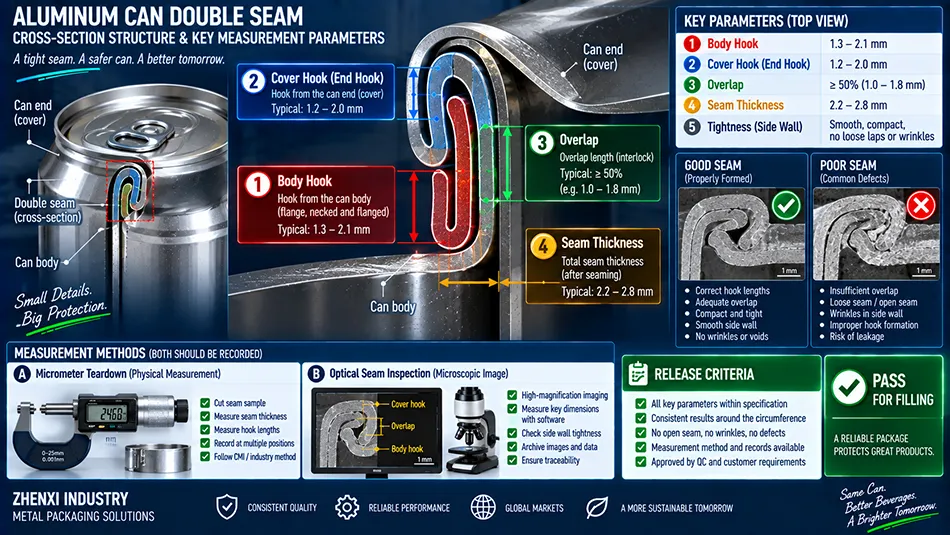
A double seam is the mechanically formed closure joining a can body and its end. FDA describes double-seam teardown as a destructive test and outlines micrometer and optical examination approaches in its low-acid canned-food guide. The FDA guidance has a low-acid canned-food scope, so it does not create a beverage limit or production schedule. Its method distinction shows why method identity belongs beside the measurement.
A cover hook is the folded edge of the can end within the completed seam; it is also called an end hook in some materials. FDA defines the double seam as an interlocked and compressed end curl and body flange, and its inspection attachments list seam structure, tightness, guidelines, and defects. FDA's container-integrity glossary and its inspection attachment index support those terms. Use them to make the record specific, not to imply that terminology alone establishes a limit.
Keep the end description inside the same evidence packet as the can body. When component options are under review, match the selected aluminum can lid to the active body-and-end record. That link can help define the requested component, while the responsible team still verifies the matrix, tooling, and inspection method that apply on its own line.
If the sample cannot be tied to its body, end, method, time, and seaming head or station, the reading is not strong enough to release a run. A seaming head is the identified closure-forming position whose samples can be traced separately. Mark the sample before tearing it down, retain the exact can and end identifiers, and record the method and location together. That prevents a correct measurement from being assigned to the wrong format or mixed with evidence from another closure position.
Make the body description concrete when formats are close. For example, teams can identify the 250 mL slim body in the component record, then connect it to the selected end and the approved matrix revision. This does not prove line compatibility; it makes the question visible to the people who must confirm it. A record missing one of these fields should move to hold-and-recheck before anyone interprets the value as a mechanical cause.
Codex notes that both measurements and their trends are important in seam-quality assessment for control purposes. The Codex code does not create a universal trend threshold. It does mean that the next question after a valid result is whether the same observation appears again under a defined package, head, and process window.
Do not average away the warning or inflate a single check into a whole-run failure. Recheck under the active method, retain the same matrix and package identity, and compare observations at the level the responsible procedure defines. If the result does not repeat, the team has learned that scope is still uncertain. If it does repeat, the investigation can focus on a traceable part of the operation without guessing a cause from one measurement alone.
A release decision should reflect the total evidence, not a favored dimension. CFIA says a questionable total seam evaluation should be held for further investigation and that final judgment depends on deviation, measurements, and observations together. CFIA's technical guidance supports that boundary. Apply it within the active package procedure rather than importing the guide's food-can examples as a beverage specification.
The escalation path must remain package- and machine-specific. Codex calls for results and corrective actions to be recorded and says the container supplier's and seaming-machine manufacturer's instructions should be followed. That Codex boundary keeps adjustment inside responsible controls. It is an authorized response after the record, evidence, and source of responsibility have been reconciled, not the “third box” in a generic troubleshooting chart.
| Evidence state | What it establishes | What it does not establish | Next decision |
|---|---|---|---|
| Traceable sample, current matrix, and aligned observations | The result can enter the responsible release review. | It does not replace other package or process checks required by the active procedure. | Release only through the responsible approval path. |
| Missing identity, expired matrix, uncertain method, or one unresolved reading | The evidence is incomplete. | It does not prove a defect or identify a setting change. | Hold and recheck with traceable records. |
| Confirmed repeat finding within a defined head or process window | The issue warrants a focused investigation. | It does not name a universal mechanical cause or adjustment. | Escalate through approved quality and OEM controls, then verify again. |
Package discussions become clearer when the body and end are stated together. Before a review, define the 500 mL beverage can configuration before a seam review rather than sending only a measurement and a capacity. The supplier can then discuss the requested can and end context, while the line owner remains responsible for the approved limits and any production disposition.
In this illustrative 4,800-can run, a repeat finding from Head B leads to a hold on the affected scope while the team reconciles the current matrix and investigates under its responsible procedure. The example is a decision pattern, not a Baixi Cans customer incident or a universal lot-disposition rule.
A beverage co-packer is preparing a 4,800-can order on 1 beverage canning line with 2 seaming heads. The active body-and-end matrix is available, and each sample is marked with its production time and head. During the review, Head B produces a result that needs confirmation, while Head A provides comparison samples. A confirmed repeat finding establishes the need for responsible investigation; it does not tell the reader which setting to change.
The technician repeats the teardown under the approved method. The Head B sample shows the same body-hook/overlap concern against the active matrix, while the Head A samples do not show that pattern. The team has not yet established a cause or a permitted equipment change. The evidence is now stronger than a transcription error, but it still does not isolate a cause. The meaningful scope is the identified head and the process window defined by the facility's procedure, not an assumption that every can on the line is identical or that one roller adjustment will resolve the issue.
The team holds the Head B scope for investigation, retains the matrix, samples, and method record, and follows the plant's authorized escalation and OEM controls. After any authorized action, it repeats the documented teardown evaluation before release review. The gate is evidence-based: package identity, current matrix, traceable samples, documented investigation, and repeat evaluation must agree. This illustrative example supplies no pass value, adjustment target, inspection frequency, or instruction to change a seamer setting.
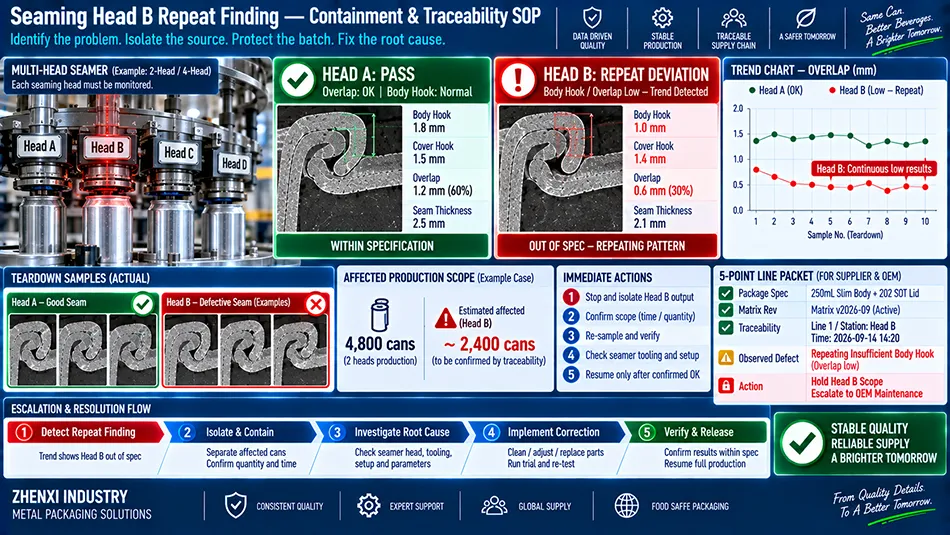
A useful packet names the body, end, matrix revision, sample traceability, and the exact unresolved question. That is more helpful than asking whether a single overlap, body-hook, or tightness value is “good.” It lets the supplier identify the relevant component context and lets the line team keep control of its own procedure and production decision.
A head-specific record is also a recognizable closure-control pattern. In its poultry-product scope, USDA's cited closure rule calls for closing-head examination, recorded results and corrective actions, and container specification guidelines on file. It is not a beverage requirement here; it is a useful reminder that traceability makes the next technical conversation more precise.
Baixi Cans can help clarify available can and lid configurations, while the facility's responsible quality and equipment controls determine release, hold scope, and any authorized adjustment. When those details are ready, send the package and evidence details for a configuration discussion.
No, one teardown result can support release only when its sample identity, current matrix comparison, and scope have been verified under the responsible procedure. A value with a complete record and aligned evidence may enter release review, but a single untraceable or unexplained reading should not become a whole-run decision. Confirm the package, method, closure position, and whether the observation repeats before status changes.
Record the measurements and observations required by your active method and matrix, together with the sample, package, time, and seaming-head or station identity. The exact list depends on the closure system and approved procedure. In addition to values, retain the visual observations and the matrix revision used for comparison so another qualified reviewer can understand what the record does—and does not—show.
Place the result on hold when its identity, relevant matrix, or repeat-pattern scope is unresolved, or when total evaluation is questionable under the active procedure. Hold does not automatically mean reject or adjust. It preserves time to verify the sample, reconcile the comparison boundary, and decide whether the finding is isolated, repeating, or linked to a defined production scope.
The responsible plant quality and equipment controls should authorize any seamer adjustment using the active procedure, OEM documentation, and package-specific closure record. A supplier or technical guide can help clarify the body and end context, but neither a generic web value nor a single teardown reading identifies the correct setting. Repeat the approved evaluation after an authorized action before considering release.

