
Empty-can damage is often assigned to the wrong moment because a photo shows where the defect was found, not where it began. A dent discovered near filling may have arrived with the pallet, appeared during sweep-off, or been added at the first transfer. The practical way to investigate is to keep matched evidence at each point in that route. That turns a visible defect into a question the line team, packaging buyer, and can supplier can review from the same record.
The first documented repeat is the first suspect window, not proof of root cause. A depalletizer is a machine that removes empty cans from a pallet and feeds the line.
FDA says empty containers should be handled to preclude damage and inspected before filling. The FDA inspection guidance concerns low-acid canned food rather than beverage-line compliance, but its handling principle is directly useful here: arrival condition and line condition are separate evidence states. If the first retained cans already show the same defect, the investigation begins with pallet build, transport, storage, and receipt records; if they do not, the route after release from the pallet deserves closer attention.
Start the record before anyone removes a top frame or layer pad. A layer pad is a sheet placed between pallet layers to separate and support the containers. Photograph the visible pallet face, the layer-pad condition, the pallet identifier, the body format, and any repeated marks on accessible cans. Before comparing photos, match the affected body to Baixi Cans aluminum can options before the review; different diameters, shoulder shapes, and finishes can make an otherwise similar mark look like the same defect.
The record does not need to prescribe a plant-wide sample size. It needs enough matched, time-stamped witnesses to answer a narrower question: was this exact dent, scuff, or flange condition already present before the can entered the handling route? Mark uncertain observations as uncertain. A clean arrival witness does not clear every upstream cause, and a damaged arrival witness does not prove every later mark came with the shipment.
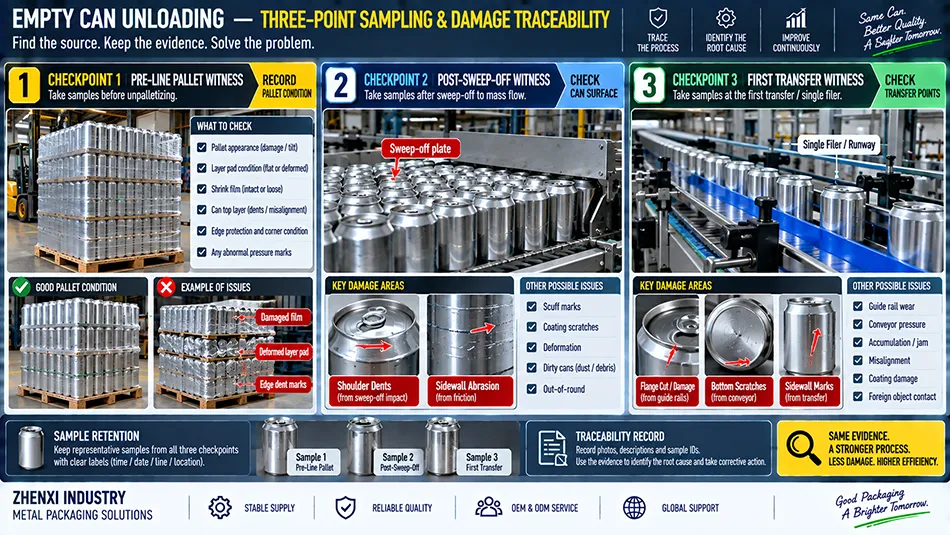
Compare pallet, sweep-off, and first-transfer witnesses before assigning a suspect route. A witness sample is a time-stamped retained can or small group used for comparison. Give each witness the same basic label: pallet or route ID, can format, location, time, defect class, and photo reference. The objective is a continuous comparison, not a collection of disconnected images.
FDA's Part 3 attachments provide illustrations and definitions used with its container inspection guide. The inspection attachments, including Attachment 1, are useful for naming an observed feature consistently; they do not create a beverage-line setting. Installed depalletizers do not share one safe universal adjustment. In the witness sheet, use the product name rather than a vague label; for a slim body, record the specific 250 mL slim can format in the witness sheet.
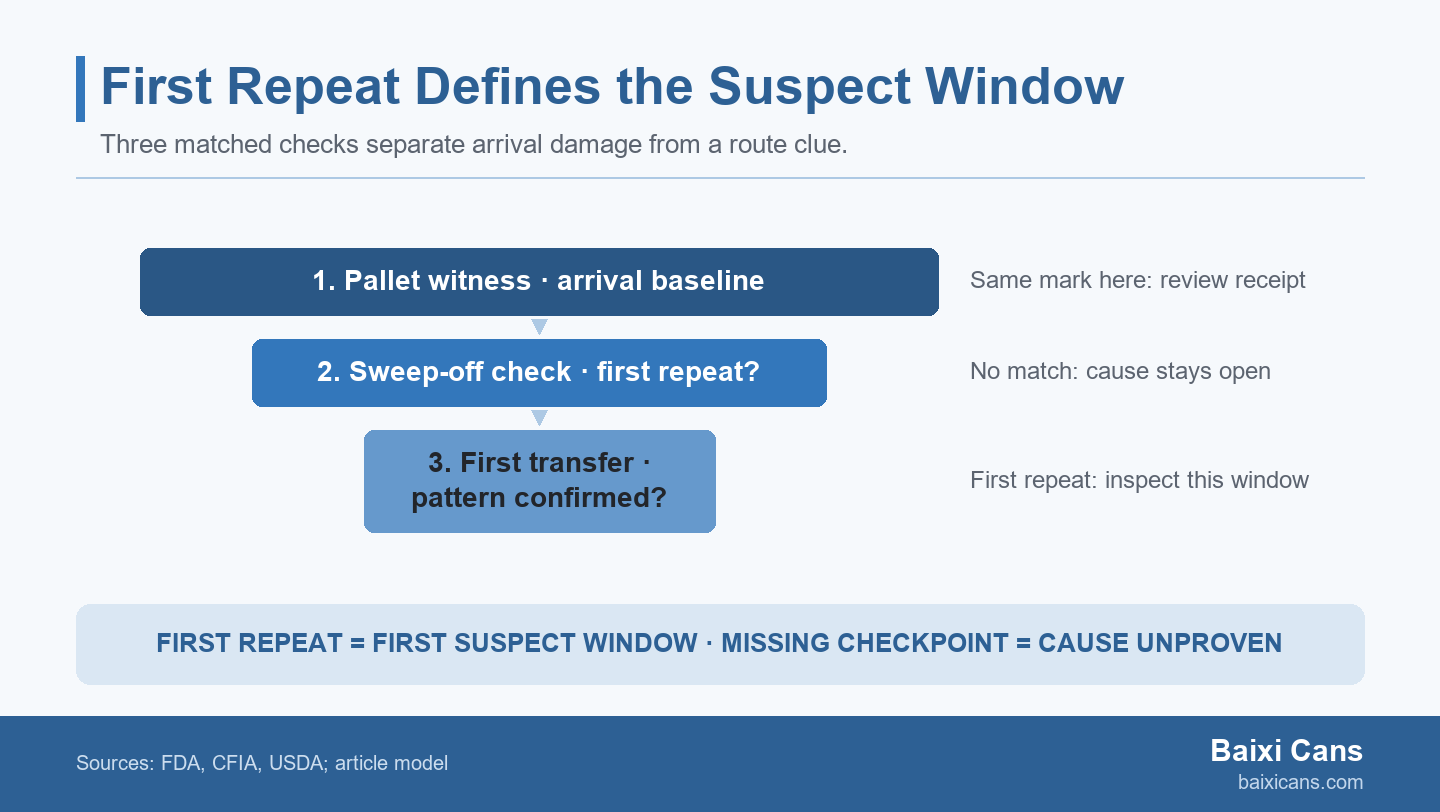
A pre-line witness preserves the evidence that later damage comparisons need. Select representative cans that can be traced back to a visible pallet position, then record the body area being reviewed: rim, shoulder, sidewall, base, or flange. Retain the accompanying information that could change the interpretation, including the pallet condition, layer-pad condition, wrap condition, and any sign that a container may have shifted before it reached the machine.
This is not a pass/fail release instruction. It is a way to stop memory from replacing evidence when the line is running. If a mark exists at the pallet witness, document it as an arrival observation and compare its orientation, height, and surface condition after handling. If no matching mark exists, keep the pallet evidence available rather than declaring the supplier cleared; later checks may still reveal that the defect classification was too broad or that the witnesses were not comparable. A clear photo needs a matching location and time to become useful route evidence.
The earliest repeated defect checkpoint is the first suspect window. Check immediately after sweep-off, then at the first transfer beyond the depalletizer, and keep the observation method consistent. A repeat at sweep-off but not on the retained pallet is a reason to inspect that route window; it is not a diagnosis of the exact contact event. A repeat only after the first transfer shifts the next question downstream instead of treating sweep-off as the default culprit.
FDA defines cable cuts as cuts or grooves worn into can ends and bodies by a runway conveyor system. Its container-integrity glossary gives the team a real mechanical category to inspect, not a diagnosis of any observed mark. Document the actual installed route and ask the responsible operator to inspect it under the approved procedure rather than importing a number or setting from another line. For each suspected contact point, note whether the mark appears on the lead or trailing side and whether its height changes. Preserve the route record before cleaning, adjusting, or moving the evidence.
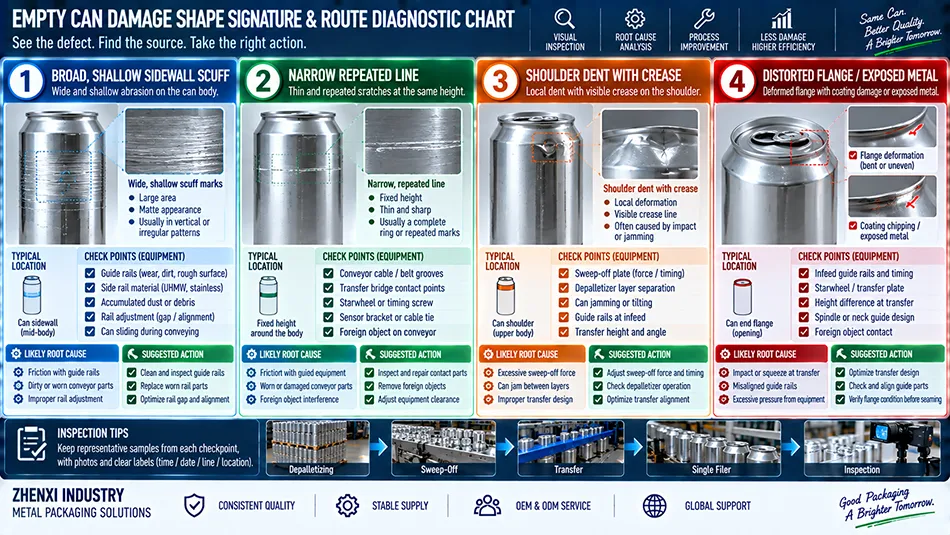
CFIA lists flange damage during shipping or depalletizing among common sources of a knocked-down flange defect. Its metal-can defect guidance also shows why shape can be useful without being conclusive: a repeated form can guide a bounded inspection question, but a common source does not identify the cause of a particular can. Use the shape to decide what to compare next, not to write a conclusion before the route has been inspected.
| Observed signature | Route question to test | Immediate evidence boundary |
|---|---|---|
| Broad, shallow sidewall scuff | Does the scuff first appear after a guide or transfer where sliding contact is possible? | Compare finish and direction at the same checkpoints before treating it as cosmetic-only. |
| Narrow repeated line at a similar height | Does the line align with one repeated point in the documented can path? | Record the height and orientation; do not name a component without inspection. |
| Shoulder dent with a crease | Is the same shape absent at the pallet witness and repeated after sweep-off? | Keep affected witnesses and route photos together for the line review. |
| Distorted flange or exposed metal | Could the condition affect later closure or protection of the container surface? | Apply the responsible package procedure before treating the condition as a routine appearance issue. |
A signature becomes persuasive only when several facts agree: the defect class is consistent, the first appearance is documented, and the route evidence has no missing checkpoint. If any of those facts is absent, use the record to define the gap. The correct next action may be another controlled comparison, not a broader claim about incoming quality or machine performance.
USDA requires empty containers to be handled and conveyed to prevent damage that could affect hermetic condition. The USDA container rule applies to meat and poultry products, so it is not a beverage-can acceptance standard. It does provide a useful integrity boundary: hermetic condition refers to a closed package’s ability to keep contaminants out, and a visible defect that could affect later closure deserves a review under the actual can specification and plant procedure.
FDA's HACCP guidance asks whether packaging material resists damage that could permit microbial contamination. FDA’s HACCP guidance places physical hazards in a chain that includes procurement, handling, manufacturing, and packaging; the practical lesson is to contain the relevant route and preserve traceability across that chain rather than treating the incident as only a cosmetic dispute. A light, isolated surface mark may remain an observation pending comparison, while a sharply creased dent, exposed metal, or flange deformation may require a more cautious review because the condition could affect later handling or closure.
When the review reaches a possible closure concern, keep the body format, visible flange condition, and intended end together in the record. For that handoff, keep the intended can-end configuration with the damage record. The can supplier, packaging team, and line owner still need their own approved criteria; this record simply gives them a consistent starting point.
An onset mismatch is a localized evidence task, not a confirmed root cause. The following example is illustrative, not a Baixi Cans customer incident or a release instruction. For an early packaging discussion, use Baixi Cans' service process to organize the packaging inputs. It shows how a route record can reduce an undifferentiated can-quality concern to one reviewable window while the responsible team keeps control of its own equipment and quality decisions.
The first suspect window is not a confirmed root cause. In this illustrative run, a co-packer operations lead needs to decide whether the empty-can route can continue, while a packaging buyer needs a fact-based supplier discussion. The run uses 36,000 cans on 18 pallets of the same 250 mL slim body. A pre-line pallet witness exists, but the exact contact event has not been confirmed by the responsible line review.
The retained pallet witnesses show no repeated shoulder dents before the first pallet enters the depalletizer. Immediately after sweep-off and again at the first transfer, the team sees the same crease at a similar height on multiple cans. That comparison gives 54 checkpoint records in the illustration—18 pallets multiplied by three locations—not a prescribed sampling plan. Its value is that each record can be compared by location and defect class instead of blending all 36,000 cans into one unexplained total.
The clean witness and the repeated post-sweep crease narrow the first suspect window to the sweep-off route, but they do not prove a setting, a component, or a supplier cause. The team conditionally holds the affected route window, preserves the pallet and station evidence, and asks the responsible line owner to inspect relevant contacts under the installed procedure. The buyer can then prepare a technical discussion from a defined package and route question rather than from an unsupported allegation.
After the responsible inspection, the team compares a new controlled witness set rather than changing several variables at once. The route may move forward only when repeat observations, package review, and the responsible procedure support that decision. This illustrative example provides no approved setpoint, sampling frequency, or product-release rule; it shows why evidence should stay attached to the route until the team can distinguish a verified contact event from a plausible one. It also leaves time for the buyer to compare the retained can, route photos, and current component description before requesting a broader conclusion.
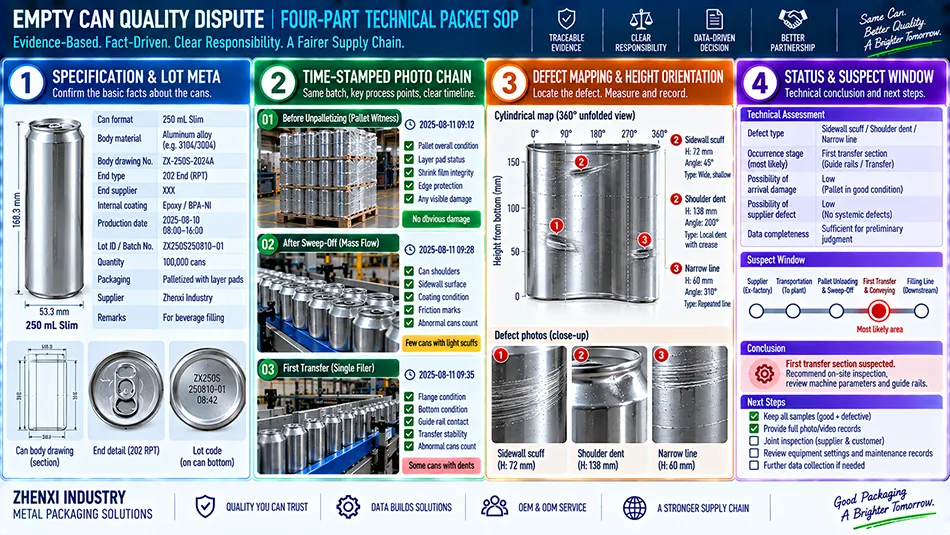
A package, pallet, route, and defect record makes a technical discussion reviewable. Bring together the can body and end configuration, pallet-build photos, retained pre-line witnesses, time-stamped images from each checkpoint, defect locations, and a short statement of what is known, what is uncertain, and which route window is under review. That packet lets each participant see the same evidence without converting an early observation into a conclusion.
If the record needs an external technical discussion, send the can format, pallet build, station photos, and defect map for a technical discussion.
A team can only support that conclusion when the same defect class is absent in retained pallet witnesses and first appears at a documented handling checkpoint. Even then, the result identifies a suspect route window, not the exact contact event. The responsible line review must connect the repeated defect to an inspected route condition under the installed procedure before anyone assigns root cause.
Flange deformation, sharply creased dents, exposed metal, and any feature that could affect a later seam should be reviewed under the responsible package procedure. A surface scuff may still need documentation, especially when it repeats at one route point. The distinction is not whether the mark looks serious in a photo; it is whether the condition may affect protection, handling, or later closure.
No, not until the scratch is classified, tied to a known route segment, and reviewed against the installed equipment maker's approved procedure. One scratch can be an arrival observation, a handling event, or an inconsistent witness comparison. Preserve the evidence first, then change only the relevant variable through the plant's responsible process.
Send the body and end configuration, pallet build, retained pre-line samples, time-stamped station photos, defect locations, and the first checkpoint where the defect appears. Include the observations that do not fit the suspected cause as well. A supplier can respond more usefully when the record separates what arrived on the pallet from what first repeated along the handling route.

