
Imagine you are the founder of an emerging beverage brand, preparing to launch your very first batch of products into highly competitive overseas markets. A successful product strategy begins with clear brand positioning, but its physical execution depends entirely on differentiating your packaging on the retail shelf. What packaging specification allows you to secure unique brand differentiation while maintaining maximum compatibility with global retail channels? The answer is the 330ml standard aluminum can. To help international beverage brands analyze the strategic value of this packaging asset, this guide draws upon 2026 industrial benchmarks, material engineering parameters, and global trade dynamics to break down the complete ecosystem of the 330ml aluminum can.
No matter where your brand stands—whether you are an agile startup executing low-volume market testing or an established enterprise managing large-scale global exports—securing a reliable manufacturing partner is essential. Baixi Cans, as a leading Chinese manufacturer of high-performance two-piece and three-piece aluminum cans, maintains mass-production capacity for the 330ml standard configuration alongside an advanced suite of high-definition printing technologies. We help beverage innovators transform complex design concepts into shelf-ready, high-converting aluminum packaging assets.
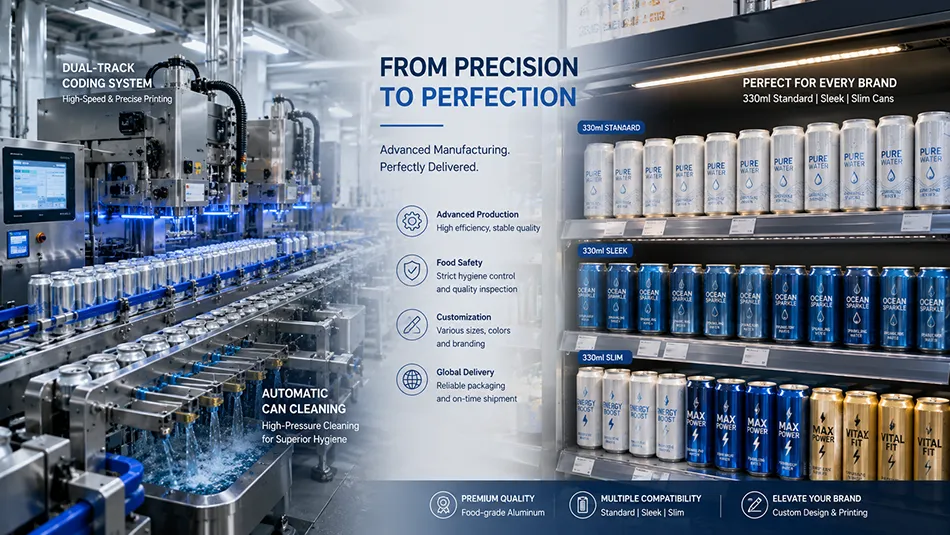
Before diving into the detailed mechanical and logistical layers of this format, procurement and operations teams can utilize this high-level cross-functional matrix to immediately map their most critical operational objectives:
| If you are a... | Your Core Technical Focus | How Baixi Cans Drives Your Value |
| Beverage Procurement Director |
Avoiding technical pitfalls in container sizing, coating specs, and volumetric tolerances |
Supplies a fully certified, size-standardized catalog backed by a strict FSSC 22000 quality loop |
| Supply Chain Manager |
Minimizing management friction when switching between diverse beverage filling requirements |
Offers concurrent two-piece and three-piece manufacturing lines to consolidate vendor management |
| Brand Founder / Operations Lead |
Accessing flexible decoration methods for lower volumes without sacrificing premium shelf appeal |
Balances production from zero-MOQ digital printing up to high-volume conventional lithography |
| International Export Director |
Ensuring your container assets clear destination customs and pass foreign filling lines seamlessly |
Delivers global compliance documentation alongside synchronized ASN logistical data support |
To formulate a resilient procurement strategy, purchasing and supply chain teams must evaluate their operations against macro market indicators. Understanding these baseline figures provides a solid data-driven foundation for vendor negotiations and contract forecasting. It allows international FMCG operators to validate why investing in this specific format yields long-term cross-border returns.
The global aluminum beverage container market maintains a strong upward trajectory. In 2025, the sector achieved an industrial valuation of approximately $41.5 billion and is projected to expand at a compound annual growth rate (CAGR) of 5.5%, reaching an estimated $70.5 billion by 2035. Aluminum containers capture an overwhelming market share of over 96% within the broader metal beverage packaging sector. Within this dominant category, the 330ml specification is consistently ranked by global trade analysts as one of the most widely consumed and requested sizes across international retail networks.
Trend 1: The Escalation of ESG and Sustainable Circularity: As environmental regulations tighten in regions like the European Union and North America, beverage brands are actively moving away from single-use PET plastic and heavy glass bottles. Aluminum cans achieve an impressive global recycling rate of roughly 69% to 75% and possess unique circular properties that allow them to be melted down and remanufactured infinitely without any loss of structural integrity.
Trend 2: Consumer Preference for Controlled Single-Serve Portions: Modern consumers prefer single-serve volumes that match a single drinking occasion, minimizing product waste. In the popular medium-volume beverage segment ranging from 330ml to 500ml, single-serve configurations represent over 65% of all consumer transactions worldwide.
Trend 3: Lightweighting and Advanced Two-Piece Can Engineering: Continuous improvements in metal forming technology have significantly reduced the wall thickness of aluminum containers while maintaining required axial strength. This lightweighting process lowers material consumption per unit, providing significant shipping cost advantages for high-volume runs of the 330ml format.
Trend 4: Cross-Category Beverage Diversification: Changing consumer habits among younger demographics have fueled rapid growth in Ready-to-Drink (RTD) pre-mixed cocktails, functional energy drinks, and premium sparkling waters. The 330ml can has become the standard packaging format for these fast-growing beverage categories.
Exporters must navigate a complex regulatory environment characterized by changing international tariff frameworks, including ongoing adjustments to Section 232 aluminum tariffs in the United States. While these trade policies present challenges, they also create unique opportunities for export-focused Chinese container manufacturers who maintain high cost-competitiveness and automated quality control standards.
When planning product distribution, brands should also note regional preferences for specific container sizes. While the 330ml format remains the undisputed market leader across Europe, the Asia-Pacific region, and the Middle East, the North American market features co-existing demand for both 330ml and 355ml (12 oz) sizes. Interestingly, the 330ml format is gaining valuable traction in North America as an elegant packaging choice for imported craft beers and premium functional beverages. For international beverage brands seeking to simplify their supply chain with a single SKU across multiple regions, the 330ml format remains the most functional choice for global trade.
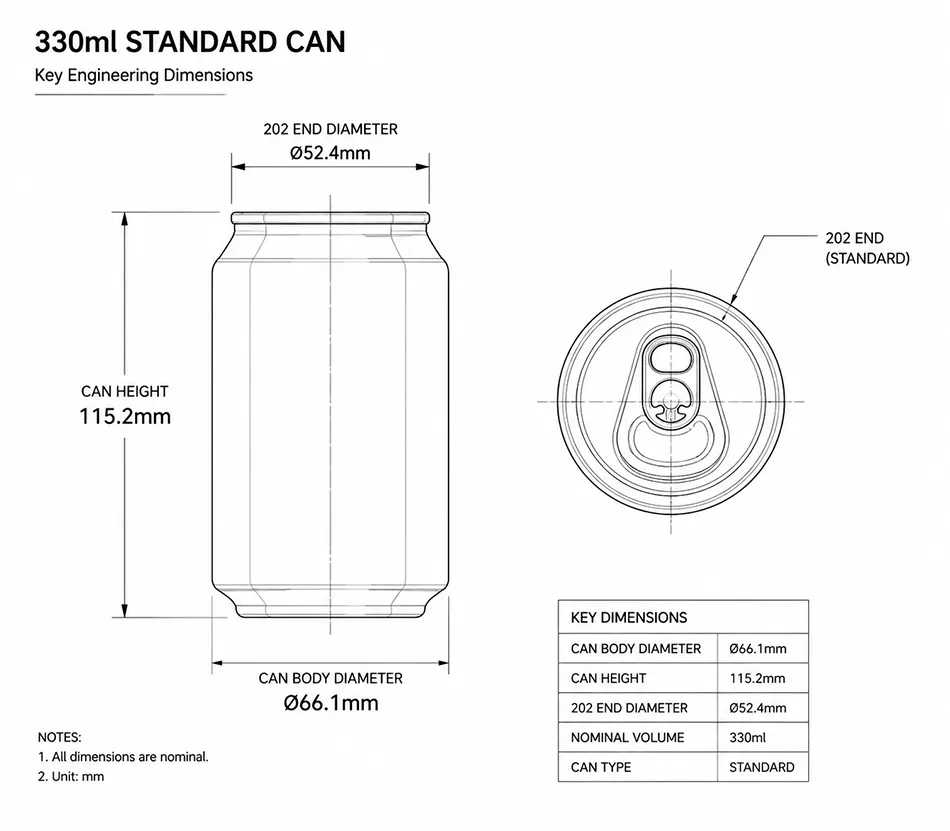
For technical procurement managers and filling line engineers, container geometry and dimensional tolerances are critical factors. A discrepancy of even a fraction of a millimeter can result in micro-leaks during seaming or structural failure under high pasteurization temperatures. This section outlines the precise mechanical dimensions that govern standard 330ml production, establishing a rigorous engineering baseline for quality control teams.
The physical proportions of the 330ml standard two-piece aluminum can have been standardized globally to ensure seamless integration with international filling equipment. Below are the industry-standard specifications:
Body Diameter (Can Specification 211): Nominally ≈ 66mm (with standard production values measuring 66.1mm to 66.24mm ± 0.38mm).
Finished Body Height: Nominally ≈ 115mm (with an industry-standard value of 115.20mm ± 0.38mm).
Internal Neck Diameter (Cap Specification 202): Nominally ≈ 52.4mm ± 0.25mm.
Base Material Composition: High-grade, food-secure aluminum alloy (typically 3000-series aluminum for the body and 5000-series for the end), engineered to meet international food-contact material regulations.
The 202 neck configuration—measuring approximately 52.4mm in diameter—is a vital technical parameter for the 330ml standard can. Because this neck size matches standard commercial seamer tools used worldwide, brands can run these containers on thousands of established filling lines across more than a hundred countries without investing in custom machinery or expensive changeparts. This universal compatibility helps reduce production setup costs and shortens the time-to-market for international product rollouts.
While the traditional standard can is the most widely used configuration for volume-driven markets, brand managers can leverage three distinct profiles within the 330ml capacity segment to optimize shelf positioning. Choosing the right visual profile shifts how consumers perceive product value and dictates the engineering parameters of the automated filling block:
Standard Profile: Features the widest body diameter (≈ 66mm) and a moderate height (≈ 115mm). This variant offers the most mature supply chain infrastructure, the highest maximum filling line speeds, and the lowest per-unit manufacturing cost. It is highly recommended for high-volume products like core carbonated soft drinks, mass-market beers, and high-volume energy drinks.
Sleek Profile: Features a narrowed body diameter (≈ 57mm) with a taller height profile to maintain the 330ml volume. Crucially, the sleek variant retains the standard 202 neck specification, allowing brands to use a more elegant, contemporary container shape without modifying their existing 202 seamer equipment. This format is highly popular for premium ready-to-drink cocktails and craft brand extensions.
Slim Profile: Features the narrowest body diameter (≈ 53mm) and requires a smaller 200 neck specification (≈ 50.0mm). Operating slim cans requires dedicated filling line components and specialized seamer setups. While it carries higher processing costs, the slim profile provides a distinct premium look often utilized for health-focused wellness shots and functional botanical elixirs.
Baixi Cans maintains active tooling and automated manufacturing systems for all three configurations, allowing brands to select the ideal shape for their market positioning and production requirements.
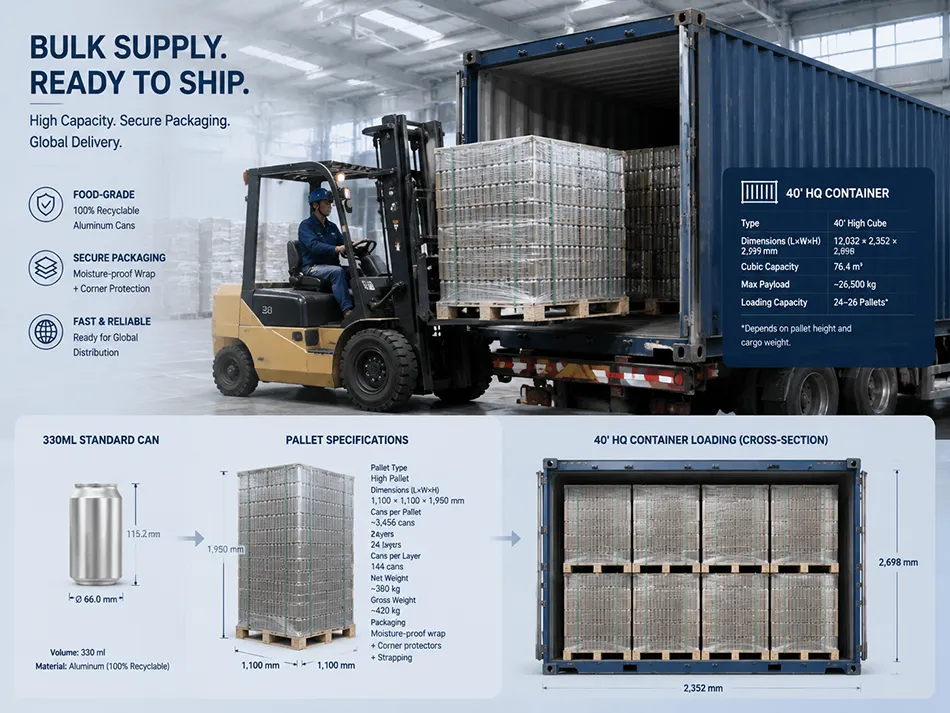
When managing high-volume operations, technical logistics teams must analyze container dimensions as part of a complete supply chain matrix. The external diameter and height of the 330ml standard can determine its stacking density on standard shipping pallets, directly affecting transportation costs. Because these standardized dimensions allow for optimized pallet utilization, they maximize the volume of product packed into ocean containers, improving transport efficiency compared to non-standard or irregular packaging options. This mathematical predictability at the pallet level translates directly into optimized container payloads and reduced shipping friction at global ports.
The 330ml capacity occupies a unique position across various product categories, serving as a versatile packaging choice for both non-alcoholic and alcoholic beverage segments. The strategic deployment of this size varies significantly depending on the target liquid category and regional market maturity.
The 330ml format serves as a primary packaging size for international beer exports. Across the European Union, the Asia-Pacific region, and African markets, this container size is the default specification for premium lager distribution. Within the international beer market, mid-sized containers between 330ml and 500ml generate 65.1% of total sales volume. The 330ml format has become a trusted choice for cross-border distribution, widely accepted across retail chains, hospitality venues, and automated vending networks in over 70 nations.
In European and Asian soft drink markets, the 330ml can is the standard size for carbonated soft drinks. In contrast, the North American market has long been dominated by the 355ml (12 oz) format. However, multinational beverage companies frequently use the 330ml container as a unified size when expanding into emerging consumer markets, reflecting a global trend toward smaller portion sizes in non-alcoholic beverage categories. For brands managing distribution across multiple international regions, the 330ml standard can provides a highly efficient single-SKU solution.
The rapid growth of the RTD alcoholic beverage sector has established the 330ml container as a preferred packaging choice. Consumer data shows that craft spirit producers and independent beverage brands rely heavily on the 330ml format, which is consistently recognized in market reports as one of the fastest-growing container sizes in the premium ready-to-drink segment.
The functional energy drink sector is experiencing a clear shift from compact 250ml cans toward the more substantial 330ml size. This capacity has become an essential mid-size option for energy brands, offering a balanced single-serve volume that fits active, on-the-go lifestyles. Concurrently, the premium RTD iced coffee segment across Europe, South Korea, and Japan has driven increased demand for 330ml aluminum packaging due to its convenience and shelf stability.
A growing number of specialized juice and tea brands are adopting 330ml aluminum cans to differentiate themselves from traditional brick cartons and PET plastic bottles. This format allows brands to position themselves for premium retail placement, either as single-serve items or as part of multi-flavor variety packs. Additionally, the complete light-blocking properties of aluminum protect sensitive juice and tea formulations from UV degradation, extending product shelf life while projecting a clean, modern brand image.
Once a brand selects its ideal container shape, the focus shifts to surface decoration. The exterior of a 330ml aluminum can serves as a highly visible, 360-degree canvas for brand identity and consumer engagement. Choosing the correct industrial printing pathway balances graphic quality against upfront tooling costs.
Conventional Dry-Offset Lithographic Printing: This high-speed process transfers individual ink colors from specialized metal plates onto a central rubber blanket, which then applies the complete design to the container body in a single rotation. This method offers exceptionally low per-unit costs and high color vibrancy for high-volume production runs.
High-Definition Digital Direct-to-Can Printing: This modern printing method requires no physical plates, allowing brands to print intricate graphic designs directly onto the aluminum container body with zero plate setup costs. Digital printing supports complex, full-color designs with photographic resolution, making it an excellent option for craft breweries, seasonal product variations, and limited-edition promotional campaigns.
Blank Can Conversion (Pressure-Sensitive Labeling / Shrink-Sleeving): For brands requiring maximum flexibility across multiple product variations, using unprinted blank cans paired with high-quality shrink sleeves or pressure-sensitive labels is an effective strategy. This approach allows companies to adjust quickly to changing inventory needs without maintaining large stocks of pre-printed cans.
To differentiate products on crowded retail shelves, beverage brands can utilize a variety of advanced tactile and visual coatings. These specialized treatments add a premium touch to the standard 330ml can format:
Tactile and Matte Coatings: Replacing gloss finishes with soft-touch matte coatings or textured varnishes creates a premium, non-slip surface that improves the consumer's physical experience.
Selective Gloss and UV Inks: Combining matte background fields with high-gloss spot UV accents creates striking visual contrast, drawing attention to logos or key brand assets under retail lighting.
Thermochromic and Photochromic Inks: These interactive inks change color when exposed to temperature changes, providing a fun, functional indicator that shows consumers when the beverage has chilled to the ideal serving temperature.
When developing artwork for 330ml aluminum containers, design teams must adhere to precise technical guidelines. Graphic layouts must accommodate specified bleeding zones and quiet areas to ensure clean execution along the tapered neck and base boundaries. Additionally, designers must factor in the container's vertical curvature to prevent visual distortion of fine text or barcode elements. Misalignments during pre-press setup can lead to visual warping on the filling line, highlighting the value of working with an experienced manufacturer.
In international beverage commerce, regulatory compliance and safety certifications are fundamental requirements for customs clearance and retail onboarding. Non-compliance is not an administrative nuisance—it is an operational liability that can trigger full product recalls or port rejections.
Every 330ml aluminum container must meet rigorous international standards for food-contact materials to be accepted by commercial filling networks and import customs authorities:
FSSC 22000 Certification: A comprehensive, GFSI-recognized food safety management system that serves as a baseline requirement for packaging suppliers entering international supply chains.
Integrated Management Systems (ISO 9001 / 14001 / 45001): Verifies consistent quality management, proactive environmental protection practices, and strict workplace safety controls across all manufacturing facilities.
BPA-NI (BPA Non-Intent) Internal Coatings: To comply with strict food safety regulations in the European Union and updating FDA guidelines in the United States, containers utilize modern, BPA-free internal liners that protect liquid freshness without compromising safety.
Export operations must be managed in accordance with evolving trade policies. For example, imports into the United States must comply with Section 232 aluminum tariff structures, which apply specific duties to imported aluminum products. Concurrently, regional compliance mandates, such as the Bureau of Indian Standards (BIS) certification requirements for metal beverage containers, underline the importance of working with an experienced manufacturer who maintains up-to-date compliance certifications and clean cross-border documentation.
From an environmental standpoint, the 330ml aluminum container offers exceptional sustainability benefits. Manufacturing a can from recycled aluminum requires only 5% of the energy needed to produce primary aluminum from raw bauxite ore, resulting in a 95% reduction in manufacturing greenhouse gas emissions. Furthermore, continuous design innovations have steadily reduced the total weight of the aluminum body, lowering transit fuel requirements and helping brands minimize their overall carbon footprint. Choosing highly circular metals helps global beverage exporters align with evolving Scope 3 corporate emission guidelines.
To simplify your sourcing process and minimize administrative delays, procurement teams can follow this structured five-step implementation roadmap. This structural framework guides engineering, purchasing, and logistics teams toward a balanced launch timeline.
Define Technical Specifications: Determine your specific container requirements, including your choice between the standard, sleek, or slim profile, required internal lining chemistry (such as standard epoxy or BPA-NI), and your chosen printing technology.
Audit and Certify Vendor Capabilities: Verify that your chosen manufacturer holds valid FSSC 22000 and ISO certifications. Confirm their experience with international shipping protocols and ensure they can provide complete quality documentation for your target markets.
Execute Line Compatibility Trials: Before committing to high-volume production, source physical sample containers to run on your automated filling lines. Test the neck dimensions against your 202 seaming machinery to ensure clean, leak-proof sealing under full production speeds.
Lock in Rolling Production Schedules: Establish long-term manufacturing agreements to protect your supply chain from material price fluctuations. Plan production timelines well in advance, leaving sufficient buffer for ocean freight and customs clearance.
Synchronize Electronic Logistical Data: Coordinate with your supplier to ensure all physical carton and pallet labels perfectly match your shipping paperwork and Advanced Shipping Notices (ASNs). This alignment ensures smooth processing through international customs and retail distribution networks.
As an established, large-scale manufacturer of two-piece and three-piece aluminum containers, Baixi Cans helps beverage brands build resilient, compliant supply chains for the global market. Operating automated production hubs in Qingdao and Xianning, we deliver certified packaging assets to distributors and brand owners worldwide.
By leveraging both two-piece and three-piece manufacturing technologies, Baixi Cans provides versatile packaging options for a wide variety of beverage products. Our seamless two-piece containers offer excellent internal pressure resistance, making them perfect for high-speed filling of carbonated soft drinks, sodas, and carbonated beers. For specialized pasteurized milk beverages, nutritional drinks, and functional teas, our three-piece configurations provide reliable structural integrity and exceptional sealing performance. This dual-capability allows us to support brands at every stage of growth, balancing high-volume production efficiency with flexible ordering options.
Additionally, Baixi Cans provides comprehensive design and logistics support for international shipments. We ensure all outer packaging matches your export documentation and electronic ASN filings, minimizing compliance friction and helping your products pass smoothly through international ports of entry.
Q1: Can 330ml standard aluminum cans and 355ml (12 oz) cans be run interchangeably on the same filling line?
A: Although both container styles utilize the standard 202 neck specification, they feature different heights: a 355ml North American standard can stands approximately 122mm tall, while a 330ml standard can measures roughly 115mm tall. This 7mm height variance requires adjusting your filling and seaming equipment heights before switching products on the line.
Q2: What are the typical Minimum Order Quantities (MOQs) for 330ml aluminum containers?
A: Conventional dry-offset lithographic printing typically requires an MOQ ranging from 300,000 to 1,000,000 units due to machinery setup requirements. In contrast, advanced digital printing options or unprinted blank cans can be sourced with flexible MOQs starting below 10,000 units. For typical ocean freight shipments, standard ordering volumes on B2B platforms often align around 124,480 units, which represents a full 40-foot High-Cube container load
Q3: What is the standard packaging configuration used for international container exports?
A: Empty aluminum containers are stacked on standardized, heavy-duty pallets and protected with secure plastic wrap to prevent movement during transit. A standard 40-foot High-Cube ocean container can accommodate approximately 124,480 empty 330ml cans, complete with their corresponding ends
Q4: How can procurement teams verify that internal coatings are 100% BPA-free?
A: Brands should request an official Declaration of Compliance (DoC) and certified formulation statements from their packaging manufacturer. These documents verify that traditional epoxy resins have been fully replaced with advanced BPA-NI (BPA Non-Intent) liner materials that meet or exceed regional food safety limits.
Q5: What custom printing and decoration capabilities does Baixi Cans support?
A: Baixi Cans supports both traditional dry-offset lithography and high-definition digital direct-to-can printing
Building a reliable international beverage brand requires a manufacturing partner who understands both precision container production and complex global logistics rules. Baixi Cans provides the industrial expertise, modern machinery, and quality control systems needed to ensure your products stand out on retail shelves and move efficiently through global supply chains.
Request a Sourcing Consultation: Schedule a 15-minute technical strategy session with our procurement team. We will analyze your production goals, review your filling line setups, and help configure an efficient packaging solution for your target markets.
Request Production Samples: Ready to evaluate our products firsthand? Reach out to our team to request physical sample containers and an explicit production quote for your project. We manufacture a full range of industry-standard containers—including
Corporate Email: sales@baixicans.com
Web Portal:

