
Imagine a craft beer brewery founder standing in a crowded retail aisle. They watch as their meticulously formulated product, packaged in a standard 330ml can, blends into a sea of identical competitor rows. Just a few feet away in the functional beverage display, a sparkling botanical water packaged in a same-capacity Sleek profile immediately catches a shopper's eye. Both containers hold the exact same volume of liquid, yet the consumer perception, perceived premium value, and brand story they convey are completely different.
Many global beverage brands face market performance bottlenecks due to choosing the wrong container format. A product formulation can be outstanding, the ingredient sourcing pristine, and the label graphics beautiful—but if the container shape fails to communicate the correct message within those critical first three seconds at the retail shelf, the consumer moves on. This psychological filter operates entirely in the subconscious, meaning that a sub-optimal packaging choice can actively suppress a brand's sales velocity despite massive marketing investments.
In the modern beverage landscape, an aluminum container is no longer just a functional vessel; it is your brand's primary physical billboard. The choice between Standard, Sleek, and Slim formats signals distinct brand identities to your target consumer:
Is your product an established, dependable classic?
A modern, lifestyle-driven innovation?
Or a premium, wellness-focused functional drink?
Once your team identifies the ideal shape for your product portfolio, the next step is partnering with a manufacturer that can guarantee stable, high-volume container supply. Baixi Cans is a leading global supplier of two-piece and three-piece aluminum beverage containers, offering full production capabilities across all Standard, Sleek, and Slim specifications.
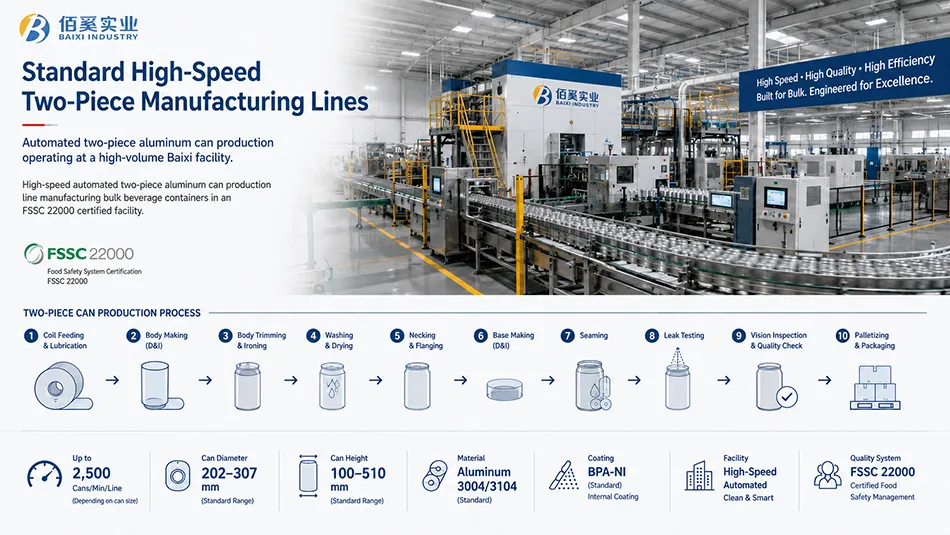
Operating high-speed production hubs certified under the FSSC 22000 Food Safety Management System and ISO quality frameworks, Baixi delivers reliable manufacturing precision and cross-border supply chain security. We help international beverage brands transition their structural packaging concepts into scalable, retail-ready products.
Many emerging beverage brands make the mistake of focusing on graphic design and label aesthetics before finalizing their physical container dimensions. This reversed approach often leads to significant operational challenges, such as unexpected filling-line mismatches, un-optimized shipping volumes, and misaligned brand positioning. When graphic designers construct complex 360-degree artwork without a fixed, technically verified canvas blueprint, the risk of text warping, seam distortion, and out-of-boundary printing increases exponentially, forcing costly creative redesigns deep into the development cycle.
Selecting your physical container format must be the very first step in your packaging development pipeline. The geometric specifications of an aluminum can dictate your entire production setup, from automated depalletizers to cartoning machinery.
A variation of just a few millimeters in container diameter or total height impacts your entire automated filling infrastructure. Infeed starwheels, guide rails, neck-handling grippers, and conveyor configurations are engineered around strict tolerances. Attempting to run a non-standard or unverified container profile through a filling line calibrated for a different format causes structural line jams, localized can wall denting, and costly production downtime. This disruption can halt an entire packaging plant, accumulating thousands of dollars per hour in lost labor efficiency and missed distribution deadlines.
Beyond basic machinery compatibility, your physical container dimensions serve four critical strategic purposes that directly influence your corporate balance sheet:
Initial Shelf Perception: The visual aspect ratio of a container changes how consumers perceive a beverage. A tall, narrow silhouette naturally communicates modern, low-calorie, or premium characteristics, whereas a classic standard profile conveys tradition, value, and reliable refreshment.
Tactile Ergonomics and In-Hand Feel: The physical grip of a container plays an important role in consumer satisfaction. The narrow grip of a slim format appeals strongly to wellness-oriented demographics looking for a light, effortless handle, while the solid feel of a standard profile satisfies traditional soft drink and beer consumers who prefer a robust, familiar grip.
Filling Line Processing and Closure Matching: Container width directly dictates the required closure size. While a classic standard profile typically uses a 202 stays-on tab, specialized slim formats require a narrower 200 closure. These sizing differences require specific change-parts, timing adjustments, and custom calibration on high-speed seaming lines.
Volumetric Transport Density and Global Freight Costs: The packing layout of containers on a shipping pallet determines your total ocean freight efficiency. Minor shifts in outer container diameters alter the number of units that fit into a standard 40ft shipping container, directly impacting your landed logistics costs per unit and overall export profitability.
Ultimately, these strategic dimensions mean that every millimeter of structural variation ripples down your entire supply chain. By locking in your container geometry before engaging in graphic iterations, your operation secures predictable technical tolerances, optimized palletization strategies, and a cohesive brand narrative from day one.
To help procurement managers, packaging engineers, and supply chain directors select the right container format, the following technical deep-dive outlines the exact engineering profiles of the three industry-standard designs. These geometric blueprints dictate the mechanical handling parameters required for fault-free factory throughput.
The standard aluminum container is the foundation of the global beverage industry. Built around a historic 211 body diameter (approximately 66mm), this format provides excellent internal volumetric space and exceptional structural column strength, allowing for dense vertical stacking in automated distribution centers.
Dimensional Engineering: 66mm body diameter. Container height varies by volume: a standard 250ml can stands at approximately 92mm, the widely used
Closure Sizing: Uses the industry-standard 202 neck finish (52.4mm diameter), making it seamlessly compatible with high-speed filling equipment and universal outfeed solutions worldwide.
Primary Application: Carbonated soft drinks, mass-market lagers, traditional iced teas, energy-blend multi-packs, and high-volume ambient juices.
Strategic Advantage: Delivers the lowest per-unit manufacturing cost, maximum filling-line stability under high processing speeds, and excellent resistance to internal pressure deformation.

The slim container is the narrowest format available in mass production. Engineered around a refined 200 body diameter (approximately 53mm), it provides a distinctive, ultra-tall appearance that intentionally signals specialized, highly targeted ingredients.
Dimensional Engineering: 53mm body diameter. A standard
Closure Sizing: Requires a specialized, smaller 200 neck finish closure (50.0mm diameter), which requires dedicated seaming components and precise calibration of the lid-feed turret.
Primary Application: Premium energy drinks, functional RTD coffees, boutique nutritional formulas, collagen waters, and portion-controlled wellness tonics.
Strategic Advantage: Conveys an upscale, premium identity that stands out in traditional retail displays, while offering an elongated vertical surface that maximizes the visual impact of minimalist branding designs.
The sleek format balances the space efficiency of a standard container with the premium feel of a slim design. It features an intermediate 204 body diameter (approximately 57mm), presenting a modern, "sculpted" look that fits comfortably into consumer hands.
Dimensional Engineering: 57mm body diameter. A 250ml sleek variant stands at 115mm tall, while the popular 12oz (355ml) variant bridges the gap between classic volumes and contemporary style, satisfying both North American and European standard preferences.
Closure Sizing: Cleverly maintains the standard 202 neck finish (52.4mm diameter), allowing brands to use standard
Primary Application: Hard seltzers, premium craft sodas, RTD spirits, sparkling waters, and contemporary lifestyle energy drinks.
Strategic Advantage: Provides a modern, lifestyle-focused aesthetic while preserving production compatibility with existing 202 seaming systems, reducing upfront capital tooling costs for expanding brands.
This master reference table provides the exact dimensions, closure codes, and production metrics for cross-border packaging development:
| Technical Parameter | Standard Can (e.g., 330ml / 500ml) | Sleek Can (e.g., 335ml / 355ml) | Slim Can (e.g., 250ml Variant) |
| Nominal Outer Body Diameter | ~66mm (211 Wire Specification) | ~57mm (204 Wire Specification) | ~53mm (200 Wire Specification) |
| Industry Neck Finish Code | 202 Diameter Finish (52.4mm) | 202 Diameter Finish (52.4mm) | 200 Noded Diameter Finish (50.0mm) |
| Required Closure Type | Standard |
Standard |
Narrow 200 Specification Lids |
| Relative Production Speed | Maximum Throughput (Up to 3,000 CPM) | High Speed (Minor Line Tuning) | Moderate Speed (Requires Guidance Adjustments) |
| Visual Aspect Ratio (H:W) | Balanced, Robust (Low Ratio) | Elongated, Flowing (Medium Ratio) | Ultra-Tall, Premium (High Ratio) |
| Print Canvas Surface Area | Wide Horizontal Layout | Elongated Vertical Canvas | Maximum Vertical Narrative Space |
Consumer purchasing decisions are heavily influenced by subtle visual cues. In a matter of seconds, shoppers categorize products based on their physical shape. Understanding the consumer psychology behind different container sizes allows your brand to align its packaging with market expectations, reducing cognitive friction at the point of sale.
The classic standard design, used for major products like global colas and regional beers, communicates reliability and excellent value. Because consumers have interacted with this format for decades, it presents a low barrier to purchase, making it ideal for products designed for casual consumption, family gatherings, and mass market retail channels.
For a beverage company launching a traditional carbonated soft drink or a high-volume lager, utilizing the standard
The sleek format has become the default choice for modern lifestyle beverages, such as hard seltzers, premium mixers, and functional energy drinks. Its balanced proportions feel contemporary and active without looking overly medicinal or industrial. By updating traditional volumes into a more streamlined shape, brands can capture the attention of style-conscious consumers.
Consumer insights indicate that younger demographics connect the sleek shape with social gatherings, clean ingredients, and modern design. According to recent retail surveys, a strong majority of millennial and Gen Z consumers associate sleek profiles with a more modern lifestyle. Adopting a sleek configuration allows brands to target premium price points and position themselves as modern lifestyle choices in highly competitive market segments.
The slim format is closely associated with wellness and portion control. Its tall, narrow silhouette mirrors the sleek design language of the health and beauty sectors, making it the preferred choice for natural energy formulas, cold-brew coffees, and functional kombuchas. The narrow profile intentionally moves away from associations with mass-market, high-calorie sodas, aligning instead with a clean, wellness-focused lifestyle.
The smaller
While marketing departments often prioritize visual appeal, procurement teams must evaluate the practical manufacturing and financial implications of different container formats. Transitioning from one style to another introduces distinct operational variables that affect your bottom line, requiring close coordination between your creative and production teams.
The primary operational consideration when changing formats is the container's neck finish diameter. Standard and sleek containers share the same 202 neck dimension, meaning you can run both styles using the same closure feeding systems and seaming chucks. This compatibility drastically reduces line changeover times, allowing a factory to pivot production with minimal mechanical intervention.
Conversely, switching to a slim container requires moving to a narrower 200 neck diameter. This change requires your engineering team to install specialized change-parts, swap out seaming heads, and adjust container handling systems, which increases your line changeover times. Procurement teams must account for these technical requirements when calculating total batch costs, ensuring that short-run productions remain financially viable given the required mechanical adjustments.
The geometric dimensions of each container type alter how pallets are arranged and stacked inside standard shipping containers. Because slim containers are taller and narrower, they create a different pallet configuration than shorter, wider standard cans holding the same volume. These variations directly influence how safely pallets can be stacked in multi-tier shipping layouts.
These layout variations change the number of units that fit on a single pallet layer, which can affect your total shipping density and ocean container utilization. For long-distance export supply chains, a decrease in volumetric efficiency can lead to higher freight costs per unit. Sourcing teams must run detailed palletization simulations to ensure that the premium pricing gained from a specialty shape outweighs any incremental changes in international shipping costs.
Because standard shapes run continuously on high-speed production lines around the world, they typically offer lower Minimum Order Quantities (MOQs) and greater scheduling flexibility. Specialty slim and sleek sizes require dedicated production runs and complex machinery adjustments, which can result in larger minimum volumes and extended production lead times from traditional single-line operations.
Furthermore, managing quality control across different suppliers for varying container formats adds significant operational complexity. Sourcing all three formats from separate manufacturers increases administrative friction, complicates quality audits, and limits your volume purchasing leverage. Variations in metal alloy compliance, internal coating thickness, and print accuracy across multiple vendors can create inconsistencies in your final product quality on the shelf.
To solve this challenge, global brands partner with vertically integrated manufacturers like Baixi Cans. By operating versatile production lines for Standard, Sleek, and Slim containers, Baixi allows enterprise buyers to combine different container styles under a single supply contract. This integrated approach simplifies vendor management, maximizes bulk purchasing power, and ensures consistent quality control and uniform printing accuracy across your entire product portfolio.
Analyzing how major beverage companies adjust their structural packaging choices highlights the clear connection between container design and market growth. These strategic adaptations demonstrate how matching the right packaging shape with target consumer groups can unlock new revenue streams.
A major global spirits brand recently updated the packaging for its pre-mixed cocktail line, moving away from classic short standard containers in favor of a customized 330ml Sleek format. The brand's primary goal was to improve shelf visibility in crowded retail environments and differentiate its premium spirit blend from traditional, value-focused beers.
The update led to a significant increase in retail placements, particularly in cold-shelf displays and convenience checkout zones. Consumer feedback confirmed that the streamlined sleek profile made the product look more premium, justifying its higher retail price point and helping the brand establish itself as a market leader in the competitive RTD category.
A fast-growing functional energy beverage company expanded its market reach by introducing a compact
The slim container's premium, wellness-oriented design helped the brand secure distribution in upscale grocery chains and fitness centers, proving that a smaller, targeted package size can successfully unlock new consumer segments and position an energy drink as a healthy, daily functional supplement.

Choosing the right container format requires balancing consumer appeal, production compatibility, and long-term supply chain economics. Use this step-by-step decision framework during your next procurement and product development planning session to ensure your choice aligns with your long-term business goals:
If your product targets mass-market channels requiring high production volume and classic styling (such as traditional sodas or value lagers), choose the reliable Standard format to maximize value perception.
If your product is a lifestyle-driven drink focused on modern social trends (such as hard seltzers or craft cold brews), select the contemporary Sleek design to capture millennial and Gen Z demographics.
If your product is an premium, health-focused functional blend (such as energy tonics or nutritional shots), choose the elegant Slim profile to emphasize high quality and portion control.
Check whether your current seaming equipment is set up for standard 202 ends or if you have the operational flexibility to run 200 neck finishes without significant capital reinvestment.
Calculate the line changeover times, track guide modifications, and starwheel adjustments required to shift between different container widths on your automated conveyor systems.
Look beyond the base per-unit manufacturing cost and evaluate your fully landed expenses, including external print setups, internal protective liners, and international ocean freight efficiency.
Assess how much premium pricing your brand can achieve by moving to a specialty sleek or slim shape, ensuring it covers any adjustments in shipping costs or manufacturing premiums.
Ensure your chosen packaging manufacturer can reliably produce all three formats under strict international food safety standards, such as FSSC 22000, to guarantee compliance in your destination markets.
Confirm their proximity to major international shipping ports to minimize inland logistics overhead, guarantee reliable export delivery schedules, and protect your manufacturing timelines.
Building a resilient, versatile beverage brand requires a packaging partner who understands both production precision and global logistics. Baixi Cans operates advanced, high-speed production facilities equipped to deliver standard, sleek, and slim aluminum containers tailored to your exact specifications, supporting your growth from initial product testing through to global distribution.
Our manufacturing facilities utilize automated optical inspection systems and precision testing to ensure that every container meets strict structural tolerances. Whether your product line requires high-volume standard
By operating complete production lines for both two-piece and three-piece containers alongside matching
Q1: Can I source Standard, Sleek, and Slim formats in a single combined order?
A: Yes. By partnering with a multi-format manufacturer like Baixi, you can organize your annual supply contract to include different container styles, simplifying your vendor management and streamlining your logistics.
Q2: Do sleek and slim containers require different types of easy-open lids?
A: Yes, they do. Sleek containers share the standard 202 neck finish with standard cans, allowing them to use the same common lid sizes. Slim containers feature a narrower 200 neck profile, which requires specialized, smaller closures to ensure a proper seal.
Q3: How does container height impact my retail shelf presentation and branding options?
A: Tall formats like slim and sleek styles provide an elongated vertical surface, giving your design team more room to showcase branding, ingredient callouts, and clean typography, which helps improve product visibility on crowded retail shelves.
Q4: Are there structural differences between these formats when packaging highly carbonated beverages?
A: Our entire two-piece aluminum lineup—across standard, sleek, and slim designs—is engineered to handle the internal pressures required for highly carbonated soft drinks, energy formulas, and sparkling waters.
Q5: What internal coatings does Baixi use to protect beverage flavor and prevent corrosion?
A: We apply advanced, food-grade internal linings—including state-of-the-art epoxy-phenolic resins and next-generation BPA-free coatings—tailored to your drink's specific acidity and pasteurization requirements, ensuring complete flavor protection and long shelf life.
Navigating fast-moving beverage retail trends requires an agile, dependable packaging supply chain. Protecting your product quality and securing your delivery schedules starts with choosing a manufacturing partner that can scale alongside your brand.
Download Our Resource Guide: Request our comprehensive Aluminum Container Dimensions & Sourcing Checklist PDF, featuring complete engineering specification sheets, filling-line tolerance guides, and international shipping planning tools.
Schedule a Technical Consultation: Let our packaging experts help you analyze your product's acidity, carbonation levels, and manufacturing setup to identify the best container configuration for your business.
Request Physical Product Samples: Contact our international sales team to receive unprinted structural samples of our Standard, Sleek, and Slim containers to run compatibility and sealing tests on your own filling lines.
Corporate Procurement Email: sales@baixicans.com
Connect with Us Today:

