
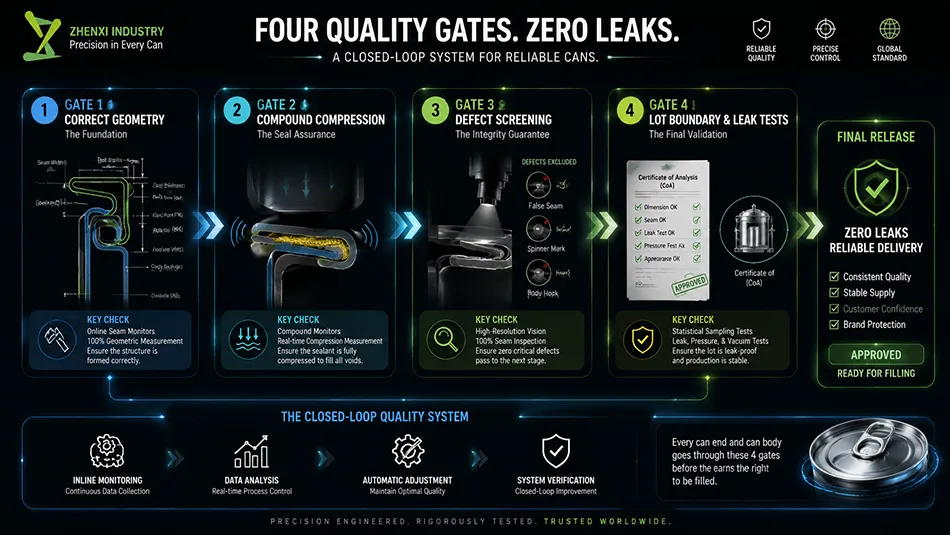
A double seam matrix prevents leakage only when four gates agree: the seam geometry is correct, the sealing compound is held under the right compression, visible defects are absent, and the production lot boundary is proven by measurement and leak evidence. "Zero leakage" is not achieved by one good seam number; it is achieved by a controlled relationship among body hook, cover hook, overlap, tightness, countersink, end fit, seamer setup, and line events.
FDA's low-acid canned food inspection guide explains that the double seam is formed in two operations using a chuck, lifter, first-operation roll, and second-operation roll. FDA also stresses precise adjustment because these parts form the seal. CFIA guidance connects overlap and tightness to the compression of sealing compound. For beverage buyers, that is the matrix: geometry plus compression plus defect control plus release evidence.
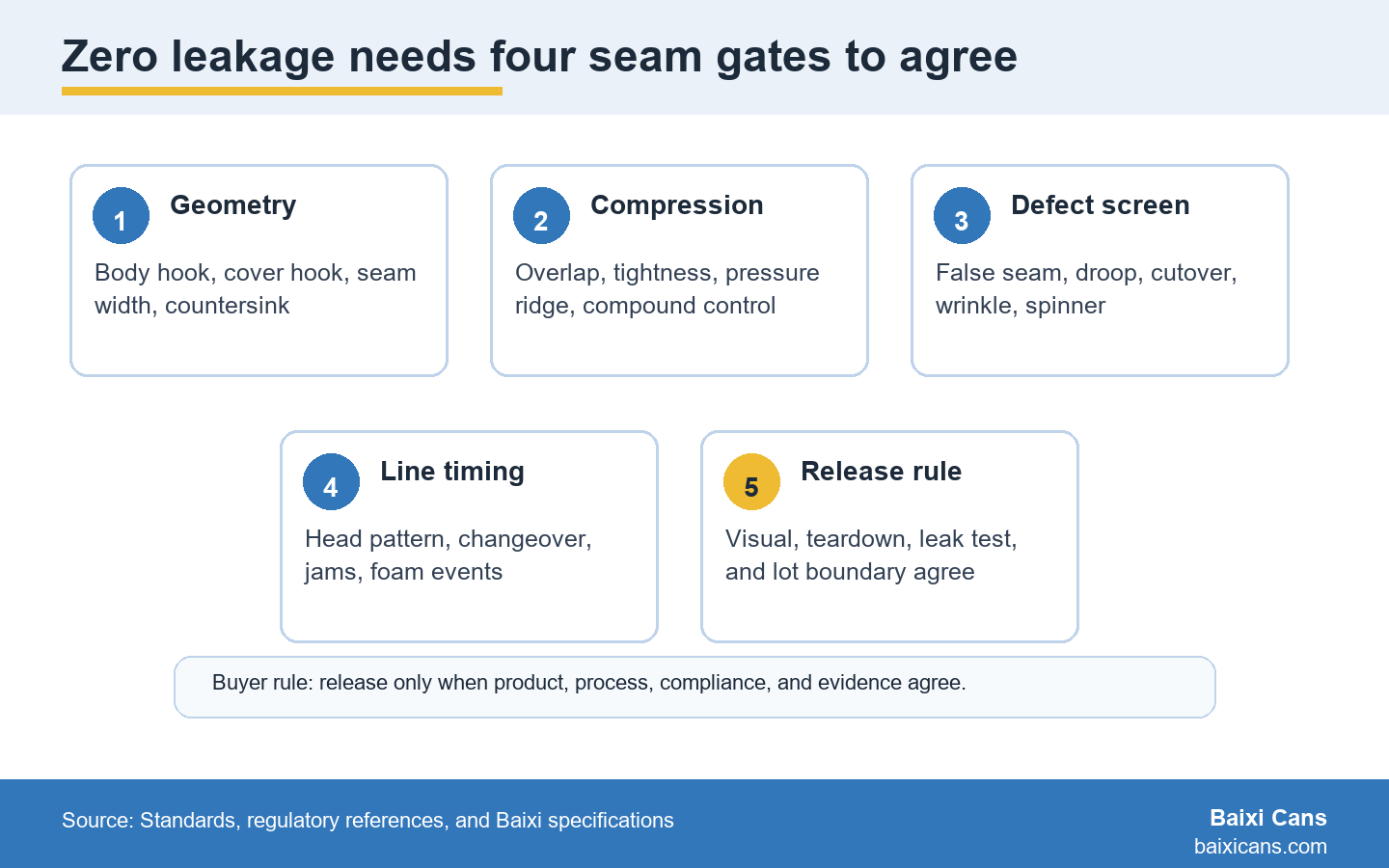
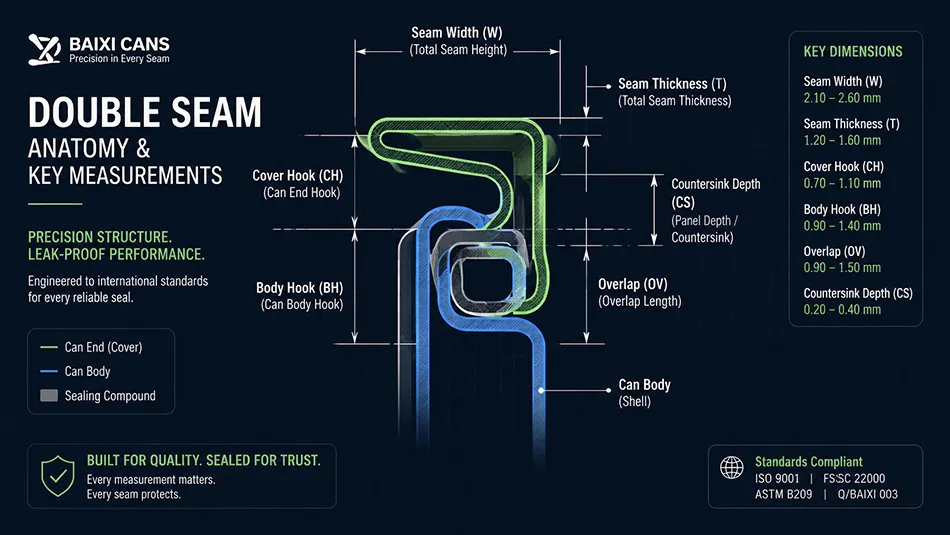
The double seam matrix is a relationship map, not a scorecard: each seam dimension only matters because it changes the probability of a hermetic closure.
The core measurements include seam width, seam thickness, countersink depth, body hook, cover hook, overlap, tightness rating, wrinkle rating, and pressure ridge. Some plants add visual classification, leak test results, teardown photos, head number, end lot, body lot, and time window. The matrix is useful because it prevents one passing number from hiding a failing relationship.
For example, a seam can appear tight but be overworked, creating cutover or metal damage. Another seam can have acceptable width but insufficient overlap. A third can pass a spot teardown but fail when the defect is intermittent and tied to one seaming head. The matrix forces the team to ask whether the closure is mechanically sound across the lot, not only whether the sampled seam looks acceptable.
The buyer does not need to become a seamer mechanic, but the buyer should know which evidence proves the lot. If a co-packer sends only "seam OK," ask for the matrix elements that support that conclusion.
The first gate is geometry. The can body flange and the end curl must be formed so the first operation can roll them into a stable hook relationship. If the body hook or cover hook is wrong, the second operation cannot magically create a safe seal. It can flatten, tighten, or overwork the seam, but it cannot reliably repair a bad interlock.
This is why end compatibility belongs in the buyer's purchase decision. A 200, 202, or 206 end is not interchangeable just because all are aluminum can ends. The body, end, chuck, and roll profile must match. Baixi Cans' aluminum can lids collection lists multiple end diameters and styles, so the lid must be locked to the can body and filling line before production.
Geometry also explains why dented flanges, damaged curls, or poor depalletizing can cause leakage even when the nominal can specification is right. The double seam is formed from the physical condition of the body and end at the moment of seaming. A perfect drawing cannot protect a damaged flange.
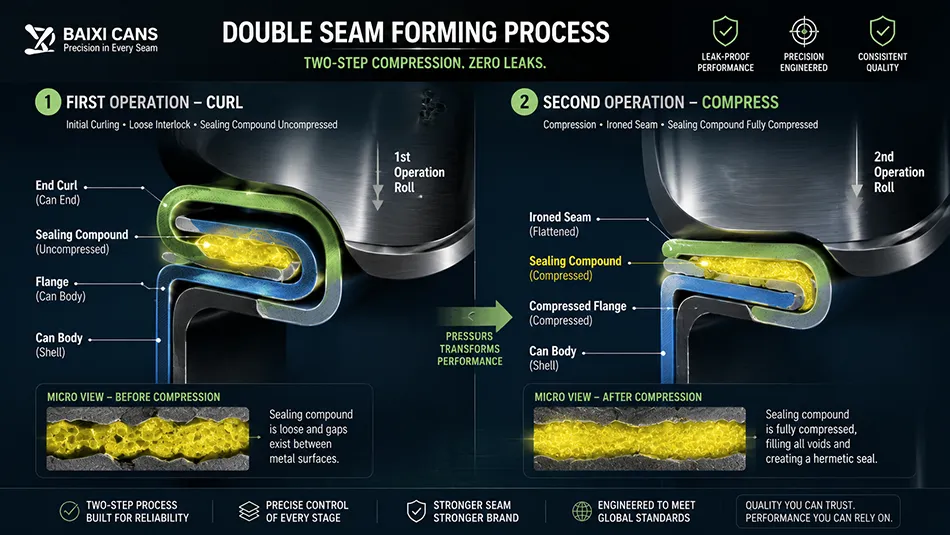
Overlap tells you whether the hooks engage; tightness and pressure ridge tell you whether the compound is being held as a seal.
The sealing compound is a critical part of leakage prevention. It fills the microscopic spaces that metal geometry alone cannot seal. CFIA guidance emphasizes that body and end hooks must overlap sufficiently so the sealing compound is held under compression with correct seam tightness. That wording is important: the goal is not simply metal folded over metal; the goal is a compressed seal that survives handling and pressure.
Too loose creates leakage risk. Too tight can create cutover, sharp seams, metal thinning, or damage. The matrix therefore needs both under-tight and over-tight failure logic. A plant that responds to every leak by tightening the second operation may solve one symptom while creating another defect class.
For pressurized beverages, compression has to survive internal pressure and temperature exposure. For acidic products, leakage can also become a corrosion or flavor issue because product may contact vulnerable areas around the seam. The seam matrix should therefore be linked to product risk, not kept as an isolated maintenance chart.
AFDO's can defect guide categorizes major visible defects and recommends laboratory examination when a suspected defect could cause loss of hermetic seal. Defects such as false seams, droops, vees, cutovers, sharp seams, deadheads, spinners, and wrinkles can indicate different root causes. They should not be averaged into one "appearance issue" category.
Visible defects create the triage layer of the matrix. A catastrophic false seam should trigger a different response from a minor wrinkle with stable teardown data. A sharp seam after a jam should trigger immediate inspection of the affected window. A head-specific spinner pattern should point toward machine setup or wear. The matrix should tell operators how each defect changes the hold, sample, or release decision.
Buyers can use this logic when reviewing co-packer reports. Ask whether gross visual closure defects were checked after jams, changeovers, and startup. Ask whether defects were tied to seaming head and time. A report that lists only final accepted output may hide the investigation work that proves why the accepted lot is safe.
Even strong seam measurements need a lot boundary. If a problem starts at 10:12 and is corrected at 10:24, the release decision must define which cans are inside that window, which samples represent the window, and which evidence proves the correction worked. Without a lot boundary, a leak test can become a lucky sample rather than a release gate.
Leak testing, pressure testing, vacuum testing, dye testing, incubation, or retained-sample checks may be used depending on product and plant practice. The point is not that every beverage needs every test. The point is that the selected test must answer the product's leakage risk. A still water line, a highly carbonated soda, and an acidic energy drink do not carry the same seam consequences.
An illustrative scenario shows the cost of weak lot boundaries. A line running 72,000 cans per hour produces 1,200 cans per minute. If the plant cannot identify the ten-minute window around a seamer disturbance, up to 12,000 cans may need conservative hold or recheck. A better matrix with head, time, end lot, and sample records can shrink the investigation from a shift problem to a defined release decision.
| Matrix area | Buyer question | Leakage implication |
|---|---|---|
| Body hook and cover hook | Do the hooks interlock according to the approved guideline? | Weak interlock can create false seam or low overlap risk. |
| Overlap | Is overlap measured optically or only estimated? | Insufficient overlap weakens the mechanical seal. |
| Tightness and wrinkles | Does tightness hold compound without overworking metal? | Loose seams leak; over-tight seams may cut or crack. |
| Countersink and seam width | Are values stable by seaming head and time? | Drift can show tooling or setup instability. |
| Defect classification | Are false seams, droops, cutovers, and spinners separated? | Different defects require different corrective action. |
| Release evidence | Do visual, teardown, leak, and lot boundary records agree? | Agreement turns inspection data into a defensible release. |
The most useful buyer habit is to ask for the conclusion and the evidence together. "Zero leakage" is only meaningful when the report shows why leakage risk was controlled.
The highest-risk moments for leakage are often startup, changeover, restart after a jam, and the first commercial run of a new can or lid. During these windows, the line is proving whether the theoretical body-end combination can run under real speed, product, foam, and handling conditions. A normal hourly sample may be too slow for this phase because the process has not yet shown that it is stable.
A stronger matrix adds first-article approval. Before the line enters full release, the plant should check visual seams, teardown measurements, leak or pressure evidence when required, lid feed, end lot, body lot, and head-by-head patterns. The first accepted samples should be retained with time stamps. If a changeover moves from a 202 end to a 200 end, or from a standard can to a slim can, the matrix should restart rather than inherit the previous format's approval.
This is especially important for custom or export orders. A buyer may not be present at the filling line, but the buyer can request first-run evidence. The request should name the body and end combination, startup sample count, seam measurements, defect classes checked, and the rule for when the line is allowed to move from trial to commercial speed. That request turns zero leakage from a promise into a controlled release event.
That evidence also helps later dispute resolution.
Baixi Cans supplies can bodies and lids, so its role is upstream from the co-packer's seamer operation but still central to leakage prevention. The can flange, lid diameter, end curl, compound, coating, and lot traceability all affect the seamer's ability to form a reliable closure. According to company materials, Baixi Industry offers aluminum cans and lids across multiple beverage formats, including standard and slim cans and multiple lid options.
For a buyer, the practical step is to align Baixi's body and lid specification with the filling partner's seamer before production. If the project uses a 500ml standard aluminum can, a slim energy-drink can, or a customized lid, the seam matrix should be built around that exact body-end-line combination.
Before the first production run, send Baixi Cans and the filler the can body specification, lid diameter, lid style, product pressure, filling-line model, target speed, and seam acceptance requirements. Ask the filler to define startup sampling, head-by-head teardown, gross defect checks after jams, leak or pressure testing, and lot-boundary rules. If the body and lid are not yet selected, use Baixi's contact page to align can, lid, and seam requirements before the order is locked.
Some minor wrinkles may be acceptable if overlap, tightness, pressure ridge, and leak evidence remain within the approved guideline. The decision should be based on the complete seam matrix, not on appearance alone.
Overlap and seam thickness answer different questions, so neither should be used alone. Overlap confirms hook engagement, while thickness and tightness help show whether the compound is compressed without overworking the metal.
Line jams can damage flanges, disturb lid placement, create sharp seams, or produce intermittent closure defects. After a jam, the plant should define the affected production window and perform visual and teardown checks before release.
Yes, especially for new cans, new lids, pressurized beverages, acidic drinks, or export orders. Buyers should request enough data to confirm the exact body, lid, seamer, and product condition produced a stable closure.
No, leakage prevention depends on the can body, lid, seamer setup, line operation, product pressure, and handling. A supplier can provide correct specifications and traceability, while the filler must prove closure performance on the actual line.

