
The year 2023 marked a definitive turning point for the global rigid metal packaging sector. Following the extreme macro-environmental disruptions of 2020 through 2022—characterized by historic supply chain friction, localized material stockouts, and unprecedented ocean freight volatility—the global aluminum can market entered a period of deliberate stabilization and inventory recalibration. During the preceding "can shortage" era, beverage brands were forced into a reactive purchasing posture, often securing any available packaging inventory regardless of premium pricing or long lead times. In 2023, however, the industry experienced a structural pivot as global supply lines caught up with consumption patterns, allowing procurement strategies to transition from emergency hoarding to calculated, data-driven optimization.
Industrial baseline metrics indicate that the global aluminum can market was valued at approximately $55.5 billion in 2023. Backed by solid economic fundamentals, a burgeoning global middle class, and an irreversible shift away from single-use plastics, the sector is projected to expand at a steady Compound Annual Growth Rate (CAGR) ranging from 3.3% to 5.15%, signaling sustained volume expansion throughout the decade.
On a regional scale, North America retained its historical position as the largest single consumption market, accounting for roughly 35% of global volume, supported by a highly mature consumer base and entrenched retail distribution networks. Concurrently, the Asia-Pacific region emerged as the primary growth engine, expanding at a CAGR exceeding 6%. Within this sub-market, China's specialized beverage aluminum can sector contributed a substantial $3.26 billion, reflecting robust domestic production and strong international trade.
This regional performance is supported by massive upstream manufacturing capacity. In 2023, China’s total output of semi-finished aluminum fabricated materials reached 46.95 million tons, representing a steady year-on-year increase of 3.9%. Although total exports of aluminum fabricated products experienced a cyclical adjustment to 8.09 million tons (down 8.3% due to international destocking as overseas brands worked through their pandemic-era safety stocks), overall manufacturing volumes remained near historic highs. This vast raw material baseline guarantees that Chinese manufacturers are uniquely positioned to offer exceptional cost stability and continuous volume availability to the global market.
This comprehensive report delivers an executive-level analysis of the global aluminum can ecosystem across seven core pillars: structural market valuations, shifting regional dynamics, technical product classifications, global competitive landscapes, volatile raw material cost structures, evolving regulatory environments, and data-driven forecasts leading to 2030.

To assist corporate procurement teams and brand owners in navigating metal packaging decisions, this functional matrix aligns distinct operational challenges with verified industrial solutions:
| If you are a... | Your Core Technical & Market Focus | How Material Strategy Impacts Your Bottom Line |
| Beverage Procurement Director | Mitigating structural container costs and ensuring supply continuity for high-speed automated filling lines. | Leveraging standardized two-piece aluminum architectures to optimize filling line efficiency and reduce single-unit costs. |
| International Supply Chain Manager | Minimizing total shipping weight per container and protecting cargo from ocean transit damage. | Transitioning to lightweight aluminum alloys to lower freight costs while locking in base metal pricing structures. |
| Packaging R&D / Quality Engineer | Verifying internal lining integrity against organic acids and monitoring high-pressure double-seam stability. | Specifying advanced Bisphenol A Non-Intent (BPA-NI) protective barrier layers calibrated to low-pH formulations. |
| Emerging Beverage Brand Founder | Navigating market entry barriers, optimizing minimum order quantities (MOQs), and building distinctive shelf identity. | Deploying agile digital direct-to-can printing for pilot batches before scaling to high-speed lithographic production runs. |
A detailed look at consensus data from leading industrial research firms confirms the solid financial foundation of the global aluminum rigid packaging sector in 2023. Because different research groups utilize slightly varying methodologies—some tracking raw aluminum coil conversion values while others calculate the wholesale value of decorated cans delivered to filling plants—it is helpful to analyze the market from multiple analytical angles to establish a true industry baseline.
According to verified industry reports:
The IMARC Group documented that the global aluminum can market reached a baseline of $52.2 billion in late 2022 and moved into 2023 with strong momentum. Projecting a steady 3.3% CAGR, their analysts expect the sector to scale efficiently to a projected $65.0 billion market valuation by 2028, driven primarily by the rapid commercialization of ready-to-drink (RTD) alcoholic beverages.
Concurrently, data compiled by AL Circle placed the 2023 market valuation at a higher benchmark of $55.5 billion. Their model forecasts a rapid short-term rise to $58.2 billion, followed by an accelerated climb to $85.6 billion by 2032, supported by an anticipated 4.93% CAGR. This faster growth rate is attributed to aggressive infrastructure investments in emerging economies, particularly across India and Southeast Asia.
Stratview Research offered a matching perspective, positioning the baseline market at $57.08 billion with a projected 4.06% CAGR to drive total market value to $73.02 billion by 2028. They highlight that the widespread adoption of aluminum cans by premium wellness and functional water brands is opening up entirely new revenue streams outside traditional soda and beer categories.
This financial growth reflects significant volume expansion across global consumer markets. Global consumer demand for aluminum beverage containers rose steadily from 343 billion units in 2015 to 416 billion units in 2020, and is on track to reach an estimated 627 billion units by 2030. Today, aluminum rigid containers command over 96% of the global metal beverage packaging segment, cementing their position as the preferred choice for modern liquid logistics.
This overwhelming dominance means that for global beverage brands, choosing aluminum is no longer merely a branding option—it has become a foundational requirement for achieving true industrial scale and supply chain efficiency.
To accurately interpret the performance of the market in 2023, it must be evaluated within its proper historical context rather than viewed in isolation. The period from 2020 through 2022 saw an unprecedented surge in demand for packaged goods, as shifting global lifestyles, lockdowns, and the explosion of at-home consumption channels created an historic "can shortage" that forced global manufacturers to run their production lines at maximum capacity around the clock.
During this peak, China’s export volume of aluminum easy-open containers hit historic records, serving as the ultimate relief valve for international brands that could not secure packaging from local suppliers. By 2023, the market entered a necessary and healthy stabilization phase. Overseas distributors and beverage conglomerates began drawing down the massive "safety stocks" they had accumulated during the crisis, which caused China's total export volume to moderate to 15.005 million kilograms.
Rather than indicating a decline in market health, this shift represented a healthy transition to a normalized baseline. It allowed global manufacturers to take older production lines offline for essential maintenance, rebuild depleted inventories with greater precision, and upgrade technical supply chain infrastructure for the next decade of growth.
The structural evolution of the global market cannot be understood as a uniform global wave; rather, it manifests as a distinct multi-speed geographical landscape where highly mature Western infrastructure operates in tandem with rapidly expanding Asian production corridors.
North America maintained its position as the largest single regional market for aluminum rigid packaging in 2023, capturing approximately 35% of total global revenue. Consumer demand in the United States remained the primary driver of this volume, with regional container consumption projected to rise from 120 billion units in 2020 to 173 billion units by 2030, representing a stable 3.73% CAGR.
The market's stability is anchored by three deep-seated trends: an expanding market for ready-to-drink (RTD) cocktails and hard seltzers, an exceptionally mature closed-loop recycling infrastructure that lowers material collection costs, and an intense reliance on aluminum packaging by the craft beer sector. From a structural perspective, rigid packaging commands a consistent 10% share of total domestic aluminum consumption in both the United States and China. This identical percentage highlights the cross-cultural reality that metal packaging has become a critical element of modern consumer staples infrastructure.
The European rigid packaging sector produced approximately 73 billion units in 2020, and is on track to expand to 109 billion units by 2030, representing a steady 4.09% CAGR. The region is currently undergoing a major structural shift, with beverage brands actively replacing traditional three-piece tinplate containers with high-performance, infinitely recyclable aluminum configurations.
This material transition is accelerated by the European Union's strict packaging waste regulations and ambitious carbon-neutrality mandates, which penalize materials with low recovery rates. To meet this surging demand, industry leaders like Ball Corporation and Crown Holdings have executed substantial capital investments, expanding high-speed manufacturing facilities across France and Spain to ensure a local, reliable supply of aluminum containers for the European soft drink and beer markets.
The Asia-Pacific region stood out as the fastest-growing market for aluminum rigid packaging, driven by rapid urbanization, expanding disposable incomes, and shifting consumer preferences. Within this region, China's beverage container market reached $33.19 billion, with the aluminum segment accounting for a dominant $3.26 billion. This specialized segment is projected to reach $63.22 billion by 2033, driven by an exceptional 6.88% CAGR.
Concurrently, India is experiencing rapid volume expansion, attracting major global packaging firms to establish new manufacturing hubs within the country to capitalize on rising soft drink and beer consumption. This regional growth is further accelerated by the rapid emergence of premium sparkling waters, ready-to-drink cocktails, and canned wines targeted at younger urban professionals.
This surging regional demand is well-supported by China's upstream manufacturing capability, which achieved a total output of 46.95 million tons of semi-finished aluminum fabricated materials in 2023, ensuring a reliable, cost-effective supply of raw materials for global distribution networks.
| Geographic Region | 2023 Structural Share & Volume | Core Technical Market Drivers | Projected Long-Term Growth |
| North America | ~35% Global Share / 120B Units | High RTD beverage adoption, established recycling loops, craft beer growth. | Projections reach 173B Units by 2030; 3.73% CAGR. |
| Europe | Steady Volume Base / 73B Units | Active phase-out of tinplate, strict carbon-reduction goals, premium branding. | Projections reach 109B Units by 2030; 4.09% CAGR. |
| Asia-Pacific | Fastest-Growing Market ($3.26B China Base) | Urbanization, rising middle-class consumption, expansion of functional energy lines. | Projected to reach $63.22B by 2033; 6.88% CAGR. |
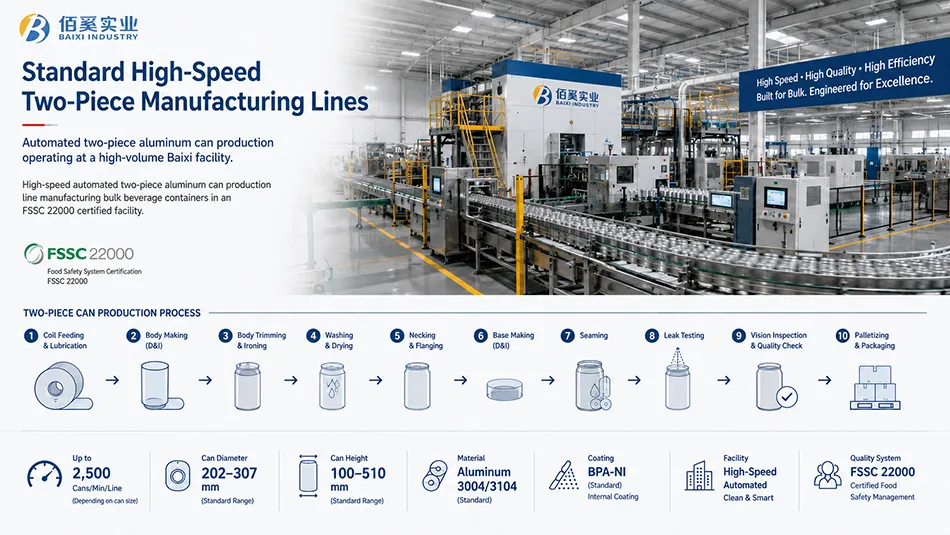
The structural division of the global aluminum container market is defined by manufacturing technology, where different forming techniques create distinct performance profiles optimized for specific beverage categories and pressure requirements.
The modern two-piece beverage container—where the body and base are formed as a single seamless component from an initial metal sheet using the advanced Draw and Ironing (DWI) process—remains the undisputed industry standard. Accounting for 69.3% of total global demand, the two-piece segment was valued at $33.68 billion and is projected to reach $41.67 billion by 2029.
The primary advantage of the two-piece architecture lies in its seamless construction, which completely eliminates the risk of side-wall leaks and provides exceptional gas retention for carbonated beverages. Because the container relies on internal carbonation pressure to maintain structural rigidity, its walls can be ironed down to micrometric thicknesses, significantly reducing raw material use per unit. This lightweight, high-strength design makes it the preferred choice for high-volume carbonated soft drinks, mass-market beers, and mainstream sparkling beverages.
In contrast to the seamless design of two-piece containers, the traditional three-piece container architecture—consisting of a separate top end, a rolled cylindrical body joined by a vertical weld seam, and a separate bottom end—retained a specialized 30.7% share of global demand in 2023.
While largely phased out of high-pressure carbonated beverage lines due to material efficiency considerations, the three-piece configuration remains essential for non-carbonated applications that require excellent structural rigidity. Because non-carbonated products lack internal gas pressure to keep the container stiff, three-piece cans rely on thicker walls and mechanical seams to withstand the physical demands of shipping and stacking. This structural stability makes them highly effective for high-viscosity fruit juices, nutritional dairy concentrates, retort-sterilized functional beverages, and promotional lines where manufacturers frequently adjust container dimensions without investing in complex DWI tooling sets.
Beyond the core manufacturing architecture, the market saw a clear shift in consumer-facing form factors, driven by brand differentiation and changing retail display requirements:
The Standard Can Profile (typically featuring a 211 body diameter, approx. 66mm) maintained its dominant position across traditional beer and multi-pack carbonated soft drink segments, providing consumer familiarity and maximum filling volume per shelf inch.
The Sleek Can Profile (typically utilizing a 57mm body diameter) experienced rapid adoption within premium craft beers, hard seltzers, and ready-to-drink (RTD) distilled cocktails, helping brands establish a modern, premium identity on retail shelves.
The Slim Can Profile (featuring a 53mm body diameter) showed strong momentum in the functional energy drink and wellness beverage segments, particularly across European and Asian metropolitan markets where consumers prefer portable, portion-controlled packaging options.
The steady expansion of the aluminum can market is driven by a combination of strict regulatory frameworks, technological innovations, and evolving consumer habits that collectively favor sustainable metal packaging over traditional alternatives.
The exceptional recyclability of aluminum remains a primary driver of industry growth. Achieving stable global recovery rates between 69% and 75%, aluminum beverage containers perform significantly better than alternative packaging materials like single-use plastics or heavy glass.
Because remelting post-consumer aluminum scrap consumes only 5% of the energy required to refine primary ingot from raw bauxite ore—preventing 2.6 tons of $CO_2$ emissions per ton of metal processed—global brands rely heavily on aluminum to meet strict Scope 3 sustainability targets. This environmental performance is further supported by Extended Producer Responsibility (EPR) mandates and Deposit Return Schemes (DRS), which penalize non-recyclable materials while rewarding standardized, infinitely circular aluminum packaging.
Modern container manufacturing relies on continuous technological innovation to optimize material efficiency. Through advanced metallurgical down-gauging, engineers have successfully reduced container body and end thicknesses without sacrificing the structural integrity required to withstand internal carbonation pressures.
Transitioning from traditional three-piece configurations to streamlined two-piece DWI designs yields an immediate 15% reduction in material use. Current engineering roadmaps indicate that a further 5% to 8% reduction in weight for standard profiles is highly achievable, lowering base material costs and reducing transport emissions across the global logistics network.
The commercial adoption of digital direct-to-can printing has transformed branding and inventory management for beverage companies. By eliminating the high setup costs and long lead times associated with traditional lithographic printing plates, digital decoration enables true print-on-demand production with flexible minimum order quantities (MOQs).
This capability allows craft beverage brands and major consumer goods companies to launch regional trial flavors, introduce limited-edition event packaging, and maintain leaner inventories, freeing up working capital that would otherwise be tied up in large warehouse stocks of pre-printed containers.
Modern retail markets are increasingly shaped by consumer demand for convenient, lightweight, and durable packaging solutions. Younger demographics place a high premium on clear environmental benefits, favoring packaging that offers verified recyclability.
Additionally, aluminum's superior thermal conductivity enables rapid cooling, enhancing the consumer experience in immediate-consumption channels, outdoor events, and rapid-delivery services where product temperature is a key element of customer satisfaction.

To understand China's position as a reliable production hub for the international market, it is necessary to examine how its manufacturing infrastructure integrates upstream raw material security with advanced downstream logistics.
Upstream Material Security: China maintains a leading position in primary metal production, with domestic primary aluminum capacity stabilizing at 43 million tons, complemented by an expanding secondary recycled aluminum output of 9.5 million tons. Operating nearly 60% of global smelting capacity, China provides exceptional supply chain stability and material availability for international distribution networks.
Midstream Production Capacity: Domestic manufacturing lines have successfully adopted high-speed, continuous Draw and Ironing (DWI) technologies, producing premium two-piece and three-piece aluminum containers that meet strict international quality standards. This robust production capability integrates seamlessly with global logistics networks, ensuring that packaging components represent a consistent 10% share of total domestic metal utilization.
Downstream Export Performance: Following a record-setting export surge in 2022 where outbound shipments of aluminum easy-open containers peaked at 22.74 million kilograms, the market stabilized in 2023 at 15.005 million kilograms as international buyers worked through built-up inventories. This healthy stabilization laid the foundation for a strong market rebound, with export volumes rising significantly to 30.598 million kilograms—representing a powerful 103.92% year-on-year volume expansion that highlights China's vital role as a reliable manufacturing hub for the global beverage industry.
Raw material costs represent a significant component of total manufacturing expenditures for rigid metal packaging, with aluminum typically accounting for 60% to 75% of total container production costs. During 2023, the London Metal Exchange (LME) cash price stabilized within a reliable trading corridor between $2,100 and $2,350 per metric ton.
This price stability provided welcome relief after the extreme market volatility of March 2022, when geopolitical disruptions and supply chain imbalances sent prices soaring to a record high of approximately $3,984 per metric ton.
The price correction in 2023 was driven by a temporary easing of downstream demand, high global interest rates that encouraged inventory reductions, and temporary slowdowns in industrial construction sectors. This lower, more stable pricing environment allowed beverage brands and packaging manufacturers to establish reliable cost baselines and secure predictable operating margins.
The global distribution of aluminum products is shaped by shifting national trade policies and customs regulations. A key regulatory milestone occurred when export tax structures were adjusted, replacing previous zero-tariff policies on high-purity primary metal ingots with a 30% export duty.
This policy change successfully directed raw primary metal toward domestic manufacturing lines, ensuring that downstream semi-finished products and completed consumer packaging components remain the primary drivers of international trade. By incentivizing the export of high-value, fully manufactured goods over raw ingots, this regulatory framework helps maintain the global cost-competitiveness of finished container products.
The global aluminum can manufacturing sector is characterized by a high degree of market concentration, with the top four global producers—Ball Corporation, Crown Holdings, Ardagh Group, and Can-Pack—controlling approximately 55% to 60% of total global production capacity.
These industry leaders maintain large-scale manufacturing networks located close to major beverage bottling plants to minimize shipping costs. However, this high concentration has created opportunities for agile, technologically advanced manufacturers capable of delivering flexible production schedules, customized printing options, and responsive client service to emerging brands and international buyers.

To optimize procurement costs, brand owners must understand the entire lifecycle of the material, tracking how raw ore transitions through refining, manufacturing, and filling before returning as recycled scrap.
Upstream Processing (Bauxite to Primary Ingot): Raw bauxite ore is extracted from major global deposits and refined into pure alumina via the Bayer process, which is then smelted into high-purity primary aluminum ingot.
Midstream Manufacturing (Coil Rolling to Finished Container): Ingot blocks are rolled into high-precision commercial coils, which are processed through high-speed automated production lines. Here, containers undergo continuous draw-and-ironing (DWI) forming, internal spray application of advanced BPA-Non-Intent (BPA-NI) protective barrier coatings, and multi-color decoration.
Downstream Distribution and Circular Recovery (Filling to Closed-Loop Recycling): Finished containers are shipped to automated beverage plants for high-speed filling and seaming with matching
As the global rigid packaging market matures, the criteria for choosing a manufacturing partner have expanded beyond simple production capacity. While industry leaders often rely on rigid, long-term contracts to secure large volume commitments, modern beverage brands require more flexible supply chain solutions.
This market evolution has highlighted the value of agile, customer-focused manufacturing partners. Forward-looking suppliers prioritize production flexibility, rapid prototyping, and accessible minimum order quantities (MOQs), enabling brands to scale production smoothly from initial test batches to high-volume commercial runs. By combining advanced quality control with responsive customer service, these mid-tier manufacturing partners provide an effective alternative to rigid corporate supply structures, helping beverage brands maintain lean, resilient supply chains.
Positioned within China's robust industrial manufacturing network, Baixi Cans operates high-efficiency production facilities designed to deliver reliable, export-compliant rigid packaging solutions to beverage brands worldwide.
Baixi Cans operates modern production hubs in Qingdao and Xianning, manufacturing a comprehensive range of two-piece and three-piece aluminum containers tailored for carbonated soft drinks, beers, energy lines, and functional beverages.
Our facilities produce standard international formats, including high-volume
We maintain strict quality control standards throughout the manufacturing process, backed by international certifications including FSSC 22000, ISO 9001, ISO 14001, and ISO 45001. Our production lines utilize advanced, verified BPA-NI internal spray linings, ensuring full compliance with food contact safety standards in strict export markets like the European Union, North America, and Japan.
Baixi Cans offers a comprehensive, one-stop service model that combines container manufacturing, custom printing, and international logistics management. We support both high-speed lithographic printing for large-scale retail distribution and agile digital direct-to-can decoration for low-MOQ regional launches.
Our export teams handle all customs clearance documentation, batch testing certificates, and shipping configurations, ensuring safe, on-time delivery to your production facility.
Looking ahead to 2030, the global aluminum can market is projected to expand steadily from its baseline toward an estimated $78.9 billion to $85.6 billion valuation, driven by key structural trends across the beverage industry:
Widespread Adoption of Advanced Inner Linings: Evolving global food safety standards will accelerate the transition toward next-generation BPA-NI internal coatings, ensuring absolute product purity and safety for sensitive beverages and wellness formulations.
Expansion into Diverse Food Categories: Driven by strict plastic reduction policies like the European PPWR, brands will increasingly adopt lightweight aluminum packaging for non-beverage products, including ready-to-eat meals, soups, and premium spreads.
Growth of Independent Brands via Digital Decoration: The continued development of digital direct-to-can printing will lower market entry barriers, allowing independent craft producers and startup brands to achieve professional shelf presence with low-MOQ production orders.
Elevated Role of Metal Packaging in Corporate ESG Frameworks: As companies face increasing pressure to lower their Scope 3 greenhouse gas emissions, aluminum's lightweight profile and high recycling efficiency will make it a preferred choice for corporate sustainability strategies.
By 2030, the Asia-Pacific region is anticipated to become the world's largest consumer of aluminum packaging, with global container recycling rates on track to surpass 85%. As supply chains normalize and raw material costs stabilize, the long-term economic and environmental benefits of aluminum will reinforce its position as a primary packaging material for the global beverage market.
Q1: What was the verified valuation of the global aluminum can market in 2023?
A: While specific market research reports show minor variations, industry consensus positions the global baseline market valuation at approximately $55.5 billion in 2023, supported by steady volume growth across international markets.
Q2: What are the primary structural differences between two-piece and three-piece containers?
A: Two-piece cans feature a seamless, integrated body and base formed from a single metal sheet via the DWI process, offering excellent gas retention for pressurized carbonated drinks. Three-piece cans consist of a separate top, bottom, and welded body cylinder, providing high vertical rigidity suitable for non-carbonated retort foods and specialized juices.
Q3: What percentage of energy is saved by utilizing recycled aluminum scrap?
A: Reprocessing post-consumer aluminum scrap consumes only 5% of the energy required to refine primary ingot from raw bauxite ore, reducing carbon emissions by 2.6 tons of $CO_2$ per metric ton of metal processed.
Q4: How did raw material pricing trends perform during 2023?
A: LME cash aluminum prices stabilized within a reliable trading corridor between $2,100 and $2,350 per metric ton in 2023, correcting downward from the record volatility seen in 2022 and providing a stable cost foundation for beverage brands.
Q5: What standard container profiles are available from Baixi Cans?
A: Baixi Cans manufactures a complete range of international formats, including Standard, Sleek, and Slim profiles across both two-piece and three-piece configurations, with universal
Transitioning from market analysis to practical procurement requires dependable, professional execution. Select the action step below that aligns with your brand's current operational milestones:
Schedule an Engineering Sourcing Session: Arrange a 15-minute introductory technical consultation with our packaging specialists to analyze your container specifications, review printing options, and discover ways to optimize your logistics costs.
Secure Production Samples and Volume Pricing: Contact our international sales division to request physical sample containers and an accurate volume quote for your specific product line. Whether you are launching a regional trial or securing high-volume supply, Baixi Cans delivers the quality and supply chain security your business needs to scale.
Corporate Email Intake: sales@baixicans.com
Digital B2B Portal:

