
A less-common beverage can is a practical launch choice when the exact can and end, the filling-line requirements and the first commercial supply route are supported by current information. A catalogue entry or an attractive sample alone cannot establish that position. Check the repeat-order opportunity separately, and keep an alternative open until you know which changes it would require. This matters whether you are choosing packaging for carbonated drinks, beer or juice: the useful question is whether the proposed package can support your actual project.
A catalogue listing, a representative sample, a confirmed launch order and a repeat-order path answer different availability questions. The listing identifies a candidate. The sample lets you examine a particular package. Commercial confirmation addresses the requested quantity and supply conditions. Reorder planning addresses what happens after the first run. Keep those distinctions visible when a supplier says a format is “available.”
For this decision, “less-common” means unfamiliar or difficult to obtain within your proposed supply route. It does not automatically mean a uniquely shaped can. A conventional format can be uncommon for a particular manufacturing site, filling plant or destination. Start by asking what is unusual in your project: the body proportions, the end, the decoration, the production source or simply the replenishment route.
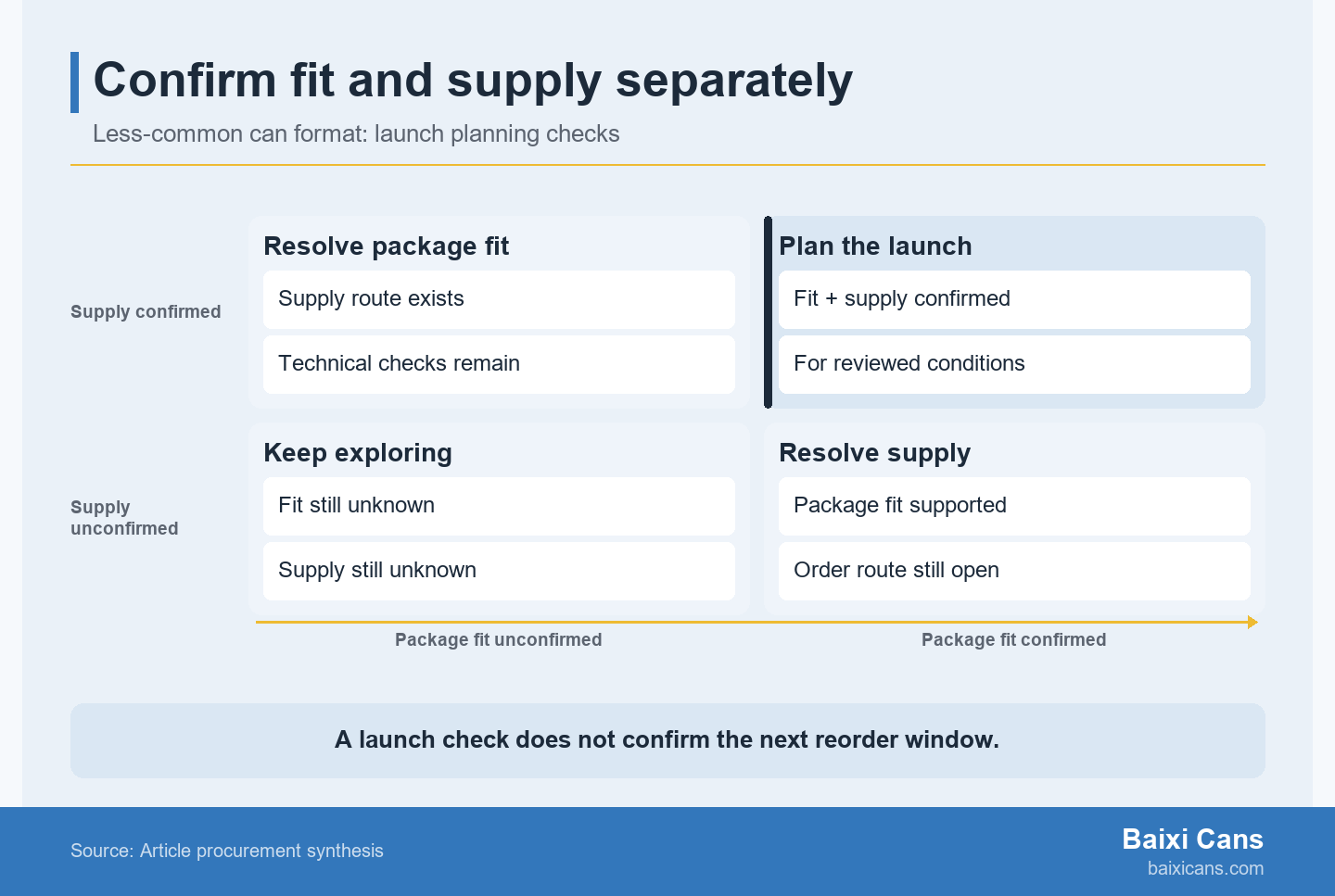
These are questions, not automatic approval stages. A supplier might have stock while the filling plant still lacks the required tooling. Alternatively, a package might suit the line while its production opportunity remains open. Neither situation is solved by describing the can as a regular catalogue product.
Use Baixi’s aluminum-can range to identify candidates for a packaging enquiry. Ask about the exact format you intend to buy rather than treating the range page as a stock list. That keeps the enquiry focused on a specific can, quantity and destination, without assuming every listed format has the same supply conditions.
Describe the can body and can end separately, including drawing revisions and proposed manufacturing sites. Then connect them as the package you want evaluated. A capacity name or a photograph is useful for an initial conversation, but it leaves too much unresolved for comparing commercial routes. Two offers described with the same volume may still refer to different packages.
Send the supplier the current drawing or specification, intended beverage category, relevant filling process and decoration requirement. If you only have a physical sample, identify it as the reference and ask which proposed specification it represents. Keep a distinction between a sample taken from the intended route and a similar-looking sample used to illustrate the shape. Both can help a discussion; they do not establish the same facts.
Change parts are size-specific machine components used when changing a format. For Dixie seamers, Dixie specifies change parts for additional can sizes and requests sample ends for a chuck and containers for a base plate. The chuck is the tool supporting the end during seaming. This illustrates why the end belongs in the sourcing conversation from the beginning; a body sample alone does not answer the tooling question. Follow the requirements of your own machine supplier rather than copying Dixie’s sample quantities.
Package suitability also includes the beverage. The public introduction to the Brewers Association’s can-compatibility guidance says not every combination of beer brands and beer cans is compatible and recommends assessing each intended beer brand. That beer-specific advice does not establish a test limit for juice or carbonated soft drinks. For those applications, describe the actual beverage and process to the packaging and filling partners instead of borrowing a beer result.
When reviewing can-end specifications and options, ask for the end intended for the proposed body, including its design identification and drawing. Do not choose a replacement by the nominal end size alone. Record whether the sample, quotation and technical discussion all concern that same combination; resolve a different component identity before treating the offers as equivalent.
The relevant equipment question is whether the actual installed filling and packing line can process the proposed package. A machine family’s advertised range is a starting point for that discussion. It does not identify the options, tooling or settings installed at your plant.
For example, Krones’ Craftmate C specifications distinguish standard and optional can formats. That distinction matters when a buyer hears “the machine can run it”: the advertised capability may depend on a configuration that is not present. Give the equipment supplier the proposed package details and the installed machine identification so the answer concerns your line.
Height flexibility also has a scope. Wild Goose’s 2020 description of the Gosling QuickChange covers changing can heights while retaining the same diameter and lid type. This historical model description illustrates a specific distinction, rather than confirming current equipment availability or support. A successful height adjustment therefore cannot, by itself, establish that a different body diameter or end will run.
Ask the filling plant which interfaces change from its current package: empty-can handling, filling position, end feeding and seaming, followed by the intended outer pack. Keep the reply specific. “Height adjustment checked; end tooling unresolved” is more useful for a launch decision than “format accepted.” It tells procurement which issue still affects the candidate without turning the enquiry into a machine-adjustment tutorial.
The outer pack deserves its own check. PakTech’s specification library provides separate specification sheets for slim, standard and sleek can carriers. Separate documents do not prove any proposed carrier fits your can, but they give a concrete reason to identify the carrier rather than assume it follows the nominal drink volume.
For a tray or carton, ask for the proposed arrangement using the actual can dimensions. For a carrier, identify the specific carrier and application method. If a fallback changes the package, return to the affected interfaces. A fallback that can be filled but cannot be packed in the planned sale format has not yet solved the launch problem.
A usable production path connects the selected package to the requested commercial quantity. Ask whether the offer concerns existing stock or a production opportunity, where the body and end will come from, and which conditions still affect readiness. “We have made this before” can support further discussion, but it does not allocate material or confirm the present order.
For the first order, distinguish the requested date from the supplier’s confirmed basis. Record whether a stated date means production completion, readiness for collection, dispatch or arrival at the filling plant. If arrival is the planning requirement, ask what transport and receiving assumptions connect the earlier milestone to that date. An unexplained date still leaves the connection to the launch schedule unresolved.
Keep body and end quantities side by side. If one component is proposed from stock and the other from future production, ask how those routes align for the intended run. Do the same with decoration: a sample may show the right shape without representing the printed version or artwork revision being quoted. Resolve that difference while the format is still a candidate.
Assess the next order separately. Ask when a replenishment request should be raised, how the next production opportunity would be confirmed, and whether the body and end would follow the same route. Record what remains conditional. A successful first run establishes evidence about that run; it does not create an ongoing production reservation.
Give the supplier an initial demand estimate and a separate replenishment estimate, with design quantities visible. Ask what happens if the later requirement falls outside the proposed production opportunity. The useful reply might be a review point, an alternative production route or a statement that the future window is not yet known. Preserve that answer instead of converting it into an assumed monthly schedule.
For site qualification, identify the documents to request for the selected route. Check the actual certificate holder, production address, scope and validity. Those documents support evaluation of the named facility; they do not prove that a particular can format is currently scheduled, or that every facility in a supply network is covered by one certificate. Start with Baixi’s manufacturing-site certification information.
Copy the following record once for the preferred can format and again for the fallback. Enter the actual answer and a dated document or message reference in the middle column. Where an answer is unknown, name the missing information and use the final column to decide what remains conditional. Do not turn an unanswered field into a pass.
| Check | Enter for this candidate | Action when unresolved |
|---|---|---|
| Package identity | Body and end identifiers; drawing revisions; proposed manufacturing sites. | Request the specific combination before comparing offers. |
| Sample relevance | Sample origin and specification; connection to the proposed commercial route. | Keep sample observations separate from production confirmation. |
| Beverage and line fit | Intended use and process; reviewed package; remaining tooling or trial needs. | Resolve the identified interface with the relevant technical partner. |
| Launch supply | Requested body/end quantities; stock or production basis; open conditions. | Keep the format’s commercial availability conditional. |
| Quantity and decoration | Printed or unprinted; design count; quantity per design; applicable minimum confirmed. | Ask how the actual requirement fits the proposed order basis. |
| Timing and arrival | Confirmed milestone and date basis; proposed transport; required plant arrival. | Identify the missing timing assumption before tying it to launch. |
| Repeat-order opportunity | Expected demand; when to ask again; how the next body/end run is confirmed. | Retain a review point and fallback; do not assume recurring capacity. |
| Fallback differences | Alternative package; changed line, artwork and outer-pack interfaces; supply status. | Check the changes before calling the alternative usable. |
Illustrative example: a brand receives a sample of its preferred can and the plant checks the height adjustment. The proposed end tooling is still unconfirmed, and the supplier has not identified the repeat-production window. In the record, the sample row has a reference, the line-fit row still names the end-tooling question, and the repeat-order row remains open. The observations do not support an unconditional launch commitment.
The next actions are specific: send the proposed end details to the equipment partner and ask the packaging supplier about the next production opportunity. If the tooling and first-order route are subsequently confirmed, launch planning can move forward for those conditions; the unknown repeat window still needs a review point or a checked fallback. If stock is confirmed but tooling remains unresolved, supply evidence alone does not change the technical decision.
Use the record alongside Baixi’s beverage-packaging articles when an open field calls for more background on package selection. Keep the actual project answers in the record. General guidance helps you formulate the question; it cannot supply your manufacturing slot, tooling status or destination arrival date.
Keep the launch conditional if package suitability or supply timing remains unresolved. A fallback becomes useful when its changed interfaces and supply route have been checked. Decide which features you can change: the package proportions, decoration route, outer pack or launch timing. A format change is one option; a revised schedule may preserve the preferred package when the alternative would introduce more unresolved work.
Set a project-specific review point before the remaining work no longer fits the launch plan. At that point, compare the evidence for the preferred format and the alternative. If only the preferred format’s supply is unresolved, ask whether the alternative actually has a firmer route. If neither does, choosing the more familiar-looking can has not removed the uncertainty. Revise the plan around the missing confirmation.
For Baixi enquiries, the current minimum for custom cans is 300,000 cans. The calculation per design or across a combined order still needs confirmation; there is no below-minimum exception to assume. This is not a blanket minimum for every unprinted can, can end or accessory. Keep the actual decoration and quantity breakdown visible when evaluating a proposed fallback.
Send the can and end specifications, beverage use, total quantity and quantity per design, printed or unprinted requirement, number of designs, existing artwork status, destination, project stage and contact details. Ask which route can be considered and what information is still needed for quotation. Baixi supplies packaging; the response does not reserve a production window or provide beverage formulation or filling. Through its packaging enquiry service, request a packaging supply review.
No. A conventional can can be uncommon within a particular supply route, so check availability for the actual specification and destination. Describe what is different in your enquiry instead of using “special can” alone. If you need a genuinely unusual shape, ask whether that exact package can be considered; a broad format catalogue does not establish the capability.
Unprinted cans help only when the required format and quantity are available; changing decoration does not establish can supply. Unprinted means the can has no printed decoration, not that it is bare or uncoated. For labels or shrink sleeves, confirm the relevant dimensions; do not add an extra surface-treatment requirement. The underlying can-and-end supply question remains separate.
Confirm the calculation with Baixi before planning quantities across designs; the current custom-can minimum does not settle the per-design or combined-order basis. Provide the number of designs and quantity for each, including any differences in the can format. Do not treat a total quantity or a historical container-based listing as confirmation that every proposed design qualifies.
A second site is a candidate backup until the exact can, end and supply path have been checked for the proposed package and filling line. Ask which specification and sample represent that site, what changes from the first route, and how its commercial quantity would be supplied. A site name or certificate alone does not answer those package-specific questions.

