
After a beverage can supplier delays delivery, accelerate the work that can genuinely overlap: check usable stock, confirm the existing packaging combination, review repeat artwork and available production windows, and obtain freight options at the same time. Start with the quantity missing by the plant's required date. A fast factory-ready estimate helps only if the packaging can reach the plant and be used for the affected run.
The best recovery option may be confirmed stock, an evidenced repeat-production slot or a smaller first delivery from an agreed supply. Each depends on actual availability and fit. Urgency alone does not create stock, reserve capacity or remove necessary packaging checks.
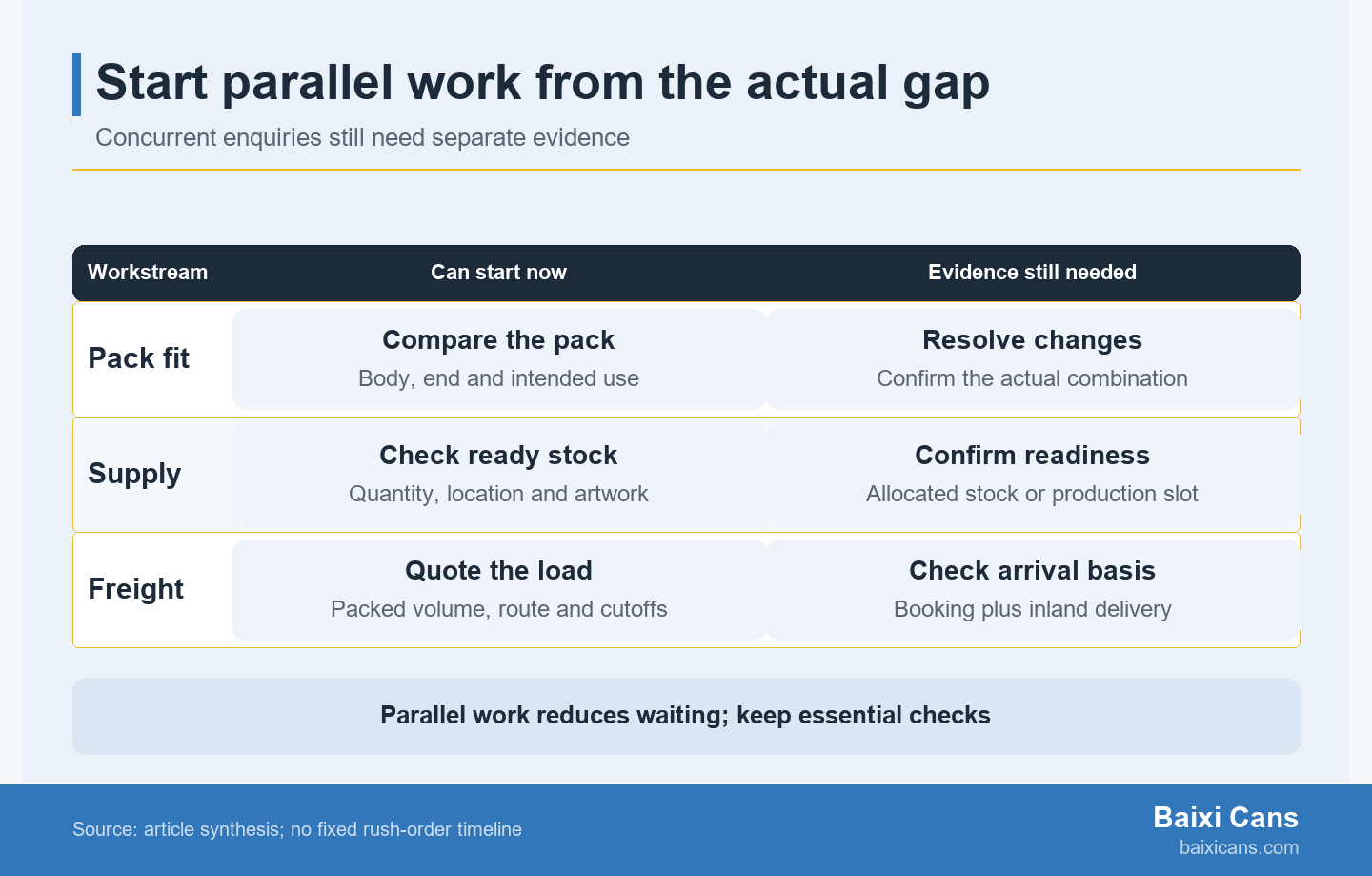
Define the usable can/end gap and required plant date first, then run packaging, supply and transport enquiries in parallel. This gives every enquiry the same job: close a specific interruption without relying on an unverified substitute or an unsupported delivery promise.
Give the delay a clear status as well. A revised forecast, finished goods awaiting dispatch and cargo already moving create different recovery choices. Ask the incumbent supplier what is actually complete and what evidence supports the revised date before duplicating an order elsewhere.
Count packaging that is usable for the affected run and available by its required date. Keep bodies and matching ends separate: complete sets are limited by whichever component is scarcer. Exclude quantities already committed to another run, unresolved stock and incoming material that cannot arrive in time.
For each relevant lot, record the format, component identity, physical location, quantity and current status. Separate stock at your plant, allocated supplier stock, completed goods awaiting collection and goods in transit. A supplier's general stock list does not establish that the listed quantity is reserved for your project or includes the required ends.
Consider a hypothetical run requiring 80,000 complete can/end sets. Usable on-hand stock is 40,000 bodies and 30,000 matching ends. A further 20,000 matched sets are already dispatched and confirmed to arrive before the run. That gives 60,000 bodies and 50,000 ends available by the required date: enough for 50,000 complete sets. The urgent gap is 30,000 sets. A separate offer of 15,000 sets with an unconfirmed arrival stays outside this confirmed coverage.
The calculation changes the enquiry. Asking for 80,000 additional bodies would overlook the existing coverage and the limiting end quantity. Ask instead which supply can close the actual component gap by the stated date, while keeping the full order requirement visible. This is planning arithmetic, not a statement of supplier stock, process yield or a custom-order minimum exception.
Use your actual production requirement, including any established operating allowance, rather than add a generic wastage percentage. If demand or an incoming date changes, update the component calculation and retain the revised assumptions. An incoming consignment should appear once in the record, even if both supplier and forwarder report it.
Attach the current specification or drawing so the quantity has a defined format. For a candidate enquiry, identify the corresponding Baixi Cans aluminum can formats.
Start with the exact body/end combination already established for the beverage and equipment. Check whether the proposed supply is genuinely the same configuration or merely shares a capacity description. If something changes, identify the difference and the applicable technical confirmation needed before counting the material as usable.
Dixie's seam terminology explains that seam profiles vary with the can and manufacturer specifications, while its change parts serve a particular can/end combination. A nominally similar can therefore does not establish the same equipment interface. Obtain the actual candidate information instead of assuming interchangeability from a catalogue description.
Equipment changes may introduce work that an urgent schedule must still accommodate. Wild Goose's chuck guidance identifies lid-style-specific chucks and calls for external and internal double-seam inspection after tooling replacement. Follow the requirements applicable to the actual equipment and package; do not transfer one manufacturer's setup instructions to every line.
The intended beverage also remains relevant. The public introduction to Brewers Association can-compatibility guidance recommends assessing every beer brand intended for cans because not every beer is compatible with every can. That is a beer-specific warning, not a test method for all beverages. It explains why an emergency does not extend existing evidence to a different product automatically.
Keep the recovery discussion specific: which component changed, which evidence already covers the proposed use, and what remains unresolved? A drawing comparison or a sample can answer part of that question without completing every necessary check. If the candidate needs validation that cannot be finished before the run, its apparent availability does not close the urgent gap.
When another supply site is proposed, request applicable documentation with the correct holder, production site, scope and validity. Certification scope does not confirm the proposed body/end combination. Check availability through Baixi certificate and document guidance.
Once the affected package is identified, send the same specification, quantity and required date to the people investigating stock, production and transport. They can develop options concurrently. Technical questions can be raised while available stock is checked, and a forwarder can assess the packed load while the supplier investigates readiness.
For a stock proposal, ask for the actual quantity and location, matching ends, decoration status, lot identity and whether the quantity can be allocated to the project. Ask what remains before collection. “Available” may describe goods physically present, a catalogue format or a future production possibility; the recovery plan needs the actual meaning and a dated confirmation.
For repeat printing, establish whether the current artwork and production records are available and unchanged. Existing files can avoid unnecessary design work. They do not prove that materials, the intended line and a production window are available now. Ask for the proposed start, completion and packing dates, together with the outstanding conditions and the date on which the plan was checked.
Keep a quotation, an accepted order-specific plan and a confirmed production window distinct. Ask which prerequisite still prevents the supplier from committing to the window, without assuming that the initial commercial discussion reserved capacity. Reconfirm the schedule after the supplier records the relevant order milestone, and identify any change to the earlier proposal.
Transport status needs the same precision. Maersk distinguishes confirmed and unconfirmed bookings and notes that some requests need additional checks. Use the actual booking status for the shipment; a request or a quoted departure does not itself establish a confirmed movement or plant arrival. Keep the shipment reference with each update so competing route proposals stay distinguishable.
Parallel work reduces waiting between enquiries while preserving their separate checks. Record which technical, supply or transport fact still controls the proposed usable date. Keep adjacent purchasing research separate from that live recovery record, using the packaging procurement resources.
Compare transport options from the same cargo-ready point to the same plant destination. Include packing, collection, origin handling, main carriage, destination handling, clearance and final delivery as applicable. Then include the plant's normal receiving and readiness steps. A departure date, airport arrival or port arrival is a different milestone from packaging usable for the scheduled run.
Request options for the actual pallet dimensions, gross weight and complete load. DHL's chargeable-weight explainer explains chargeable weight as the greater of gross weight, including packaging and pallets, and volumetric weight. Empty cans occupy space, so a quote based only on the metal's weight leaves an important input missing. Obtain the route-specific quotation rather than assume a generic airfreight price or saving.
A smaller ocean consignment also has stages beyond the sailing itself. Flexport describes LCL—less-than-container-load shipments combined in one container—as consolidated at origin and deconsolidated at destination. Ask the forwarder to include those stages and the relevant cutoffs in the actual estimate. This does not imply a fixed consolidation delay for every route.
Compare a full shipment with a split recovery option only when both can be described concretely. For the first delivery, specify which bodies and ends it contains, how many complete sets become usable and when the balance is expected. Sending bodies faster while the required ends remain late may leave the production gap unchanged.
Check that the packing and handling plan remains appropriate for the components. Discuss pallet protection, transfers and receiving arrangements with the supplier and forwarder. A hurried change to shipment size should not obscure how the thin-walled bodies and loose ends will be protected and identified.
Ask whether the quoted service includes origin pickup, destination clearance support and the final plant leg, and which dates remain estimates. Use a current update for the chosen lane; a general service description cannot prove that space is available for this load. If the proposed date changes, update the usable-gap record rather than preserve an obsolete recovery assumption.
Keep the exact end requirement in every split-load discussion. If another end is proposed, review its information separately through Baixi can-end options.
Copy the checklist into the recovery enquiry and enter the actual gap, package identity, supply evidence and transport milestones. For each unresolved item, record the next question and a date for the reply. “Not confirmed” is a useful status when it identifies what still prevents the proposed supply from meeting the run.
| Action | Evidence to record | Verification that remains |
|---|---|---|
| Define the affected run | SKU, body/end specification, beverage use, required plant date and total/per-design demand. | Keep the required date tied to the production need. |
| Calculate component coverage | Usable on-hand and confirmed on-time incoming bodies and matching ends; subtract prior commitments. | Count each lot once; exclude uncertain arrivals from confirmed coverage. |
| Check the candidate package | Current drawings, end identity, established equipment/application scope and any changes. | Resolve differences and complete the applicable validation before use. |
| Confirm the stock proposal | Actual quantity, location, lot, decoration status, matching ends and project allocation. | Identify remaining packing or dispatch conditions. |
| Confirm a production option | Artwork revision, actual line/material availability, order milestone and proposed start/completion dates. | Distinguish an indicated window from the current confirmed plan. |
| Compare the complete route | Packed dimensions/weight, pickup, booking status, handling, clearance and final-delivery estimate. | Check route-specific deadlines and the dates still conditional. |
| Verify a split delivery | First-load body/end quantities, complete sets supplied, lot identities and balance plan. | Confirm that the first load reduces the actual urgent gap. |
| Set the next decision | Outstanding question, reply/checkpoint date, latest update and stated fallback. | Recalculate coverage when a material assumption changes. |
Check shipping requirements early enough to meet the selected movement. VGM means the verified gross mass of a packed container. Maersk's VGM guidance states that it communicates cargo and VGM deadlines with booking confirmation and that missing VGM can prevent loading. Use the current deadlines and instructions for the actual shipment, rather than a generic cutoff interval.
Read the completed checklist as a sequence of dependencies. If stock is confirmed but packaging applicability is unresolved, freight preparation can continue while the usable date remains conditional. If the package is established but the proposed production slot is unconfirmed, retain the enquiry as an option and keep the fallback active. A completed row does not automatically complete the other rows.
Set a decision checkpoint before the affected run, leaving enough time to act on the remaining alternatives. Name what happens if supply readiness, essential validation or transport is still unresolved then. The checkpoint depends on the actual options; there is no universal emergency-order decision interval.
A fallback may use confirmed suitable packaging already available, a feasible first delivery or a rescheduled affected run. State which quantity each option supports. If none can meet the requirement, communicate the remaining gap explicitly rather than convert an uncertain date into a production commitment. Keep later recovery work moving without counting it as present coverage.
For an urgent enquiry to Baixi Cans, send the body/end specification, existing technical records, required plant date and component gap. Include total and per-design quantities, printed or unprinted requirement, design count, artwork status, beverage use, destination, project stage and contact details. Ask what availability or production-window evidence, documents and sample arrangements can be confirmed for the project, and which dates remain conditional. To discuss the packaging supply route, review Baixi packaging services.
It can be considered when the actual format, intended package, decoration plan and quantity are suitable and confirmed. Unprinted means no printed artwork; it does not establish a bare or uncoated can. If labels or sleeves are planned, confirm the required dimensions without adding an assumed surface-treatment step. Check the decoration schedule as part of the recovery date.
No. A bridge-delivery quantity does not establish a smaller new custom order, available stock or a guaranteed production date. Baixi's current custom-can minimum is 300,000 cans; the per-design and combined-order calculation still needs confirmation. Do not extend that minimum to every unprinted can, end or accessory, or treat a split delivery as evidence of an emergency MOQ waiver.
No. Existing artwork can reduce repeated design work, but it does not reserve materials, a line or a date. Ask whether the stored revision matches the current requirement and whether the supplier has confirmed the associated production window. If the packaging or artwork has changed, identify the extra work instead of treating it as an unchanged repeat job.
Keep it conditional and make the next production decision using confirmed quantities and the stated fallback. Ask which event or missing confirmation prevents a firmer estimate, and when it will next be checked. Update the gap when evidence changes. A candidate shipment remains useful to investigate even when it cannot yet support a committed production date.

