
A can is not a material choice that ends with “aluminum” or “steel.” It is a matched package: the body, the surface that contacts the product, the end, the manufacturing and filling conditions, and the recovery route must work together. That distinction matters when a buyer is choosing a format, approving samples, or writing an inquiry that a supplier can actually evaluate.
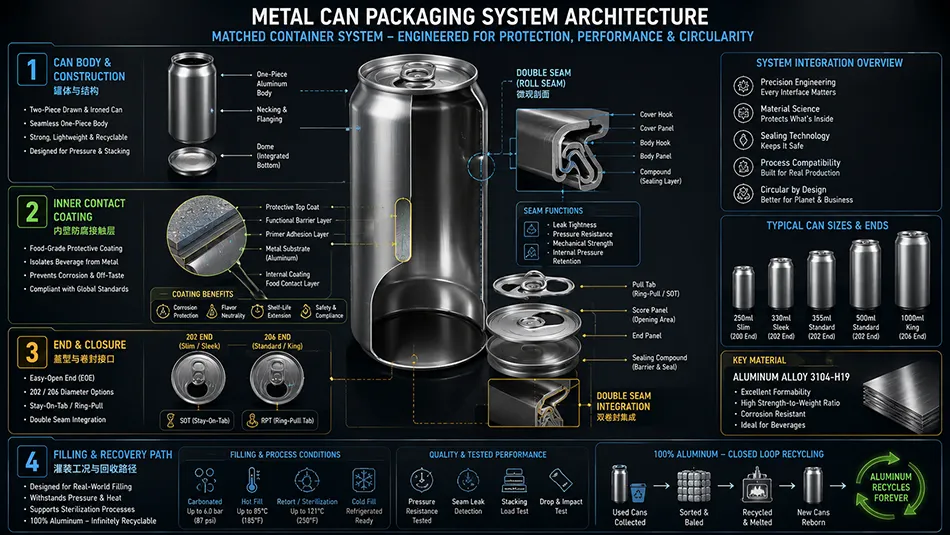
Can Makers describes beverage cans as available in a wide range of shapes and sizes and gives them a 360-degree printable surface. That is useful category context, not a demand forecast or a performance result for any particular can. A body shape, print surface, and opening style may all change how the package is used and specified.
A buyer should not approve metal can packaging until the product, construction, contact layer, closure, process, and end-of-life route have been named. For a buyer, metal can packaging is a matched container system made of the can body, contact layer, end, process, and recovery route. The contact layer is the material surface between the contents and the metal substrate. A material name can start the conversation, but it cannot answer the questions that make the package usable for a particular drink, food, market, or distribution path.
Think of a can request as a chain of decisions rather than a request for a blank cylinder. The product determines which contact conditions matter. Construction determines how the body and end relate. The end determines the opening interface. The process determines what must be checked under fill, handling, storage, and transport. Finally, the recovery route determines how an end-of-life statement should be framed. If one link is still vague, the team may be comparing attractive samples without comparing the same package system.
For a concrete format reference, Baixi Cans buyers can review a 500 mL aluminum can format after the intended contents and use conditions are clear. The point is not that one format fits every product; it is that a real body size becomes meaningful only when the surrounding assumptions are named.
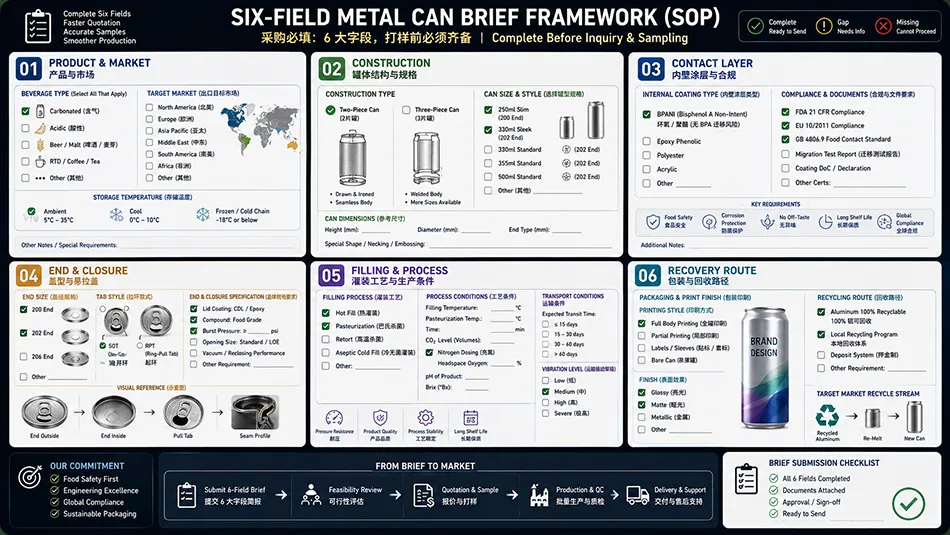
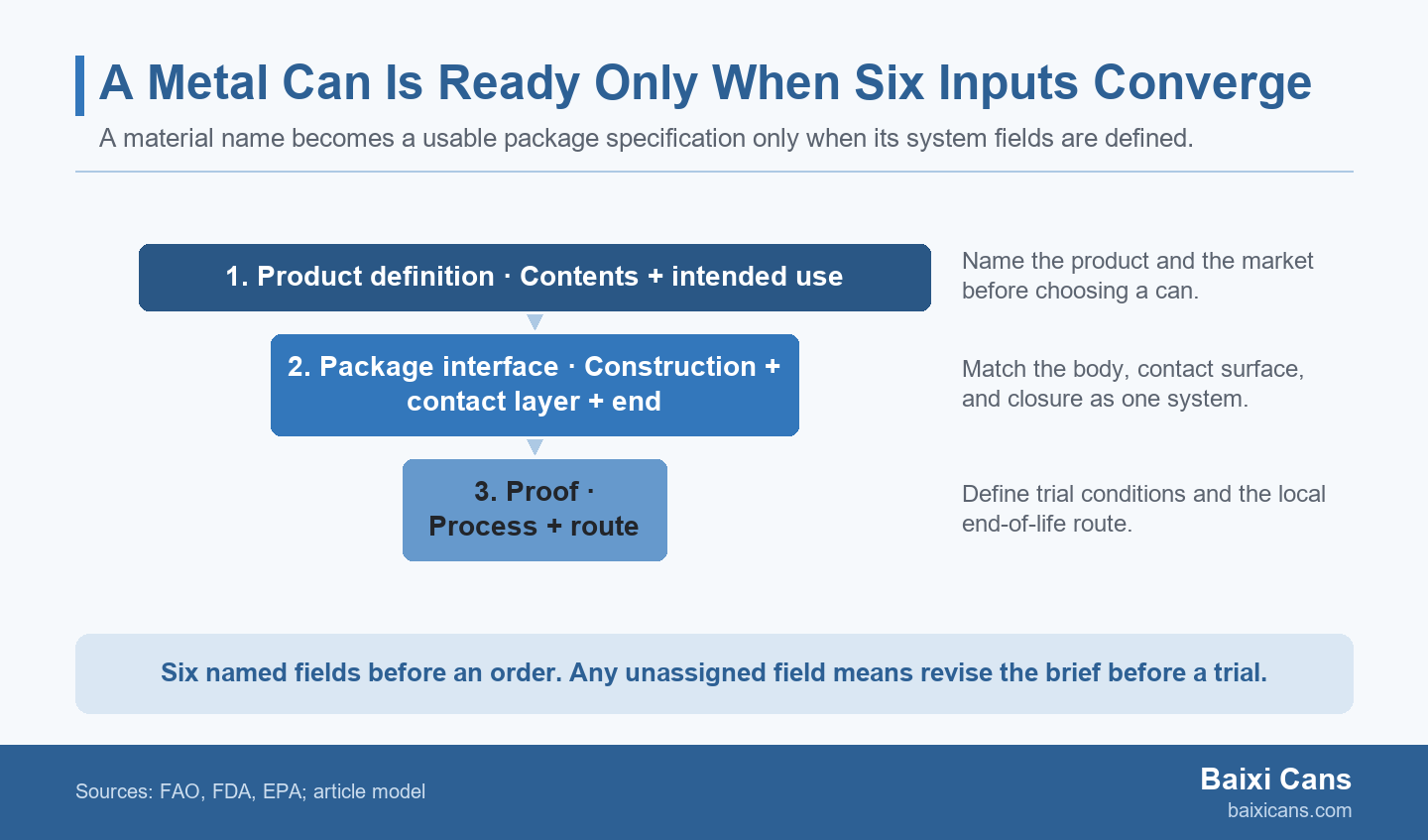
Six named fields turn a metal-can request into a usable specification before samples or artwork advance. The fields are the contents, construction, contact layer, end, process, and recovery route. This is a buyer framework, not a compliance standard: its value is that it shows the unanswered field that could invalidate an otherwise promising package choice.
These questions work because they join decisions that are often made by different people. Marketing owns the product and artwork context; packaging owns the configuration; quality or regulatory colleagues own the intended-use review; operations owns the process; procurement owns the supplier handoff. A missing field does not prove that the can will fail. It does mean the buyer has no defined basis for deciding which evidence, sample, or trial result applies.
Construction defines the body-and-end relationship that must be named before a can can be evaluated for a specific product. It tells the buyer which physical configuration is under discussion, but it is not a verdict that one construction is automatically better. Suitability still depends on the contents, components, process, and evidence required for the actual use.
For an inquiry, construction should appear next to the product description, not as a late technical footnote. That gives a supplier enough context to identify the relevant body, end, contact surface, and evaluation path. It also prevents a team from treating a photograph, a size label, or a material name as proof that two cans have the same interface.
FAO describes metal containers as normally divided into two-piece and three-piece welded or soldered constructions. The description is a construction classification, not a universal performance ranking. Buyers should use it to ask what is being supplied, then confirm why that configuration fits the intended product and process.
This two-piece can construction has its body and base formed together and a separate end applied after filling. A three-piece can has a body section plus separately attached ends, with a side seam in the body construction. These labels describe where the physical joins are, which in turn affects the component relationship the buyer must document. They do not remove the need to validate the selected configuration under the actual product and operating conditions.
The practical handoff is simple: put the construction in the request, identify the body and end pair, and ask what sample and process evidence represents that exact pair. If the contents, recipe, fill method, or end change, the original answer may no longer apply. A construction label is a starting boundary for the conversation, not a shortcut around the conversation.
FAO's food packaging manual describes a modern two-piece can as a body and base formed together with a separate end applied after filling. The separate end is therefore part of the functional package interface. It should be selected with the body, not added after a material and volume choice has already been treated as final.
The closing interface also has its own language. A double seam is the rolled join that attaches the end to the can body. For the buyer, the useful consequence is not to diagnose that join from a distance. It is to make the body-and-end combination explicit in the brief and define which checks, documents, or samples represent the chosen combination.
That pairing becomes especially important when different teams are approving different parts of the package. Artwork may sit on the body, an opening experience may be tied to the end, and the process may be set by a filler or co-packer. A single description of the selected body and end keeps those decisions connected and makes later changes easier to spot.
FDA defines food-contact substances to include food packaging and its components. This is U.S. regulatory context, not a global authorization statement. It is still a useful reminder that suitability cannot be inferred from the metal substrate alone; the complete contact system and the intended use need to be identified for the applicable market.
FDA notes that BPA can be a component in metal-can coatings that protect food from direct contact with metal surfaces. The example does not mean every coating is the same or that an FDA statement resolves requirements elsewhere. It does show why a buyer should ask about the complete contact configuration rather than treat a bare-metal description as the whole answer.
In a usable inquiry, name the product, relevant fill and storage conditions, intended market, and the supporting records or review required. If a product formula, process, or market changes, repeat the suitability discussion instead of assuming that a previous sample approval follows the new use unchanged.
Once the body-and-end pair is clear, a buyer can compare aluminum can lid options for the selected body. That keeps the opening component connected to the specific system being reviewed rather than to a generic can category.
FAO Codex guidance says can makers should help determine the correct can specification for a new food product or recipe change. The guidance supports a limited but important conclusion: a generic format name does not settle the specification when the product or recipe changes. The buyer still needs to verify the exact process and market requirements.
A format label cannot replace a defined trial under the actual fill, handling, storage, and distribution conditions. A useful trial states what was filled, which body and end were used, which settings applied, how the packs were handled, and which route was represented. Without those limits, a positive result may be repeated on a different configuration without anyone noticing the change.
Ask for evidence that belongs to the selected system, not a broad claim about the factory or the material. The relevant records may cover the sample configuration, process conditions, inspection points, packing assumptions, and a clear decision after the trial. The buyer's job is to decide which conditions matter before asking a supplier to demonstrate them.
At the order stage, separate a past observation from the next release decision. A record from an earlier sample is useful only if the body, end, product, process, and route it represents are still the same. If one of those inputs has changed, note the change and agree whether a new sample, a focused check, or a full trial is needed before the result is carried forward.
For a visual production reference after that evidence path is defined, buyers can see the can-production workshop context.
EPA estimated that 2018 recycling was 73.8 percent of generation for U.S. steel packaging and 50.4 percent of generation for U.S. aluminum beverage cans. Those are historical U.S. figures for two different categories. They are not global recycling rates, a prediction for a specific market, or proof that every can enters the same recovery system.
The Aluminum Association says plastic labels and other plastic components on aluminum cans can hurt recycling efforts by diluting aluminum value and causing operational and compliance problems for recyclers. That is industry-association context, but it helps separate the substrate from the wider package design. A recovery statement should consider the local collection route and any added components, not just the word “metal.”
A responsible buyer brief records the geography, category, time boundary, collection route, and package features behind any environmental statement. That wording is less dramatic than an unlimited circularity claim, but it is more useful to the teams choosing labels, sleeves, secondary packaging, and local partners. It also makes it possible to update the claim when the route changes.
Before describing a format as recyclable or circular, ask a narrower operational question: who collects it, what material stream receives it, and which added parts stay with it at that point? The answer can differ between markets and between channels in the same market. Recording that difference protects the buyer from turning a material property into a promise about a route that has not been confirmed.
When format and decoration choices are still open, buyers can inspect a 250 mL printable slim-can format as one concrete configuration, then assess its system assumptions separately.
A supplier-ready metal-can brief connects the contents and process to the chosen construction, contact layer, end, and logistics route. It gives every team the same starting point and lets the supplier respond to a defined package rather than to a material label. Keep it short enough to be used, but specific enough that an omitted input is obvious.
Use the brief as a change-control record, not just an RFQ attachment. When the contents, end, artwork, process, or route changes, mark the field that changed and ask whether the earlier evidence still applies. This creates a clear handoff between commercial, packaging, quality, and operations teams. It also prevents an approved drawing or quotation from being mistaken for an approval of a different finished package.
This sequence does not guarantee suitability. It gives the buyer a disciplined way to ask the right question and to keep one decision from silently changing while another team is approving samples. When the brief is complete, a buyer can shortlist aluminum can formats against the brief.
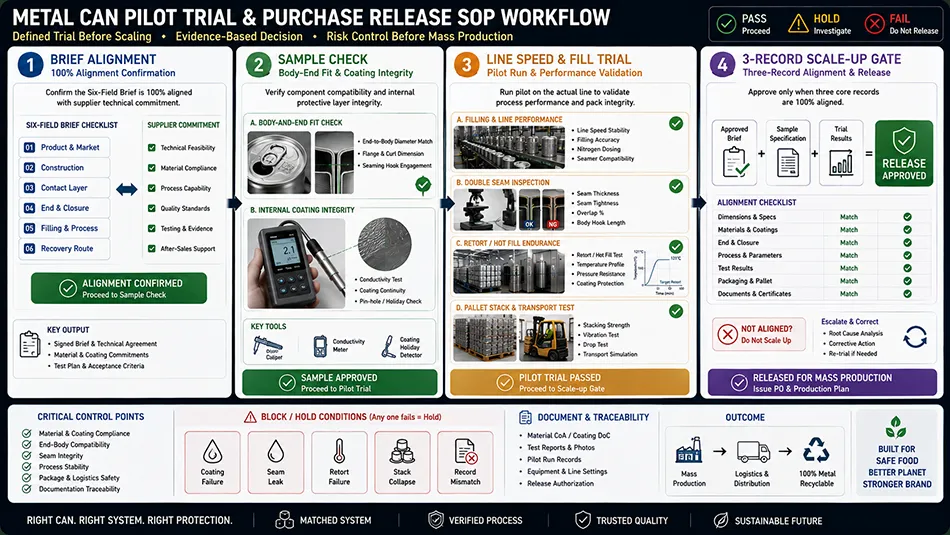
A format trial should keep the product and operating conditions defined before its result becomes a purchase decision. That does not require a universal test protocol. It requires a written comparison: what was made, what conditions it experienced, what evidence was collected, and what would force the team to retest.
Before samples arrive, define the decision the trial is meant to make. A packaging team may need evidence about the body-and-end configuration; an operations team may need a defined handling and packing path; a quality or regulatory team may need the product and target market inputs. A trial that changes the formula, can configuration, line conditions, and distribution route at once cannot show which change produced the result.
Set the pass condition before the run. It might be an agreed package configuration, a stated set of process observations, a defined inspection record, or a decision that the recovery wording has an adequate local basis. The point is not to create a universal score. It is to make the next decision traceable to the question the team actually asked, rather than to an attractive but unbounded sample result.
Keep three records together: the approved brief, the sample specification, and the trial result. If the records describe the same system, the next purchase discussion has a clear foundation. If they do not, revise the brief before scale-up. For a supplier discussion built around those six fields, buyers can review your metal-can brief with Baixi Cans.
Metal can packaging is the broader category, while an aluminum beverage can is one specific matched configuration within it. The broader term can include different metals, constructions, ends, and contact systems. For a purchasing decision, name the actual body, end, contents, intended use, and route instead of assuming the category label tells a supplier everything needed for a sample or review.
A two-piece can forms its body and base together, while a three-piece can uses a body section with separately attached ends. The distinction identifies the physical construction and the joins that the package contains. It does not make one construction universally better. The intended contents, selected end, manufacturing process, and needed evidence determine which configuration needs to be discussed and evaluated.
An interior coating may be part of the system, but suitability must be assessed for the contents, intended use, and target market. FDA notes that coatings can protect food from direct contact with metal surfaces in a U.S. regulatory context. A buyer should ask about the relevant contact layer and supporting evidence for the exact product instead of assuming that all coatings or markets have the same requirements.
A buyer should send one concise brief that names the product, use conditions, construction, end, artwork, route, and requested evidence. Include the target market, desired format, sample quantity, decision owner, and timing. That gives a supplier enough information to identify what can be quoted, sampled, documented, or tested, and it makes any missing assumption visible before a larger order moves forward.

