
An aluminum can is useful only when it turns a drink into a usable package, not when it simply holds liquid. The body and end must work with the beverage, the opening, the information on pack, and the route after use. That makes packaging selection a proof-ownership decision: before choosing a format, someone should be named to supply the evidence behind each intended function.
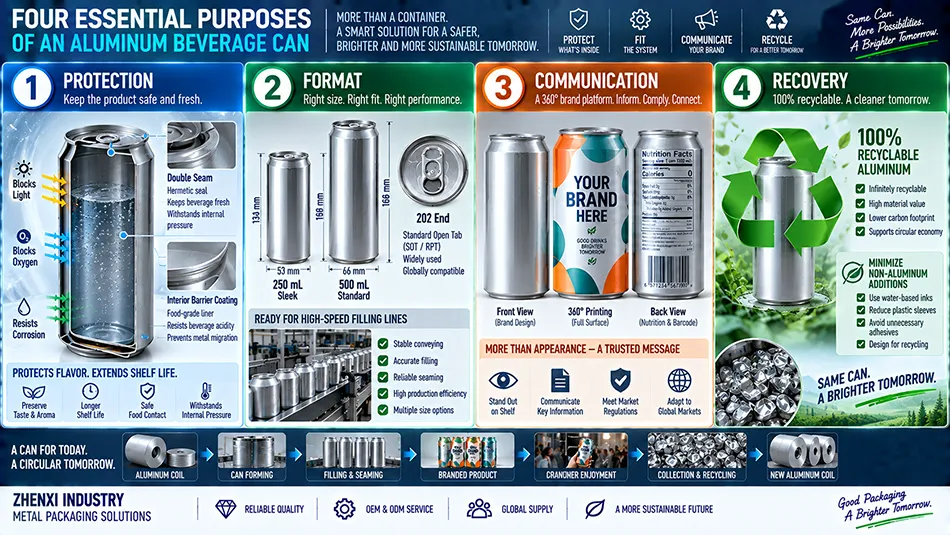
The purpose of an aluminum can is to make a beverage usable through protection, format, communication and recovery decisions rather than simply contain liquid. Containment is the visible job; the less visible jobs are to protect the drink through a defined pack system, give the product a format people and operations can use, carry clear market-facing information, and account for what happens after consumption. None of those jobs is proven by an empty body alone.
This framing is useful because it separates a can's potential from a project claim. A brewery, beverage brand, importer, or packaging manager can ask four different questions: What conditions must the product withstand? Which body-and-end combination is being evaluated? Who releases the artwork? What recovery route is actually relevant? A “yes” to one question does not answer the other three.
Protection is a system outcome involving the beverage, the interior interface and the closure, not aluminum alone. A material description can start a packaging conversation, but it cannot establish shelf life, chemical suitability, filling performance, or a result in a particular market. Those outcomes depend on the product conditions and the evidence used to assess them.
The practical shift is small but important: write the product condition before asking for a can. Record the beverage type, intended market, storage assumptions, and the evidence still needed. This stops a generic “aluminum protects the drink” statement from becoming an unstated promise about a specific formula.
FDA includes food packaging and its components in its food-contact substance framing and assesses intended-use safety in the United States. A food contact substance is a packaging-related material that comes into contact with food under its intended use. In other words, the package is evaluated in relation to its use, not merely by the word “aluminum” on a purchase description.
CMI describes an inside protective coating applied and cured during two-piece can manufacture. That manufacturing detail makes the interior interface visible, but it does not establish suitability for a particular beverage. The buyer still needs the relevant product, market, and intended-use evidence from the responsible parties before treating the interface as resolved.
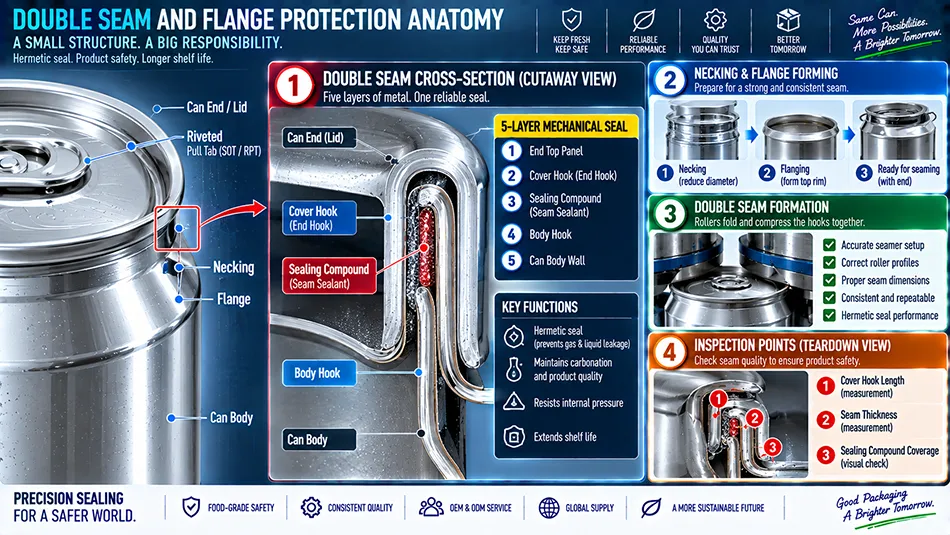
The Aluminum Association's North American can LCA describes necking that matches the lid diameter and a flange that forms part of the seal. The report is a North American manufacturing model, not an approval for any particular line, but it shows why the body and end belong in the same decision. The end is not an afterthought added to a chosen capacity; it completes the package interface.
CFIA describes visual inspection, measurements, teardown and cross sectioning as complementary double-seam assessment methods. A double seam is the mechanically interlocked edge where the can end meets the body. This general metal-can guidance does not supply a beverage-specific limit, but it makes the decision consequence clear: a finished-looking end is not the same thing as closure evidence.
A useful can format is a documented body-end choice, not just a capacity and shape preference. Capacity may be the first question a brand asks, yet a usable brief also names the body style, the end requirement, handling considerations, and the unresolved validation question. This is a better handoff than a request for “a slim can” or “a standard can,” because it tells operations and suppliers what still has to be checked.
CMI publishes separate reference dimensions for 202 can ends and cans. Its public 202 reference makes that separation visible. It is not a universal compatibility approval: public dimensions cannot replace validation against a specific filling and closing arrangement.
| Brief item | What to name | Why it changes the decision |
|---|---|---|
| Body | Capacity and body style | It keeps the commercial format choice explicit. |
| End | End requirement and opening expectation | It prevents the closure from becoming an unstated assumption. |
| Validation | Owner, timing, and evidence requested | It keeps a reference dimension from being mistaken for line approval. |
Opening convenience belongs in the same discussion, but it should be described as a requirement rather than assumed from the body shape. A brief can state the expected opening experience, any handling constraints, and who will confirm the selected end against the intended pack process. This avoids treating a visible tab or a familiar diameter as proof that the whole use case has been settled.
For example, a buyer working from a slim format can use a 250 mL slim can format as the named body reference, then add the end question and the validation owner to the same brief. Qingdao Baixi Industry (Baixi Cans) can therefore be used as a body reference in the commercial discussion without implying that the page itself proves beverage or line compatibility.
CMI describes aluminum beverage cans as offering 360 degrees of branding real estate. That is the physical reason a can has a communication purpose: its exterior can carry a brand system, product cues, and required market information in the same object that delivers the drink.
More printable area does not settle what belongs there. Artwork, copy, language versions, barcode placement, and market-specific statements remain release decisions. Assigning that release to a brand, regulatory, or market team is more reliable than assuming that an attractive design is ready because it fits the can wall.
Use the packaging brief to separate two questions that are often blended together: what the can should look like, and what information may appear on it in the intended market. The first is a creative choice; the second needs the appropriate review. Keeping them separate protects both the product presentation and the decision record.
That distinction also keeps late changes manageable. When the market-facing copy is owned by a named reviewer, a body change, a language change, or a new mandatory statement can be examined against one current artwork version. Without that owner, teams may approve the shape and graphics while quietly carrying different assumptions about the release-ready file.
The Aluminum Association says aluminum-container design choices and non-aluminum materials can affect recycling operations. Its design guidance recommends maximizing aluminum and minimizing non-aluminum materials where possible. The point is not that every can will have the same outcome; it is that recovery begins with choices made before the package is released.
EPA's 2018 U.S. data reports beer and soft drink cans as the most recycled aluminum packaging category at 50.4 percent. That same 2018 U.S. measure reports 0.67 million tons. It is a dated U.S. measure, not a global result or a prediction for one brand. Use scoped data this way: to ask whether the proposed material additions and the target market's collection path support the recovery claim being considered.
A useful recovery note names the market, the added materials, and the local route after use. It should not say that a product is “fully recyclable everywhere” unless evidence supports that exact statement. The honest packaging decision is often more specific: reduce unnecessary non-aluminum additions, check what is removable, and describe the intended recovery context with its limits.
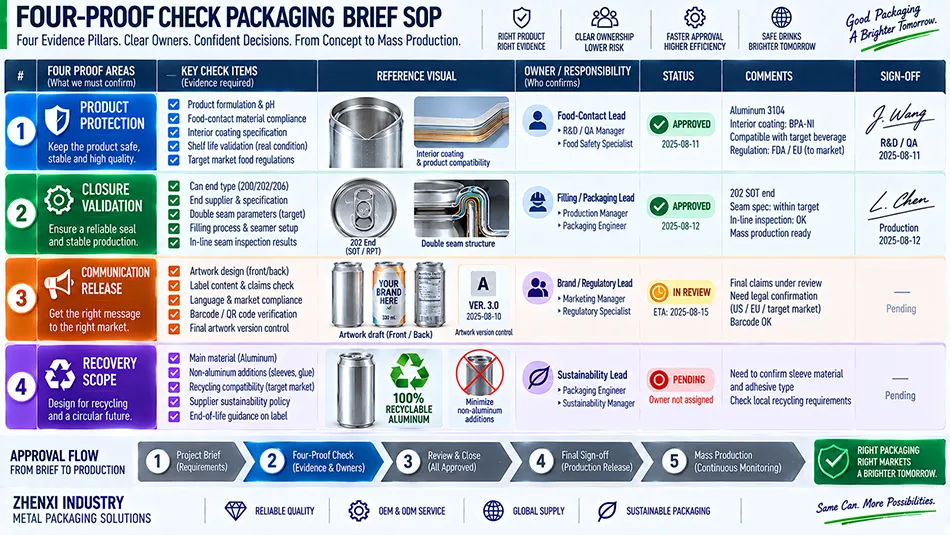
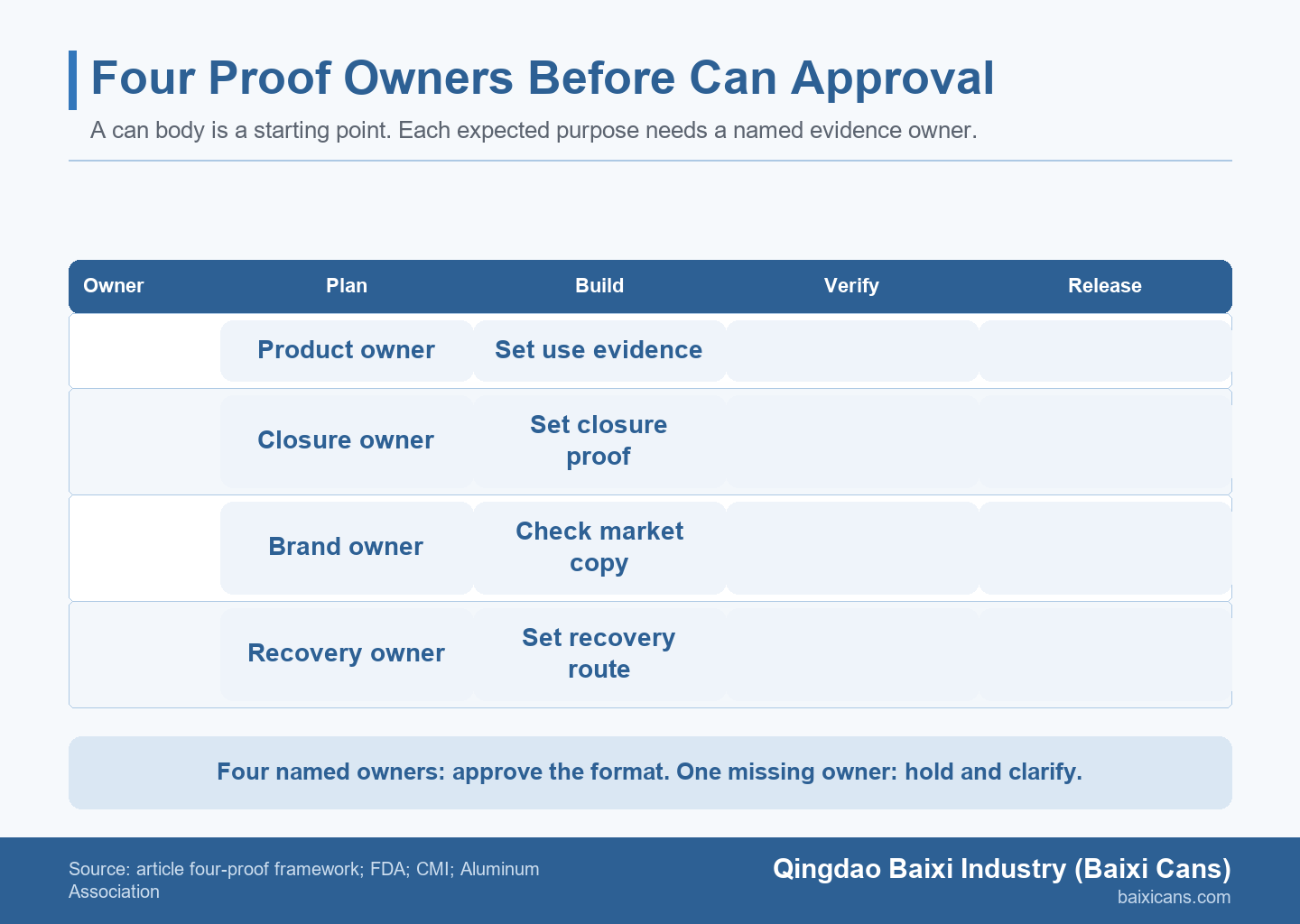
A packaging brief is approval-ready only when product, closure, communication and recovery proof owners are named. A proof owner is the responsible person or team that provides the evidence behind a packaging purpose. This is an original buyer-side decision rule, not a legal requirement or a substitute for technical testing: it simply prevents a format from being treated as final while one of its expected functions still has no accountable source of proof.
| Purpose | Proof owner to name | Evidence or decision to request | Hold trigger |
|---|---|---|---|
| Product protection | Product or food-contact lead | Intended-use conditions and the needed assessment path | The beverage conditions are still generic. |
| Closure | Filling or packaging operations lead | Named body, end, and closure-validation requirement | The end is unspecified or the seam evidence is undefined. |
| Communication | Brand or market release lead | Artwork version and target-market review status | The artwork is attractive but not released. |
| Recovery | Packaging or sustainability lead | Added-material review and local recovery context | A broad claim has no market scope. |
Start with the incomplete row, not the prettiest format. If the product team has not set the intended-use question, it is too early to treat the body as a protection answer. If the closure team has not named the end and validation evidence, it is too early to call the package finished. That sequence avoids a common responsibility gap: each team assumes another team has supplied the missing proof.
For a larger-format discussion, a buyer can compare a 500 mL can body against the four proof checks before converting a product page into a full packaging brief. The page can anchor the body conversation, while the buyer's team still records the beverage conditions, end decision, artwork release, and recovery scope that the page cannot establish on its own.
Before the next supplier conversation, turn the four rows into one version-controlled page. Put the selected body and end at the top; beneath them, record the product condition, the artwork file reference, the recovery context, each owner, and the date each open item will be reviewed. This creates a shared handoff without pretending that the document itself is technical validation. It also gives purchasing a clear signal about whether it is asking for a quotation, an additional document, or a decision from another internal team.
When a requirement changes, update the row that owns it rather than changing a general claim across the brief. A new beverage condition returns the product row to review. A different end or line arrangement reopens the closure row. A copy change sends the communication row back to release, while a new sleeve, label, or destination market reopens the recovery row. This simple discipline makes a change visible before it becomes an unowned assumption.
The four-proof check is also useful when several teams are involved in the same launch. Procurement can keep the commercial body choice visible without becoming the owner of food-contact evidence. The brand team can release the current artwork without being asked to judge closure performance. Operations can identify the closure question without making a recovery claim. Clear ownership is not bureaucracy for its own sake; it is a way to show which decision remains open and who can close it.
Once those four entries are present, the commercial discussion is clearer: the team knows what it has selected, what evidence is still needed, and who must close each gap. If your brief already names the body but not the end, ask Baixi Cans to help scope the body-and-end conversation and review can-end options alongside the body and packaging brief.
They can help protect a filled beverage from light and air, but freshness still depends on the beverage, coating, closure and filling controls. A can body should therefore be treated as one part of the protection system, not as a standalone freshness guarantee. The required evidence changes with the formula, intended use, target market, and the controls used to fill and close the package.
An aluminum can is not automatically a food-contact approval. A can format does not by itself establish that every food-contact component is appropriate for a particular beverage and market. Food-contact decisions are tied to intended use and the relevant regulatory pathway. The buyer should identify the product conditions and ask the responsible party for the appropriate evidence rather than infer a universal conclusion from the body material.
Because the end and the body meet at the double seam, the body choice does not finish the closure decision. The selected end, sealing interface, and validation requirement need to be documented with the body. A drawing or public reference can help specify the components, but it does not replace confirmation for the particular filling and closing arrangement.
Aluminum cans are not always the best sustainable package. Their design can support recovery, but the result also depends on added materials, local collection and actual recycling pathways. A better claim names its geography and conditions instead of promising the same result everywhere. Buyers can reduce uncertainty by reviewing non-aluminum additions and the destination market's practical recovery route before making a broad environmental statement.

