
Yes—an unopened aluminum beverage can can be chilled in a refrigerator when the beverage’s own storage instruction permits it. The real risk is not the cold metal; it is an undefined cold-storage scope that omits the minimum temperature, duration, beverage, and action if the route goes colder than planned. Ordinary chilling is a service condition. A possible freezing event is a different package-and-product decision.
That distinction matters to beverage buyers because a route log records exposure, not a complete release result. The can format, beverage formula, pack-out, and label may all change what the record means. Treat the fridge question as the starting point for a usable storage instruction, not as a blanket promise that any can may sit in any cold environment.
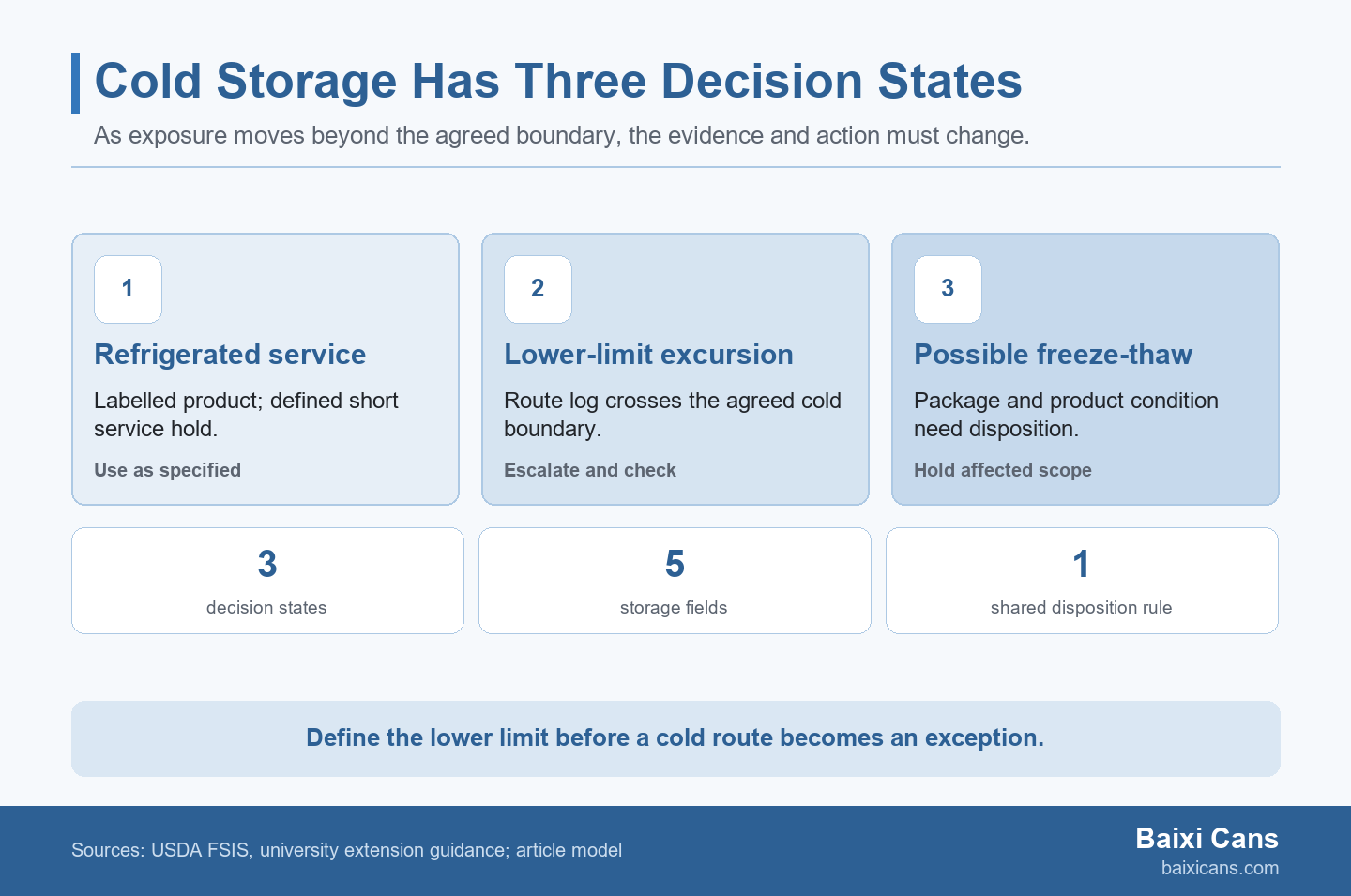
A buyer needs a distinct decision path once a cold-storage instruction is no longer tied to the named product and agreed route boundary.
USDA FSIS advises keeping canned goods away from high or low temperature extremes and warns against using leaking, bulging, or badly dented cans. The practical implication is simple: do not let a commercial instruction collapse into “cold is always better.” A buyer needs to know whether the product is being chilled for near-term service, stored for inventory, or routed through conditions that may approach freezing.
For a beverage brand choosing its format, that is why the can description and storage instruction belong in the same conversation. Qingdao Baixi Industry (Baixi Cans) readers can review the 250 ml slim can format, then attach the beverage, intended service temperature, and actual distribution route to the request. The product page identifies a format; it does not replace the beverage owner’s storage direction.
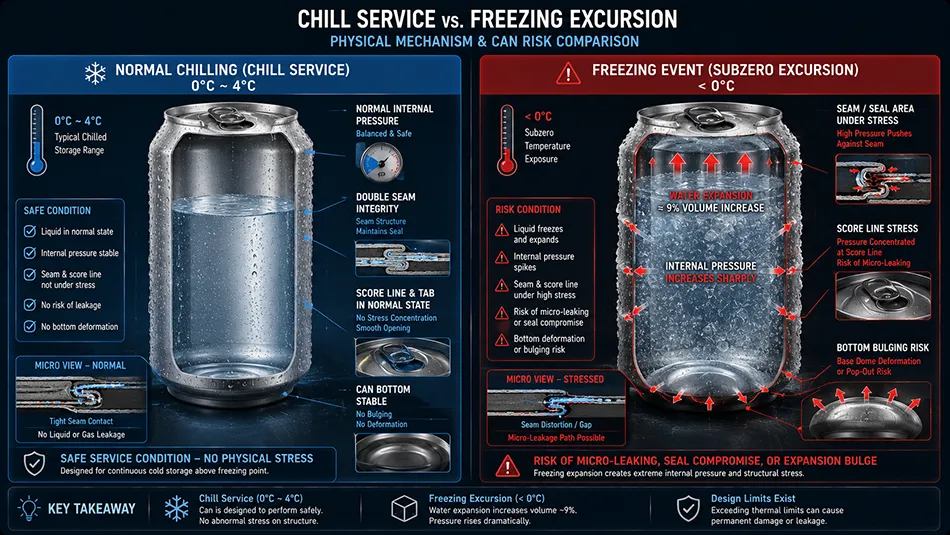
A useful cold-storage statement must set an agreed lower boundary before a route log can be interpreted as normal service or an exception. “Keep cold” is too vague to guide a warehouse, carrier, or buyer after the fact. The lower limit belongs beside the named beverage and a defined exposure duration, not in a general note about an aluminum container.
A product’s stated storage instruction has to govern the cold-storage decision before a buyer relies on a generic can answer. First confirm whether the unopened beverage is intended for room-temperature storage, refrigerated storage, or another defined condition. Then ask whether the planned fridge or route condition matches that instruction. This order avoids the common mistake of letting the visible container decide a requirement that belongs to the product and its validation.
For this reason, a product specification should name the beverage class and any formula or handling characteristic that changes its cold response. A carbonated drink, still drink, and food product may arrive in similar metal containers, yet the relevant storage statement can differ. The article’s framework does not infer a freezing point from the can body, and neither should an RFQ.
Utah State University advises that sealed cans should not be allowed to freeze and notes that freezing can lead to bursting cans or broken seals. That does not supply a universal beverage limit, but it explains why a freezer question needs a different response from ordinary refrigeration. A temperature excursion is a recorded period outside the agreed range for a product or route; it is the signal to begin an exception review, not proof of a particular failure.
The distinction is especially important when logistics language says “refrigerated,” while the actual route includes an unheated dock, overnight handoff, or a vehicle zone that could move below the agreed limit. The correct question is not whether the can feels cold. It is whether the recorded condition stayed inside the scope that the product owner, packer, and buyer agreed before dispatch.
University of Minnesota Extension says liquid in a container may expand during freezing, and a University of Illinois explanation identifies water expansion as the main factor in its carbonated-drink freezer example. Minnesota Extension source; Illinois Physics Van source. Those are mechanism clues, not a pressure calculation or a safe duration for every can. They explain why a possible freezing event needs more evidence than a normal refrigerator hold.
Oregon State University and Kansas State University both make seam or seal condition a key check after canned food freezes. For a finished commercial beverage, use that as a review boundary: keep the exposed pallet identities, route minimum, duration, and observable package condition together, then follow the beverage owner’s product-specific instruction. Do not turn a general canned-food page into a self-issued release certificate.
A freeze-thaw condition is one in which a product may have frozen and then warmed again before review. It is not interchangeable with “the can was cold.” If package condition is in question, the closure matters as much as the body; buyers comparing end configurations can review aluminum can lid options while documenting which end style is actually on the exposed format. That preserves traceability without implying that a product page supplies the disposition.
A pressure-related can incident does not identify its own cause: an FDA-posted 2022 recall described warm-liquid yeast fermentation leading to over-carbonation and a risk of cans bursting. FDA recall source. The recall concerned a named situation; it does not explain every damaged can. Its value here is diagnostic discipline: do not look at a bulge, a leak, or a temperature record and assign one cause before the relevant product and package evidence is reviewed.
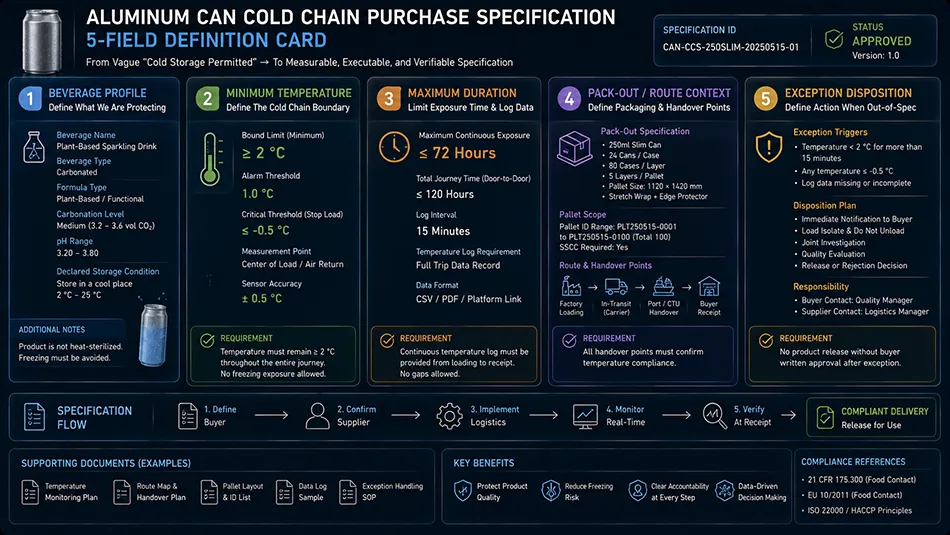
A purchase specification needs defined storage inputs before it can support a release or exception decision. The most practical replacement for “cold storage permitted” is a short statement whose fields can be checked by the buyer, beverage owner, packer, and logistics partner against the same record.
Before choosing a format, assign the same statement to the people who will use it. The buyer needs an RFQ field. The beverage owner needs a product instruction. The packer and carrier need a route limit and alert expectation. The reviewer needs a named response when an alert occurs. When those records point to different terms, the problem is not that the can lacks a generic “fridge-safe” label; the problem is that the order has no shared operating condition.
That is also where can selection becomes commercially useful rather than promotional. A buyer can compare the 500 ml custom can format and ask the storage questions against that nominated beverage and pack-out. The format link supports the size discussion; the storage fields still need product-specific answers.
USDA FSIS says unopened commercially canned foods may be refrigerated for a short period, while cool, dry storage is preferred for unopened storage. That is a useful boundary for a labelled product being chilled for service, but it does not say that refrigeration extends every product’s shelf life or proves tolerance for a cold route. Here, shelf-stable means a product designed to remain safe at room temperature before opening when stored as labelled.
A cold-storage statement becomes decision-ready when it names the beverage, minimum temperature, maximum duration, pack-out or route context, and post-excursion disposition. This is an original procurement rule, not a universal technical standard. Its purpose is to stop a later reviewer from guessing whether the log, the product instruction, and the package condition were meant to answer the same question.
| Field | What it removes | What the buyer should record |
|---|---|---|
| Beverage | Assuming the can material sets product storage. | Product name, formula family, and labelled pre-opening condition. |
| Minimum temperature | Vague “keep cold” wording. | Agreed lower boundary and alert threshold. |
| Maximum duration | Ignoring time below the boundary. | Allowed exposure window and log interval. |
| Pack-out or route context | Applying one result to every pallet. | Pack configuration, route leg, pallet identity, and handoff point. |
| Disposition | Inventing a response after an alert. | Named owner, hold or release action, and review evidence. |
Based on this comparison, the decision rule is not “stay cold.” It is “keep the named product inside its agreed range, and use the agreed action when it leaves that range.” A route log becomes useful only when all five fields let the next reviewer interpret it without filling in missing assumptions.
A logged low-temperature event should trigger the pre-agreed action for the affected scope, not an automatic release or automatic rejection of the whole order. A disposition rule tells named owners whether to release, hold, inspect, or discard an affected subset. It should identify who owns the decision, what evidence they need, and whether a route alert applies to a traceable subset or the full shipment.
This gives operations a more useful sequence than “check the cans.” First identify the exposed pallet or route leg. Next compare the time and minimum against the written product scope. Then collect the package-condition evidence that the product owner requires. Finally, apply the named action. If no action was written in advance, the information gap itself is the escalation: pause the applicable decision until the owner defines one.
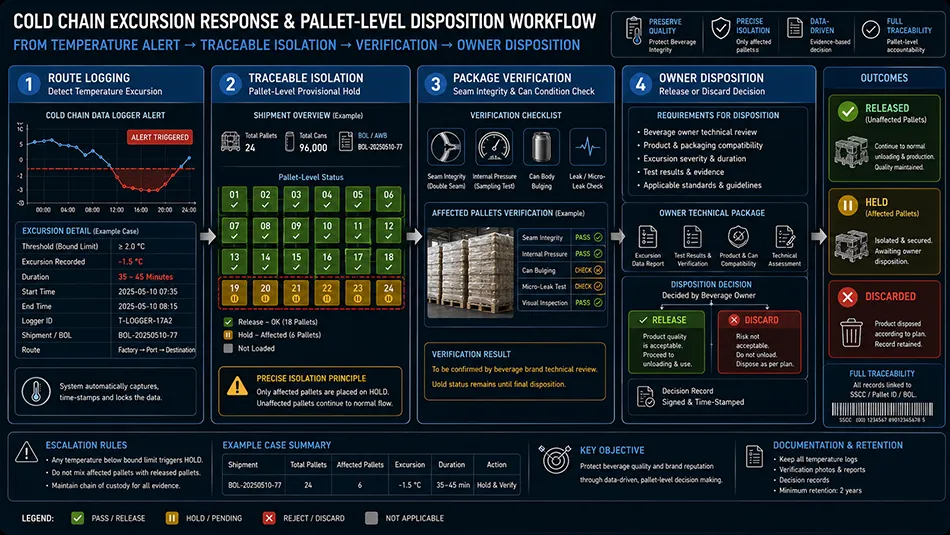
A repeated low-temperature record should be treated as a process-escalation signal while the exposed subset receives product-specific disposition. Repetition matters because a single unexplained event may be a local handoff issue; the same pattern on separate legs exposes a weakness in the route instruction or its monitoring plan.
In an illustrative 480,000-can sparkling-water order, a buyer and importer have chosen a 330 ml aluminum format for five regional transfer legs. Sixty percent is packed before final release. The key point is not the size of the order; it is that each route leg can be associated with a defined pallet population instead of being treated as one undifferentiated shipment.
Two logs covering the same 96,000-can subset show 35 to 45 minutes at -1.5°C. The written note only says “cold storage permitted”; it omits a lower boundary, duration limit, beverage-specific freeze point, and response. Those logs establish a repeated route exception, not proof that the beverage froze or that every can failed. The missing storage fields are what prevent a defensible release decision.
The buyer places the traceable 96,000-can subset on provisional hold and continues reviewing the unaffected route legs. That selective hold preserves the option to release unaffected scope while the beverage owner supplies product-specific disposition. The corrective action is to replace the vague note with the five fields above and require an alert whenever the agreed lower boundary is crossed.
Release depends on reconciling the pallet identities, route minimum, duration, package-condition check, and the beverage owner’s written instruction. This is a composite procurement scenario, not a customer case, a test result, or a claim that -1.5°C always freezes a beverage. Its lesson is narrower: repeated exceptions should repair the decision system, not invite a guess about an entire order.
A buyer can start a bounded storage review by handing over the beverage, can format, end style, route minimum and duration, pack-out, and current records together. This is useful before an order is released because it makes missing information visible while the commercial and logistics terms can still be changed.
If those inputs are ready, contact Baixi Cans to share the cold-storage inputs for a can-format review.
Yes—when the beverage is labelled shelf-stable and refrigeration is a short service hold, not an unbounded storage program. Check the product’s own storage direction first, then define how long and how cold the service hold will be. A can being suitable for ordinary chilling does not establish tolerance for a freezing route, an unheated dock, or a long-duration low-temperature excursion.
Treat it as a documented temperature excursion, not automatic evidence of failure, and follow the beverage owner’s product-specific disposition rule. Preserve the affected pallet identity, route minimum, duration, and visible package condition. If the written scope does not say what to do after the event, escalate that information gap before the affected subset is released.
No—a bulged or ruptured beverage can requires investigation because pressure or package-integrity problems can have more than one cause. A temperature record can show one relevant condition, but it does not prove root cause on its own. Review the specific product, package condition, route history, and any applicable technical or food-safety instruction before assigning a disposition.
An RFQ should name the minimum temperature, maximum exposure duration, beverage type, pack-out, and required action after an excursion. Add the can format and closure configuration so the record identifies the actual packaged product under review. Avoid relying on phrases such as “cold storage permitted” unless every field has a named owner and a usable exception path.

