
Sparkling wine in aluminum cans is promising, but it is harder than canned soda because wine chemistry, sulfur compounds, pressure, liner compatibility, and category rules all have to work at the same time. The AWRI winemaker guide to wine in a can is a useful starting point because it treats canned wine as a technical package-development task, not only a lifestyle trend.
Recent research and coverage have made the chemistry question more visible. The AJEV paper on wine in aluminum cans and related public research records show why buyers should connect wine composition, liner selection, and shelf-life testing before ordering printed cans. The opportunity is real, but the release file needs to be more disciplined than a novelty launch.
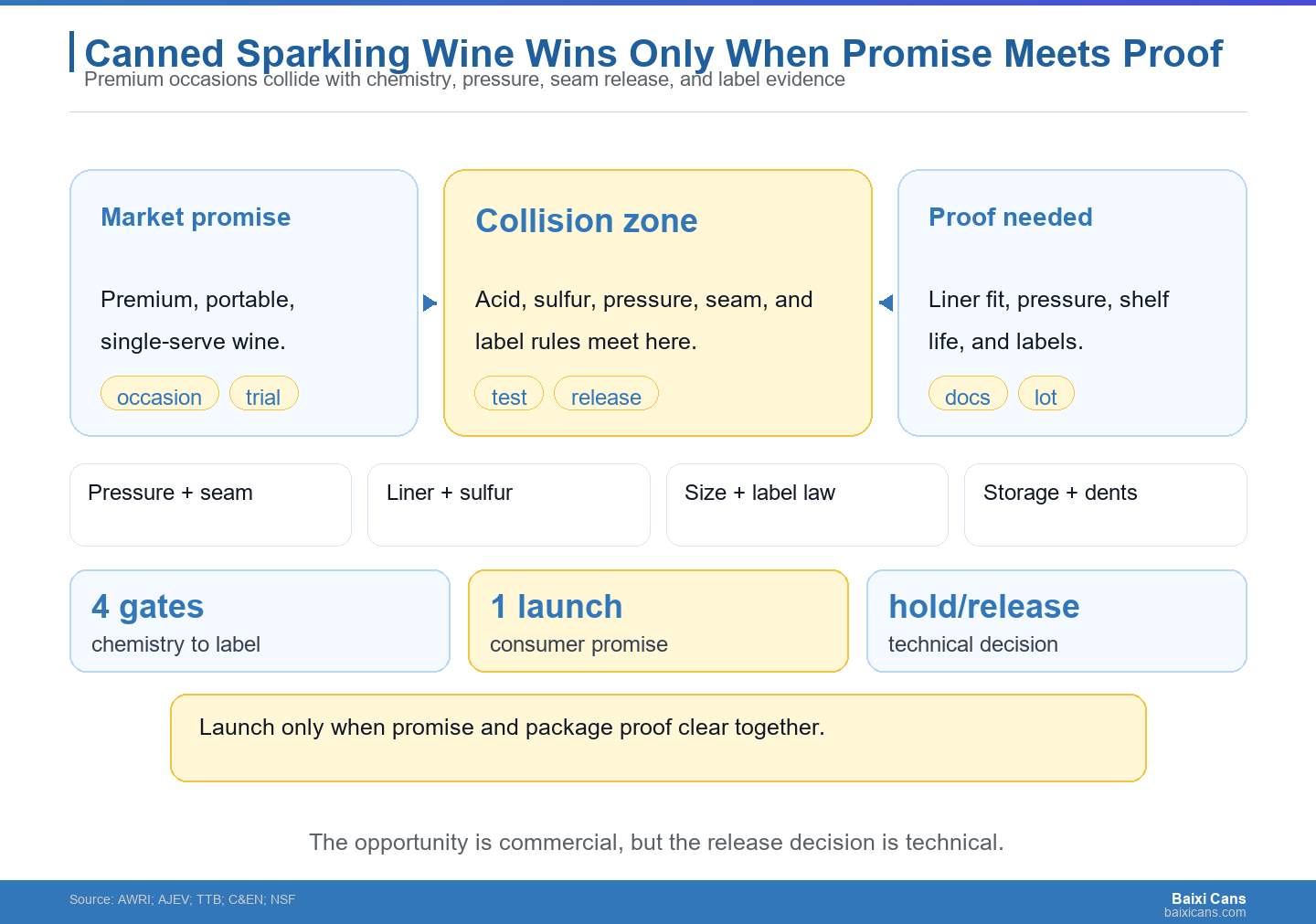
Soda in cans is mature. Sparkling wine adds a more reactive beverage matrix, different consumer expectations, and category-specific labeling.
A sparkling wine can is not a soda can with nicer artwork; it is a wine-package compatibility project under pressure.
The AWRI canned wine guide is direct about the need to manage wine composition and package choice. Sulfur dioxide, acidity, dissolved oxygen, phenolics, and aroma compounds can change how the wine behaves in a can. A liner that works for a soda or beer should not be assumed to work for sparkling wine without a trial.
Can-coating background helps explain why. The liner is a barrier, and the drink can stress that barrier. The decision rule is to treat sparkling wine as a product-package compatibility test: wine chemistry, liner, end, pressure, shelf life, and storage temperature should be reviewed together before the brand promises a premium experience.
Sparkling wine also carries pressure and sensory expectations. A consumer may forgive a casual canned cocktail, but not flat, metallic, discolored, or sulfur-shifted sparkling wine sold as premium. Fill volume, dissolved oxygen, carbonation, seam quality, storage temperature, and distribution time all become part of the package promise.
The AJEV research paper supports a more cautious approach because it connects wine in cans with chemical change over time. Based on our analysis, a trial should include at least 3 checkpoints: initial fill, warm or accelerated storage if appropriate, and final shelf-life tasting or lab review. One clean first-day sample is not enough proof.
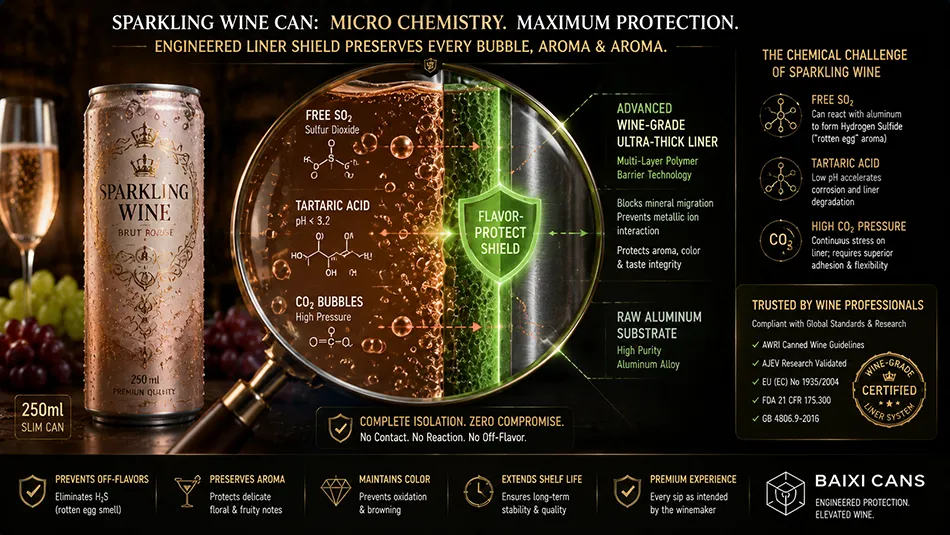
The best canned wine decisions come from pairing wine research with packaging trials, not copying soda assumptions.
The NSF public access research record and Cornell repository file help buyers justify a real trial plan. They make the conversation less subjective: the question is not whether canned wine is fashionable, but how a specific wine changes under a specific liner, fill, temperature, and time condition.
The hidden cost of skipping pilot testing is claim mismatch. A product can taste acceptable after filling and still drift after weeks in warm distribution. The decision rule is to approve a canned sparkling wine only after the brand defines a shelf-life target and tests the wine-can system against that target.
Industry coverage such as Packaging Insights on aluminum wine packaging and science reporting from Chemical and Engineering News show that the wine-in-can topic has moved beyond novelty. Buyers, retailers, and consumers may like the convenience, but technical credibility determines whether repeat purchase follows the first trial.
That is the must-win angle for sparkling wine cans: the package can create new consumption occasions, but it cannot be marketed around portability alone. The can must protect aroma, color, carbonation, mouthfeel, and trust. If the product requires a shorter shelf life, the label, route to market, and inventory plan should reflect that boundary.
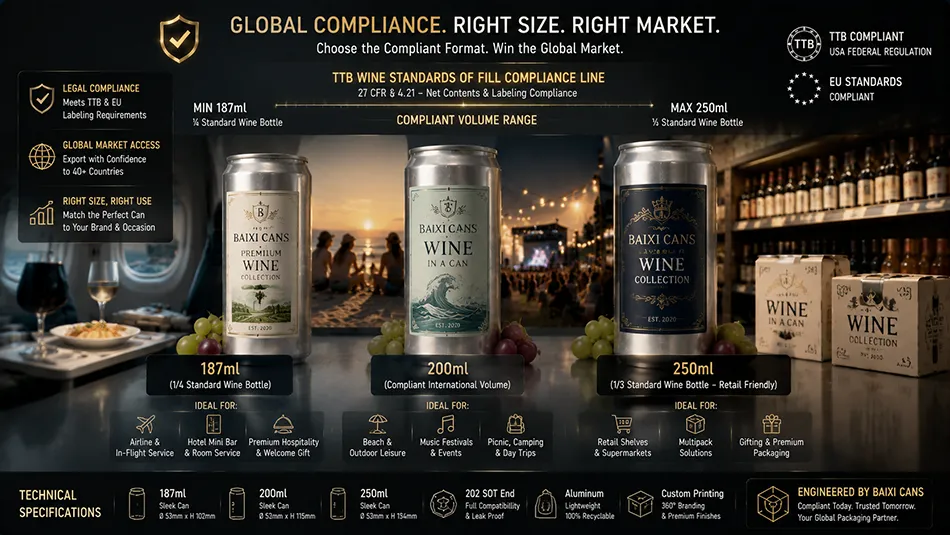
Sparkling wine cans compete on occasion, but wine remains a regulated and expectation-heavy category.
The TTB wine net-contents guidance helps US-bound projects avoid treating can size as a purely creative decision. The Federal Register standards-of-fill rule also shows that wine and spirits fill sizes can change through regulation. A sparkling wine can may be portable and modern, but it still needs compliant net-content and label planning.
For export buyers, the safest approach is to decide market and category before ordering printed cans. A 187ml, 200ml, 250ml, or other size may create different shelf, label, and consumer expectations by market. The supplier can support the physical can discussion, but the brand should own regulatory confirmation.
Canned sparkling wine works best when the size matches where the product is consumed: concerts, beaches, airline-style service, hotel minibars, outdoor events, sampling, or multipacks. Oversized formats weaken the portability advantage, while very small formats may make premium pricing harder unless the occasion is clear.
Baixi buyers can compare 250ml slim cans with standard can options depending on the target occasion. The decision rule is not to copy soda sizes. It is to connect wine occasion, pressure, liner, lid, print, and market rules into one launch specification.
| Decision | Sparkling wine risk | Buyer check |
|---|---|---|
| Can size | Too large weakens single-serve occasion | Match net contents, occasion, and shelf channel |
| Liner | Sulfur, acid, and aroma interaction | Run compatibility and shelf-life trial |
| Pressure | Flat product or seam stress | Check carbonation, fill, end, and storage |
| Label | Wine category and net contents | Review destination-market rules before print |
| Distribution | Heat can accelerate quality drift | Define cold chain or realistic shelf-life boundary |
The table shows the buyer's job: prove the occasion, prove the package, and prove the category file before buying decorated cans at scale.
Baixi Cans can support the format discussion when the buyer provides wine chemistry, pressure target, market, and lid requirements early.
Sparkling wine buyers should not ask for a can body first and a lid later. The can, end, liner, filling method, pressure, and storage plan are connected. Baixi's aluminum can lids should be discussed with the chosen can size because seam and opening expectations are part of the wine experience.
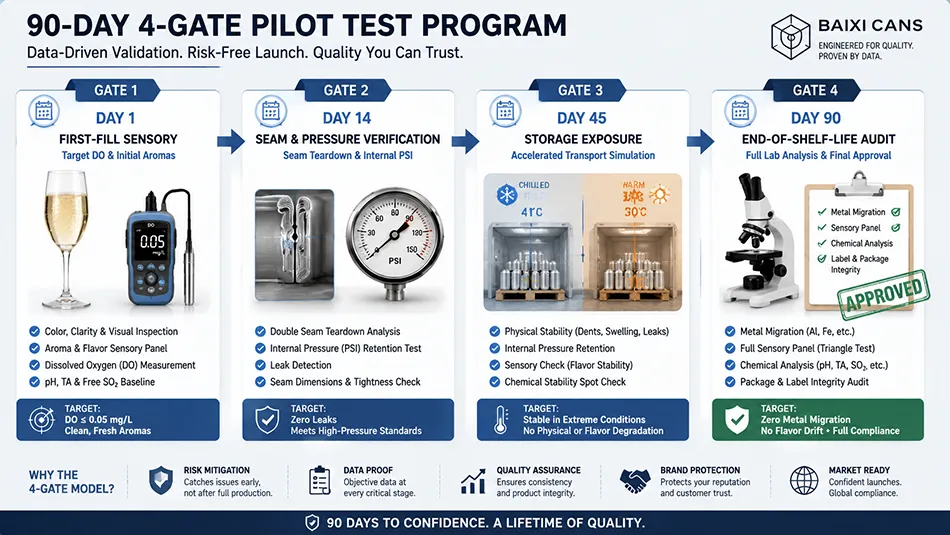
Based on our analysis, a practical pilot plan has 4 release gates: first-fill sensory check, pressure and seam check, storage-condition review, and end-of-shelf-life review. If the project cannot define those gates, it is not ready for a full printed-can order. The pilot does not need to be slow, but it does need to be honest.
A buyer can use Baixi aluminum cans to compare sizes and printing options, but the supplier should receive the technical context: wine type, carbonation target, free SO2 approach if relevant, pH, alcohol, sweetness, shelf life, filling process, and target market. That context lets Baixi Cans discuss available can and lid routes more realistically.
Before approving artwork, send Baixi Cans the wine profile, desired serving size, target carbonation, market, label constraints, lid preference, and trial timeline. Use Baixi Cans contact support to request a package feasibility discussion that treats canned sparkling wine as a technical launch, not just a new label format.
This is the point where the topic becomes operational: the buyer turns technical uncertainty into the questions a supplier, filler, or compliance reviewer can answer.
According to the AWRI wine-in-can guide, wine composition and package choice have to be managed together. According to the AJEV canned wine paper, wine in aluminum cans can show chemistry changes over time. That makes the pilot a shelf-life test, not a one-day tasting event.
Research from the NSF public access record and the Cornell repository file supports the same practical conclusion: the wine, liner, oxygen, storage, and time condition should be tested as one system. For sparkling wine, pressure and carbonation add another layer that ordinary still wine trials may not fully answer.
According to the TTB wine net-contents guidance, wine package size and label presentation require category attention. According to the Federal Register standards-of-fill rule, fill-size rules can change through formal action. A sparkling wine can should therefore be checked for occasion fit and market rules before printed cans are ordered.
Calculated from a 4-gate pilot - first fill, pressure and seam check, storage review, and end-of-shelf-life review - missing one gate leaves 25 percent of the release logic untested. The limitation is important: a clean pilot does not make every wine can-ready, but it gives the buyer a disciplined reason to scale or stop. According to the AWRI canned wine guide, wine composition and packaging must be considered together, so the trial should record free SO2 approach if relevant, pH, alcohol, carbonation target, fill temperature, liner route, and storage condition. Data from a 90-day pilot should not be reduced to one tasting note. Keep filled samples at the intended storage condition, add a warm-condition set if the route justifies it, and compare opening pressure, color, aroma, seam condition, and metallic or sulfur notes at agreed intervals. For market readiness, according to the TTB wine net-contents guidance, the size and label file also need review before decorated cans are scaled. Assign one approver from winemaking, one from packaging, and one from compliance so a positive sensory note cannot override an unresolved package or label issue. Retain unopened samples from each trial lot and photograph the can body, end, and code before storage begins. If the warm-condition set fails while the intended-storage set passes, the launch is not automatically dead, but the sales channel, shelf-life claim, and distributor temperature requirement must be narrowed before scale-up. If both sets fail, return to liner, wine adjustment, or format selection before buying printed inventory. Record the stop decision in the project file.
For specification planning, review Baixi's aluminum cans, can lids, and service process before moving a sparkling wine concept into printed production.
Send Baixi Cans the wine style, pH, alcohol, sweetness, carbonation target, free SO2 approach if relevant, shelf-life target, filling method, desired size, lid style, and destination market. Ask for a can-and-lid discussion before you approve decorated stock for a sparkling wine launch.
Yes, sparkling wine can be packaged in aluminum cans when the liner, pressure, fill, storage, and label plan fit the wine. It should be treated as a tested package system rather than a direct copy of soda canning.
Wine chemistry can interact with liners and change over time, especially when sulfur, acidity, oxygen, and aroma compounds are involved. Sparkling wine adds carbonation and pressure expectations to that challenge.
The best size depends on market rules and consumption occasion. Many projects consider single-serve or multipack sizes because portability is one of the strongest reasons to use cans.
They may need liners proven suitable for the specific wine chemistry and shelf life. Buyers should not assume a liner used for soda or beer automatically works for sparkling wine.
A useful pilot includes first-fill sensory review, liner compatibility evidence, pressure and seam checks, storage-condition review, and end-of-shelf-life evaluation. The target market and label rules should be checked before printing.

