
Opening evidence belongs to the identified end system because the score panel and stay-on tab are end structures, not features of the empty body alone. The end record should therefore name the actual end and opening configuration being considered, rather than extending an empty-body result to a component that was never tested.
That distinction sets up a practical way to read aluminum can testing parameters. The important question is not simply whether a supplier has a value for a structural check, coating adhesion, height or leak screening. It is whether that value describes the current can, the method used and the decision a buyer needs to make next—receive the bodies, begin a filling trial, investigate a change, or release a completed package.
Beverage-can quality control covers parameters at different stages, so one generic pass label cannot describe geometry, coating, mechanical behavior and downstream interface evidence at once. A technical production-control study lists finished dimensions, coating checks and separate mechanical checks, while noting that the required values are defined individually by customers. Read the beverage-can quality-control study.
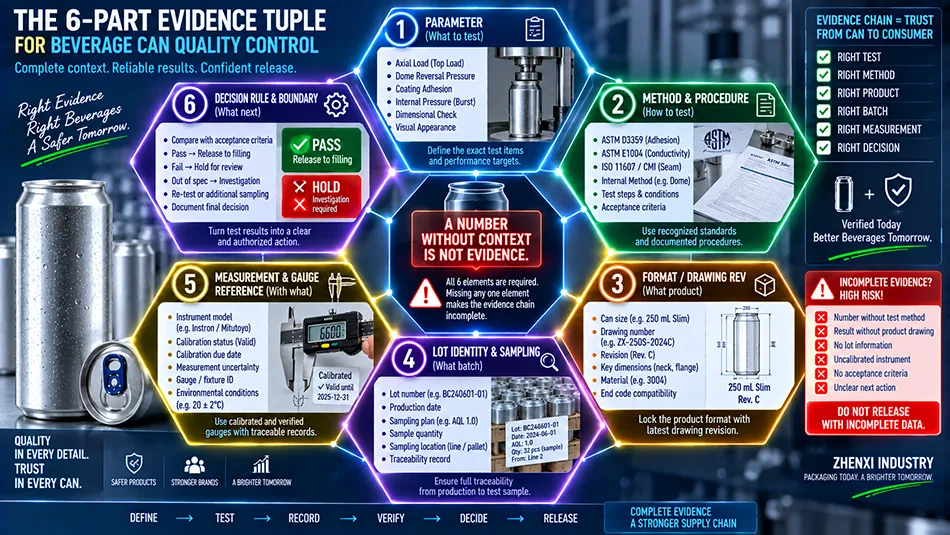
Treat each release-relevant result as a six-part evidence tuple: parameter, method, format or drawing, lot, measurement reference and decision rule. This is an organizing model, not a prescribed test standard or a numerical limit. Its value is simple: if one field is missing, the team can see exactly what must be clarified before the result is used to support a release decision.
For example, “a structural check passed” is incomplete evidence. A usable statement identifies the body format and drawing revision, the lot, the test method and sample plan, the measurement context, and whether the result permits the next operation or requires review. This prevents a historic average, an unlabelled certificate or a result from another format from being mistaken for approval.
A useful can test plan separates geometry, structural behavior, coating or leak condition and end-system performance because the production process exposes those as different control questions. The categories can overlap in a production discussion, but they should not be merged in the acceptance record. Each produces a different answer and has a different boundary.
The two-piece-can manufacturing sequence treats coating, necking, flanging and mechanical leak testing as separate operations. See the separate stages in CMI’s manufacturing overview.
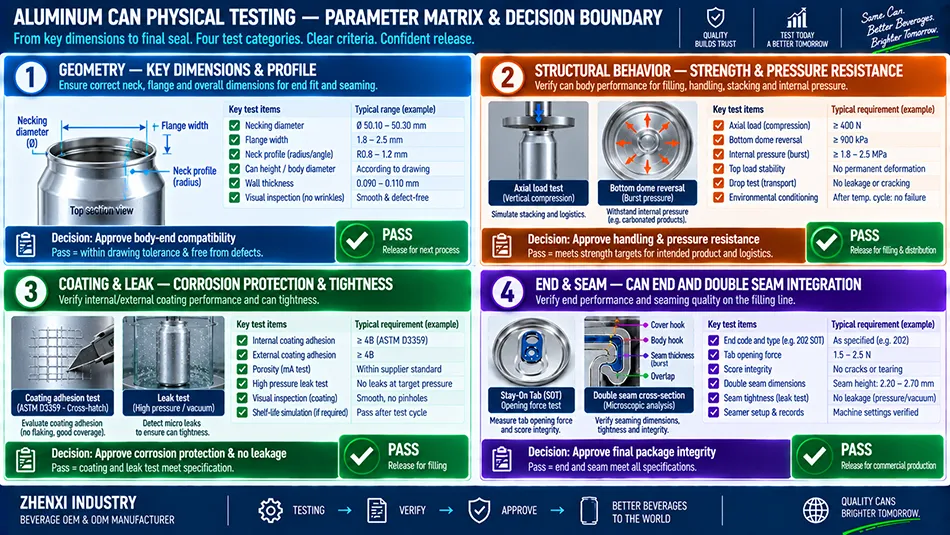
| Test family | Primary question | Record needed before the next decision |
|---|---|---|
| Geometry | Does the current body match the intended body-to-end interface? | Drawing or format identifier, measured feature, method and sampled lot. |
| Structural behavior | Does this identified body have evidence for the stated handling or pressure question? | Test configuration, result, current format, lot and interpretation basis. |
| Coating or leak condition | What specific coating property or leakage screen was evaluated? | Method scope, surface or body state, result and stated limitation. |
| End and finished seam | What has been evaluated after the matched end and closure process are involved? | End identifier, closing context, finished-can evidence and trial decision. |
Neck and flange geometry should be checked as body-to-end interface evidence because necking fits the designated end size and the flanged rim is prepared for future double seaming. A flange is the outward rim of the body that will contribute material to the later mechanical double seam; it is not itself a completed seam. The Can Manufacturers Institute’s two-piece-can overview places necking and flanging before the later closure operation. For a slim format, review a printable 250 mL slim can format with its own current drawing.
Reference dimensions can help identify which measurements belong to a 202 can-and-end system, but they must not be copied into a supplier acceptance plan without the applicable drawing and agreement. Public reference material gives shared vocabulary; it is not a current project specification.
CMI publishes separate reference dimensions for a 202 can and end, with a disclaimer that limits reliance on the reference material. Read the 202 can-and-end reference page and its disclaimer.
For a geometry review, ask which drawing revision applies, which feature was measured, how it was measured and which body lot the readings represent. That is more useful than requesting a detached “neck diameter report.” If you are comparing formats, keep the drawing with the particular body profile instead of carrying dimensions across from another can. Qingdao Baixi Industry (Baixi Cans) can then evaluate a request against the identified format rather than against an assumed generic can.
Axial load, dome growth and dome reversal pressure are distinct mechanical parameters used in beverage-can production control. Axial load is the controlled vertical force a body withstands before structural collapse; dome reversal describes the point at which the can bottom changes shape under a controlled pressure condition. These terms name different behavior, so a result for one does not replace evidence for the other. The production-control study lists these mechanical parameters separately.
A structural result should remain tied to the identified body and end components because a beverage can is made from multiple alloys and its components do not share one material role. Keeping the components named makes it less likely that a reading from one configuration will be carried into another without review.
The Aluminum Association’s standards overview uses different alloy examples for can sheet and closure sheet. See the Aluminum Association’s component-specific alloy examples.
Do not turn those examples into a performance limit. The buyer, supplier and filler still need to define the format, the operating question and the agreed acceptance basis. For a larger project, compare a 500 mL custom can project against its own handling and pressure test plan. A test result is strongest when it answers a named risk for that exact project, not when it is presented as a transferable number.
A coating-adhesion result has the scope of its test method: ASTM D3359 evaluates adhesion on metallic substrates and does not supply an absolute bond-rupture force. The method can therefore help describe adhesion under its stated procedure; it does not by itself establish beverage compatibility, shelf-life behavior or a universal can-coating approval. Read the published ASTM D3359 scope and limitation.
Mechanical leak testing is a distinct can-making check, so its result should be retained as leak evidence rather than folded into a decoration, coating-adhesion or structural claim. Its record should state the body condition, lot and intended next decision.
CMI describes mechanical leakage testing as a separate late-stage operation after necking and flanging. See the late-stage leak-test step in the CMI overview.
That separation helps teams write safer requirements. A request for an adhesion result should state the relevant coating and method. A request for a leak screen should state the body condition, lot and next decision. If the project also needs product-contact or shelf-life validation, record that as a separate project-specific workstream with its own product, filling and storage conditions. A pass in one of these tests should not be expanded into a claim that the test was never designed to prove.
Opening and seam questions begin at different points in the package lifecycle. Opening evidence concerns the identified end system: its scored panel, tab and the test or use condition being discussed. A body result can support the body’s next operation, but it cannot establish opening behavior for an end that has not been identified or applied. Keep the end code and the intended opening evaluation in the record so that a change of end does not disappear behind a general “can passed” statement.
The stay-on-tab mechanism record describes an end panel, score and tab as connected end components. See the documented stay-on-tab mechanism.
Finished-seam integrity requires a different evidence stage from an empty-body test because a formed closure has to exist before seam-specific evidence can be reviewed. This scope boundary prevents a preliminary body result from being represented as a finished-package approval.
FDA low-acid canned-food guidance describes total seam evaluation through measurements, teardown and visual examination. This FDA material is used only as a bounded food-can inspection example—not as a beverage regulation, frequency requirement or acceptance schedule. Read the FDA’s bounded example of total seam evaluation.
A double seam is the mechanical interlock created when a can body and end are closed together. It cannot exist while the body is empty and unseamed. The practical release path is therefore sequential: verify the incoming body for the body-side question, identify the matched end, then evaluate the finished package under the relevant closure and filling conditions. This wording protects both the buyer and the supplier from treating a preliminary check as a final-package promise.
A lot acceptance sampling plan is a scheme and rule set that uses an inspected sample to accept, reject or continue sampling a defined lot. NIST describes the plan as the combination of a sampling scheme and rules for the lot decision; its guidance does not select a sample size or AQL for a specific buyer. Read NIST’s explanation of lot acceptance sampling.
A traceability claim for a measurement result needs a documented measurement system and calibration chain, together with the measured property, result and associated uncertainty. In plain language, metrological traceability is a documented chain that connects the reading to a stated reference. That does not certify a supplier’s result automatically; it states what must be visible for the measurement claim to be assessed. See NIST’s metrological-traceability requirements.
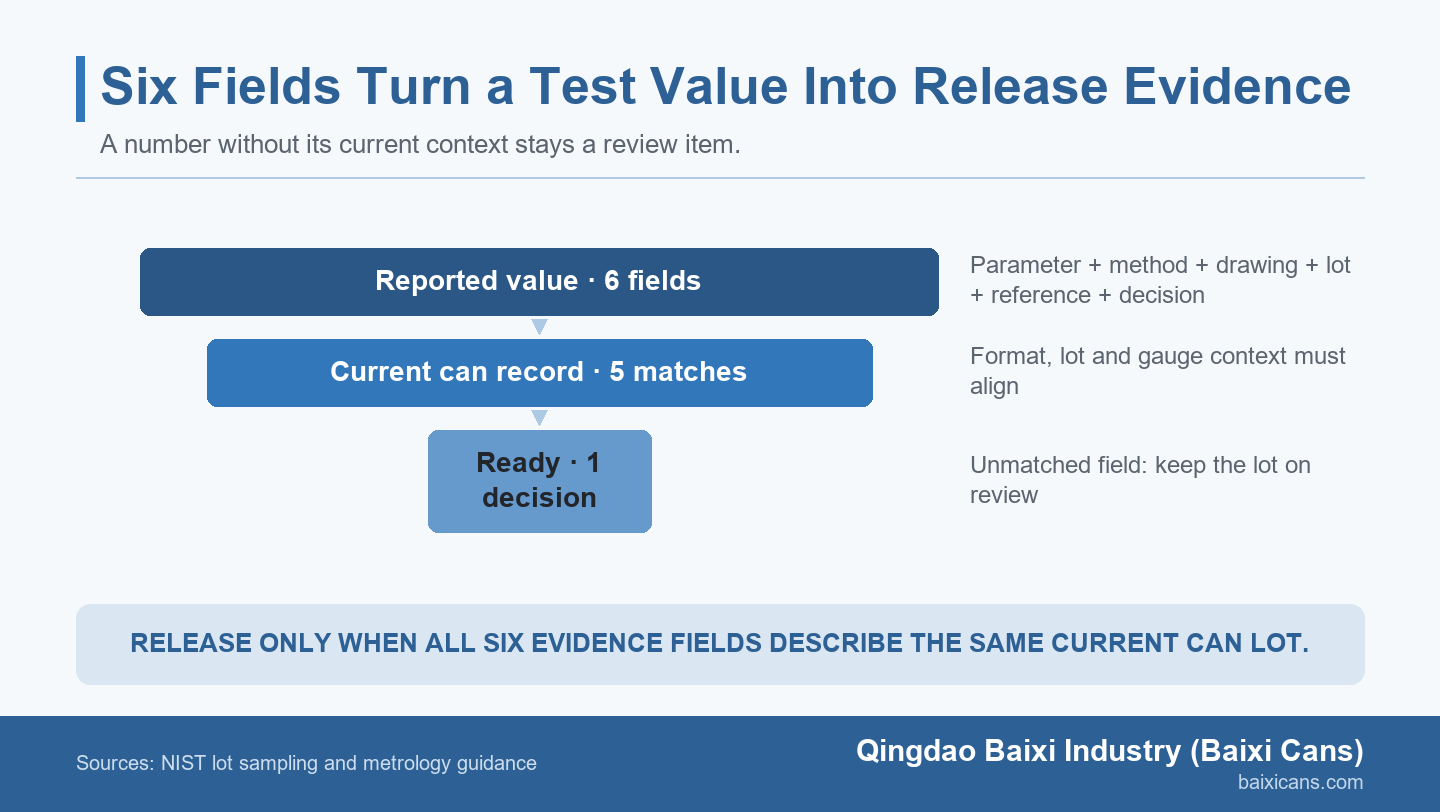
In everyday sourcing, compare records in this order: confirm the format or drawing first, then the lot, method, sample plan and measurement-system status. Only after those pieces line up should the team compare values or use them to support release. This is why a report that looks detailed can still be weak: it may contain readings without the context that makes one reading comparable with another.
In an illustrative 72,000-body lot, a structural trend without a comparable current measurement context should remain a review question before filling begins. The figure is only a scale for the example; it does not prescribe a lot size, a test value, an action limit or a sampling quantity.
When the lot, drawing, method or gauge status does not compare cleanly, verify the current measurement and test basis before using the result to release the lot. This is an illustrative response pattern, not a universal production hold rule; its purpose is to keep an unresolved evidence gap visible while it can still be contained.
A beverage brand and co-packer are preparing to release empty aluminum can bodies for a scheduled filling run. The illustrative order contains 72,000 empty bodies of one identified format, and the current lot has a recorded axial-load trend that differs from the prior production record. The bodies are still empty, but the team cannot confirm that the latest test used the same gauge status, drawing revision and sample plan as the earlier data.
The current result is associated with the 72,000-body lot but lacks the gauge-verification reference used for comparison. The prior value was recorded before the current drawing revision was issued, and no product has yet been filled or seamed into the affected bodies. The number may be valid; the comparison is what remains unproven.
The current number does not yet answer whether the shift reflects the current lot, a changed measurement condition or a format change. A historical average is not a substitute for comparable current evidence. Keep the 72,000 empty bodies on review, verify the measurement system and sample basis, then repeat or confirm the relevant structural check against the current drawing before the lot enters filling.
Segregate the lot, record the drawing revision, verify the gauge or testing system, select samples under the agreed plan and issue a revised decision record. The release packet must identify the 72,000-body lot, current drawing, sampled units, method, measurement-system status, result and named release decision. The example only shows how an evidence gap can be contained before filling; it does not set any universal release rule.
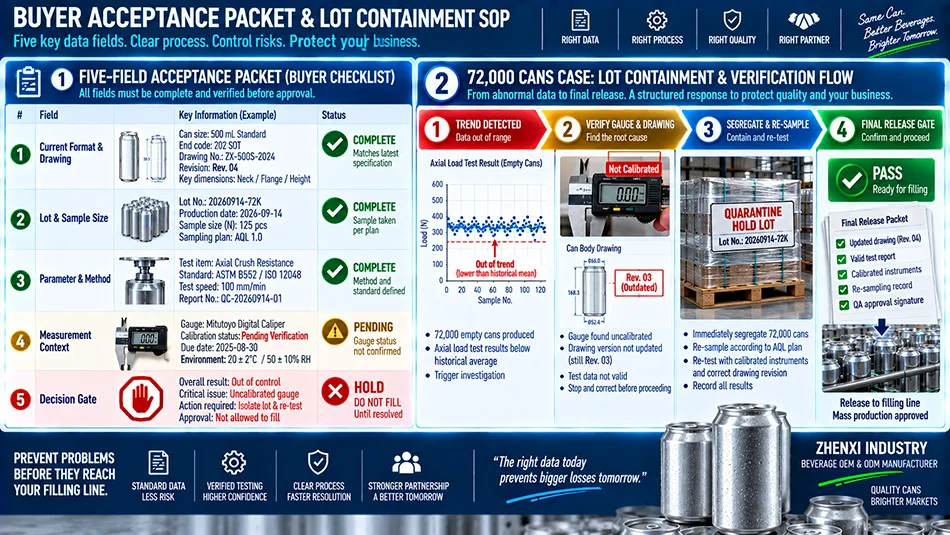
A buyer acceptance packet should connect each requested parameter to the current format or drawing, lot, method, measurement context and next decision. It is a shared handoff document, not a replacement for the supplier’s or filler’s quality system. Its job is to make the basis for the next decision complete enough to review.
| Field | What to identify | Why it matters |
|---|---|---|
| Current format | Body drawing revision and, where relevant, end identifier. | Prevents a result from another can configuration being reused. |
| Lot and sampled units | Lot identity, sample basis and sampled items. | Shows what material the result actually represents. |
| Parameter and method | Named property, procedure and test configuration. | Defines what the result can and cannot prove. |
| Measurement context | Gauge or system status, calibration reference and result record. | Makes a comparison across dates or lots defensible. |
| Decision and boundary | Named reviewer, next action and explicit limitation. | Stops an incoming-body result from becoming a finished-package approval. |
Send the packet before a release discussion, then resolve the missing field rather than guessing a limit. When the body-to-end interface is in scope, Qingdao Baixi Industry (Baixi Cans) can review the specified components, evidence and next project decision when teams review your can-end requirement with the current body drawing and test packet.
Start with the parameters that govern your immediate decision: format geometry, structural reserve, coating condition, end interface, and the comparability of the test record. Then identify the decision that each result will support. An incoming-body review may begin with geometry and the applicable structural question. A filling or closure discussion adds the matched end and finished-package evidence. Do not start by choosing a generic list of limits; start by naming the can, the lot and the next operation.
No, one axial-load result can be useful evidence, but it cannot approve a lot unless the sample plan, format, test method, result interpretation and release rule are defined together. The reading may support a structural question for the sampled bodies under the stated conditions. It does not automatically establish the condition of untested units, another drawing revision, a different can format or a finished package. Record its scope first, then decide what additional evidence the next operation requires.
No, empty-can tests can show whether the body is suitable for the next operation, while seam integrity is assessed only after the matched end is applied under the relevant closing conditions. The body’s flange is prepared for the future seam, but it is not the completed seam. Treat empty-body inspection and finished-can evaluation as connected but separate evidence stages. This avoids asking a body supplier to certify a closure that has not yet been formed on the relevant line.
No, an adhesion result describes how a coating remains attached under its specified method; beverage compatibility still needs a separate, product-specific validation plan. Keep the method, coating condition and result with the adhesion record. Then define any product-contact or shelf-life work separately with the actual beverage, filling and storage conditions. That boundary is useful for both sides: it keeps an adhesion result meaningful without turning it into a broader promise about conditions it did not test.
A usable report identifies the can drawing or format, lot, sampled units, parameter, method, gauge or system, result, acceptance basis, date and responsible reviewer. Add the intended next decision and an explicit boundary on what the result does not cover. If the test involves an end or finished seam, include the end identifier and the relevant closure context. Those fields make a result easier to compare, review and hand off than a stand-alone numerical value.

