
A clear top can make product inspection easier at the point of sale, but it also creates a qualification question that the metal can format does not answer by itself. Before approving three-piece cans with transparent lids, identify what the clear component does in the finished pack, what it contacts, and whether it participates in the final seal. A sample that looks clear and intact can still be the wrong evidence for a different membrane, filling route, or storage condition.
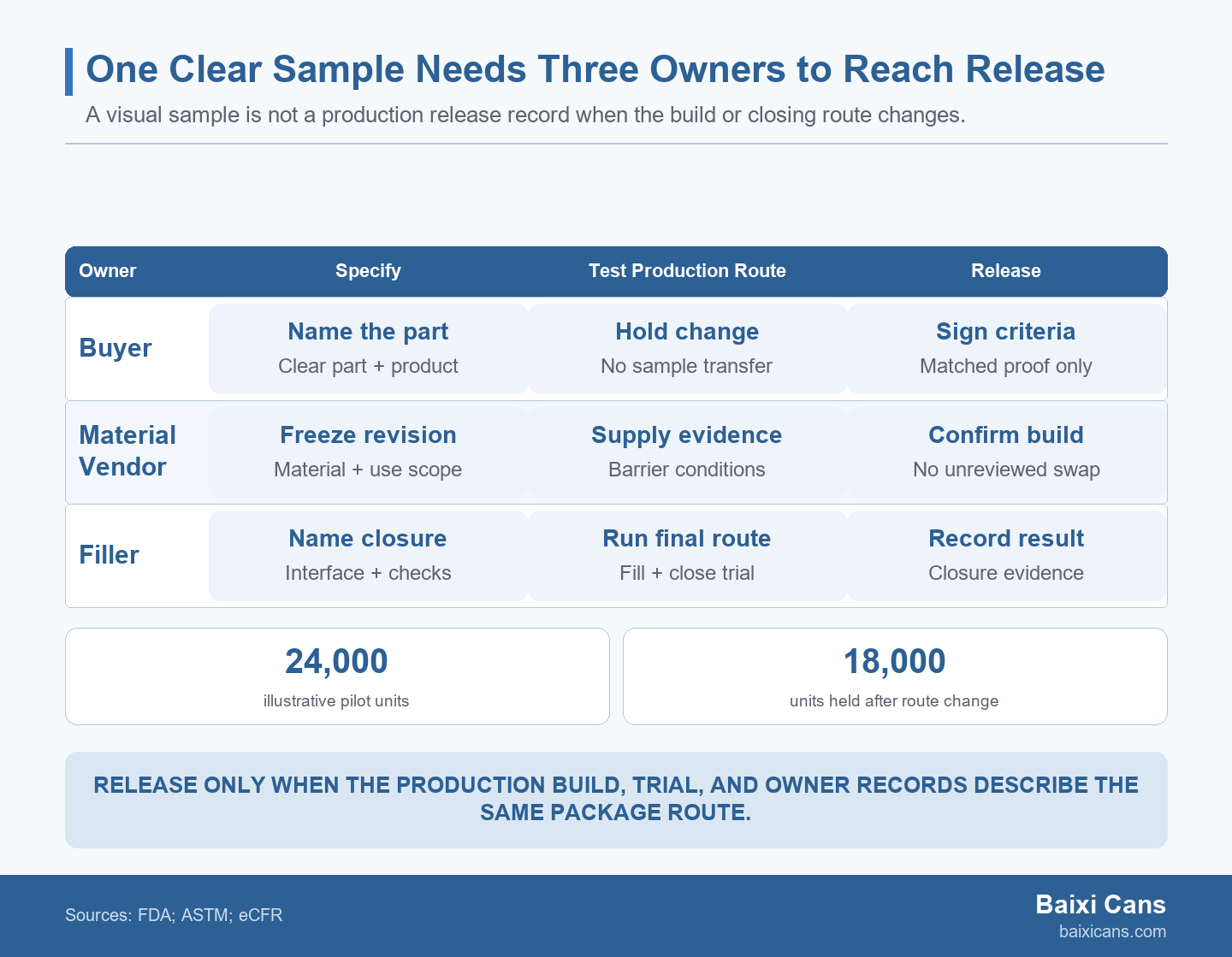
A transparent component should pass role, barrier, and closure gates before approval. The practical sequence is to establish the part's job, request evidence that matches the food and process, and run the production closure with the production component.
Three-piece can construction describes a body and two ends, not the function of any transparent component. Central education material on can construction uses the body-and-two-ends distinction, which is useful because it prevents a buyer from assuming that the word “three-piece” identifies a clear top's sealing role. In plain terms, it is a metal package built from a body and two ends. For a buyer comparing options, Qingdao Baixi Industry (Baixi Cans) can be a useful starting point to review Baixi's aluminum can format options when a conventional metal route remains the better fit.
Request a simple cross-section with every component named: metal body, bottom end, upper end or ring, clear piece, adhesive or seal layer, and any protective overcap. Baixi Cans can then discuss the conventional aluminum packaging choices without treating an unconfirmed clear construction as an existing product. That drawing turns “transparent lid” from a visual description into a package specification. It also reveals whether the product can be seen through a removable display part, a peelable opening feature, or the package boundary that must remain closed through distribution.
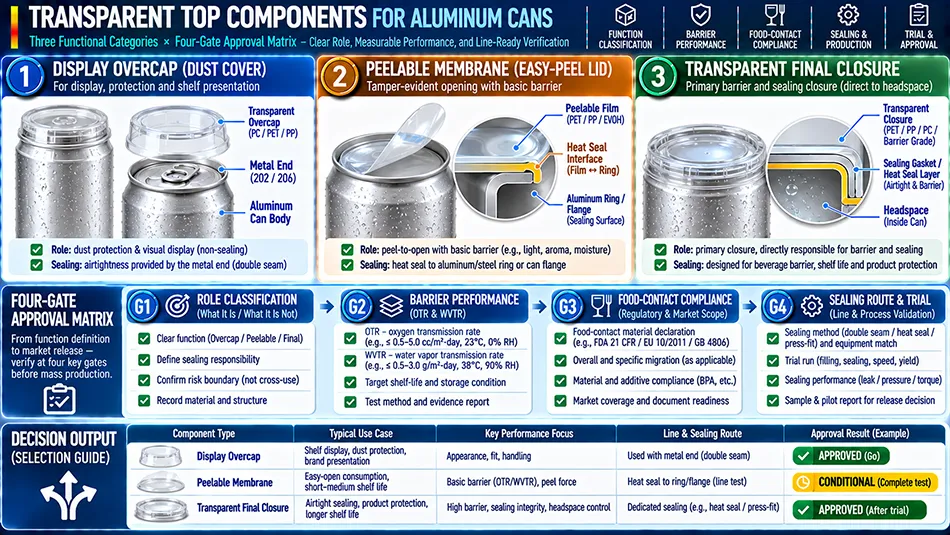
A clear display overcap, a peelable membrane, and a final closure require different evidence. A display overcap may protect presentation while the metal end beneath it still provides the package seal. A peelable membrane may be an opening feature with its own seal interface. A clear piece that closes the pack before shipment must carry the intended product, barrier, and process obligations of that exact closure system.
The distinction matters because supplier language often follows what a buyer can see, while the filling line follows the part that keeps the product enclosed. Ask which component faces the food, which one is exposed to headspace, which interface is sealed, and whether the clear part stays on through filling, thermal treatment, and distribution. If those answers are not on the drawing and specification, the concept is not yet ready for an approval request.
| Transparent-component pattern | Primary question | Evidence to request | Filling implication |
|---|---|---|---|
| Display overcap | Does another part remain the final seal? | Component drawing and attachment details | Confirm that the overcap does not interfere with handling or inspection. |
| Peelable membrane | What is sealed to what? | Material stack, seal geometry, and opening specification | Match the membrane to the actual closing equipment and inspection method. |
| Transparent final closure | Does it protect the product after filling? | Food-contact scope, barrier results, closure records, and trial evidence | Qualify the whole pack-and-process route, not a display sample. |
The comparison shows why one generic “clear lid” checklist is unreliable. The more the transparent part carries the containment job, the more the buyer needs evidence from the final production route rather than appearance approval.
Food-contact substances include packaging and its components that contact food, and their intended use matters to the safety review. FDA's food-contact overview makes this boundary explicit. For a purchase file, “food grade” is therefore not enough: identify the clear material or multilayer stack, the food it touches, its contact side, and the declaration or compliance record that applies to that intended use.
The relevant use conditions can distinguish thermal processing, hot filling, room-temperature filling, refrigeration, and freezing. FDA's conditions-of-use reference is a useful prompt to name the process instead of relying on a generic material label. Its tables are not a package approval matrix, but they help a buyer send the supplier and filler the same thermal and storage description before they discuss fit.
Keep the commercial brief specific: product recipe or category, oil or acid exposure where relevant, fill temperature, hold time, any sterilization or retort step, intended storage, shelf-life target, and destination market. A component that is reasonable for a dry snack at ambient conditions may require a different review from one used with a hot-filled or refrigerated product. The decision is about the stated use, not about whether the sample looks like a conventional can end.
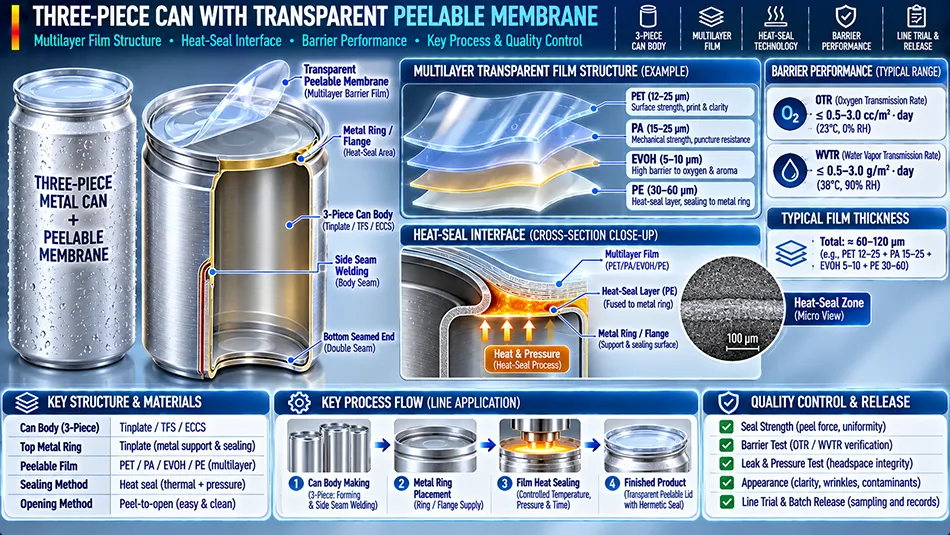
A transparent area must be evaluated as part of the complete barrier system rather than as a display-only feature. The transparent component, final closure, product sensitivity, and test conditions have to point to the same protection decision. A packaging review in Foods discusses light, gases, water activity, and temperature as connected factors in packaging design; visibility does not remove those interactions.
Start with the product's failure mode, not with a generic barrier ranking. For example, a buyer may be balancing visual presentation against light sensitivity, aroma retention, oxidation risk, moisture pickup, or texture change. The clear area may be small, but its location and seal perimeter can still matter. That is why a barrier result should be read alongside the material stack, the dimensions of the clear window, the storage environment, and the actual closure interface.
Transparency can be characterized through optical measures such as transmittance and opacity, with thickness needed for useful characterization. The review record for polymeric food-packaging transparency provides that measurement context. Use the optical requirement to decide what the buyer needs to see through the component, then separately ask whether the product can tolerate that amount and type of light exposure over its intended shelf life.
Do not solve this by requesting “maximum clarity” without a product rule. A retailer may value content visibility, while the product team may need light protection or a defined viewing area. Put both requirements into the brief: the visual purpose, the light condition to be considered, the target storage channel, and the acceptable evidence. This keeps a marketing preference from silently becoming an unsupported shelf-life promise.
Oxygen transmission rate is an important determinant of packaging functionality, but the result needs the actual material and test conditions to inform a project decision. ASTM F3136-22 frames oxygen transmission rate as important to packaging functionality. In the specification, define oxygen transmission rate (OTR) as the measured amount of oxygen that passes through a material under stated conditions, and water-vapor transmission rate (WVTR) as the measured moisture vapor passing through under stated conditions.
Those figures become comparable only when the report names the material, thickness, method, test temperature, relative humidity, specimen orientation, and unit. The same discipline applies to how the result is used: a material-level OTR or WVTR does not automatically represent a finished can with a seal perimeter and headspace. Ask the technical team to state whether the result is a film value, a component value, or package evidence, then decide whether it addresses the product's identified risk.
The filler and inspection plan must follow the actual final sealing route, not the visible design alone. Map the moment at which the package becomes closed: does a metal end form the final boundary, does a transparent membrane seal to a named ring or flange, or does another component create the finished enclosure? That decision determines the equipment interface, inspection points, records, and trial conditions that a co-packer needs before scheduling volume.
Where a conventional metal end remains the final closure, the clear part may be a display or opening feature rather than the final package boundary. In that case, buyers can compare Baixi aluminum can lid specifications while keeping the clear component's role separate from the end's functional requirements. The useful question is not whether the two pieces look compatible; it is whether the closing route and acceptance checks describe the same finished package.
Within the U.S. low-acid canned-food scope, 21 CFR 113.60 requires closure observations and records and sets double-seam examination context. The current eCFR text is a bounded example of why a seam is an operating control, not a decorative edge. A double seam is the interlocked metal closure that joins a can end to its body; it should be evaluated through the applicable process and product requirements.
This U.S. low-acid food example does not prescribe a universal seam program for every market or product. It does show the right line of thinking: name the closure, define who observes it, record the relevant checks, and agree what happens when the result falls outside the applicable acceptance rule. A clear overcap does not replace that work if the metal seam remains the final package boundary.
A transparent final closure must be qualified for the named food, process, and storage conditions rather than by borrowed seam assumptions. The evaluation should identify the sealing surfaces, lidding material, ring or flange geometry, equipment settings under study, and the evidence that the finished pack remains suitable for its stated route. A metal-seam record is not proof for a dissimilar transparent seal.
Agree the trial plan before the sample arrives. It should state which production material is being tested, the food or representative product, fill conditions, closure equipment, inspection method, storage exposure, and release criteria. If any of those variables changes, treat the trial as evidence for a changed construction rather than as a transferable approval. This avoids a common handoff gap in which artwork is approved but the production sealing system is still undefined.
A visual sample should not release production if the production membrane, closure route, or process conditions change. A matched pilot is the practical bridge between a concept sample and a purchase release: it uses the specified production component, the intended filling route, and the checks that will govern the actual order. The pilot need not prove every conceivable application, but it should answer the risks named in the project brief.
Keep the acceptance record compact and shared. It can combine the approved cross-section, material declaration, barrier report with conditions, visual reference, final-closure record, filling parameters under review, and the agreed disposition rule. If the pilot shows that the selected transparent route is not a fit, move the specification to a documented alternative instead of carrying an unproven construction into the order.
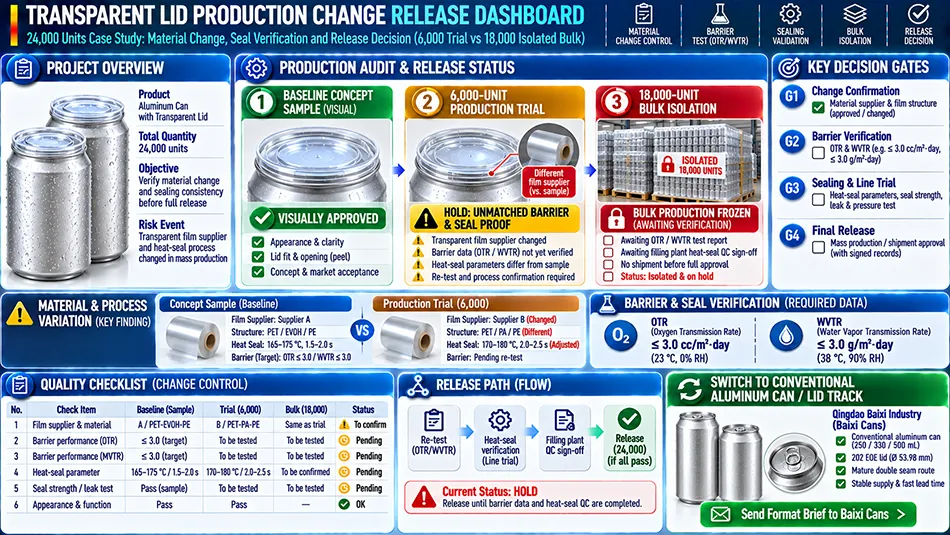
In an illustrative pilot, hold the remaining volume when the production membrane, closure record, or process route differs from the approved sample. A snack brand is considering a three-piece metal can with a transparent peelable top for a 24,000-unit retail pilot. The graphics and metal body are approved, but the first 6,000-unit production sample uses a transparent membrane from a different supplier; the buyer has no matched evidence for that material, heat exposure, food-contact conditions, or closing set-up.
The clear sample is acceptable to the commercial team, yet the production membrane has a different material stack and the filling partner has not accepted a documented closing and inspection method. The product's storage and light exposure have also not been tied to the reported barrier conditions. The visual sample therefore does not establish equivalence between the reviewed pack and the production pack.
The buyer isolates the remaining 18,000 units rather than treating printed artwork as a release signal. The team requests a named production-material declaration, a closure record, and a product-and-process trial; then it matches the membrane to its specification and agrees visual, closure, and protection checks with the filler. The trade-off is a controlled delay before release rather than a larger volume built against an unverified package route.
Release requires the same production component, named closure route, documented process conditions, and passed acceptance checks that will be used for the pilot. This is an illustrative scenario, not Baixi customer data, a process validation protocol, or evidence that one clear-lid construction suits every food. Its value is the release rule: sample approval and production approval remain separate when the construction changes.
Baixi Cans' role here is to discuss available aluminum packaging routes against a named component and process brief; transparent-lid availability and fit remain project-specific. Qingdao Baixi Industry (Baixi Cans) provides a place to see Baixi's current packaging product range when a buyer needs to consider an adjacent aluminum route. That resource does not prove a particular transparent construction is available, which keeps the inquiry focused on a feasible build rather than a visually similar package.
Send the supplier and filler one version-controlled brief with the component drawing, product description, target market, fill and thermal route, storage assumption, required visibility, barrier evidence needed, final closure, and trial acceptance checks. Identify the part number or revision for the clear material, the side that contacts food, and the supplier responsible for each document. Naming the decision owner for a material change is as important as naming the person who approves artwork.
A useful response should distinguish what is known from what still needs confirmation. It may confirm an aluminum format or an end category, but it should not convert that into a claim that a transparent membrane, seal geometry, or thermal route is already qualified. Ask the responder to return the matched drawing, material and intended-use boundary, available test conditions, closure method, trial proposal, and any market-specific question that remains open. This gives the buyer a documented handoff to the co-packer instead of a sales description that has to be decoded later.
Keep the decision record with the purchase file so the production component, process change, and release criteria can be compared against the approved sample. It also clarifies whether a separate can end, rather than the clear piece, carries the final sealing task. Once those variables are named, request a transparent-lid feasibility review from Baixi Cans.
Only when the specified transparent closure is designed and qualified for the exact package and process. Visibility does not establish that it is the final barrier or that it can replace a metal end. Start with the cross-section, then confirm the sealing surfaces, food-contact use, barrier evidence, and production closure route before treating it as a substitute.
Request the material stack, thickness, test method, temperature, humidity, OTR or WVTR result where relevant, and the storage assumption used to interpret it. Also ask whether the result applies to the material alone, a component, or the finished package. That distinction determines whether the evidence addresses the real product risk.
They may be suitable only when the exact construction is documented and validated for the named thermal process, food, seal geometry, and shelf-life target. Do not infer hot-fill or retort fit from a room-temperature sample or a similar-looking clear material. The filler should review the actual production component and intended route together.
Approve the named component drawing, food-contact scope, visual standard, barrier evidence, closing route, trial conditions, and agreed acceptance checks before mass production. If the component supplier, material stack, or process changes after sampling, reopen the approval for that changed package route. This separates artwork approval from a defensible production release.