
RTD tea can projects fail when a product-contact statement and an early taste sample are treated as the same proof. They are not. A lining statement addresses the material at the beverage interface, while a stability result addresses what happens to one finished pack under one formula, process route, closure, and storage exposure. For a commercial decision, those two records have to describe the same final pack.
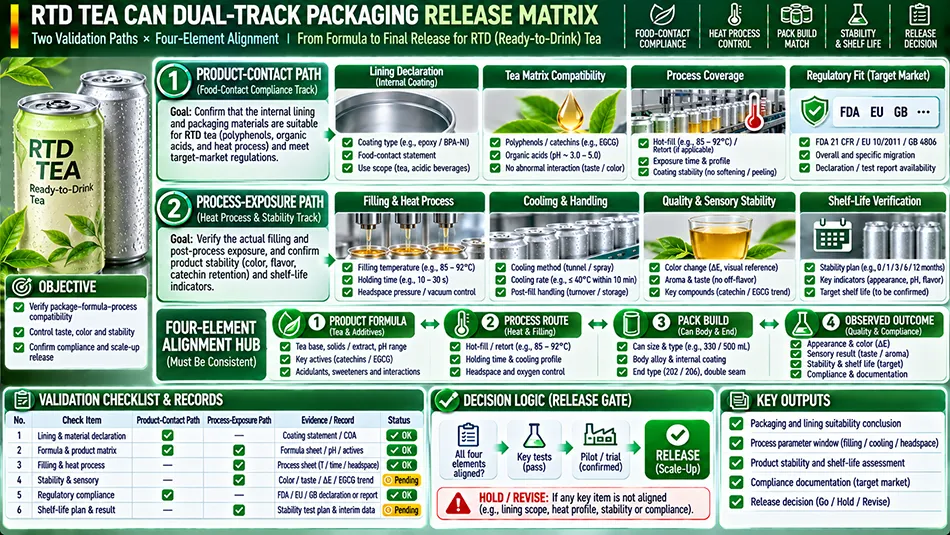
RTD tea release evidence must join a product-contact path and a process-exposure path. The first path asks what the drink contains and what lining is being evaluated. The second asks how the drink will be filled, closed, cooled, stored, and judged for quality. A can sample is useful only when it is tied to both paths.
The product-contact route begins by describing the beverage that touches the lining. In practical terms, the can lining is the thin coating inside the can that separates the drink from the metal. That definition sounds simple, but it changes the first supplier conversation: a buyer should describe the proposed tea, not merely request a beverage can.
A concise brief can protect confidential formulation details while still giving a supplier and a product team the inputs they need. Include the planned pH range or acidity system where shareable, sweeteners, tea extracts, fruit or botanical additions, carbonation status, target fill route, storage temperature, and the quality characteristics the brand intends to protect. “Tea” is a category; it is not a complete product-contact description.
A useful can inquiry names the product variables that can change product-contact and stability questions. Start with a controlled version of the beverage brief, then add the selected body, end, decoration, and closure format. If a compact format is under consideration, buyers can review the 250 ml slim can format and print options after those product inputs are known. The page is a format reference, not evidence that a particular tea and process have already been qualified.
This is also a useful first point to state the boundary with Baixi Cans. The relevant question is whether an available aluminum packaging route can be discussed against the buyer’s named brief. It is not whether any listed can should be assumed to have a pre-approved lining, thermal route, or tea-stability outcome.
Food-contact substances include packaging and its components. Here, intended use means the food, temperature, storage, and contact conditions for which a material is evaluated. The FDA’s food-contact overview frames the issue in terms of the packaging component and its intended use, including migration and exposure considerations. That is why “food grade” alone is too weak for a buyer’s approval record.
Food-contact reference conditions distinguish hot filling, room-temperature filling, refrigeration, and freezing. The FDA’s conditions-of-use table separates these routes, including two hot-fill or pasteurization categories. Use that distinction as a request discipline: ask which food and use conditions the supplied documentation covers, then compare them with the proposed tea and commercial route.
A can lining is a functional barrier at the beverage-to-can interface, but its chemistry and fit must remain project-specific. In an FDA discussion of BPA-based linings, the agency describes a barrier between food and the can surface; that functional explanation is useful without selecting a resin for this project. Read the FDA can-liner context as a reason to request the actual component documentation, not as a recommendation for a particular coating chemistry.
The thermal and closure route is a separate evidence path that must be named before sample approval. Record the proposed fill and hold conditions, the interval before closing, the end and seaming or closure route, cooling steps, and expected storage and distribution exposure. If one of those fields is still undecided, label the sample as exploratory rather than transferable production evidence.
The can end is not a cosmetic afterthought in this record. Opening convenience, end geometry, and the final closure all belong to the physical package being tested. Buyers can compare aluminum can-lid options against the closure brief, then ask the supplier and filler to identify the exact end and closure used in the trial.
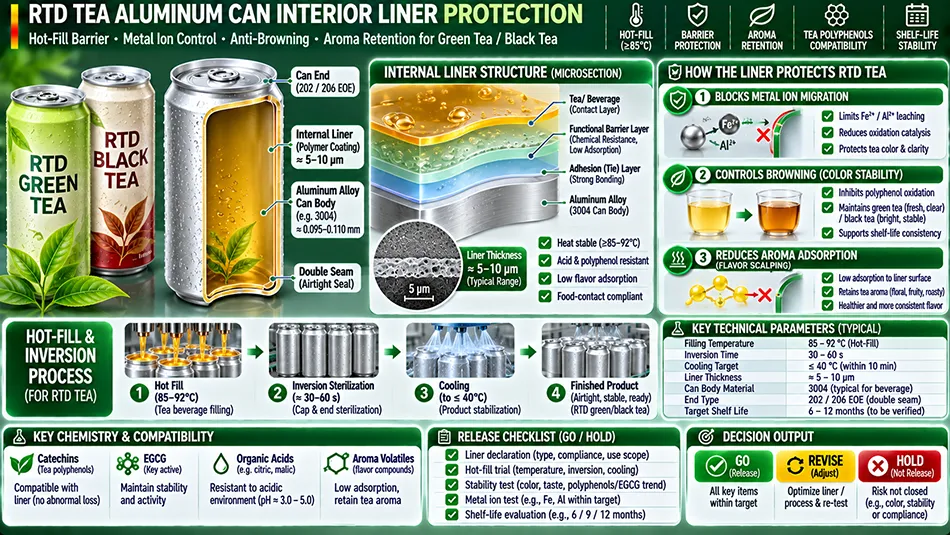
Hot filling is a distinct condition of use, so the stated heat exposure belongs in the package evidence request. The FDA reference table gives a buyer a simple safeguard: place the commercial fill route on the request, not in a separate co-packer note. The article does not set a temperature or process schedule; those must come from the responsible food-safety and process teams.
In a green-tea infusion experiment, heat treatment changed aroma quality, and ferrous ion aggravated the reported heat-associated deterioration. The peer-reviewed study is not a hot-fill specification for every tea, but it is a strong reason to include product-specific sensory observations in the pilot. If the intended brand promise depends on fresh aroma, color, or a particular flavor note, those become release criteria rather than informal tasting comments.
A component record only helps when the revision, beverage scope, and conditions can be matched to the actual pilot. Keep the lining declaration, can and end specification, co-packer ticket, and storage plan under the same controlled version. This avoids treating a supplier credential as a substitute for the document-to-pack match that the final trial must demonstrate.
Supplier credentials can support due diligence, but they do not replace a lining declaration or a finished-pack trial. Buyers can review Baixi Cans credential information alongside the component records.
A different fill route needs its own matching package and storage evidence. A switch to cold fill, aseptic fill, or a refrigerated distribution plan may reduce or change one exposure, but it also changes the conditions under which the product and pack will be evaluated. The buyer should open a new route record instead of copying a hot-fill conclusion into a different process.
This approach keeps responsibilities clear. The product developer defines the formula and quality targets; the co-packer defines the verified process route; the packaging supplier identifies the proposed can and end configuration. The mismatch risk exists because these inputs are often issued in separate documents, so no one sees that a sample and a production ticket describe different packs. A shared route record exposes that gap before commercial volume is committed.
Tea stability should be defined as observable finished-pack attributes before a test is planned. “Freshness” is too vague to make a release decision. Choose the sensory attributes, appearance, analytical markers, package observations, and storage exposures that genuinely matter to the specific tea; then agree who records each result and when it will be reviewed.
The decision is broader than taste alone. A finished pack can be checked for sensory change, color, sediment or haze where relevant, closure condition, leakage, and any validated product-specific marker. Buyers comparing adjacent aluminum packaging decisions can browse more aluminum-can packaging guides while keeping the actual test tied to their own product and route.
In an RTD green-tea model under fluorescent light, different light-protection conditions produced different sensory and EGCG-retention observations. In the published refrigerated model, 60% of panelists detected sensory differences after 10 days under the stated light conditions. That result does not establish a can target, but it does show why light exposure, storage conditions, and the selected quality marker belong in a tea test plan.
Packaging-related quality results can vary with tea composition and the attribute being measured. A cold-storage comparison of two tea infusions found different patterns across the tea systems and measured compounds. For this reason, an oxygen-transmission-rate result, or OTR, should be read as a measure of oxygen transmission through a material under stated test conditions—not as a stand-alone prediction of a tea’s commercial flavor stability.
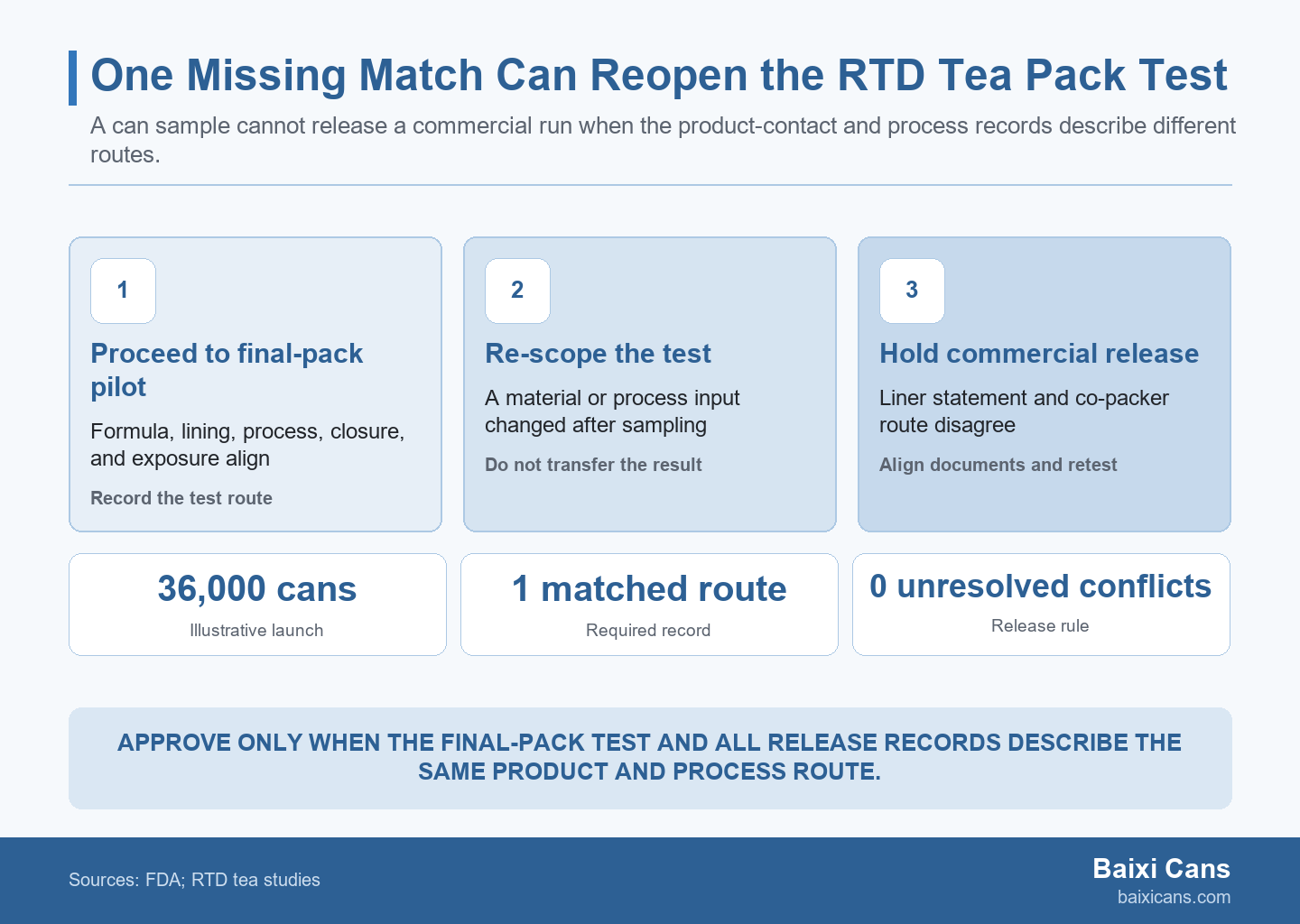
A final-pack result transfers only when formula, process, can build, closure, and storage exposure conditions match the planned commercial route. A matched pack test is a finished package test in which those same inputs are deliberately carried into the pilot. It does not prove regulatory status or a universal shelf life; it tells the project team whether one specific commercial route has been evaluated as one system.
| Record | What must match | Why it changes the decision |
|---|---|---|
| Product | Formula version, acidity system, tea extracts, additions | A generic beverage description cannot establish product-contact relevance. |
| Process | Fill and hold route, closure sequence, cooling, storage plan | A changed route can invalidate an earlier sample result. |
| Pack build | Can body, lining revision, end, closure, decoration where relevant | The tested physical interface must be the planned one. |
| Observed outcome | Agreed tea-quality, package, and exposure checks | The team can judge the attributes that define acceptable product quality. |
Based on this comparison, a test may proceed when all four records point to one final pack. If a lining revision, end, process window, or storage exposure changes, the correct action is to re-scope the test—not to average old and new evidence together.
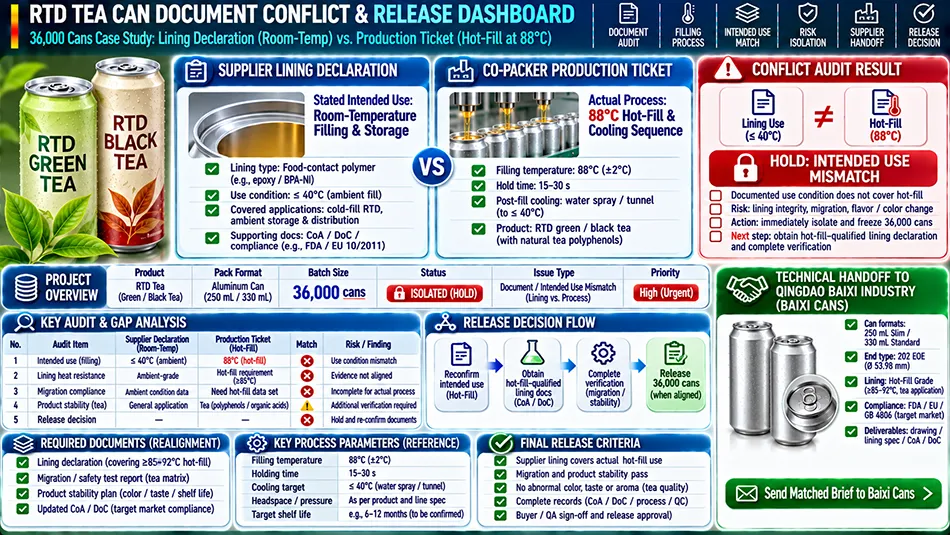
When the liner declaration and co-packer process ticket describe different routes, hold the release before a commercial run. This is an illustrative example, not a Baixi Cans project record, but it shows why a paperwork mismatch should be treated as a package-route mismatch.
In the illustrative launch, the commercial run stays on hold until the declaration and process ticket align and the final pack is tested. A beverage brand has a 36,000-can purchase order for a 330 ml noncarbonated RTD tea. Artwork and format are approved, but the team has not yet produced a stability record for the final commercial route.
The can supplier’s lining declaration describes room-temperature filling and storage conditions. The co-packer’s current production ticket, however, specifies a hot-fill and cooling sequence for the same tea formula. The two documents may each be genuine, yet they do not describe the same intended package use.
The buyer should not solve this by choosing the more convenient document. The room-temperature sample cannot establish a result for the route on the co-packer ticket, and the ticket does not establish the lining’s intended-use documentation. Holding the first run costs coordination time, but it avoids turning 36,000 finished cans into the first uncontrolled version of the test.
The corrective action is to align the formula range, lining revision, fill and hold conditions, end, closure, and storage plan; then build the finished configuration for the agreed observations. Release only when the final-pack record describes that same route. This illustrative example is a procurement decision model, not a substitute for a process authority, food-safety plan, regulatory review, or commercial shelf-life study.
Baixi Cans offers a route for packaging-service inquiries, while lining availability and process fit remain project-specific. That is the productive boundary for a packaging inquiry: it starts with the named beverage and commercial route, rather than a request to guarantee an unscoped “tea can.”
A supplier-ready brief combines formula, process, can build, closure, storage exposure, and the quality attributes to be observed. Send a controlled formula summary, desired can size and body drawing, proposed end, current process sheet, storage and distribution assumptions, plus the attributes the brand considers critical. Ask which parts of the brief can be supported by product documentation and which need a matched pilot.
For Baixi Cans, this creates a clear review path: identify an available aluminum format, state the end and artwork requirements, and keep product-contact and process questions visible for the responsible teams. When the packet is ready, request a packaging-service review with the matched pack-test brief so the discussion begins with the evidence needed to evaluate one real route.
No, a general declaration is not enough unless its stated food, process, and storage conditions match the proposed tea pack. Use it as one part of the product-contact record, then compare its scope with the formula, fill route, end, and storage plan. A qualified regulatory or food-safety reviewer should determine whether the documentation is sufficient for the target market.
No, but heat exposure is one variable that must be included in the finished-pack stability plan rather than assumed away. Tea composition, the actual thermal route, light exposure, closure, storage, and the attributes being measured all affect what the pilot must show. Do not use a published tea model as a temperature limit or shelf-life promise for another formula.
Start with the attributes that define the product claim or sensory target, then add product-contact appearance, closure integrity, and storage-exposure checks. A green tea may need defined aroma, color, and catechin observations, while another tea may have different critical attributes. The test plan should name the method, timing, condition, and decision owner for each observation.
Send the formula range, process window, can and end format, storage target, and the quality attributes that must remain acceptable. Also state whether the first request is a format discussion, a sample request, or a finished-pack pilot. That distinction helps the supplier respond with the right level of documentation instead of an overbroad suitability statement.

