
Local supply is a strong starting point when the right empty cans and ends are available for your production schedule. Imports deserve consideration when they solve a specific format, capacity or continuity problem and the complete delivery route works. Compare both offers against the same specification for packaging, required arrival date and delivered-cost basis. Beverage factories, brand owners and importers can use a shared comparison sheet to organize the evidence. Baixi Cans supplies beverage packaging for import projects; its offers can be compared with local sources on the same basis.
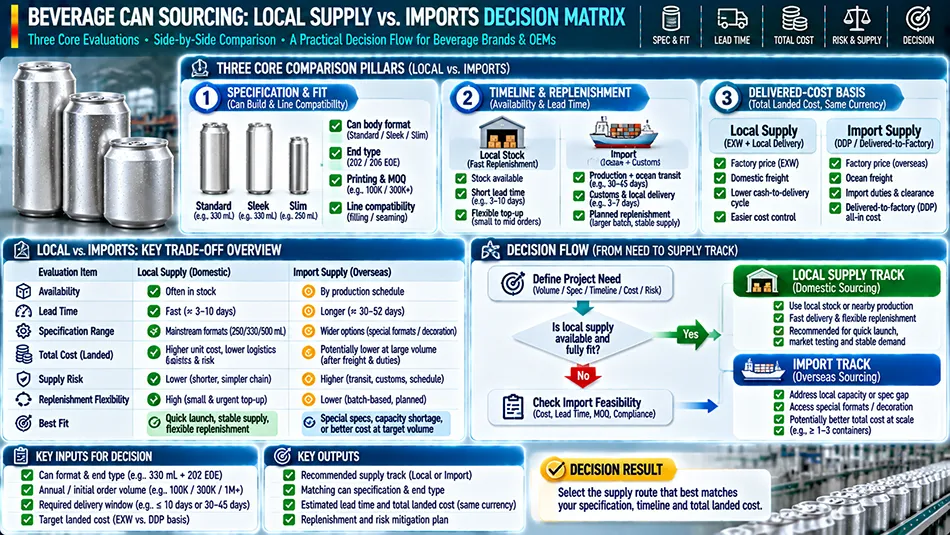
Start with suitability and replenishment, then compare delivered cost. A low price has little value if the package cannot be used on the intended line or the shipment cannot support the planned run. Equally, an overseas source can be worth qualifying when a nearby supplier cannot provide the required can consistently.
“Local” describes a supply arrangement, not automatically a manufacturing origin. A domestic distributor may hold imported stock. An overseas supplier may offer an efficient route, but that does not establish reliable replenishment by itself. Identify where the cans are made, where they are held and what will supply the next order.
Compare the same usable package before comparing countries. Send both suppliers one requirement covering the can body, compatible end, beverage application, decoration and quantities. If one offer changes the profile or end, record it as an alternative specification rather than treating it as an equivalent lower price.
Capacity alone does not identify that package. Cask's can specification tables list standard and sleek formats separately and distinguish body diameter, height and end size. The same page also gives different pallet-layer arrangements for some container and domestic-truck shipments. These are Cask-specific examples, not packing specifications for another supplier. They show why a quotation needs an identified format and packing plan, rather than a capacity description alone.
For each candidate, request the current drawing or specification reference and identify the proposed end. Include the intended beverage and filling process, such as a carbonated soft drink, beer or juice application. A visually similar sample can help communication, but it does not establish that a different package is interchangeable with your existing one.
Then describe how you buy. State the quantity for each design, whether the cans are printed or unprinted, the expected reorder pattern and the project stage. Ask how the supplier's minimum applies to that exact configuration. An annual volume spread across several designs may create a different production requirement from the same volume under one design. Do not assume that filling a shipping container satisfies a custom-printing minimum.
Distinguish stock supply from made-to-order supply in both offers. A local supplier quoting stock today and an exporter quoting a new printed production run are solving different immediate needs. Ask for the configuration you actually intend to purchase, then record any proposed substitution separately. This keeps an attractive headline offer from concealing a format or quantity change.
For a first review of candidate formats, browse Baixi aluminum can options. Use the catalogue to identify candidates for your inquiry; confirm the specific body, end, quantity and supply arrangement through the quotation.
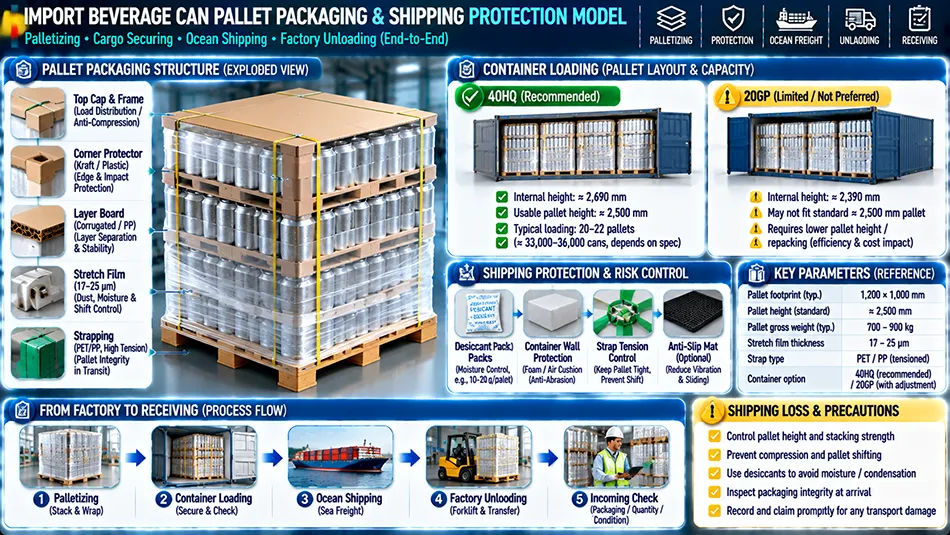
A supplier is useful when the required package can reach your receiving location in time for production. Compare the complete replenishment sequence, including the next order, instead of placing a domestic delivery promise beside an ocean-transit estimate.
Ask the local source whether suitable stock is physically available, available to your order and sufficient for the run. If replenishment depends on a new production slot or an inbound import, record that dependency. A nearby warehouse can shorten the final delivery leg without shortening the time needed to replace its stock.
For an import offer, separate production readiness, dispatch, main transport, border handling and final delivery. Request the proposed route and expected dates for each relevant stage. A shipment-ready date at the origin does not answer when the cans can reach your factory. For a landlocked destination, make the onward road or rail leg visible rather than stopping the timeline at a seaport.
The route also needs a credible packing arrangement. IMO's cargo securing and packing guidance identifies inadequate securing, overloading and incorrect declarations among poor transport-unit packing practices. For empty cans, ask the supplier and logistics provider to explain the proposed pallet protection, loading and unloading arrangement for the actual route. This is a reason to assess handling, not evidence that every long-distance shipment has a higher damage rate.
Consider how replenishment would recover after a delay. Would the next shipment use the same route, the same stock pool or a different manufacturing source? Compare answers against your planned consumption and receiving capacity. Avoid assuming that an emergency replacement can be produced and delivered faster than the original order.
Record dates as confirmed, estimated or not yet provided. This makes the remaining uncertainty visible without turning a supplier's best-case schedule into a production commitment. Both local and import offers deserve the same treatment.
Assess quality against the intended package and application, regardless of supplier location. Use the same evidence request for local and imported cans: controlled specifications, relevant product reports, appropriate samples and current manufacturing-site documents. Compare what the evidence actually establishes.
The CMI beverage-can reference lists separate can and end dimensions, including flange and curl features. This reinforces the need to identify the package interface rather than compare nominal capacity alone. Treat the reference as background for the questions you ask; the proposed supplier's current drawing and the requirements of your filling equipment remain the project-specific basis.
The beverage and process matter too. In its US food-contact reference, FDA distinguishes food types and conditions of use, including beverage categories, hot filling or pasteurization, and room-temperature filling and storage. This illustrates why “food contact” is too broad a description for a meaningful comparison. Give both sources the actual application and ask for the evidence relevant to it. The FDA tables do not establish the requirements for every destination market.
Where a supplier relies on a Food Contact Substance Notification for the United States, FDA explains that its scope is specific to the identified manufacturer, substance and conditions of use. Such a notification is not a general endorsement of every can from a country or supplier. Ask what compliance basis applies to the proposed material and use; an FCN is only one possible US authorization route.
For management-system certificates, check the holder, production address, certified activity and validity. A document covering a different facility cannot answer the same question as one applicable to the proposed production site. Product reports and certificates also serve different purposes: a management-system document does not describe every performance characteristic of the can you plan to buy.
Request the applicable documents rather than interpreting a certification category displayed online as blanket product approval. For this site-specific approach, review Baixi's certificate scope and verification notes.
Compare cost only after defining an equivalent package and destination. Put both offers in one currency and identify the delivery point, quote date, quantity and included services. A factory price and a delivered-to-factory price are different cost boundaries, even when both are described as a price per can.
As ICC explains, Incoterms are trade rules that clarify the tasks, costs and risks involved in delivering goods from sellers to buyers. Record the agreed rule, version and named place where applicable. Then identify which transport and destination charges still need to be included in your comparison. This is about matching quotation scope; no particular trade term makes an offer cheaper on its own.
Ask for the proposed packing and shipment quantities alongside freight. Confirm the number of cans and ends, pallets or other packing units, and how the goods will be handled on arrival. Empty cans occupy transport and warehouse space. A route that looks attractive on the main freight leg may still be unsuitable if its pallet arrangement cannot work with the receiving operation.
Keep missing costs visible. Write “unconfirmed” for a destination charge that has not been quoted, rather than entering zero. Likewise, an unmeasured damage allowance is an assumption to test, not an observed supplier defect rate. If you already use a landed-cost model, apply it to the confirmed inputs instead of changing its scope to favor one offer.
Compare a normal shipment plan with a realistic disruption case. For example, ask what happens if the main transport leg misses the intended arrival window: which production run becomes exposed, what stock is available and whether an alternative dispatch is actually possible. Use route-specific replies rather than a standard number of extra days for every destination.
Keep these cost questions proportionate to the decision. You are establishing whether importing merits qualification, not predicting a future freight market. Related packaging procurement articles can support the more detailed purchasing work once the supply route is feasible.
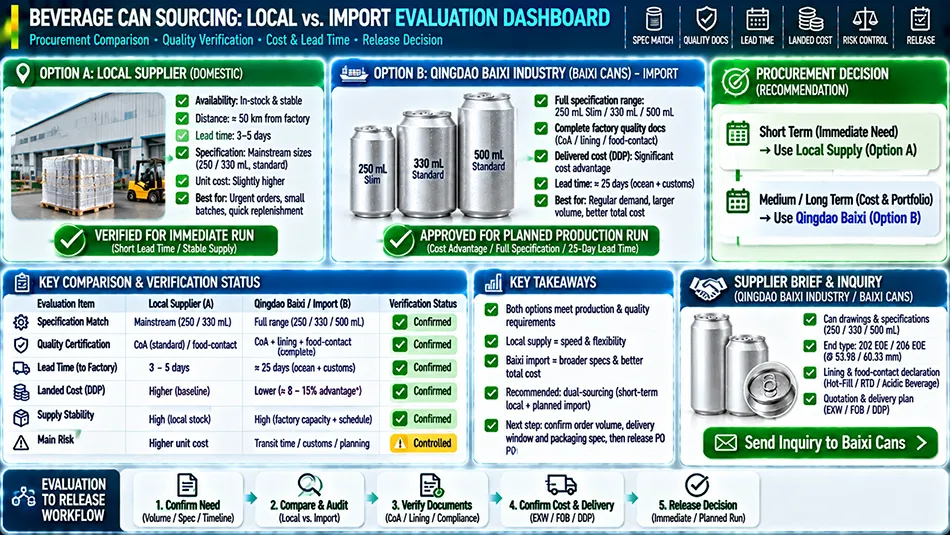
Copy the comparison sheet below and complete both columns using the same requirement and the suppliers' actual replies. Replace each “Enter evidence” prompt with a document reference, quotation detail or confirmed answer. If the answer is missing, write “unconfirmed” and use the final column to decide what to request.
| Comparison item | Local offer | Import offer | What changes the decision |
|---|---|---|---|
| Can body, end and application | Enter drawing, end and application evidence. | Enter the same evidence. | A mismatch needs a separate technical evaluation; unresolved fit prevents selection. |
| Quantity and decoration | Enter quantity per design, stock or production basis. | Enter the same details and applicable minimum. | An order pattern that cannot be supplied removes that offer from this comparison. |
| First arrival and replenishment | Enter available stock, next supply and arrival dates. | Enter readiness, route and factory-arrival dates. | A route that cannot support the run needs an alternative schedule or source. |
| Quality documentation | Enter product evidence and applicable site documents. | Enter equivalent evidence and site documents. | Missing application or site evidence remains unconfirmed, regardless of location. |
| Transport and receiving | Enter packing, handling and receiving arrangements. | Enter packing, transfers and receiving arrangements. | Resolve unsuitable packing or handling before relying on the route. |
| Delivered cost | Enter comparable total and any exclusions. | Enter comparable total and any exclusions. | Compare confirmed boundaries; obtain missing charges before claiming savings. |
| Continuity if supply slips | Enter the replenishment or recovery option. | Enter the replenishment or recovery option. | Check whether the alternatives depend on the same production or stock source. |
Do not total the rows as though every item were an interchangeable score. An attractive price cannot offset an incompatible end, and a complete certificate file cannot offset an arrival date that misses production. First separate an offer that fails an essential project need from one that merely lacks a reply. Then compare the feasible options on cost, flexibility and continuity.
For a simple trial of the sheet, imagine the imported offer has a confirmed package but no final-delivery quotation. Mark the cost row unconfirmed and request the missing leg. Keep technical suitability confirmed if its evidence is complete. The result is a focused logistics question, rather than an unsupported conclusion that importing is either cheaper or too risky.
When completing the body-and-end row, compare can-end options against the actual proposed body. A catalogue family helps identify candidates; confirm the precise combination instead of assuming that a similar name establishes compatibility.
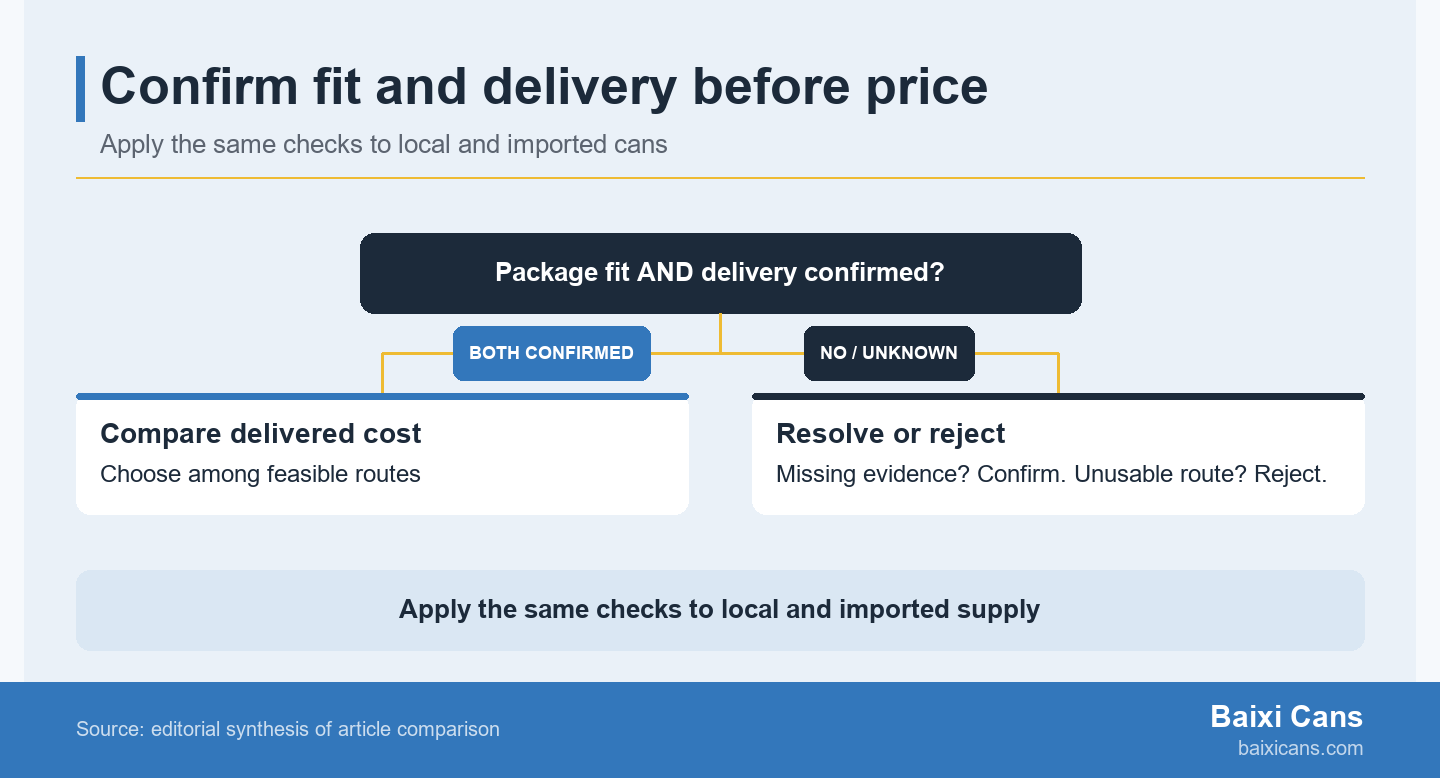
Choose local supply when suitable stock and dependable replenishment support your run and the delivered cost is acceptable. Continue evaluating imports when they resolve a real local availability or continuity gap and the complete route fits your demand. Neither conclusion follows from country of origin alone.
Consider two hypothetical purchasing situations. In the first, a brewery needs its existing package for an approaching run. A local source confirms suitable stock and delivery, while the import offer cannot establish arrival in time. Local supply is the practical choice for that run. If the local stock turns out to use a different end, that conclusion changes: proximity no longer resolves the package requirement.
In the second, a juice brand plans ahead for a format unavailable from its local candidates. An overseas source confirms the proposed package, order pattern and a feasible delivery plan. Import qualification is worth pursuing. If the required shipment cannot be received or stored, the team needs a different arrangement before committing. These examples illustrate the method; they are not customer cases or delivery promises.
Using both routes can make sense when each is independently suitable and the backup addresses a different supply dependency. Two sellers drawing from the same stock or production source may offer less protection than their separate quotations suggest.
To assess an import candidate, send Baixi the capacity, profile or drawing, intended beverage, total quantity and quantity per design. Include printed or unprinted requirements, design count, existing artwork status, destination, project stage, required arrival date and contact details. Ask Baixi to confirm candidate cans and ends, availability and a scoped packaging quotation you can enter beside the local offer. To identify the available packaging support, review Baixi packaging services.
Yes, a supplier selling locally may distribute imported cans, so check where your next replenishment will actually come from. Ask whether the offered stock is already at the local warehouse, available to your order and backed by a replenishment plan. This distinguishes a short final delivery leg from an entirely domestic supply chain without assuming either arrangement is unreliable.
New brands can consider imports when the confirmed order requirements, delivery window and storage needs fit their actual launch demand. Project age alone does not decide suitability. Compare quantities by design and identify the supplier's applicable minimum before treating an offer as feasible. A small initial launch does not establish that a custom-can minimum can be waived.
A nearby warehouse helps only when suitable stock is available to you and the supplier can explain how it will be replenished. A warehouse address or photograph does not establish either point. Request the relevant stock position and next-supply information for your can and end combination, then compare those dates with the production runs the supply needs to support.
You can compare body-only offers separately, but the production decision also needs a confirmed compatible end and its availability. Keep the body-only boundary explicit so it is not ranked against a complete can-and-end offer. Where ends come from another source, include their supply timing and packing in the route assessment; do not assume existing ends will work with a different body.

