
Qualify a second can supplier by protecting the package that already works while testing a clearly identified alternative. Record the current can, end and equipment combination; resolve candidate differences before a planned, segregated trial; then expand supply only within the conditions the results support. This reduces avoidable disruption, but it cannot guarantee zero downtime. For beverage plants, the practical goal is to learn about the candidate without making the next routine production run depend on an unproven package.
Keep qualified packaging available throughout the introduction, and preserve a verified fallback to the working configuration. A supplier's commercial readiness and a package's demonstrated performance on your line answer different questions. A factory assessment can support the supplier decision; it does not show how a candidate can body and end will behave together on your equipment.
That sequence makes second sourcing a controlled introduction. It also gives procurement a specific answer when a candidate is promising but not yet ready for routine supply.
Start from the actual working combination, not a general description such as “our usual soda can.” Gather the current can-body drawing, end specification, relevant equipment information and representative production records. Use the document revisions that describe the materials running now.
The CMI beverage-can reference lists can and end dimensions separately, including flange and curl features. These are parts of the closure interface. A baseline therefore needs the body and end definitions together, rather than the nominal capacity and a photograph. Use the reference to understand the dimensional questions; use the applicable supplier drawings for the project itself.
Format names also need precision. Cask's technical tables separate standard and sleek formats and identify diameter, height and end size. Their entries illustrate why a familiar capacity does not establish the physical format. They do not establish that a different supplier's package is interchangeable with the listed product.
Include how the working package is presented to the line: pallet dimensions and layer arrangement, separation sheets where used, end packing, and the way each component is identified. A candidate can meet a body drawing while arriving in a packing arrangement that needs a different receiving or depalletizing setup.
Record the relevant production context beside the package: beverage, filling conditions, operating speed range actually used, and downstream treatment when applicable. Keep a reference to the established inspection methods and acceptance criteria. Otherwise, a later comparison may accidentally contrast different products, speeds or measurement methods.
The result should be a concise reference for the technical discussion, not a new general supplier questionnaire. When identifying a possible alternative, compare that reference with the candidate profile in Baixi aluminum can formats.
Make differences explicit before putting candidate materials into the line. Confirm whether the proposed change concerns the body, the end, both components, or simply a different production source for an apparently equivalent specification. “Same size” is the start of this conversation, not its conclusion.
A double seam closes the package by interlocking and compressing the edges of the can body and end. Dixie's terminology guide explains that seam dimensions and profiles vary with can type, material thickness and manufacturer specifications. It also identifies package-specific chucks, base plates and seam rolls as change parts. The implication for a candidate is to review the actual interface and tooling requirement, rather than assume the current setup remains suitable.
| Item to compare | Current qualified package | Candidate package | Follow-up if different or unknown |
|---|---|---|---|
| Body drawing and revision | Enter profile, dimensions and reference. | Enter the proposed drawing and revision. | Identify the changed features and obtain the missing specification. |
| End and closure interface | Enter exact end specification and closure requirements. | Enter the end proposed with the candidate body. | Confirm the combination with the component suppliers and equipment provider. |
| Application and material evidence | Enter beverage and applicable product evidence. | Enter evidence for the same intended use. | Resolve a coating, process or application gap before extending the claim of suitability. |
| Equipment and change parts | Enter relevant tooling and setup references. | Enter confirmed changes, or “unconfirmed.” | Obtain the machine-specific changeover and test requirements. |
| Packing and line presentation | Enter pallet, layer and end-packing details. | Enter the actual proposed shipment arrangement. | Check receiving, feeding and separation needs. |
Fill the table from controlled documents and actual supplier replies. Mark a confirmed difference separately from missing information: a different feature may be acceptable after review, while an unknown feature cannot be assumed equivalent. Agree which configuration will actually be sampled so that the trial answers the questions in the final column.
Keep the supplier's quality-system evidence in proportion to this task. Check certificate holder, manufacturing address, activity and validity, then continue the package-specific review. For Baixi candidates, the relevant starting point is site-specific certificate verification.
Book a defined trial window and identify exactly what will enter it. Keep candidate bodies and ends separate from qualified stock, with clear lot and configuration references. Plan the time needed for setup, checks and restoration so that an inconclusive trial does not consume the window needed for the next routine run.
Set the trial questions before selecting its quantity and duration. Feeding, transfer, closure formation, filled-package behavior and repeatability may require different observations. Use enough material to answer the agreed questions under the planned conditions; there is no universal pallet count or short-run duration that qualifies every can, line and beverage combination.
Tooling is part of the trial scope. Wild Goose's chuck guidance links its chucks to a specific lid style and calls for external and internal seam inspection after tooling replacement. That is equipment-specific guidance, not an adjustment instruction for every seamer. Use the manual and technical support for the installed machine to establish what needs changing and checking.
Keep the trial identifiable from material entry through finished samples. Record the body lot, end lot, tooling configuration, relevant operating conditions, interruptions, adjustments and observed results. If the candidate end changes midway, record a new configuration rather than blending the observations into one apparent pass.
Where practical, avoid changing the beverage, body, end and several operating conditions simultaneously. If several changes are necessary, describe them clearly and limit the conclusions accordingly. A problem in such a trial may need further separation before its cause can be established.
Use the plant's operating and equipment-safety procedures for setup, guarding, isolation and restart. Stop for an unacceptable result or when the planned restoration point is reached. The objective is usable evidence from a bounded test, not an extended attempt to make an unidentified combination run.
A trial result should state what was tested, by which method and under which conditions. Separate handling and feeding observations from closure measurements and finished-product checks. “The cans ran” is too broad to describe all three.
In its metal-can defect guidance, CFIA distinguishes external examination, teardown and cross-section assessment of seams. The document addresses food-can integrity, including commercially sterile low-acid and acidified low-acid foods. Its distinction between inspection methods helps explain why appearance alone cannot establish every internal seam attribute; its numerical criteria and regulatory context should not be transferred wholesale to a beverage-can project.
For your candidate, use the applicable can/end specifications and equipment requirements to define the closure checks. Keep actual measurements and observations, rather than recording only “pass.” If a method or measuring position differs from the baseline, reconcile that difference before interpreting the comparison. This avoids treating a method change as proof of a material defect.
Consider a hypothetical trial: a candidate body feeds acceptably in a slow, empty-can check, but the intended production-speed run and filled-package checks have not happened. Record the feeding result as successful within that condition. Schedule the unanswered checks before expanding its use; neither reject the entire supplier because testing is incomplete nor describe the package as fully qualified.
If interruptions occur, document where and under what configuration. Compare counts against the same inspected or processed quantity and distinguish startup observations from steady running where the records allow it. Do not report a lower defect rate from a smaller or differently inspected sample as a like-for-like improvement.
Keep adjacent supplier and purchasing questions separate from the trial conclusion. They can be pursued through related packaging procurement resources.
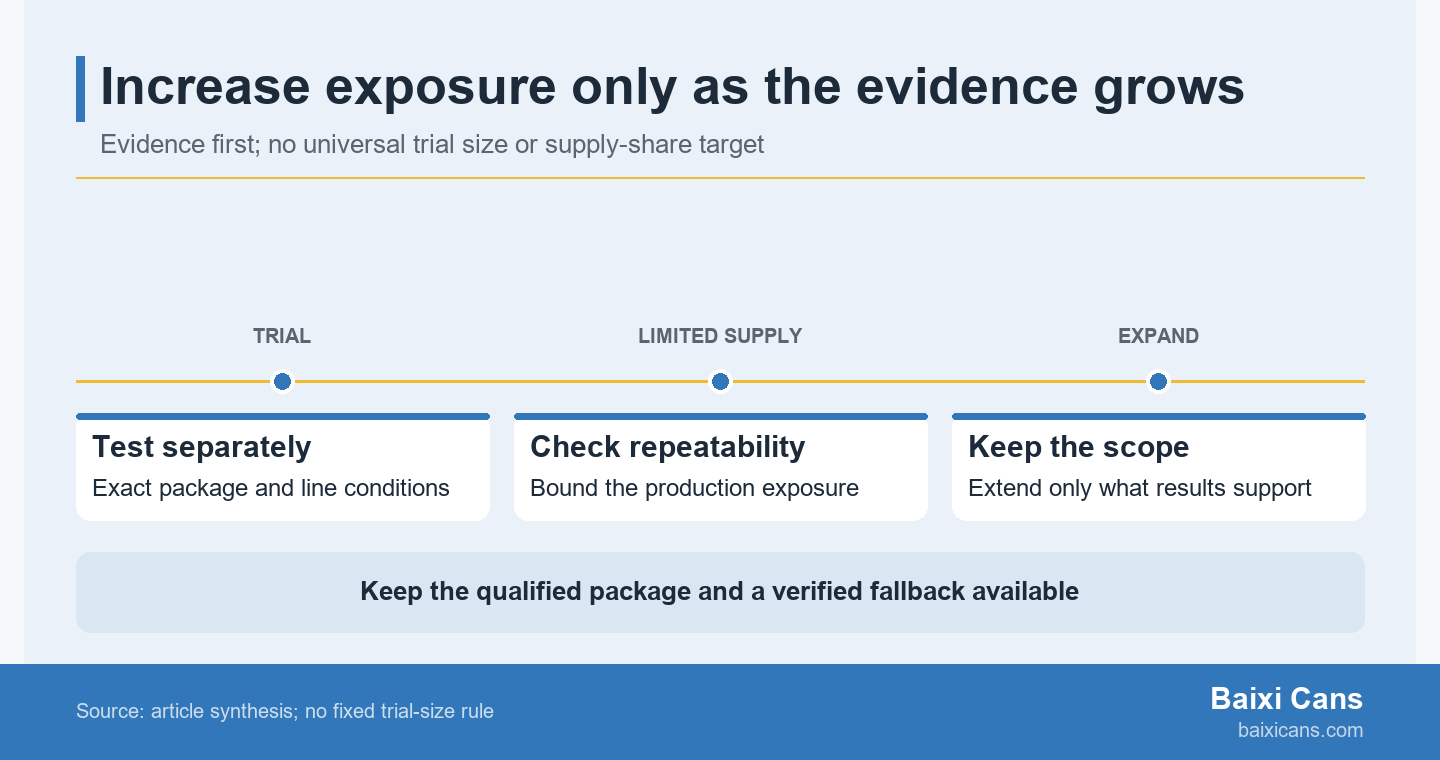
A successful trial supports a defined next step, not an unrestricted switch. Describe the tested body/end combination, line, operating conditions and beverage application, then choose an initial production exposure that can be monitored and recovered if results differ. Keep the qualified supply route available while that evidence develops.
Product compatibility can extend beyond immediate line behavior. In its public introduction to can compatibility, the Brewers Association advises assessing each beer brand intended for cans because not every beer is compatible with every can. That beer-specific guidance does not set a universal test duration for beer, juice or carbonated drinks. It supports keeping application suitability distinct from a short mechanical trial.
| Supply stage | Evidence to carry forward | Permitted next decision | If evidence is incomplete or unacceptable |
|---|---|---|---|
| Segregated trial | Identified body/end lots, setup, conditions and results against applicable criteria. | Define a limited production use within the demonstrated conditions. | Resolve the specific gap or revise the candidate; keep routine supply on the qualified package. |
| Limited supply introduction | Results from the bounded production use, including repeatability and applicable filled-product checks. | Consider expanding the same qualified combination and application. | Contain the candidate scope, investigate differences and repeat affected checks. |
| Expanded supply | Continuing conformity and repeat supply evidence within the stated scope. | Increase allocation while maintaining the required monitoring and fallback capability. | Reduce exposure or return to the qualified package; reassess changed conditions. |
Use the table as a progression rule, not a fixed percentage split. Write the proposed quantity, conditions and evidence needed for the next step in the project plan. The appropriate exposure depends on what remains uncertain and what the plant can monitor and recover; a generic purchasing ratio cannot answer that.
Keep the commercial order quantity distinct from the amount used in a line trial. A small technical sample does not establish a small custom-production order option or an exception to the supplier's minimum. Confirm the actual order basis before planning the introduction around it.
When the second source includes an end change, preserve the precise end reference through the progression. To identify candidates for that discussion, compare Baixi can-end options.
A usable fallback needs both available qualified packaging and a verified return to its equipment configuration. Saving a previous settings file is useful, but restoring it alone does not establish that the line is ready for normal production after physical adjustments or tooling changes.
Before the trial, identify the qualified bodies and ends needed for the next run, the relevant setup references and any change parts that will be restored. Include the equipment provider's applicable return checks and the plant's normal startup verification. Put restoration time into the trial schedule rather than assuming it can be recovered later.
Define concrete stop conditions for the trial: an unacceptable package result, unresolved feeding or seaming behavior, or reaching the latest point at which the qualified setup must be restored. The specific limits come from the project and applicable technical criteria. Scheduling pressure does not make an unacceptable result usable.
After a stop, separate remaining candidate materials and trial output so that their identity and status stay clear. Restore the qualified package and setup under the applicable procedures, then verify performance before routine production resumes. If the working package no longer gives its established results, investigate that condition; do not assume a return is successful because the original supplier's cans are back on the conveyor.
The qualification record can then end with a useful technical decision: proceed within a defined scope, repeat a specific test, or stop the candidate configuration. This gives the supplier a focused question and prevents each later discussion from reopening the entire introduction.
For a Baixi packaging inquiry, send the current specification or drawing, existing end and equipment information, beverage application, total quantity and quantity per design. Include printed or unprinted requirements, design count, existing artwork status, destination, project stage and contact details. Ask Baixi to confirm candidate cans and ends, available specifications, sample arrangements and a scoped quotation for comparison. To identify the relevant packaging support, review Baixi packaging services.
You can propose the current end for the candidate body, but suitability still needs confirmation for that precise combination and equipment. Give the body supplier the actual end reference and closure requirements. If you later test a candidate end as well, keep those results separate: the body-only trial did not test the new body and new end together.
Qualifying one format establishes evidence for the tested package and conditions; other sizes or end styles need their own applicability review. The supplier may have a credible quality system across its range, but that does not show every format works with your change parts, feeding arrangement or beverage. Identify the differences and determine which existing evidence can legitimately be reused.
Unprinted samples can answer specific fit questions, but they do not establish the print, appearance or handling performance of the final decorated package. Record the sampled configuration and ask which characteristics are shared with the proposed production can. Keep later checks focused on the remaining differences; an unprinted sample result is neither irrelevant nor complete evidence for the finished printed order.
Keep the candidate at the document or sample-review stage until a suitable trial window is available; do not treat scheduling pressure as qualification evidence. You can still resolve drawing differences, confirm proposed ends and change parts, and arrange the material needed for the eventual test. Preserve the current supply plan rather than substituting the candidate into a routine run merely to obtain trial results.