
To request a match for an existing beverage can, send unused, unseamed can bodies and their matching loose ends if available, supported by clear photographs, any original records, and the equipment and beverage conditions. If you only have a finished can, say so: it can begin the discussion, but it leaves different questions unanswered.
The useful outcome is an identified packaging candidate and a clear list of details still requiring confirmation. A similar appearance does not recover the original drawing, its tolerances or the coating specification. The information card below helps a filling plant or brand buyer prepare that request without guessing the missing values.
Build the request around the physical sample you actually hold. Identify the body, include matching loose ends where available, and connect them to known equipment and application details. Keep missing information explicit so the recipient can ask for confirmation instead of assuming a complete specification from appearance.
Before dispatch, tell the recipient what you have and ask which components and quantities they need for the proposed examination. Identification by photographs and physical dimensional review may require different material. There is no reason to choose a universal parcel quantity before agreeing that purpose.
An unused empty body preserves the open top in the condition supplied for filling. Its flange is the outward edge at the top of the body. A loose, unused end preserves its own edge profile before closing. Where you can obtain both from the current packaging supply, identify them as a pair rather than sending a body with an unverified lid found nearby.
A double seam is the closure formed when the body edge and the end edge interlock. Dixie's seam terminology explains this formed joint and notes that its seamers are tested with customer-furnished cans and tops. That manufacturer example illustrates why both components matter; it is not a promise about another supplier's equipment service.
A closed beverage can shows the assembled package, including the top, base, appearance and visible markings. Its rim has already undergone seaming, so a measurement there is not a measurement of the original unseamed flange. Opening the pull tab also changes the end's condition. Label such a reference as closed or opened, even when the can is now empty.
Different examinations also preserve different evidence. CFIA's metal-can guidance distinguishes external examination, seam teardown and cross-section examination. Its food-can context does not supply beverage acceptance limits here. For this matching request, agree the examination before cutting or flattening your only reference.
If you lack an unused body or loose end, describe the gap and continue gathering the other information. Do not dismantle a closed can to present the recovered pieces as unused components. Keep any damaged reference identified as damaged; a bent edge should not silently become the target shape.
When reviewing Baixi aluminum can formats, use your identified reference to discuss possible candidates. A catalogue resemblance is a starting point for that discussion, while the actual proposed body and end still need their own technical information.
Photograph the reference before packing so the recipient can recognize both its features and its departure condition. Keep the unedited originals and use consistent file names. A useful set includes an overall view, a side view, the base, and the top or neck area. For an unused body, show the open edge clearly; for loose ends, photograph both sides and any readable marks.
Take a separate close view of each marking rather than relying on a distant photograph of the whole can. Copy the characters into the request exactly as visible, and mark an uncertain character as unreadable. If you know what a code means, state where that interpretation came from. A printed code is a clue; its appearance alone does not establish the manufacturer, alloy or coating.
The CMI beverage-can reference lists body and end dimensions separately, including flange and curl features. This helps explain why a volume description and an overall photograph do not describe every interface. Use the actual supplier's controlled drawing for a proposed package rather than applying the reference table to an unidentified sample.
If you add a ruler to a photograph, keep its units visible and describe the image as an orientation aid. Perspective and an unclear measuring position can obscure the feature being shown. Send any actual measurement separately with its unit, instrument and measuring location. Distinguish a value you measured from one copied from a drawing; neither should be silently substituted for the other.
Attach available original specification sheets, end labels and drawing revisions with their file names and dates intact. Identify which sample each file describes. A document for a previous format may be useful background, but label it that way rather than presenting it as current technical evidence.
Keep supplier-document requests separate from visible identity clues. Ask for the applicable holder, production site, certified scope and validity when requesting certification; an identifiable physical can does not establish those details. For project-specific availability, consult Baixi certificate and document guidance.
The equipment record should identify where the current package is used, not merely say that the factory has a canning line. Provide the seamer maker and model, known tooling references and the current end description. Include available manual or setup-document references. If a technical contact can supply a clear tooling-mark photograph safely through the plant's normal procedure, associate it with the relevant machine.
Oktober's existing-can FAQ, for example, asks for size, manufacturer, end type or profile, and available specifications or photos. It also describes etched upper-chuck markings as an identification aid for its equipment. Follow your own equipment maker's identification method; the same markings or tooling arrangement cannot be assumed on every seamer.
State whether the reference is the package currently running on that equipment or simply a market sample you want to resemble. These are different starting points. “Currently used” should identify the actual combination and any known issue, such as an unresolved feeding problem. “Desired appearance” should describe the intended format without implying that the factory has already demonstrated it.
The beverage and process record matters for a separate reason: the can's exterior does not identify the proposed contents or the conditions they will experience. State whether the project is beer, a carbonated soft drink or juice, and describe filling, any heat treatment, storage and intended shelf life as known. If a process detail is unavailable, record who can provide the technical information rather than selecting a convenient value.
The US FDA food-contact reference tables distinguish beverage categories and use conditions such as hot filling, pasteurization and room-temperature filling and storage. This illustrates why intended use belongs in the request. It does not establish worldwide compliance or approve a particular can for your product.
Once these inputs are collected, packaging procurement articles can support adjacent purchasing questions. Keep the present matching request focused on the physical reference and its actual use conditions rather than expanding it into a general supplier audit.
Give each reference set a sample ID and carry that same ID through the component bags, photo names, document list and email. Use a separate ID when the format or component pairing changes. This connects the physical reference to its supporting information and keeps unknowns visible when several people contribute files.
Copy the card below into your request and enter the answer after each field name. Use “not available” or “not confirmed” where appropriate, followed by the specific missing item. Those are useful answers: an empty cell leaves the recipient unsure whether the item was forgotten, unavailable or considered unnecessary.
| Field | Enter or attach |
|---|---|
| Reference identity | Sample ID; your format or SKU name; source; date obtained; known body and end manufacturers. |
| Physical contents | Count and condition of unseamed bodies, unused loose ends and closed or opened reference cans; identify the intended body/end pairing. |
| Known format | Stated capacity and format; available body/end codes; distinguish documented nominal dimensions from your own measurements and include units. |
| Photos and markings | Overall, side, base, open top or closed rim, loose-end views and readable marks; list the matching file names. |
| Technical records | Available body/end drawings or specification sheets, revision and date; identify the sample they describe and any known discrepancy. |
| Equipment context | Seamer maker/model; known tooling or manual references; current end description; currently used package or desired reference only. |
| Beverage and process | Product type; carbonation where relevant; filling and heat-treatment conditions; storage, intended shelf life and destination market. |
| Requested response | Possible candidate body/end; available controlled technical information; unresolved matching questions; proposed sample examination and arrangements. |
For a set called “REF-A,” for example, the side photograph can be named “REF-A-side” and the component list can name “REF-A-body” and “REF-A-end.” This naming example creates no technical specification; its purpose is to stop a photograph of one format being matched to another format's lid.
Review the card against the actual parcel before sending it. If an end is missing, say so in the physical-contents row as well as the requested-response row. With that distinction recorded, Baixi can-end options provide a starting point for discussing the required component, subject to confirmation of the precise proposed combination.
A matching parcel needs the identifying features to survive the journey. Agree the receiving contact, examination purpose, quantities and any return requirement before dispatch. If an examination will consume a sample, discuss whether an untouched reference can be retained. The receiver's actual method should determine what is needed; avoid assuming that one can is sufficient for every task.
The general principles in FedEx's breakables packing guidance include a suitable box, cushioning, individual protection and limiting movement. These are general transport principles, not a can-specific packing specification. Select protection for the actual components and route with the recipient and carrier instead of importing a fixed cushioning thickness into every sample request.
Protect the open body edge and loose-end edges from contact that could bend them. Keep ends contained so they do not rub against bodies or become mixed with another reference set. Use identifiers on protective packaging rather than covering the features or markings the recipient needs to examine. Restrain movement without squeezing the body into a different shape.
Photograph the packed components and include a contents list using the same IDs as the information card. Send a digital copy before the parcel arrives. Ask the recipient to note arrival damage before interpreting a distorted feature as the original design. If a reference arrives bent, another intact sample or controlled document may be needed for that feature.
Prefer unused, unfilled references where available. If the only available object contains beverage, confirm acceptance and shipping arrangements with the receiver and carrier before sending it. Do not cut or otherwise alter it merely to make dispatch easier without first agreeing how that change affects the intended examination.
A missing loose end or controlled drawing leaves a specific question, rather than making the entire request useless. Identify that gap and ask for the relevant component or information before treating a proposed can as interchangeable. The following table helps turn incomplete records into focused follow-up.
| Missing or uncertain item | Send or ask next | What remains unresolved |
|---|---|---|
| Only a closed or opened can | Disclose its condition; send photos; request an unused body and matching loose end from the current source where obtainable. | The original unseamed interface is not directly represented. |
| No loose end or confirmed end identity | Send available end-package labels and equipment references; ask the current supplier or equipment maker to identify the end. | Body/end pairing and tooling suitability need confirmation. |
| No controlled body/end drawing | Provide known codes and clearly labelled measurements; ask the candidate supplier for its controlled technical information. | Observed dimensions do not establish nominal tolerances or all material requirements. |
| Application or process unknown | Request actual beverage and filling/process details from the relevant technical contact. | A physical resemblance cannot establish product-use suitability. |
| Bent or otherwise altered reference | Mark the affected area and seek an intact reference or applicable drawing. | The affected feature cannot be assumed to represent the original design. |
Consider a hypothetical request containing only an opened retail can, with no drawing and no loose end. Enter “opened reference only” in the card, attach the identified photographs and supply known equipment details. Use the first rows above to request unused components or original technical information. A supplier can then discuss a possible format and list what is still missing; this has not produced a confirmed drop-in replacement.
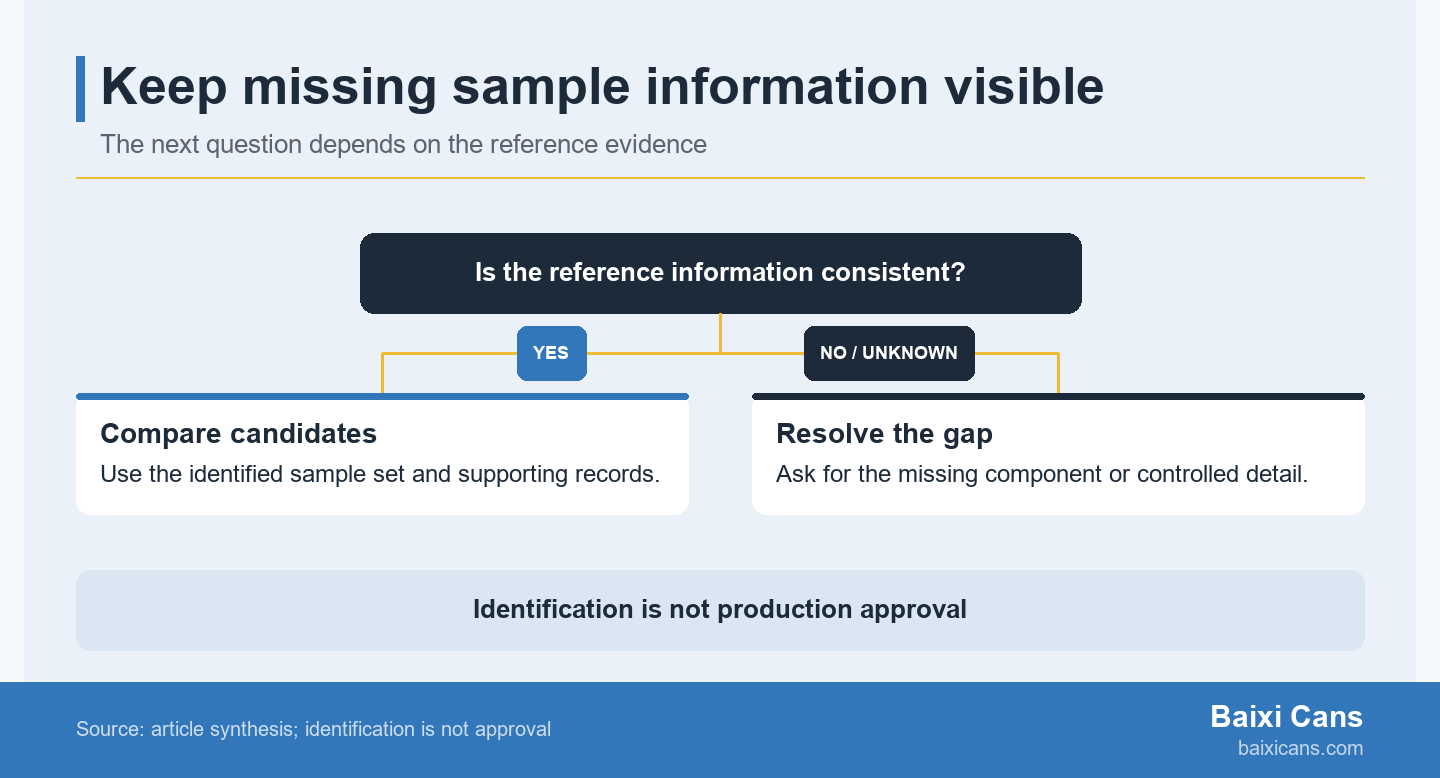
If the sample set and records are consistent, compare identified candidates. If information is missing or conflicting, resolve the relevant gap first. In either case, identifying a candidate is separate from establishing its suitability for production.
To discuss a reference with Baixi Cans, send the card, photographs and available specification. Add total quantity, quantity per design, printed or unprinted requirement, number of designs, existing artwork status, destination, project stage and contact details. Ask the team to confirm candidate packaging, available documents, sample arrangements and a quotation, including outstanding technical questions. Baixi supplies the packaging; beverage formulation and filling remain outside that service. For the packaging supply route, review Baixi packaging services.
Yes, it can start an identification discussion if you describe its condition accurately. Say whether the pull tab alone was opened or whether the can was cut or crushed. Preserve the remaining features and obtain unused components where possible. Its value as a recognizable reference does not turn the altered top into an original unseamed specification.
No. Unprinted means there is no printed artwork; it does not establish the internal coating specification. Request the relevant technical information for the intended beverage rather than inferring chemistry from a silver appearance. If labels or sleeves are planned for the unprinted can, confirm the required dimensions; do not add an assumed surface-treatment step to the matching request.
Send both and identify the discrepancy instead of choosing the more convenient value. Include the document revision, sample source, units and how the measurement was taken. Ask the relevant supplier to clarify which specification the reference represents. Preserve both records until the difference is explained; an older file date alone does not prove which physical sample it describes.
Use the physical sample as the reference for its actual condition and format, and list other formats separately. One size can illustrate a desired general appearance, but it does not provide the missing geometry for every height, body profile or end combination. Give additional reference sets their own IDs so the supplier can identify which information belongs to each request.

