
Aluminum cans larger than 1 liter are rare not because aluminum cannot hold that volume, but because thin-wall economics, pressure, handling, filling-line tooling, and category rules usually make smaller formats the better package. The Aluminum Association frames beverage cans as lightweight engineered packaging, and that engineering advantage depends on standard shapes, fast lines, and predictable handling.
A 1 liter question sounds like a material-limit question, but it is really a system question. The CMI manufacturing sequence shows how much of a can's reliability comes from drawing, ironing, necking, and flanging. As diameter and height increase, those steps become less forgiving, while filled weight, shelf handling, pressure load, and end performance all become harder to justify.
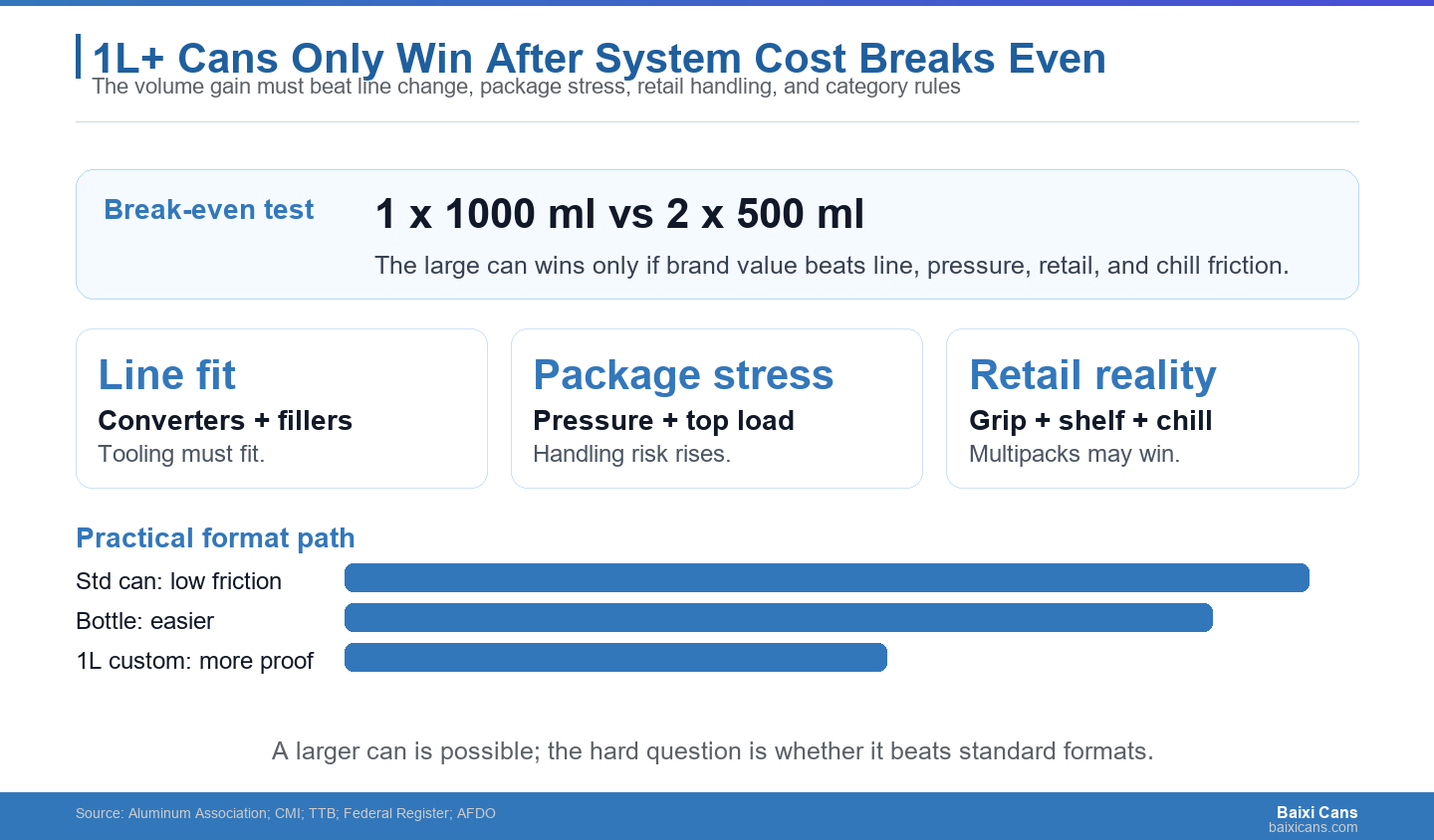
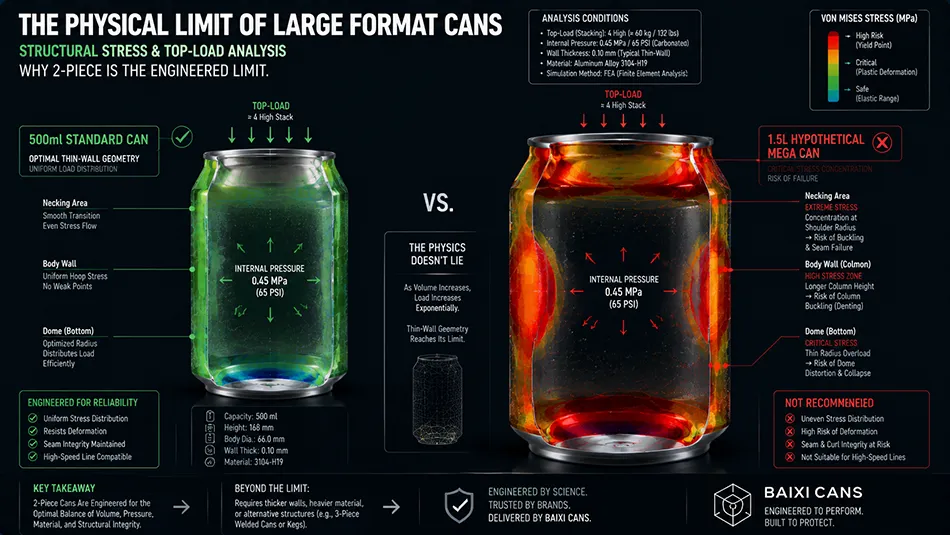
No. The better question is whether the thin-wall beverage-can system still makes sense after the package gets that large.
Large cans are rare because the package stops behaving like a high-speed commodity can before aluminum stops being a usable metal.
The Aluminum Association Teal Sheet reminds buyers that aluminum families cover many product forms. So the claim is not that aluminum cannot make a container above 1 liter. The issue is the thin-wall two-piece beverage can format: it is optimized for light weight, speed, stackability, and standard closures. Pushing volume up changes the economic balance.
Based on our analysis, a buyer should treat 1 liter as a decision boundary rather than a hard law. If the brand needs more than 1 liter, compare the total system cost of a nonstandard thin-wall can against two 500ml cans, a resealable aluminum bottle, a pouch, or a keg-style package. The answer may be format strategy, not a larger can.
Carbonated beverages create internal pressure, while distribution adds stacking, drop, vibration, and temperature exposure. A larger container increases filled weight and can make consumer grip, opening comfort, chilling time, and panel resistance less attractive. The end also has to carry a larger closure job, and the body has to remain stable through the same logistics chain.
The AFDO double-seam and can-defect guide matters here because bigger volume does not remove ordinary seam and defect requirements. It can make them more consequential. A failed seam or distorted end on a large can creates more product loss, more cleanup, and a more visible customer complaint than the same failure on a smaller single-serve pack.
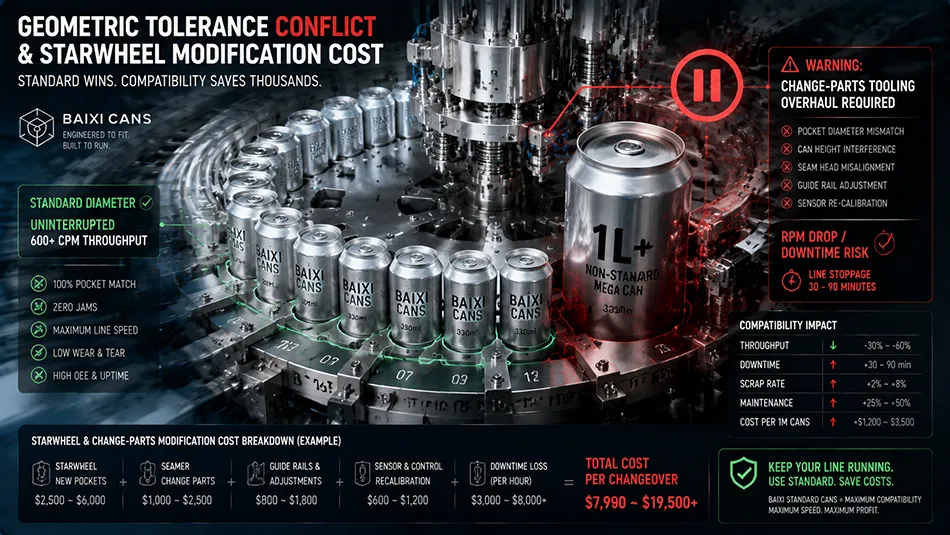
The can is only one part of a filling system. Depalletizers, rinsers, fillers, seamers, conveyors, pasteurizers, label checks, packers, and pallets all prefer predictable sizes.
The CMI manufacturing explanation shows how standardized geometry is built into the can before it reaches the filler. Once cans move into a plant, that geometry continues to matter. A larger diameter or taller body may need different guides, change parts, seamer tooling, fill valves, accumulation settings, packaging materials, and pallet patterns.
The hidden cost is downtime. A nonstandard large can may look efficient by volume, but if it slows the line, raises jam risk, or reduces pallet density, the economics can reverse. The decision rule is to price the format by filled cases per hour and delivered servings per pallet, not by milliliters per empty can.
Retailers and consumers also vote against awkward formats. A can above 1 liter is heavier when chilled, harder to drink from directly, slower to cool, less convenient for cupholders, and less intuitive for single-serve pricing. For carbonated drinks, once opened, the large format loses carbonation over repeated servings unless the package is resealable, which ordinary beverage cans are not.
The Aluminum Association can overview is strongest when the package is lightweight, recyclable, and convenient. A larger-than-1-liter non-resealable can weakens the convenience part of that value proposition. The key insight is that a can's advantage is not simply metal efficiency; it is the match between portion, shelf, line, and use occasion.
For alcoholic beverages, pack size is not only a can-engineering decision. It can intersect with label, net-content, and category rules.
Alcoholic beverages add another layer. The TTB standards-of-fill update and the 2025 Federal Register rule show that wine and distilled spirits packaging can be affected by category-specific net-content rules. These rules do not explain every nonalcoholic can size, but they do remind buyers that package volume can be a regulated commercial decision.
For RTD cocktails, canned wine, and similar products, buyers should check the destination market before choosing a novelty size. The TTB distilled spirits net-contents guidance is especially relevant for spirit-based products. A large can that looks distinctive may create label, serving, or retailer problems if the category file is not checked first.
For most beverage brands, two or three standard cans beat one very large can because the line runs faster, the consumer can chill portions separately, the package is easier to hold, and the retailer can price servings cleanly. The sustainability comparison also needs nuance: a nonstandard large package can use less packaging per liter but may lose that advantage if it causes slower filling, more damage, or lower pallet efficiency.
The decision rule is: if the product is meant for sharing, repeated pouring, or long open time, ordinary cans may be the wrong format. If the product is meant for individual consumption, standard cans are usually more convenient than a 1 liter single can. The format should follow the drinking occasion, not the desire to look different.
| Constraint | Effect on 1L+ cans | Buyer response |
|---|---|---|
| Internal pressure | Higher carbonation stress and bigger product loss if failed | Use pressure and seam evidence before format approval |
| Line tooling | Change parts and slower handling can erase volume savings | Price by servings per hour, not empty-can volume |
| Consumer use | Heavy, non-resealable, slow to chill, poor portion fit | Compare multipacks or resealable formats |
| Alcohol rules | Net-content and category expectations can limit simple size choices | Check TTB or destination-market rules early |
| Export logistics | Lower pallet density and higher dent consequence | Run packaging and transit assumptions before tooling |
The table shows why 1 liter is a useful warning line: after that point, system costs often grow faster than the volume benefit.
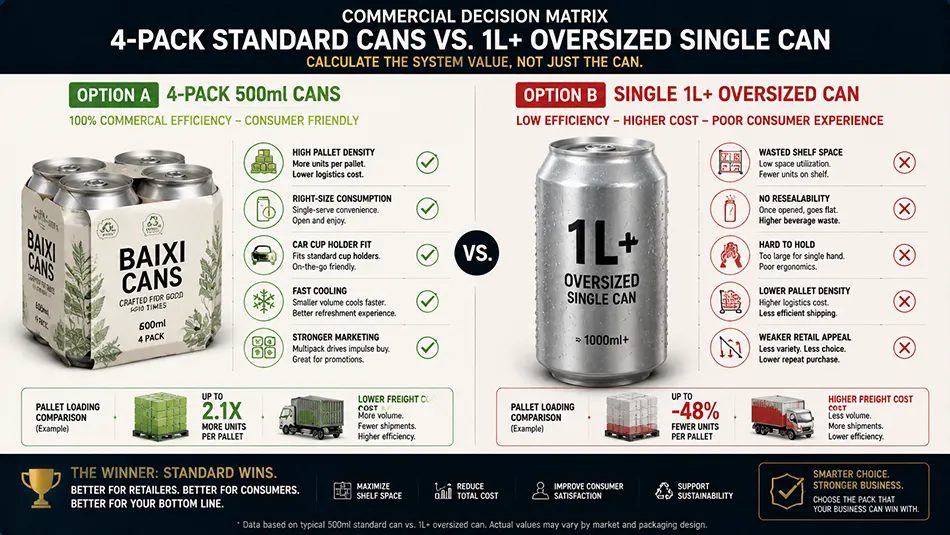
Baixi Cans can help buyers avoid forcing a nonstandard package when a standard can, lid, or multipack strategy would launch faster.
A buyer should first decide whether the drink is single-serve, sharing, sports hydration, beer, cocktail, or wine. For larger but still practical single-serve projects, Baixi's 500ml custom aluminum can option may be more realistic than a 1 liter can because it fits familiar handling and line assumptions. For smaller premium or sampling formats, the 250ml slim can may solve a different commercial problem.
Based on our analysis, the useful threshold is not exactly 1000ml; it is the point where the package needs new tooling, creates slower line speed, and becomes awkward after opening. If two standard cans meet the same consumption need with less operational risk, the large can has to prove a marketing advantage strong enough to pay for that friction.
Large-volume discussions should include the can end from the start. A bigger body changes pressure, opening, and handling expectations, so aluminum can lids belong in the same conversation as body diameter and height. The buyer should also ask how cartons, trays, and pallets would change if a nonstandard format is considered.
Before requesting a 1 liter or larger custom direction, send Baixi Cans the beverage type, carbonation, filling line, target servings, retail channel, and destination market. Use the Baixi Cans contact page to request a format feasibility review that compares standard cans, multipacks, and alternative packages before committing to tooling assumptions.
This is the point where the topic becomes operational: the buyer turns technical uncertainty into the questions a supplier, filler, or compliance reviewer can answer.
According to the Aluminum Association, beverage cans earn value from lightweight, recyclable convenience. According to the CMI manufacturing overview, that convenience depends on a formed, standardized package path. Those references make the large-can question more practical: will the proposed size still run, stack, chill, open, and sell better than standard packs?
According to the AFDO can-defect guide, closure and defect control stay important regardless of the marketing idea. According to the CFIA defect guidance, physical container condition can change release decisions. A 1 liter-plus can therefore has to prove not only capacity but also seam, dent, pressure, and handling tolerance.
According to TTB standards-of-fill update, alcohol package sizes can be shaped by formal standards. According to the Federal Register rule, wine and distilled spirits fill sizes are not merely design choices. Even when a large can is technically possible, regulated categories can make the size harder to label, price, or distribute.
Calculated from 1000 ml equals 2 units of 500 ml, the serving comparison delivers the same liquid volume but not the same operations. The 2-can route keeps standard line handling, easier chilling, and smaller product loss per failure. The 1-can route must beat those advantages with a real occasion or cost benefit, not only novelty. If the larger can also reduces cases per pallet or needs slower seamer settings, the buyer should record that cost before approving the shape. Otherwise the format decision rewards volume on paper while punishing the line, the warehouse, and the consumer. That trade-off should be reviewed with sales, filling, and logistics together. Put the agreed format rationale and approval notes into the sourcing brief before RFQ release.
Compare Baixi's standard aluminum can formats, 500ml custom can option, and aluminum can lids before assuming that a 1 liter-plus can is the best answer.
Send Baixi Cans your desired serving size, beverage type, carbonation level, filling equipment, market, pallet target, and reason for the large format. Ask the team to compare a nonstandard can with standard cans and multipacks before you build artwork around a size the line may not want.
No, they are not physically impossible, but thin-wall beverage cans above 1 liter are usually unattractive. Pressure, handling, line tooling, retail convenience, and category rules often favor smaller standard formats.
A 2 liter non-resealable can would be heavy, slower to chill, harder to handle, and less convenient after opening. A PET bottle or multiple smaller cans usually fits that use occasion better.
Yes, filling lines are built around certain diameters, heights, ends, conveyors, and packers. A large nonstandard can may require change parts, slower speeds, or new packing assumptions.
They may be possible in some markets and categories, but alcoholic beverages can face net-content, label, and serving rules. Buyers should check destination regulations before choosing a novelty size.
Compare standard cans, multipacks, resealable aluminum bottles, pouches, or kegs depending on the drinking occasion. The best package is the one that fits the line, shelf, consumer, and market.

